Volkswagen's profits have plunged, and it plans to lay off 50,000 employees. It vows to increase its earnings in China.
The Volkswagen Group has stumbled again.
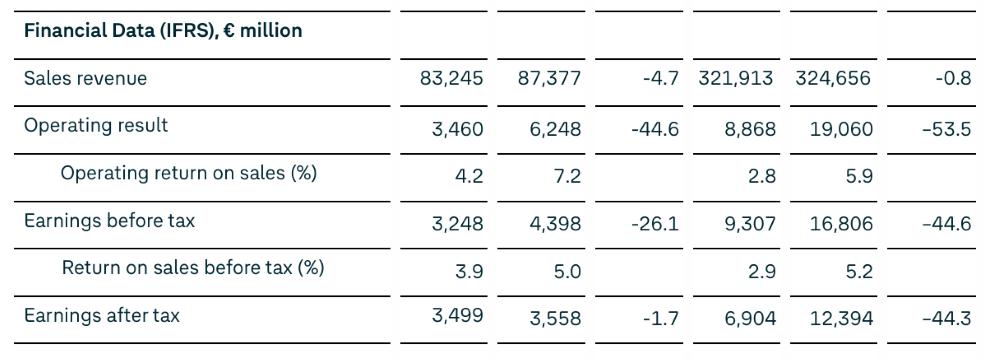
According to the latest financial report, in 2025, with the revenue basically the same as the previous year, the operating profit was directly halved, only reaching 8.868 billion euros, plunging nearly 53.5% year-on-year, the lowest level since 2016.
To relieve the pressure on profits, the most effective way is to lay off employees. Volkswagen's CEO mentioned in an earnings call that Volkswagen will cut approximately 50,000 jobs in Germany in total.
This scale is larger than the agreement reached between Volkswagen and the labor union in the previous fiscal year to cut 35,000 jobs, and the scope has also expanded to Audi, Porsche, and CARIAD, the software subsidiary of the Volkswagen Group.
Facing this life - saving transformation, the Chinese market should rightfully become the key to breaking the deadlock.
01 Tariffs Hurt Volkswagen Badly
The decision to cut 50,000 jobs in the next five years is behind a bleeding financial report.
Volkswagen's annual revenue in 2025 was approximately 321.91 billion euros, a slight year - on - year decrease of only 0.8%. It can be said that it was basically the same as the previous year. The revenue performance also reflects the sales situation to a certain extent. Last year, the Volkswagen Group's total global sales volume was 8.98 million vehicles, a decrease of 43,000 vehicles compared to 2024, also a slight year - on - year decrease of 0.5%.
However, compared with the slightly declining revenue and sales volume, Volkswagen's profitability has suffered an avalanche.
Its annual operating profit was approximately 8.9 billion euros, a decrease of 10.192 billion euros compared to 19.06 billion euros (approximately 151.883 billion yuan) in 2024, a year - on - year drop of nearly 54%. Converted into an operating profit margin, it was only 2.8%. If calculated based on the net profit after tax, it was only 6.9 billion euros, a significant year - on - year decline of 44%. Compared with 12.4 billion euros in the previous year, it was almost halved, the lowest level since 2016, which was also the historical lowest level due to the "emissions scandal".
It is worth mentioning that Volkswagen specifically emphasized in the financial report that after excluding special factors, the operating profit margin of the Volkswagen Group was 4.6%, especially after excluding the impact of tariffs, the corresponding operating profit margin was 5.5%.
However, even this figure is still quite a distance from the 8% - 10% target set for 2030. Arno Antlitz, CFO and COO of the Volkswagen Group, even admitted: "In the long run, it is far from enough."
The "profit killer" leading to this performance is obvious. Volkswagen also clearly pointed out in the financial report that the decline was mainly affected by US tariffs, costs related to Porsche's product strategy adjustment, currency fluctuations, and the product price structure.
Especially the US tariff policy. Since Trump imposed an additional 25% tariff on imported cars and parts from multiple countries around the world in April last year, if the Volkswagen Group excludes special items and the impact of US tariffs, its operating profit would be 17.7 billion euros. That is to say, US tariffs have cost Volkswagen nearly 9 billion euros in profits.
Moreover, as Volkswagen's former "cash cow", Porsche's revenue decreased by approximately 3 billion euros (approximately 23.9 billion yuan) due to the additional US tariffs in 2025. Coupled with the strategic adjustment of products last year, Porsche's net profit plummeted by 98% year - on - year, contributing less than 100 million euros in net profit to the Volkswagen Group in 2025.
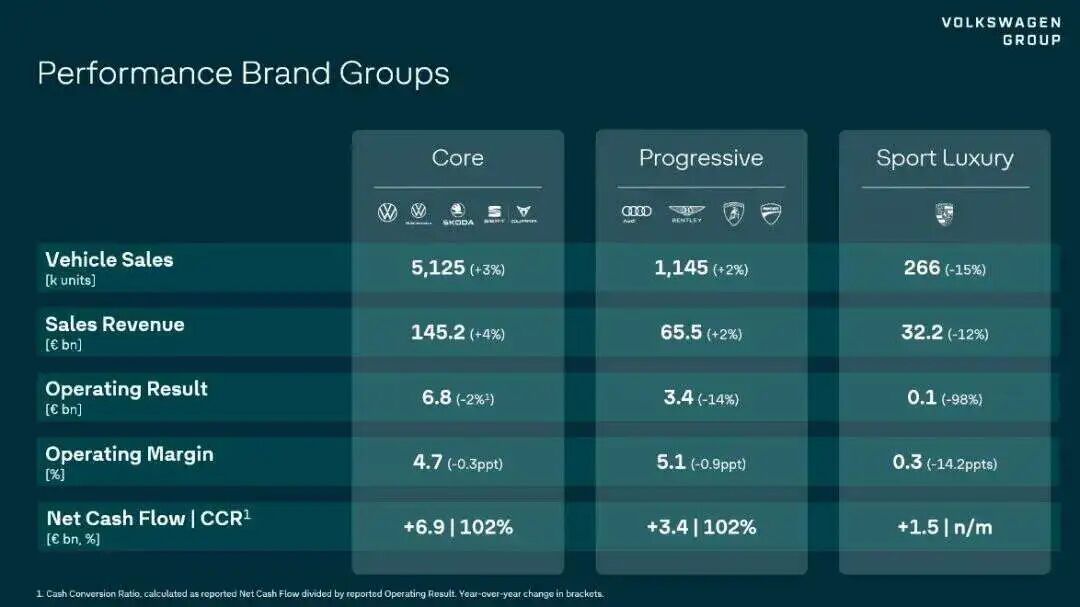
In other words, the money Volkswagen earned in Europe and other regions has been used to fill the deficit in the North American market.
In 2025, although Volkswagen's total sales volume was basically the same as the previous year, the regional performance was further differentiated. The European market increased by approximately 4% year - on - year, especially in Germany, the "home base", which increased by 5.6%. In addition, regions such as South America, the Middle East, and Africa increased by approximately 10%, while the North American market declined by nearly 11% due to the impact of tariffs.
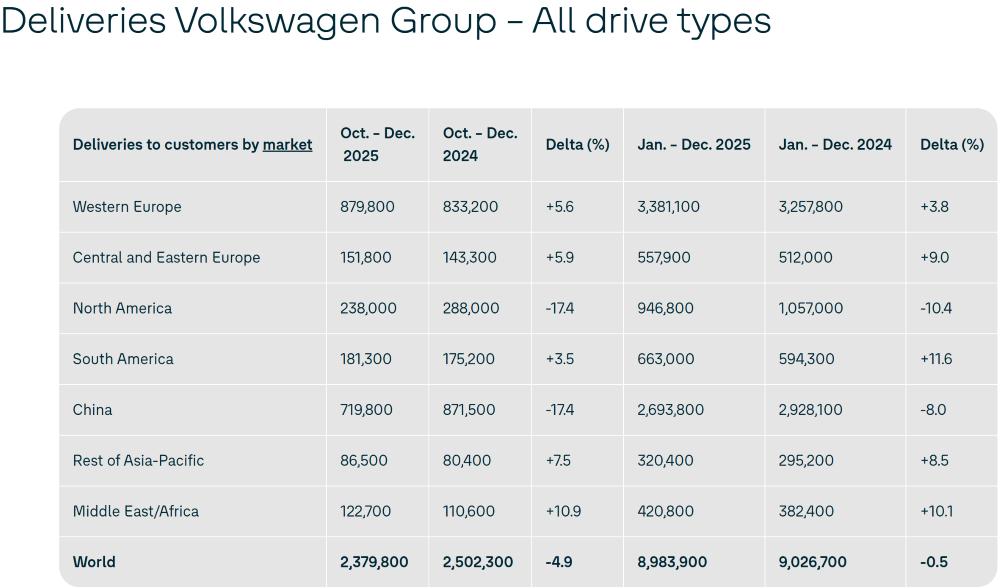
The dismal performance in the Chinese market has also become a major factor dragging down the performance. In 2025, Volkswagen's sales volume in the Chinese market was 2.694 million vehicles, a decrease of 234,000 vehicles compared to 2024, a year - on - year decline of 8%. Especially the sales volume of pure - electric vehicles declined particularly severely. While the overall sales volume of Volkswagen Group's pure - electric vehicles increased by 32% year - on - year, the sales volume of pure - electric vehicles in China decreased by 44.3% year - on - year.
The significant decline in sales data has also determined Volkswagen's overall performance in China. The financial report shows that in 2025, the operating profit contribution of Volkswagen's associated/joint - venture enterprises in China accounted for by the equity method decreased from 1.742 billion euros in 2024 to 958 million euros in 2025, a decrease of 784 million euros (approximately 6.247 billion yuan), a year - on - year decline of approximately 45%.
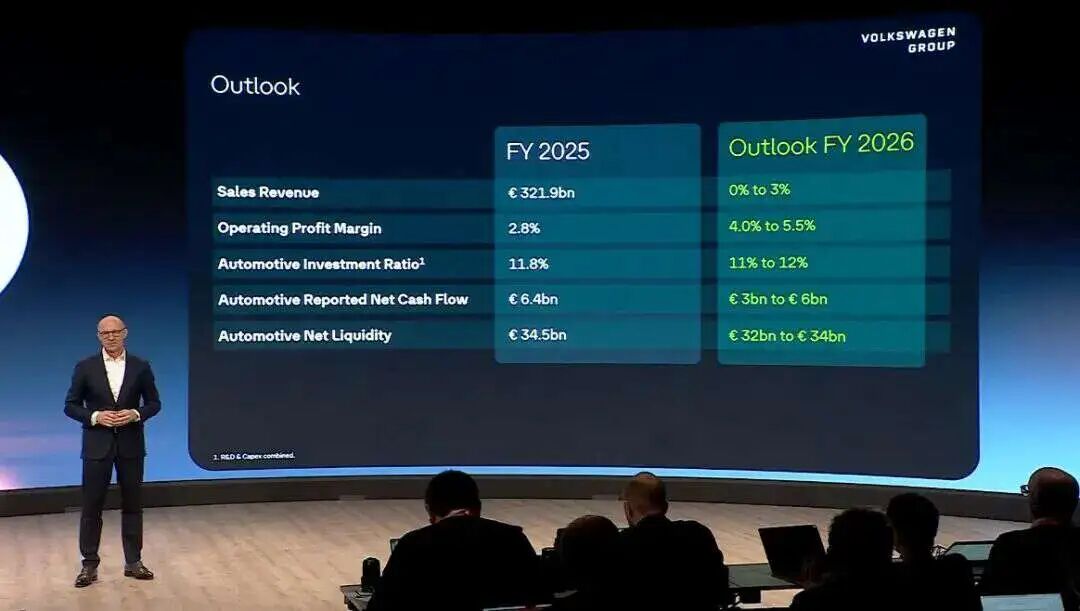
Under the influence of tariff factors, Volkswagen's outlook for this year is still not optimistic. It is expected that its revenue growth will be between 0% and 3%, and the operating profit margin is expected to be between 4.0% and 5.5%.
02 Focusing on the Chinese Market
The continuously declining profit performance and the pessimistic outlook for the future have forced Volkswagen to re - evaluate its previous strategic plan and start to take a two - pronged approach.
On the one hand, it is extreme cost reduction. At the end of 2024, the Volkswagen Group reached an unprecedented agreement with the labor union to cut 35,000 jobs, but in Volkswagen's view, it is not extreme enough.
This time, Volkswagen Group CEO Oliver Blume revealed in a letter to shareholders that by 2030, the Volkswagen Group will lay off approximately 50,000 employees in Germany. This is a direct increase of 15,000 people compared to the lay - off scale reached at the end of 2024, covering Audi, Porsche, and the software subsidiary Cariad. The goal is to save more than 6 billion euros in annual net costs by 2030.
Arno Antlitz, CFO and COO of the Volkswagen Group, also directly stated: "Only by continuing to vigorously cut costs, leveraging the group's synergies, and reducing redundancies to sustainably improve profitability can we achieve our goals. This is exactly the focus of our work in the next few months."
It is worth noting that according to the financial report, Volkswagen employed 682,700 employees in the 2024 fiscal year, and this figure dropped to 667,100 in 2025. In other words, Volkswagen laid off approximately 15,600 employees last year.
In January this year, the Volkswagen Group issued a statement saying that it plans to reduce the number of board positions in its core brands (including the Volkswagen brand, Skoda, Seat/CUPRA, and Volkswagen Commercial Vehicles) by approximately one - third by the summer of 2026.
Not long ago, there were also reports that Porsche, a subsidiary of the Volkswagen Group, plans to merge the Taycan and Panamera models into a single series to control costs. This shows the Volkswagen Group's determination to reduce costs, even for its luxury brands and the board of directors.
However, the problem is that just saving money is not enough to solve the fundamental problem. The other approach is acceleration, especially in the Chinese market.
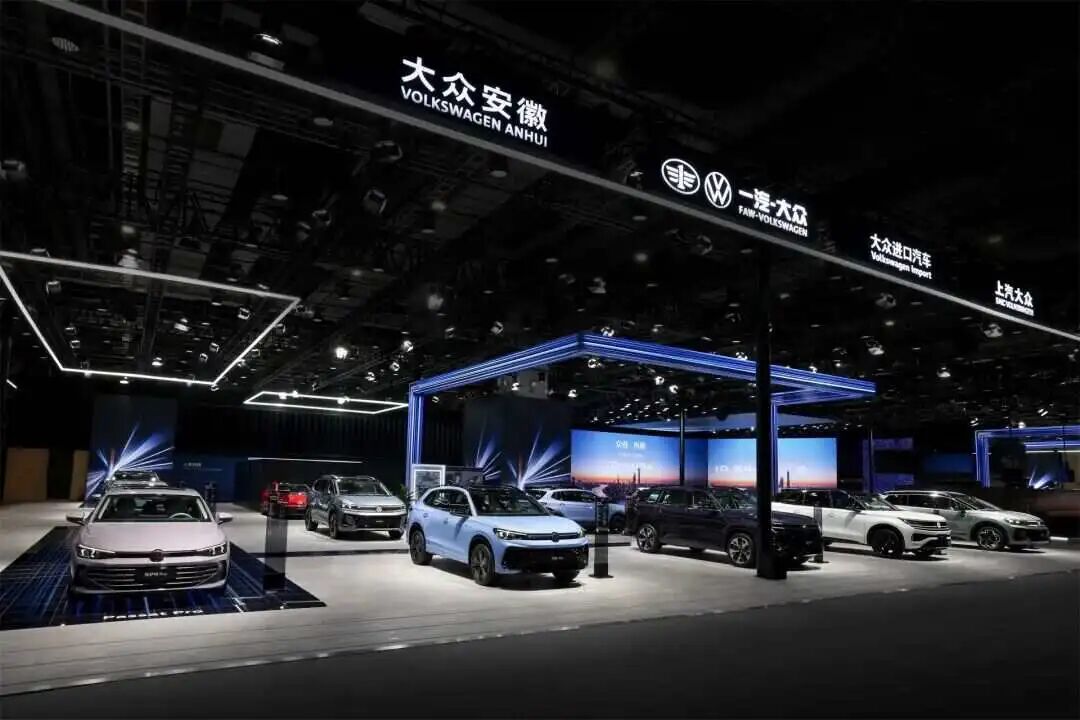
At the earnings call, Oliver Blume clearly stated that in 2026, Volkswagen will launch the "largest - ever new energy product offensive" in China, with more than 20 new models. He also said that "more innovative models will be launched in the product offensive in the Chinese market."
Ralf Brandstaetter, Chairman and CEO of Volkswagen Group (China), also posted on domestic social media, mentioning that the ID. ERA 9X and YuZhong 08 are representative heavy - weight models in Volkswagen's offensive of more than 20 new cars.
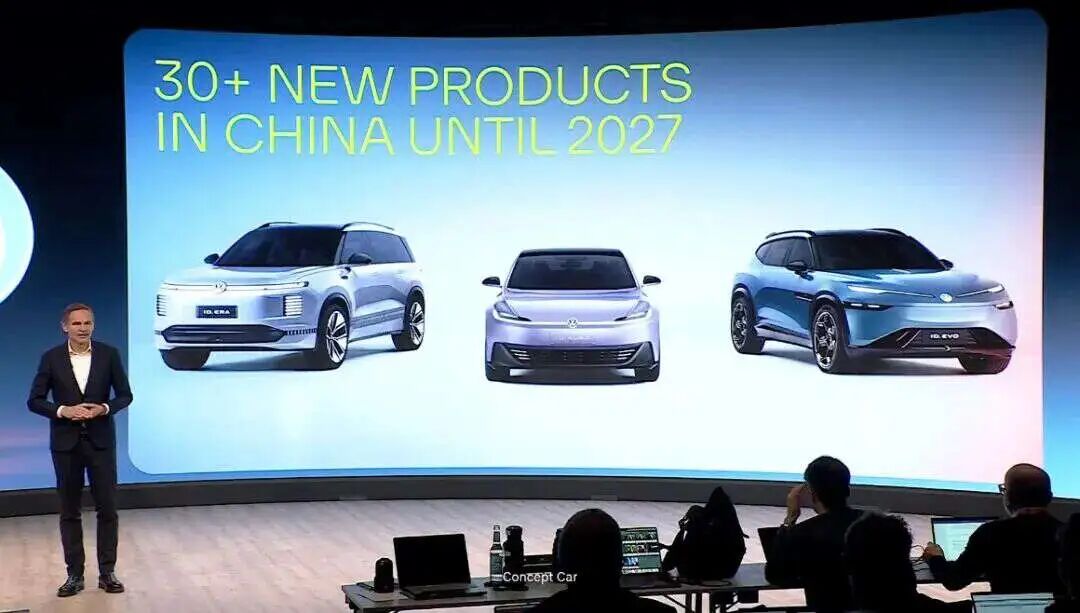
"By the end of 2027, we will launch 30 new pure - electric, plug - in hybrid, and range - extended models in the Chinese market. At the same time, maintaining our position in the internal combustion engine market is a key pillar of Volkswagen's transformation," said Oliver Blume.
In Volkswagen's view, the product development cycle in China has been shortened by approximately 30%, and based on local battery technology and technical paths such as CEA, a 40% cost optimization has been achieved on the CMP platform (Compact Main Platform). 2026 is a year when the strategic transformation results of the Volkswagen Group will be accelerated.
It is worth noting that Oliver Blume also mentioned at the earnings call that "the development model in China also enables us to explore export opportunities in new markets." This may mean that in the near future, products developed by the Chinese team may be exported back to other markets, which was unimaginable in the past.
In addition, the Volkswagen Group is also continuously deepening its local technology layout in the Chinese market. For example, the joint - venture company Horizon Robotics and Volkswagen Group, Coreway, is developing its first self - developed chip for assisted driving, with a computing power of 500 - 700 TOPS.
On the one hand, it is "tightening its belt", and on the other hand, it is increasing its investment in the Chinese market. Volkswagen clearly knows where it can make more profits.
This article is from the WeChat official account “SuperEV - Lab”, author: Wang Lei, published by 36Kr with authorization.