250 million children worldwide are at risk of development. A sub - journal of Science: AI in mobile phones is more accessible than "home visits"
Globally, over 250 million children under the age of 5 are at risk of not reaching their full development potential due to poverty, lack of incentives, and early care.
Although early intervention is regarded as the key to breaking the intergenerational cycle of poverty, the traditional "home visiting" model is costly and labor - intensive, making it difficult to scale up in low - income countries.
When artificial intelligence (AI) meets mobile technology, can it provide personalized parenting guidance to parents in remote areas at a very low cost?
A recent study published in Science Advances gives an affirmative answer.
A large - scale randomized controlled trial conducted by a team from the Swiss Tropical and Public Health Institute and its collaborators in rural Peru shows that AI digital intervention not only significantly promotes early childhood development, but its cost is only 1/15 of the traditional method, demonstrating amazing cost - effectiveness.

AI Application in "Parenting" in Poor Rural Areas
For a long time, the home - visiting program based on the "Reach Up" model has been recognized as the "gold standard" for parenting intervention. It is indeed effective, but its drawbacks are also very obvious: this model highly depends on a large number of trained professionals and involves high transportation and material costs.
For low - and middle - income countries with limited resources, it is almost an impossible task to cover all remote villages with this model.
With the popularization of mobile networks, a new technology has emerged: in theory, AI - driven digital tools can provide caregivers with timely, personalized guidance that is in line with the child's developmental stage.
But there are still doubts in the scientific community: Can this high - tech method really take root and work in poor areas that need help the most? Can its effect be compared with in - person home visits?
To find the answer, the research team selected the Cajamarca region in Peru in the Andes Mountains as the test site and conducted a rigorous three - group cluster randomized controlled trial. They recruited 2461 caregiver - child pairs (the children's initial ages were between 3 and 9 months). The participants were randomly assigned to one of the following three groups:
Digital Intervention Group (DI): Use an AI parenting chatbot;
Home - Visiting Group (HV): Receive home visits from professionals every two weeks;
Control Group: Receive no additional services.
The AI recommendation engine dynamically adjusts the pushed content based on the child's age, development status, and the caregiver's previous feedback. Every week, caregivers receive age - appropriate activity suggestions; the platform has a built - in milestone tracker, Q&A function, and popular science articles.
Considering the possible unstable network in remote areas, the research team also provided a physical activity manual as auxiliary support to ensure uninterrupted service.
Is AI Intervention Really Effective?
When the children reached 2.5 years old, the research team used the Global Scale of Early Development (GSED) to evaluate them.
The results are exciting: the children in the home - visiting group improved their development level by 0.17 standard deviations; the children in the digital intervention group improved their development level by 0.11 standard deviations.
Although numerically, the effect of AI is slightly lower than that of in - person home visits, the effect of the digital intervention group is still significant, reaching about 65% of the home - visiting effect.
This means that without frequent in - person home visits and only through mobile phone interactions, AI can still effectively promote the early development of children in poor areas.
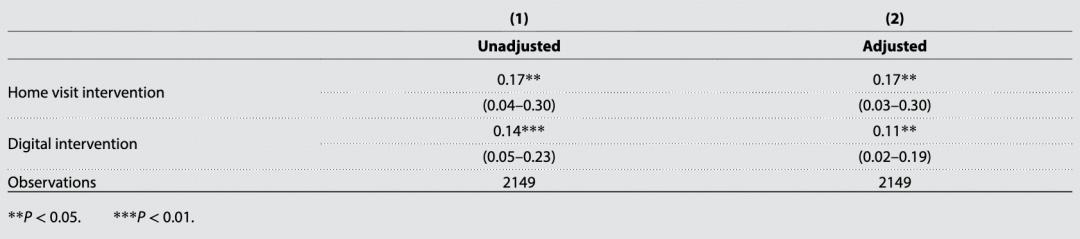
Figure | Assessment of the impact on child development (GSED). This table shows the estimated intention - to - treat effects of the project on child development.
In terms of secondary outcomes, both groups had a positive impact on the caregiver - reported child development and parenting beliefs, but there was no statistically significant association with the control group in terms of the caregiver's mental health.
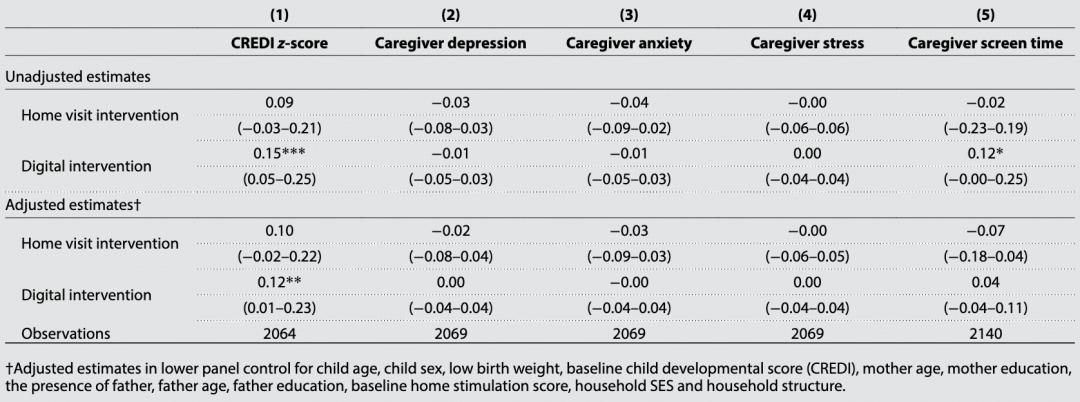
Figure | Estimated impact on caregiver - reported development, mental health, and screen time. This table shows the estimated intention - to - treat effects of the project on secondary outcomes. The estimates are based on an ordinary least - squares model with clustered standard errors. The values shown correspond to point estimates and 95% confidence intervals.
Cost - effectiveness analysis further highlights the potential for large - scale promotion of digital intervention.
The average cost per child in the home - visiting model during the 18 - month intervention period is as high as $654. This money is mainly used to pay the staff's salaries, transportation costs, and for materials such as toys and picture books.
For digital intervention in the same period, the average cost per child is only $41.4, which is 1/15 of the cost of traditional home visits. In addition, the home - visiting model needs to spend $4090 to improve the development level by 1 standard deviation, while digital intervention only needs to spend $414.
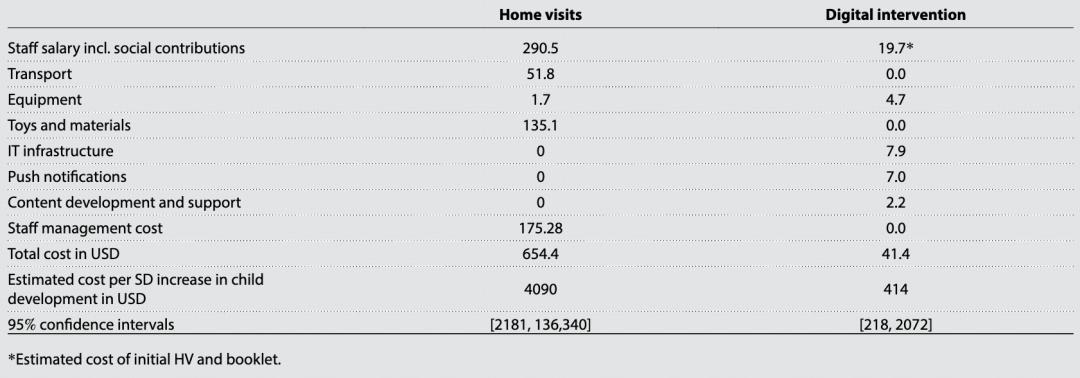
Figure | Estimated project cost per child. This table shows the estimated project cost per child in US dollars (USD), calculated based on an 18 - month intervention period. For home visitors (HVs), the cost is based on two field workers supporting 80 rural households using motorcycles for transportation services. The costs of both projects are based on a medium - scale project covering about 25,000 children.
Discussion and Outlook
Although digital intervention has achieved positive results overall, its coverage is still limited.
For example, about 15% of families failed to access the intervention system due to lack of smartphones or difficulty in completing platform registration. These families have a lower average education level and socioeconomic status.
This finding suggests that while promoting digital intervention, supplementary measures for the most vulnerable groups are needed to prevent technological progress from inadvertently widening the digital divide in the field of parenting support.
In terms of trial limitations, this trial was only conducted in a specific rural area in the Peruvian Andes. Its specific human and geographical environment means that the results need to be carefully considered when being extended to other regions or cultural backgrounds.
In addition, the current research design cannot identify the "minimum effective components" in AI intervention. That is, whether it is the weekly push notifications, personalized activity suggestions, or the Q&A function that has a key impact remains to be further disassembled and verified in subsequent research.
Looking to the future, with the continuous evolution of AI technology, such digital tools with low infrastructure requirements may provide a new path for large - scale support of child development in resource - poor areas.
Especially in low - and middle - income countries facing a shortage of human resources, AI chatbots are expected to be an effective supplement to home - visiting programs and jointly build a hierarchical and classified parenting support system.
This article is from the WeChat official account "Academic Headlines" (ID: SciTouTiao). Author: Academic Headlines. Republished by 36Kr with permission.