The first group of people who kept lobsters have already "abandoned" them.
The trend of AI has changed again.
A few days ago, people were still wondering how to raise lobsters. Now, some people on Xianyu are already paying to "release" them.
It only took a short five days from paying 666 yuan for installation to paying 299 yuan for uninstallation.
In these five days, some people queued up for installation, some deployed overnight, some earned 260,000 yuan in a few days by relying on it, and some found they couldn't use it at all after installation.
Also in these five days, civil servants raising "government lobsters" hit the hot search, the risk notice from the Ministry of Industry and Information Technology went viral, Ma Huateng said "I didn't expect it to be so popular", and Xiaomi, Tencent, and Huawei successively entered the arena.
How did this wave start? What are people discussing? We looked back with the help of social media data.
What happened between "seeking installation" and "complete uninstallation"?
If we use one sentence to summarize the process of the lobster's popularity, it followed the route of "fermentation in the geek circle → recommendation by business tycoons → fission on social media → entry of big companies to break into the mainstream → boost with government endorsement".
OpenClaw was first born in November 2025. As long as it is given authorization, it can autonomously control the computer, like a human, to open software, write code, send emails, organize files... and complete complex tasks for you from start to finish. Therefore, it first became popular among Silicon Valley elites and domestic programmers.
But in China, this "human assistant" didn't become popular on a large scale immediately. For the next three months, it was just a toy for technology enthusiasts.
Until February 2026, Fu Sheng, the CEO of Cheetah Mobile, shared his "14-day lobster-raising experiment" - using the lobster to send New Year greeting messages and write popular articles. "One lobster is equivalent to a team."
This lobster began to enter the public eye in China, moving from the geek circle to the venture capital circle and the general public.
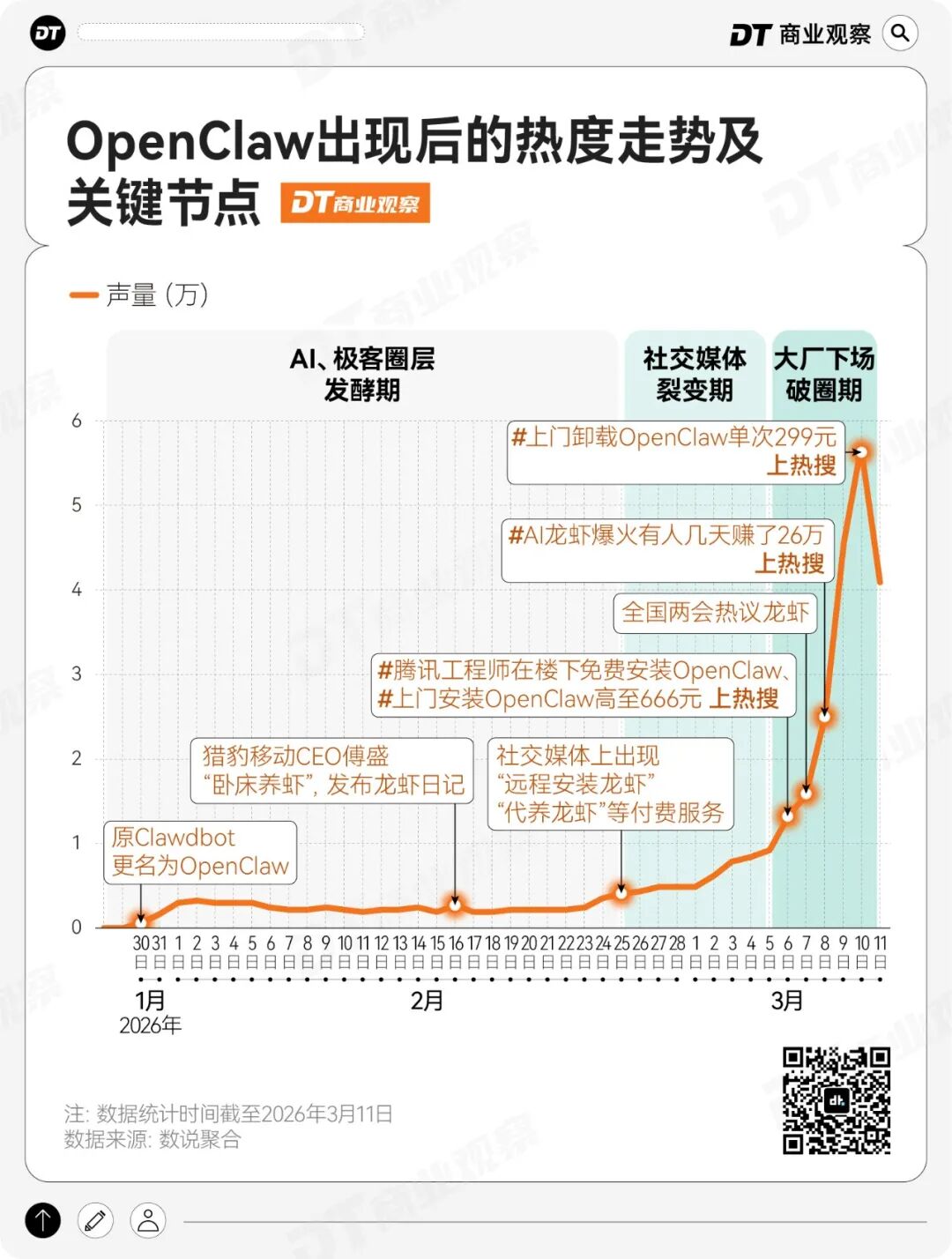
Immediately afterwards, installation tutorials and actual test sharing of lobsters appeared on Xiaohongshu and Douyin. On Xianyu, there emerged "one-on-one lobster deployment services" with prices ranging from dozens to hundreds of yuan. Raising lobsters changed from a technical topic to a money-making opportunity, and social fission further spread the popularity.
But that wasn't enough. What really turned the lobster from a niche tool into a national hot topic was the collective entry of big companies.
On March 6th, Tencent launched a free lobster installation service by setting up a stall at the entrance of the Shenzhen Building. The popularity at the scene made Ma Huateng respond, "I didn't expect it to be so popular."
The popularity on social media on this day also reached a new peak.

(Image source: Xiaohongshu)
During this period, major domestic Internet companies and mobile phone manufacturers rushed to enter the arena, providing users with "one-click deployment" services for lobsters, launching lobster plugins, and integrating lobsters into the operating systems of hardware products.
For example, Baidu launched a mobile version of OpenClaw, allowing new users to try it for free; Tencent conducted an internal test of QClaw, and Enterprise WeChat released the official access method for OpenClaw and launched the full-scenario AI intelligent agent WorkBuddy to help users lower the threshold of using lobsters.
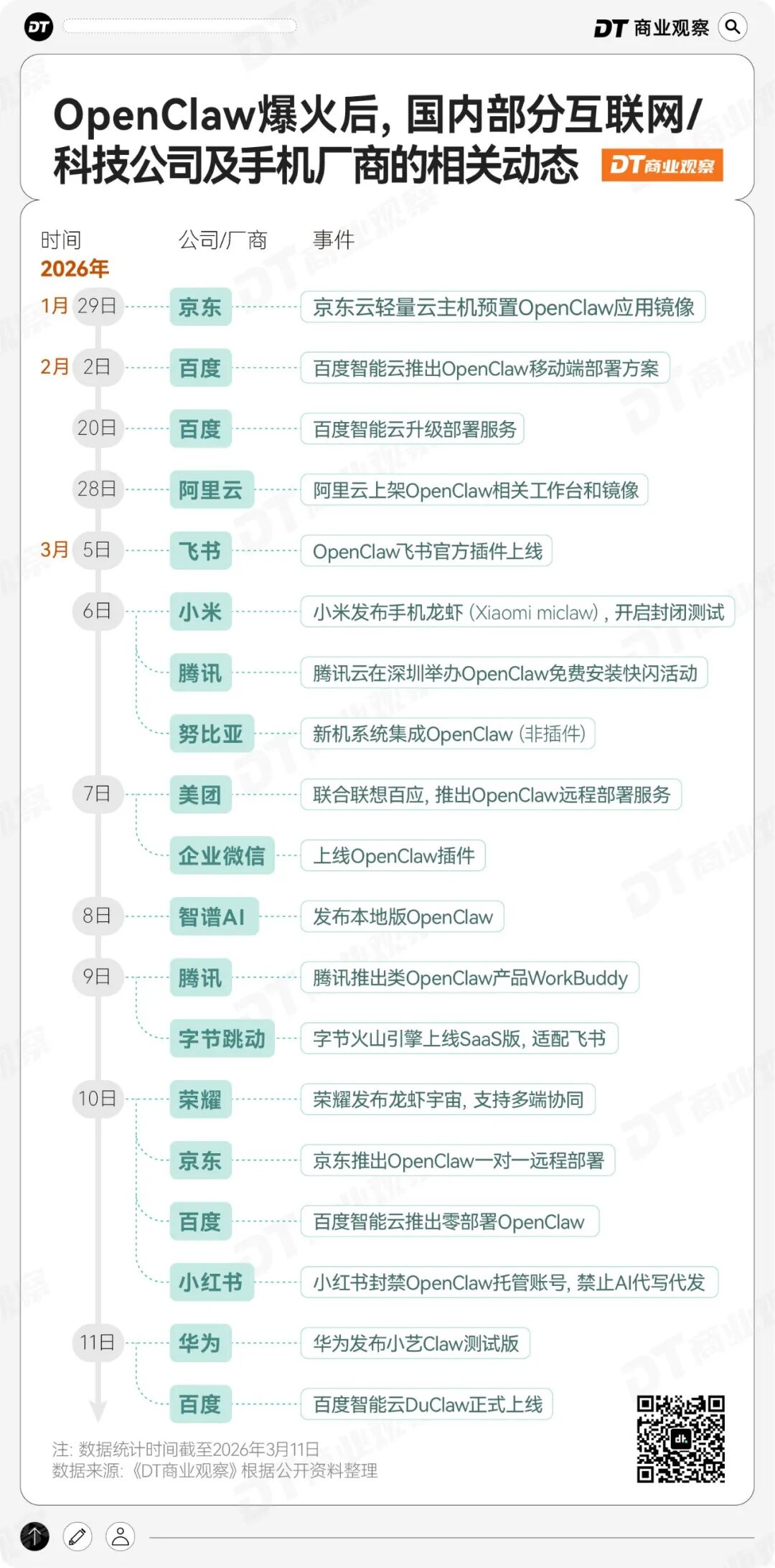
Meanwhile, local governments also quickly followed up, stamping their approval on this wave of enthusiasm and allowing the popularity to continue to spread.
First, Longgang District, Shenzhen, Guangdong, issued the "Ten Measures for Lobsters", and then Wuxi and other places introduced the "Twelve Measures for Raising Lobsters", with a maximum subsidy of 5 million yuan. The topic of civil servants raising lobsters also hit the hot search on Weibo.
If the premise of the lobster's popularity comes from the highlights of new technology and the demand of the public to keep up with AI, then big companies' scramble for traffic entrances, governments' competition for the high ground of the AI industry, and self-media's pursuit of the paid content trend have put "raising lobsters" at the intersection of various interests, thus fueling waves of popularity and making the lobster craze spread like wildfire.
What changes have taken place in people's attitudes towards lobsters from adoration to being both loved and hated?
As the topics related to lobsters become more and more popular, ordinary people's attitudes towards lobsters have changed from "adoration" to "calmness", and even "weariness".
According to Shuoshuo Aggregation, as of March 11, 2026, on the Chinese Internet, OpenClaw had the highest volume of mentions on Weibo, exceeding the sum of WeChat, Douyin, Xiaohongshu, and Bilibili platforms, while Douyin had the highest interaction volume.
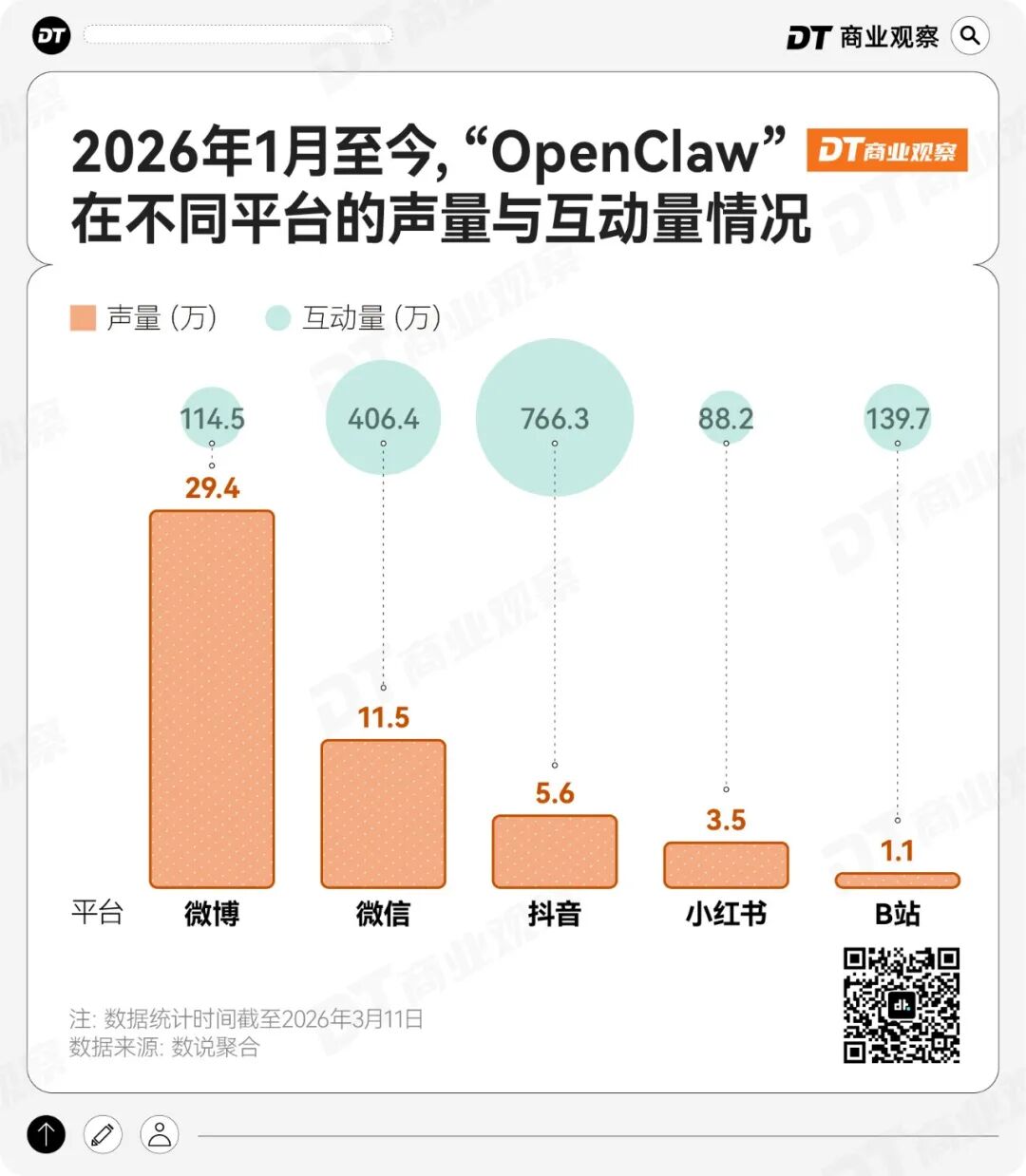
Looking at the hot search topics on Weibo and the discussion topics on Douyin, we found that Weibo is the public opinion field, which to a certain extent determines the direction of people's discussions about lobsters; Douyin is more like an exchange circle for ordinary people, where people share how to install, whether it's useful, and whether it's worth the trouble.
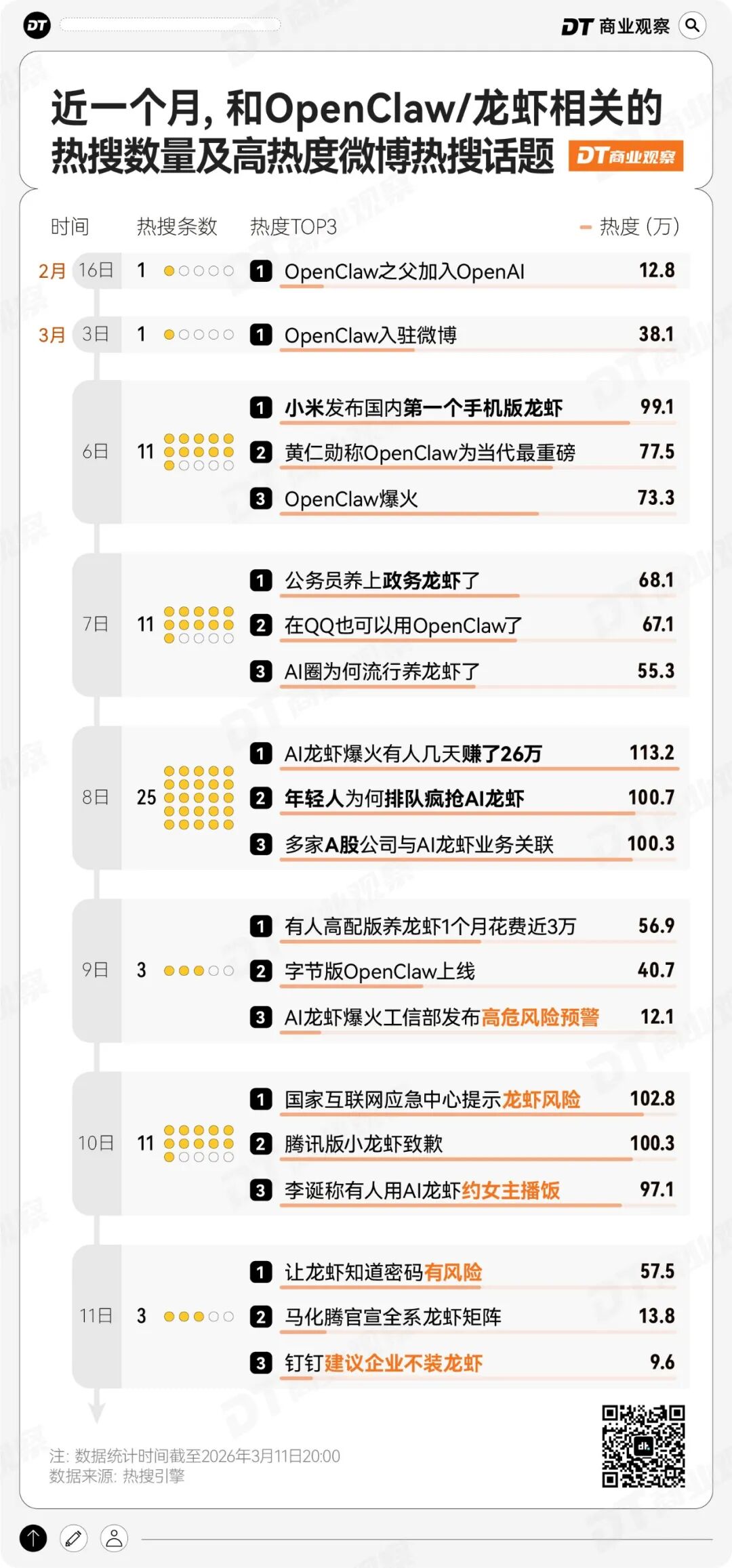
Let's first look at Weibo. The number of Weibo hot searches related to lobsters is basically consistent with the popularity trend of lobsters in China mentioned above.
March 6th (the day when Tencent set up a stall to install lobsters) was an obvious watershed. Before that, there were only sporadic topics on Weibo. After that, the number and popularity of Weibo hot searches continued to rise.
The trend of Weibo hot search topics also reflects the change in public opinion about lobsters - from the adoration of "big companies entering the arena" and "tycoons endorsing" to the nationwide follow - up of "the money - making way of AI lobsters", and then to the vigilance of "high - risk warning".
In just a few days, the lobster went from being "so good" to being both loved and hated.
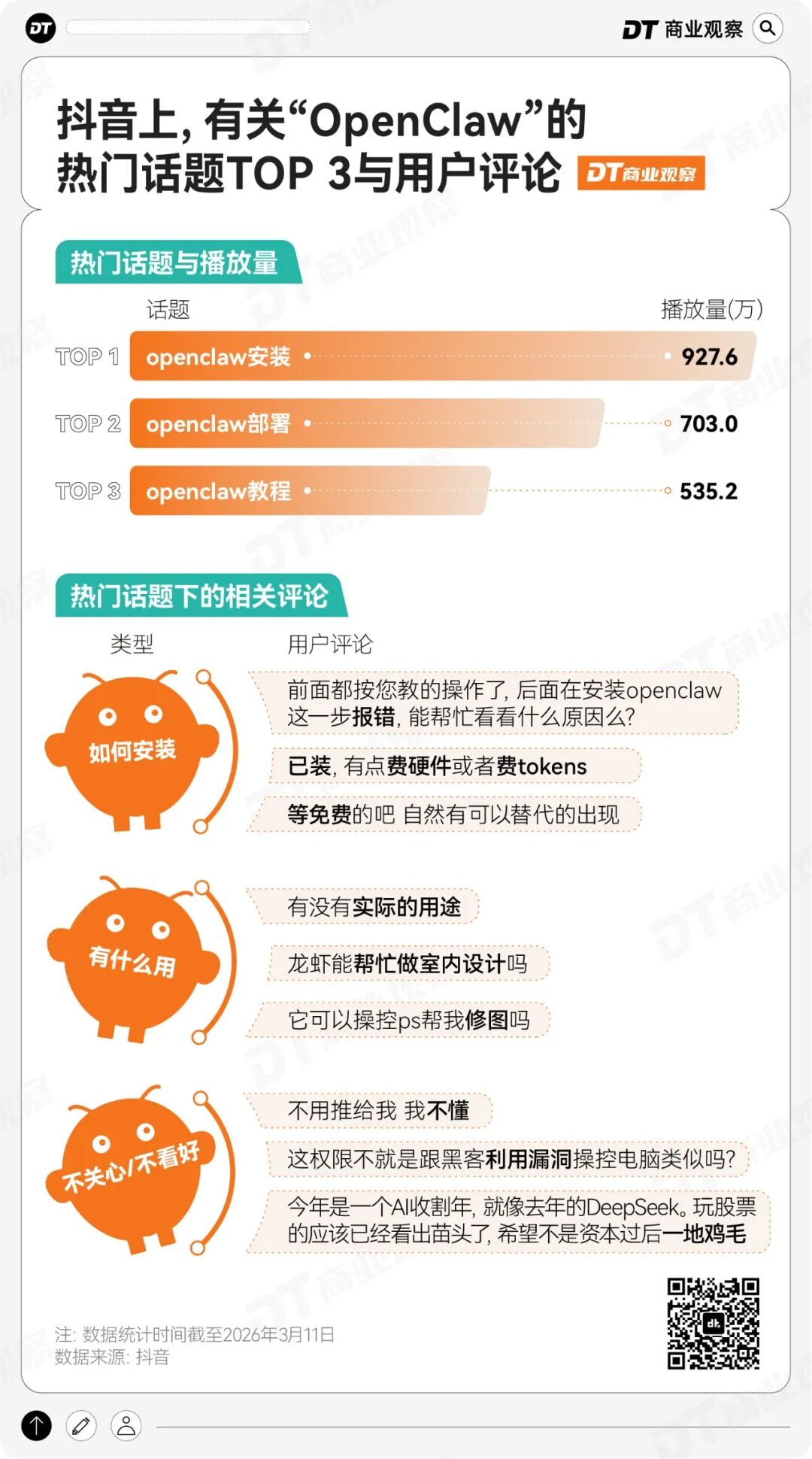
The popular topics and relevant representative comments on Douyin are more "practical".
The most direct type is "how to install".
Different from the paid on - site installation services on platforms like Xianyu, there are a large number of bloggers on platforms like Douyin sharing for free how to install.
Search for "lobster installation" on Douyin. The step - by - step teaching video has received more than 180,000 likes. In the comment section, users who followed the corresponding steps but encountered errors kept asking for help, hoping to "find out the reason".
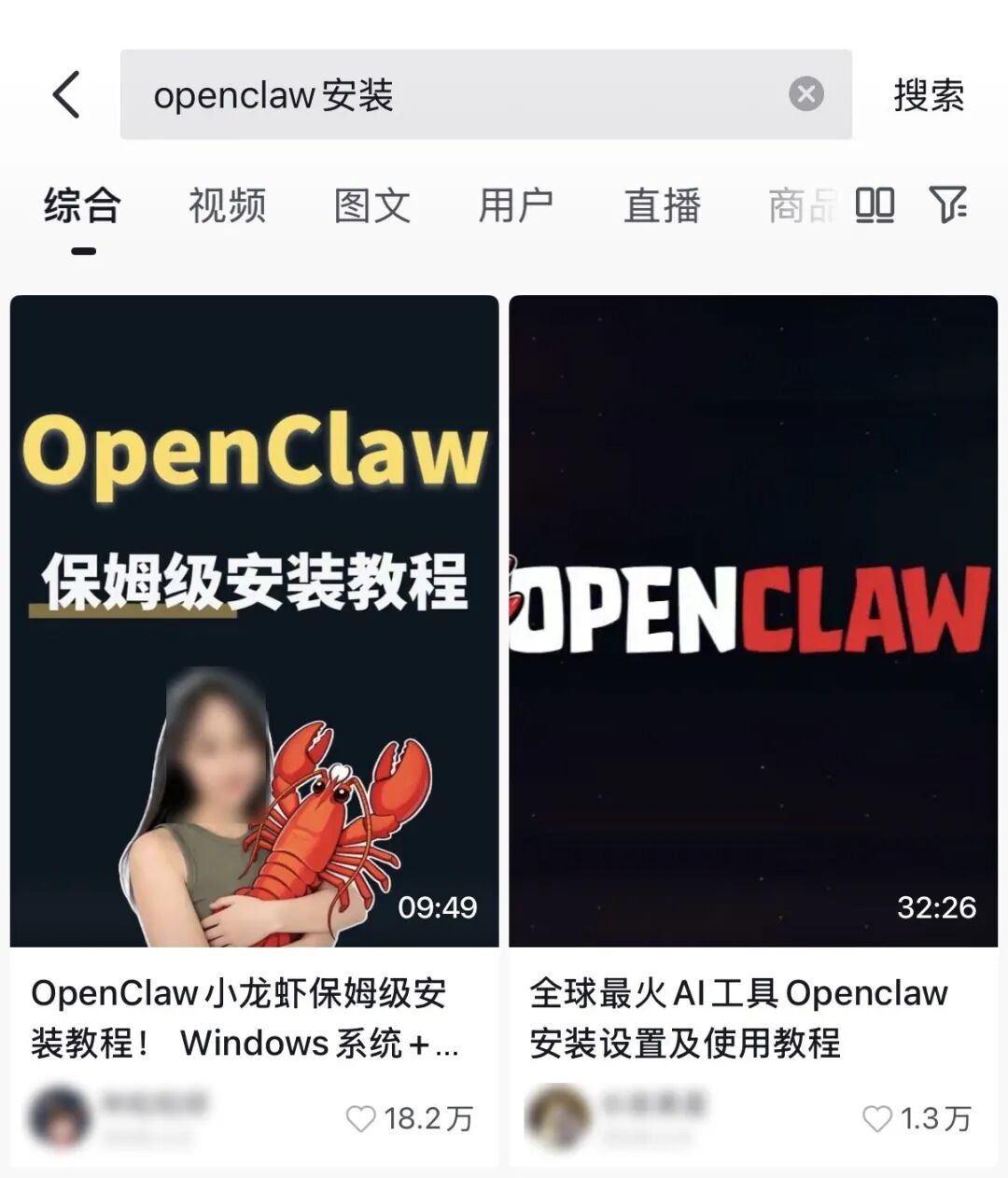
(Image source: Douyin)
Another type is to care about "what it can do".
"Can it help me with interior design?", "Can it retouch photos?", "Can it automatically trade stocks?", "Can it help me play Honor of Kings?"... These questions are very specific. Some are just for fun, and some may really want it to do the work.
But not everyone is convinced.
Some people think that OpenClaw is a "money - grabbing scheme".
Netizens who have experienced many trends have a natural vigilance against this kind of sudden popularity. Therefore, in many comment sections, you can see sarcasm like "intelligent Trojan program", joking that giving it permission is like "a hacker using a vulnerability to control the computer".
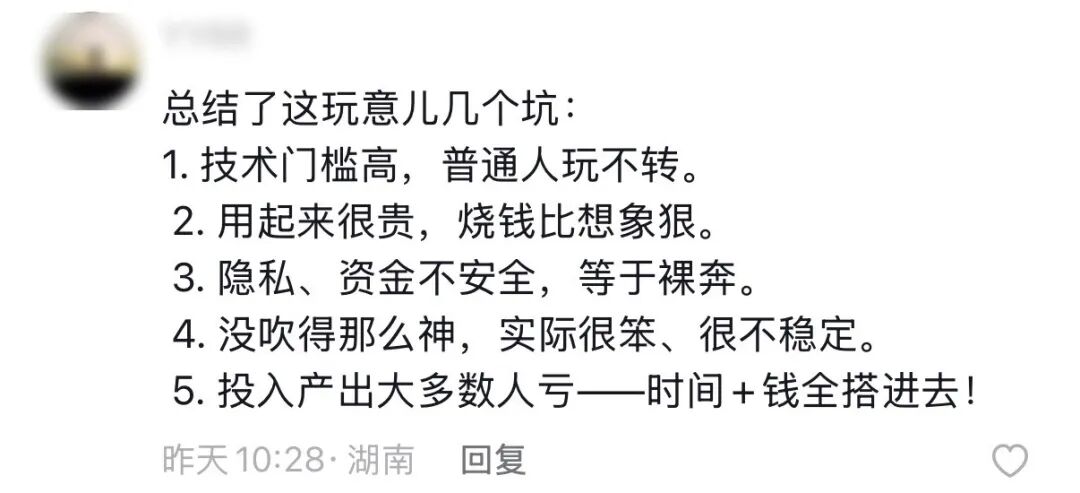
(Image source: Douyin)
So, did the people who raised lobsters really uninstall them?
Judging from social media, the popularity of lobsters seems to have reached its peak. But after interviewing some people who have personally tried to "raise lobsters", we found that for ordinary people, it still has a long way to go before it is really useful and practical.
Some people are still stuck at the first step - downloading and installing.
@Wind.Z is a programmer. She chose to "solve the problem with the same means" and directly asked Doubao where and how to install the lobster. But she hasn't successfully downloaded it yet. She blames the slow company network speed and her busy work. She doesn't have time to care about the follow - up and just installs it as far as she can.
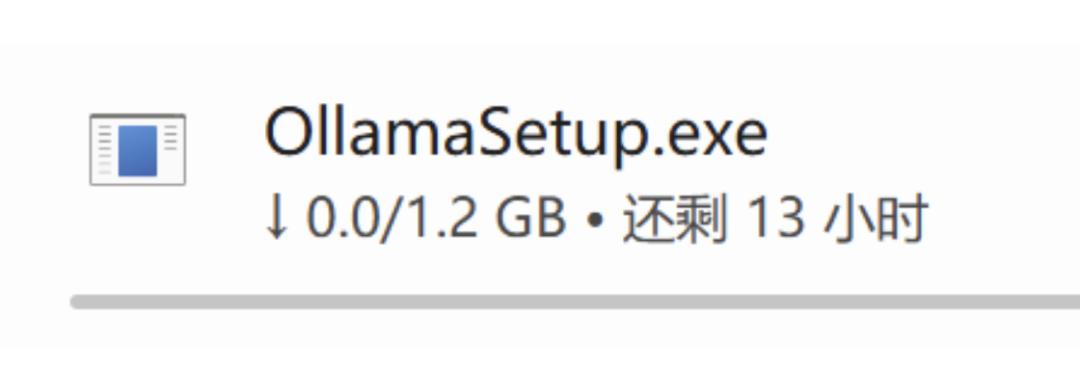
(Image source: provided by the interviewee @Wind.Z)
@Tom🐱, also a programmer, is more cautious and didn't install it himself. "On the one hand, I'm lazy. On the other hand, I think it's not safe." He told DT Business Observation that his company is also researching, "but the private deployment of the large - model computing power can't keep up, resulting in a slow response and little efficiency improvement."
@Ami, who has no technical background, tried to install it twice before succeeding, but felt it wasn't very helpful after the trial.
When he installed it for the first time, he found that he couldn't deploy it with one click as the internet said. "There were several options to choose during the installation process - whether to agree to let it access system permissions, which large - model API to use, which skills to install, and through which software to talk to the claw. I made many mistakes back and forth the first time."
What confused him the most was choosing the large model. "Of course, I chose the most expensive one, which was gemini3.1pro. But when it was really configured, it didn't reply when I sent a message to the claw. Later, I found out that I didn't buy the API quota, so there was no token to use."
The second installation was much smoother, but using it was another story. He tried to let the lobster organize industry news every day, but later found that his work didn't have much repetitive content and he basically didn't need it. "Moreover, this thing needs to keep the computer on all the time to run, which I think is very troublesome."
Although he doesn't use it anymore, @Ami didn't uninstall it because "he doesn't know how to uninstall it" and is too lazy to study it. He thinks "not much has been installed, so just leave it there."
(Image source: provided by the interviewee @Ami)
@ddl, who has been following the AI industry trends for a long time, started using it before the lobster became widely popular. His evaluation is straightforward - "OpenClaw, as an active AI, has a great future, but like other tools, the demand should come first."
Conclusion
Different from AI tools like DeepSeek and Doubao, OpenClaw is essentially an AI Agent. The last time the Chinese Internet was this lively because of a similar product might have been when Manus was extremely popular.
The difference is that Manus showed the possibility of "AI being able to do work directly", while OpenClaw has promoted this possibility to mass popularization.
Moreover, their paths to becoming popular are completely different: the former relied on the scarcity marketing of "invitation codes being hard to get", while OpenClaw has gradually become popular through the down - to - earth concept of "raising lobsters" and the collective follow - up of manufacturers.
But for ordinary people, the feeling may be the same: the AI circle is changing rapidly. Large - scale information flooding makes people afraid of missing something, but it also has