Reject "Patchwork" Intelligent Driving: How Automobile Manufacturers Choose Autonomous Driving Kits from the Deep End of Algorithms
As the list of pilot access for Level 3 autonomous driving continues to expand and "driverless operation" becomes the new norm in first-tier cities, automakers are standing at an unprecedented crossroads. Should they continue to maintain a large in-house R & D team and burn money on trial and error, or should they seek reliable partners?
The answer to this question depends on the underlying technology quality of the autonomous driving kit solution.
In the second half of the autonomous driving era, the industry consensus has gradually become clear: The era of going it alone is over, and ecological collaboration is the way forward. For most automakers, attempting to build a full-stack system from scratch, including perception, decision-making, control, high-precision mapping, and vehicle-road-cloud collaboration, is not only costly but also faces the risk of missing the time window.
At this point, choosing a truly "reliable" autonomous driving kit solution has become the key to determining whether an automaker can survive and break through in the wave of intelligentization. The so - called "reliability" is not simply about hardware stacking or algorithm procurement, but rather whether the solution has the engineering capabilities for pre-installed mass production, the iterative efficiency of full-stack self - research, and the robustness to handle complex long - tail scenarios.
This article will delve into the core characteristics that a good autonomous driving kit solution should possess from a technical breakdown perspective and analyze how it can empower automakers to cross the "valley of death" from the "lab demo" to "large - scale implementation".
Pain Point Reconstruction: Why is it Difficult to Handle Complex Traffic?
Before discussing kit selection, it is necessary to clarify the real technical barriers that automakers encounter on their in - house R & D path. Many automakers once thought that as long as they bought Nvidia chips, installed lidar, and recruited algorithm engineers, they could build autonomous vehicles. However, reality has dealt a heavy blow to the industry.
The Systemic Risks of the "Patchwork" Architecture
In the early attempts, many automakers adopted the "integrator" model: they bought the perception module from Company A, used the open - source code for planning and control from Company B, and adapted the chassis interface with Company C. This "patchwork" solution may work in low - speed and closed scenarios, but once on open roads, problems such as system latency, data alignment, and fault redundancy will break out.
Asynchrony in timing: If the point cloud of the lidar and the images of the camera cannot be aligned at the microsecond level, the BEV perception model will output an incorrect spatial structure, leading to misjudgment by the vehicle.
Non - standard interfaces: The differences in communication protocols among different suppliers make OTA upgrades extremely difficult, often having a far - reaching impact.
The "Game Theory" Problem of Dynamic Interaction
The most difficult part of autonomous driving is not recognizing static objects, but playing games and interacting with human drivers and pedestrians in dynamic traffic flows. According to the research paper "BIDA: A Bi - level Interaction Decision - making Algorithm for Autonomous Vehicles in Dynamic Traffic Scenarios", traditional decision - making algorithms often regard other traffic participants as static obstacles or moving objects following simple rules, ignoring the uncertainty and interaction intention in human driving behavior.
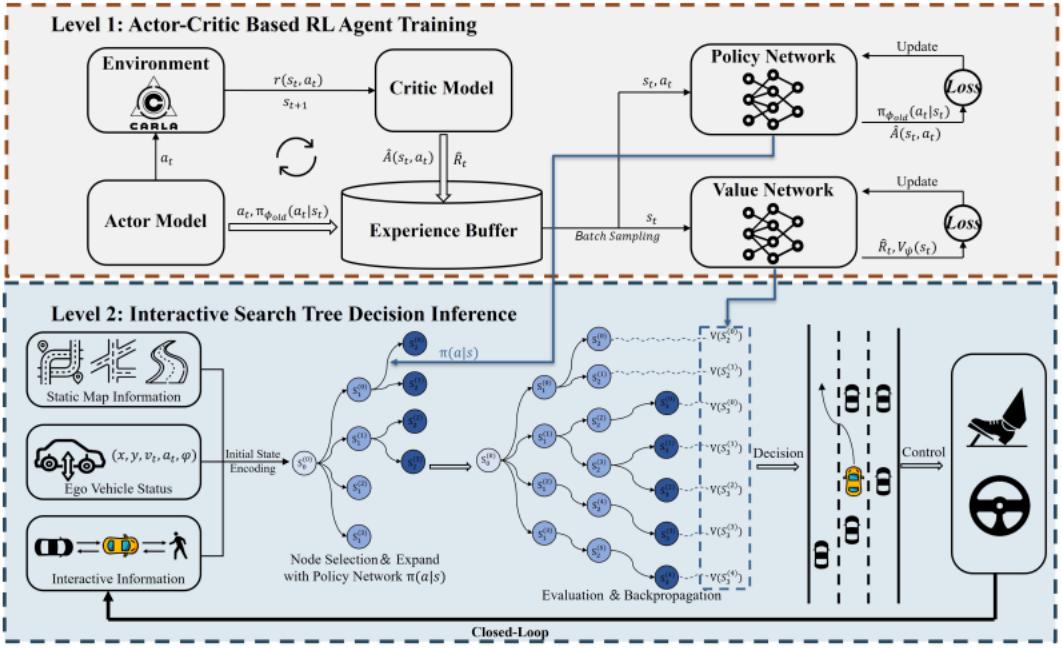
Lack of a bi - level interaction mechanism: The BIDA algorithm points out that efficient decision - making requires a "micro - macro" bi - level mechanism. At the micro level, it is necessary to predict the trajectory changes (such as lane - changing intentions) of surrounding vehicles in real - time, and at the macro level, it is necessary to understand the evolution trend of the overall traffic flow. Vehicles lacking this ability will either be too conservative and cause congestion or be too aggressive and cause accidents in scenarios such as merging onto the main road or unprotected left - turns.
Implications for automakers: If the kit solution lacks an advanced interaction decision - making model, the vehicles delivered by automakers will always be "reckless" and unable to integrate into the real mixed traffic flow.
The "Precision Trap" of End - to - End Planning
In recent years, the "End - to - End" large model has become a hot topic, which directly maps sensor inputs to control commands. However, this brings new problems: the accuracy and interpretability of trajectory selection. Research shows that although pure end - to - end models have strong generalization ability, they often lack consideration of subtle dynamic constraints when generating candidate trajectories, resulting in trajectories that are not smooth enough and may even oscillate in extreme cases.
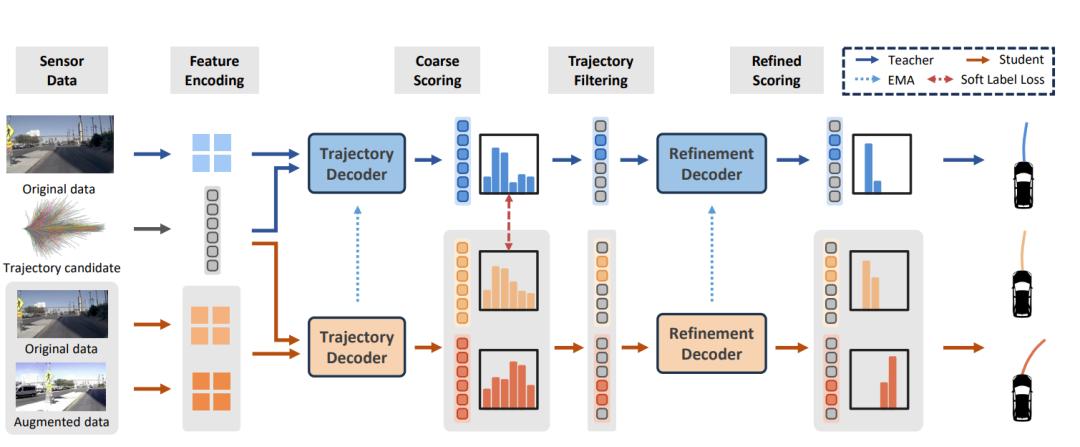
The necessity of precise screening: An innovative trajectory screening mechanism can re - rank and optimize the numerous candidate trajectories generated by the end - to - end model based on comfort, safety, and dynamic feasibility.
Automakers need a system that can drive smoothly like an experienced driver, rather than an AI that can only "roughly" drive. This requires the kit solution to embed a high - precision trajectory optimization module within the end - to - end framework.
The Huge Gap in Vehicle - Grade Engineering
The code that works in the laboratory (including the above - mentioned advanced algorithms) is still a long way from vehicle - grade mass production. Vibration, high temperature, electromagnetic interference, and long - term operational stability are all challenges. Many in - house R & D solutions are amazing in the demo stage but frequently crash or have sensor failures when installed in vehicles. The root cause is the lack of industrial - grade system engineering capabilities.
Therefore, the core value of an excellent autonomous driving kit solution lies not in "replacing" automakers, but in filling these technological and engineering gaps, allowing automakers to focus on vehicle definition, brand operation, and user service.
What Kind of Kit Solution is "Truly Reliable"?
To determine whether a kit solution is trustworthy, one cannot simply rely on the advertised parameters but must delve into the details of its technical architecture. Taking the MOGOX autonomous driving kit solution, a representative in the industry, as an example, we can establish evaluation criteria from four dimensions and integrate the latest concepts of the aforementioned academic research.
Perception Layer: From "Strongest Single Point" to "Optimal Fusion"
Many solutions like to show off how many - line lidar they use, but the real test lies in the deep fusion ability of multi - sensor fusion.
A reliable kit solution must have a perception configuration with 360° zero blind spots and multiple redundancies. For example, the MOGOX solution uses a luxurious configuration of "8L11V6R12U" for manned scenarios such as taxis and buses:
Collaboration between the main lidar and the blind - spot - filling lidar: Four high - line - count main radars are responsible for high - precision modeling at long distances (over 200 meters), and four blind - spot - filling radars cover the near - field blind spots. This design is not a simple superposition but seamlessly stitches the point clouds from different fields of view through a spatio - temporal synchronization algorithm.
Heterogeneous sensor fusion: In strong light, backlight, or bad weather conditions, cameras may be blinded, and millimeter - wave radars may have insufficient resolution. An excellent solution (such as the architecture based on BEVFusion) can perform fusion at the feature level, complementing the texture information of cameras with the depth information of lidars to ensure stable 3D object detection in any environment.
This means that automakers do not need to worry about the selection of a single sensor. The kit provider has solved the physical limit problem through algorithms and directly delivers "all - weather available" perception results.
Decision - Making and Planning: Introducing a Hybrid Architecture of "Bi - level Interaction" and "Precise Screening"
This is the area with the greatest technical differences and the dividing line between top - tier and ordinary solutions. A mature kit solution is evolving into a "hybrid enhanced architecture":
Top - tier solutions no longer plan paths in isolation but have a built - in bi - level interaction decision - making engine.
Micro - interaction: Predict the lane - changing and cutting - in intentions of surrounding vehicles in real - time and calculate the optimal response strategy (whether to yield or accelerate) through a game - theory model.
Macro - collaboration: Understand the overall traffic efficiency at intersections to avoid global congestion caused by the optimization of a single vehicle. This ability enables vehicles to show high levels of anthropomorphism and smoothness in scenarios such as unprotected left - turns and following in congested traffic, completely solving the problem of "machines being afraid to drive".
After the end - to - end large model generates preliminary trajectories, the solution introduces a high - precision trajectory screening and optimization module. This module verifies the dynamic feasibility of candidate trajectories and eliminates those that are theoretically feasible but provide a poor riding experience (such as sharp turns and sudden acceleration or deceleration). Through a re - ranking algorithm, it selects the "golden trajectory" that complies with traffic rules and takes comfort into account. This ensures that the vehicle is not only safe in logic but also smooth in experience, reaching the level of an experienced driver.
After the AI outputs instructions, a rule - based verification module is introduced. Once the AI's decision violates traffic regulations or safety thresholds, the rule layer takes over immediately. This architecture ensures both the anthropomorphism and smoothness of the driving experience and meets the strict safety and compliance requirements of automakers, avoiding the risk of accident liability caused by AI "hallucinations".
Computing Power and Middleware: "Elastic Space" Reserved for the Future
Hardware may become obsolete, but the architecture can last. A good kit solution must have foresight in terms of computing - power platforms and software architectures.
High computing - power redundancy: The MOGOX solution is equipped with a dual - Orin water - cooled domain controller, providing 550 TOPS of computing power. This is not only to run current algorithms but also to support more complex functions in the future, such as the Occupancy Network and large - language models on vehicles.
Efficient middleware: Traditional ROS (Robot Operating System) has limitations in real - time performance and resource scheduling. An excellent solution will develop its own middleware (such as ALITA), using a PU - based scheduling architecture to achieve millisecond - level communication between distributed nodes. This is crucial for multi - sensor synchronization and fast OTA.
It protects the life - cycle value of the vehicle. Automakers do not need to replace the hardware platform every two years and can unlock new functions through software upgrades, significantly reducing the total cost of ownership (TCO).
Positioning and Mapping: The Ability to Walk Independently without Relying on a "Crutch"
High - precision maps were once the "crutch" of autonomous driving, but fresh maps (SD Map) and lightweight map solutions are the future. A reliable kit must have strongly robust positioning capabilities.
Multi - source fusion positioning: The deep fusion of GNSS + IMU + LiDAR + vision + wheel speed sensors ensures centimeter - level positioning accuracy in areas without GPS signals, such as tunnels, overpasses, and underground garages.
Real - time mapping ability: With online SLAM capabilities, the vehicle can update local maps in real - time during driving to adapt to temporary construction or road changes.
By getting rid of the dependence on the coverage of high - precision maps, autonomous vehicles can be quickly replicated in more cities, accelerating the commercialization process.
Implementation is King: From a Technical Closed - Loop to a Business Closed - Loop
No matter how cool the technology is, if it cannot be converted into business orders, it is a liability for automakers. A good kit solution must have a "implementation gene".
The Engineering Standards for Pre - installed Mass Production
This is the dividing line between a "toy" and a "product". A reliable solution provider will deeply participate in the early stage of vehicle development, embed sensors in the vehicle body design, and hide the wiring harnesses to meet the vehicle - grade requirements for earthquake resistance, water resistance, and temperature resistance.
The sensors of retrofitted vehicles are exposed, easy to damage, and have a large wind resistance, making them unable to pass the quality verification of automakers. Pre - installed mass - produced vehicles, on the other hand, have an integrated appearance, and their reliability has been verified over millions of kilometers. Only through pre - installed mass production can automakers deliver vehicles on a large scale and enter the government procurement catalog or operation fleets.
The Flywheel Effect of the Data Closed - Loop
Autonomous driving becomes smarter with more use, provided that there is a data feedback mechanism. An excellent kit solution has a built - in trigger - based data collection and automatic annotation system.
When the vehicle encounters difficult scenarios during operation, it automatically uploads data to the cloud. The cloud automatically annotates and trains the model, and then pushes the new version to the fleet via OTA. This "weekly iteration" ability is difficult for in - house teams to achieve. For automakers, choosing such a partner is like having an "external brain" that continuously evolves.
The Dimensionality - Reduction Strike of Vehicle - Road - Cloud Collaboration
When single - vehicle intelligence reaches its limit, vehicle - road collaboration (V2X) provides a bird's - eye view. A kit solution with vehicle - road - cloud integration capabilities can use the data from roadside devices to make up for the blind spots of on - board perception. This provides a unique competitive advantage for automakers to participate in smart - city projects and obtain government orders.
How Should Automakers Make a Selection?
Faced with a wide variety of solutions in the market, automakers should follow the following "Three No - Selection" Principles when making decisions:
Do not choose a "pure assembly" solution: If the supplier relies entirely on external procurement for core components and only modifies open - source algorithms without the ability to optimize at the underlying level, do not choose it. Such a solution will be helpless when encountering deep - seated bugs.
Do not choose a "no - mass - production" solution: A solution that has not been verified through large - scale pre - installed mass production and does not have millions of kilometers of actual operation data poses a high risk. Laboratory data cannot represent the complexity of the real world.
Do not choose a "closed" solution: If the supplier does not provide data interfaces, does not support customized development, and cannot connect with the automaker's cloud platform, the automaker will lose control of user data and operation.
The right approach is to find a "deeply - bound" partner. The cooperation models between MOGOX and King Long for pre - installed mass - produced buses and the exploration of the Singapore market with BYD represent the future trend: The technology provider provides the brain, and the automaker provides the body. They jointly define the product and share the business benefits.
In this model, automakers are no longer just "payers" but "co - builders" of the ecosystem. The kit solution provider offers not just a hardware box but an intelligent system that is growable, evolvable, and operable.
Return to the Essence and Embrace the Ecosystem
The end - game of autonomous driving is not a solo performance by one company but a