Breaking through the limit of over ten thousand consecutive edits, the Chinese Academy of Sciences proposed the first knowledge retention method with theoretical stability.
LyapLock enables large models to maintain old memories and accurately learn new knowledge during tens of thousands of knowledge updates for the first time. It uses a "virtual queue" to monitor the risk of forgetting in real-time, dynamically balance new and old knowledge, and theoretically ensures long-term stability. The editing effect is 11.89% better than mainstream methods. It can also empower existing models, allowing AI to truly learn to "grow continuously."
Large language models often contain factually incorrect or outdated knowledge, which has led to the development of model editing methods for precise knowledge updates. However, due to the lack of an appropriate long-term knowledge retention mechanism, the current mainstream "locate-then-edit" methods show a gradual decline in performance during continuous editing.
To address this issue, researchers from the Institute of Information Engineering of the Chinese Academy of Sciences proposed LyapLock, which models continuous editing as a constrained stochastic programming problem, considering the challenges posed by the cumulative retention error constraint and the gradually revealed editing tasks.
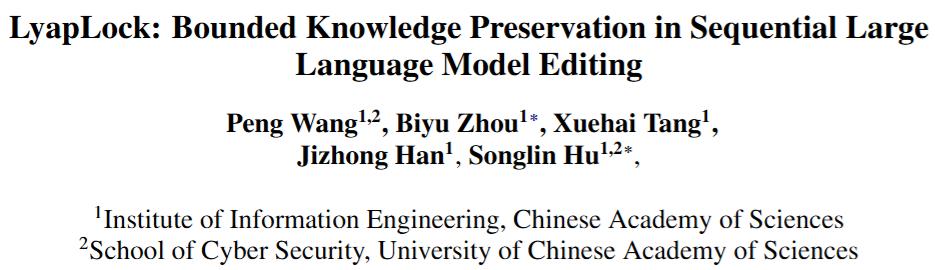
Paper link: https://arxiv.org/pdf/2505.15702
LyapLock integrates queuing theory and Lyapunov optimization, decomposing the long-term constrained programming into manageable step-by-step subproblems for efficient solution.
This is the first model editing framework with strict theoretical guarantees, achieving asymptotically optimal editing performance while satisfying long-term knowledge retention constraints.
Experimental results show that this framework extends the continuous editing ability to over 10,000 times. While stabilizing the general capabilities of the model, its average editing effect is 11.89% better than the current state-of-the-art (SOTA) baseline methods. Additionally, this framework can be used to enhance the performance of existing baseline methods.
Research Background
The current mainstream "locate-then-edit" paradigm (such as the well-known ROME and MEMIT) is extremely accurate in single knowledge updates. To make them suitable for continuous editing, recent studies (such as RECT and AlphaEdit) have attempted to add heuristic constraints such as regularization or null space projection during parameter search.
The pain point is that these methods are essentially short-sighted.
Most of them only focus on short-term single-step incremental optimization and lack a rigorous theoretical framework to manage the cumulative effects of continuous editing in the long term.
Each edit seems to only damage a little of the original knowledge, but after 10,000 edits, the cumulative preservation loss will show an out-of-control upward trend.
Experiments have cruelly proven this: after continuously editing 10,000 samples, the performance of all mainstream baseline methods on downstream tasks has almost dropped to zero (Figure 1).
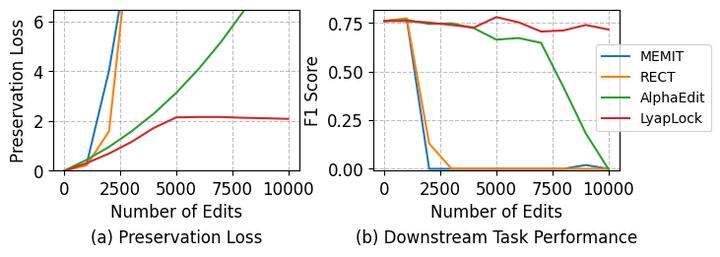
Figure 1: Line graph of the explosion of preservation loss and the zeroing of the F1 score on downstream tasks for baseline methods
Research Method
Since treating the symptoms rather than the root cause doesn't work, the problem must be redefined from a global perspective.
Instead of patching the single-step loss function, LyapLock directly models continuous editing as a stochastic programming problem with long-term constraints (Figure 2).
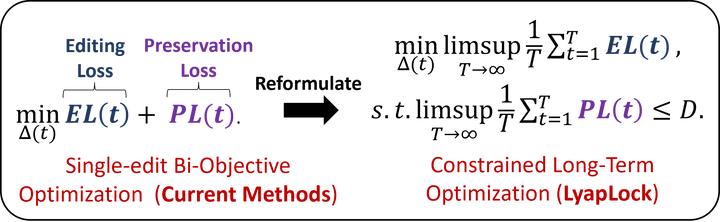
Figure 2: Comparison of the core difference formulas between traditional single-step bi-objective optimization and LyapLock's constrained long-term optimization
To put it in an "onion-peeling" way, the intuition is as follows:
- Introduce a virtual queue as a "reservoir": A virtual queue is designed to monitor the cumulative memory forgetting in real-time. If editing a piece of knowledge causes excessive damage to the original knowledge, exceeding the set red-line threshold, the water level of this queue will rise.
- Dynamic game Lyapunov optimization: This is a classic method in control theory. When the water level of the queue rises, the system will automatically sound an alarm and increase the penalty weight of "knowledge preservation loss" in the loss function. At this time, the primary task of the model becomes to "protect old knowledge."
- Strike a balance: When the water level drops (i.e., recent edits have little impact on old knowledge and are in the safe zone), the weight decreases, and the system will allocate computing resources to "learning new knowledge."
In this way, the researchers have theoretically proven that as long as the virtual queue remains strongly stable, the average preservation loss of the model during infinite continuous editing will be firmly locked within the red line.
Detailed Results
Let the real experimental data speak. Extreme tests were conducted on multiple models such as LLaMA-3 (8B) and GPT-J (6B).
Over 10,000 edits without a collapse in general capabilities
After 10,000 continuous edits, all baseline methods (ROME, MEMIT, PRUNE, RECT, AlphaEdit) failed on the six major downstream tasks of GLUE, and their performance plummeted to 0%. In contrast, LyapLock remained stable. Even when the stress test was increased to 20,000 edits, the model still maintained excellent general language capabilities. Meanwhile, while the preservation loss of other baseline methods increased exponentially, the LyapLock method limited it within a certain threshold (Figure 3, Figure 4).
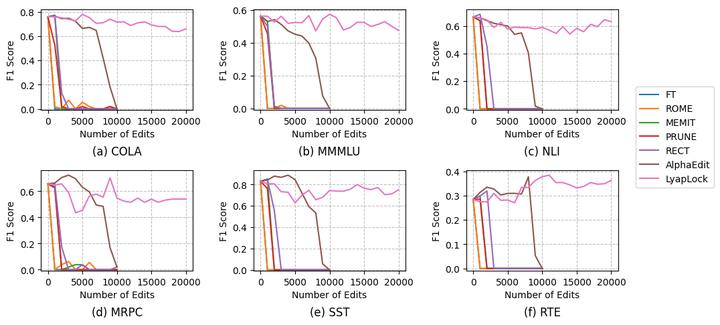
Figure 3: Comparison of the resistance to decline on GLUE downstream tasks
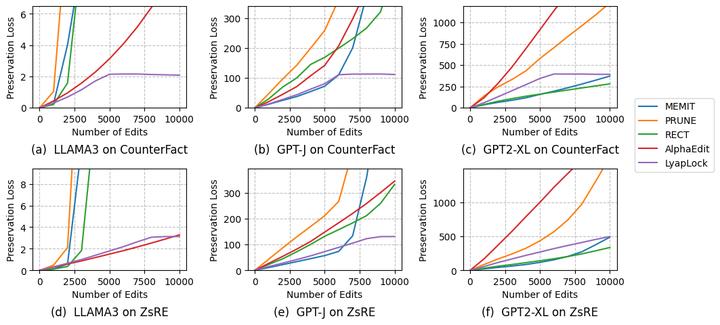
Figure 4: Comparison graph of the preservation loss being stabilized within the threshold
Top-ranked knowledge update performance
Not only does it protect old knowledge well, but it also learns new knowledge precisely. Compared with the second-strongest baseline, AlphaEdit, the average editing efficacy of LyapLock has been increased by 11.89%. In the LLaMA3-Counterfact scenario, the generalization ability has a huge gap of 19.71%.
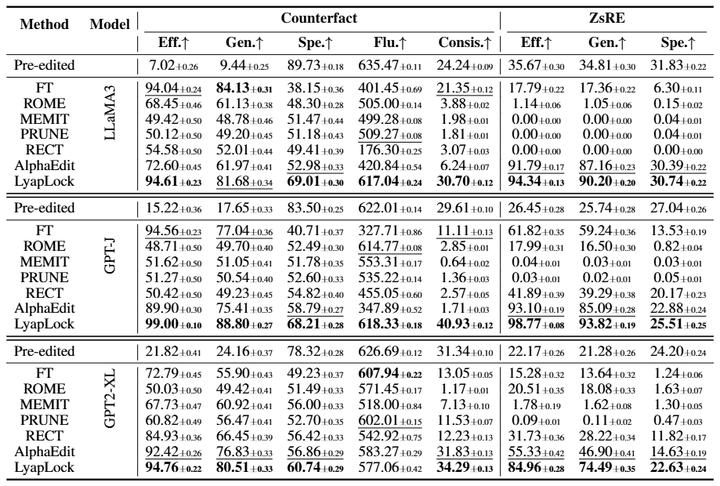
Figure 5: Main experimental results
A plug-and-play add-on
The theoretical framework of LyapLock can not only work independently but also be downward compatible! Combining it with existing methods such as MEMIT and PRUNE can directly improve their editing performance by 9.76%, and the performance on downstream tasks has skyrocketed by 41.11%.
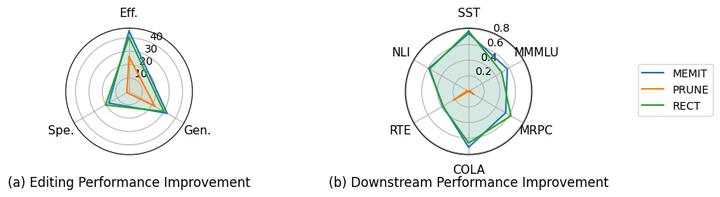
Figure 6: Radar chart of the performance improvement of baseline methods after combining with LyapLock
Summary and Outlook
LyapLock uses Lyapunov optimization for the first time to put a "lock" with theoretical guarantees on continuous editing. It proves that as long as the long-term cumulative loss is well-controlled, large language models have the potential to continuously learn and correct their cognition over a long lifespan, without "learning new knowledge and forgetting who they are."
Of course, there is still room for improvement in the current work.
For example, the evaluation mainly focuses on natural language understanding (NLU) tasks. In the future, in fields such as code generation and complex mathematical reasoning, can this continuous editing lock still be so stable? What are the limits of even larger edit volumes in the hundreds of thousands or millions? These are all worthy of further exploration by the community.
Reference materials:
https://arxiv.org/pdf/2505.15702
This article is from the WeChat official account “New Intelligence Yuan”. Author: LRST. Republished by 36Kr with permission.