No optimization, no recommendation. Google cracks down on APP power consumption.
With the large-scale application of silicon-carbon anode batteries, the battery capacity of Android phones has become increasingly large. From a few thousand milliampere-hours a few years ago to seven or eight thousand milliampere-hours today, there are even models like the Honor WIN equipped with batteries exceeding ten thousand milliampere-hours.
However, although the battery capacity of Android phones has increased, the battery life experience doesn't seem to have improved synchronously.

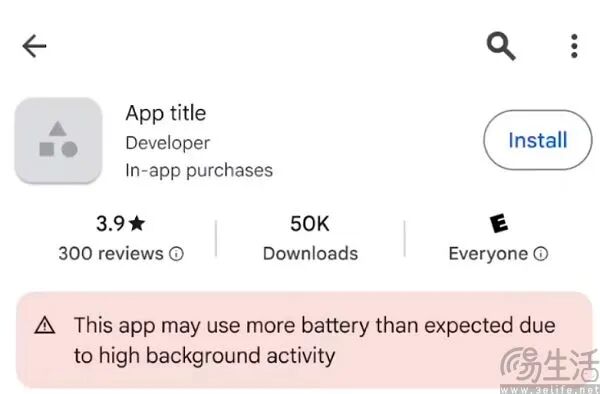
Actually, it's not that Google and phone manufacturers aren't making efforts. It's that Android app developers are too unrestrained. Therefore, on March 5th, Google announced that it would take measures to rectify apps with abnormal power consumption. Currently, it has also changed the ranking weight of apps in the Play Store, and apps with high power consumption will be affected.
According to Google, if an app has an average of 2 hours or more of background wake-ups in more than 5% of user sessions (Session) in the past 28 days when the screen is off, it will be recognized as an "app with abnormal power consumption". Such apps will have a negative impact on their search/display weight in the Play Store. In addition, these high-power-consuming apps will show a prominent red warning in the Play Store, and the page will directly state that "there is a lot of background activity, and the battery consumption may be higher than expected".

Regarding reducing power consumption and extending battery life, Google has always been working hard to improve the user experience. As early as Android 2.2, they introduced the WakeLock mechanism to Android to avoid unnecessary power consumption. By Android 6.0, Google added the Doze mode. After the device meets conditions such as the screen being off and remaining stationary for a period of time, it will automatically restrict the network activities, CPU usage, and system resource calls of background apps.
On Android 8.0, Google further tightened background task management. It prohibited most background apps from receiving implicit broadcasts (such as network changes and device startup), and non-important notifications were automatically "silenced" by the system, thus significantly reducing background push wake-ups. In recent years, they have even used AI to predict users' usage habits to freeze unnecessary apps in advance.
However, there are always countermeasures against policies. Take the WakeLock mechanism as an example. Originally, it was a mechanism in Android to ensure the correct execution of key code in apps. It allows developers to keep the SoC running after the device screen is turned off (either due to system timeout or the user pressing the power button). But some developers abuse the WakeLock to prevent the SoC from entering the sleep state in order to reach users at all times, resulting in increased power consumption.
In addition to apps staying in the background unreasonably, developers' wanton behavior in app design is also a key factor leading to higher power consumption in Android. For example, high CPU load, high-brightness display, frequent GPS positioning, high-frequency network communication, and unnecessary animations are all factors that cause high power consumption in devices.
Although the Android development guidelines require developers to use system APIs as much as possible, reduce background processes, avoid keeping the phone in high-brightness mode for a long time, use GPS and the network reasonably, reduce data transmission and reception, lower the animation frame rate, and avoid frequent CPU wake-ups to optimize power consumption, the problem is that optimization requires additional effort and cost from developers.
When the power resource is open to all developers, but they have no right to prevent others from using it, the result is that each developer tends to overuse it, leading to higher power consumption in the Android system. Actually, the developers' mindset is easy to understand. After all, even if they spend time and effort to optimize the power consumption of their apps, if other app developers don't make efforts, their efforts will be in vain.

Moreover, the continuous iteration of battery technology by phone manufacturers has, to some extent, "aided the evildoers". Developers may think that since phone manufacturers have their backs covered, why bother spending resources to optimize their apps? As a result, although the battery capacity of Android phones has been increasing, the battery life experience hasn't improved significantly.
Google's solution this time is to "make things difficult for developers". After all, in the past, developers could be irresponsible without any cost because not many users would often check the power consumption rankings of apps. Now, with the high-power-consumption labels in the Play Store, users' download decisions will definitely be affected. Among apps of the same type, if your product is labeled as "high power consumption" while your competitors' aren't, users are likely to choose the latter.
What's even more fatal is that Google has also adjusted the ranking weight in the Play Store, which is crucial for app exposure. The so-called "ASO (App Store Optimization)" is that developers use methods like brushing rankings to get their apps ranked higher in the app store. This is the result of their use of the "primacy effect".

Due to the priority of brain memory encoding, early information forms more stable neural connections, so we are prone to be influenced by first impressions. In the app store, this means that apps with higher rankings are more likely to be downloaded by users. In short, by associating the power consumption level of apps with the exposure in the Play Store, Google will force developers to actively optimize their products.
All-round and without any weaknesses, worthy of the "Folding Grand Slam".
This article is from the WeChat official account "3eLife" (ID: IT - 3eLife). The author is 3eLife. It is published by 36Kr with authorization.