Will quantum chips be the next "atomic bomb"?
In 1980, a Russian mathematician named Yuri Manin first proposed the concept of a quantum computer in his book Computable and Uncomputable. At that time, quantum computing was just a vague theoretical idea, and even its proposer himself didn't know if this idea could really become a reality.
A year later, in 1981, American physicist Richard Feynman independently put forward the same concept and pointed out in a speech: "Nature is not classical. If you want to simulate nature, it's better to do it with quantum mechanics." It was this sentence that ignited the spark of quantum computing research.
In the long years that followed, quantum computing experienced repeated setbacks and waiting.
In 1994, Peter Shor proposed the famous Shor's algorithm at Bell Labs, proving that quantum computers could theoretically crack the current encryption system; in 1999, Canadian physicist Geordie Rose founded D-Wave, the world's first quantum computing company; in 2007, D-Wave launched a 16-qubit quantum annealing simulator, which was the first time a quantum computer stepped out of the laboratory and into reality.
History seems to be repeatedly proving one thing: Quantum computing is always a technology that's "ten years away."
Then, the time came to October 2019. In the early morning of that autumn, in Google's research park in Santa Barbara, California, a group of engineers were holding their breath around a quantum chip named "Sycamore." This chip with only 53 qubits completed a specific task in 200 seconds. For the same task, it would take the world's most powerful supercomputer at that time, "Summit," ten thousand years to complete. On October 23, 2019, Google officially published a paper in the Nature magazine, announcing the achievement of "quantum supremacy" - for the first time in the history of quantum computing development, a quantum computer outperformed all classical computers in a specific problem.
When the news came, the global public opinion was in an uproar. The Economist called it the "quantum satellite moment." People suddenly realized that the "future" that once only existed in theory might really be here.
But few people know that behind Google's early morning achievement was a technological competition that had lasted for forty years. From Manin's mathematical concept, to startup companies in Silicon Valley garages, to the national-level investments of China, the United States, Europe, Japan, and South Korea today, quantum computing has never been just a technological innovation. From the day it was born, it has become the focus of great power games.
This is a story about waiting, failure, prejudice, and a comeback.
The Metaphor of the "Atomic Bomb"
When the "atomic bomb" is used to describe a quantum chip, it touches not only the fear of technological power but also a kind of civilizational anxiety.
On July 16, 1945, the world's first atomic bomb was successfully tested in the desert of New Mexico. At that moment, Oppenheimer recalled a line from the Indian epic Bhagavad Gita: "Now I am become Death, the destroyer of worlds." Less than a month later, Hiroshima and Nagasaki were reduced to ruins. The atomic bomb not only ended World War II but also opened the era of great power nuclear deterrence.
Today, when people use the "atomic bomb" to describe a quantum chip, what are they afraid of?
The first aspect is the collapse of the password system. The current encryption basis for global finance, military communication, and government secrets is almost entirely built on the mathematical assumption that "classical computers cannot factor large integers within a reasonable time." However, Shor's algorithm has proven that once there is a powerful enough quantum computer, this assumption will become invalid overnight. In 2023, the U.S. National Security Agency issued an announcement, urging all government agencies to migrate to the "post-quantum cryptography" system as soon as possible.
The second aspect is the national mobilization on a global scale. Today, major global economies are investing in quantum R & D with national strength. China's 14th Five-Year Plan lists quantum information as a priority frontier technology; the European Union launched the "Quantum Flagship" and promised to invest one billion euros in ten years; the U.S. Congress passed a bipartisan bill, investing more than 1.2 billion dollars in quantum research.
Currently, in terms of the distribution of quantum enterprises by country, there are more than 230 quantum enterprises in the European Union, accounting for 29%, among which Germany has more than 70 quantum enterprises. The United States has more than 210 quantum enterprises, accounting for 26%. China has more than 140 quantum enterprises, accounting for 17%.
If we examine this analogy carefully, the impact of quantum computing will be all - round, not limited to military or destructive aspects. The atomic bomb is a weapon with a single and clear purpose - destruction. While a quantum chip is not just a "thing" but a kind of "ability." It may subvert cryptography, but it may also help humans develop anti - cancer drugs, design new materials, and optimize the global logistics network.
However, quantum chips do have the potential to change the power structure. Whoever masters the ability of quantum chips will have an asymmetric advantage in the information age. But it won't be a definite moment like the atomic bomb. The growth of quantum chip capabilities will be gradual, commercial, and require long - term investment.
Six Routes in Competition: The Technological Landscape of Quantum Computing
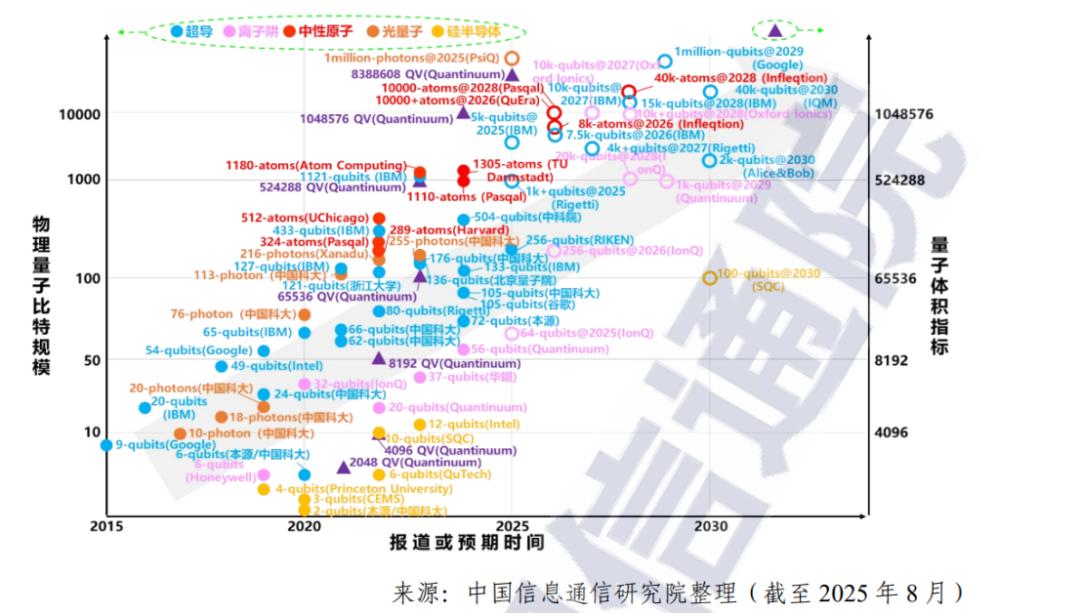
In December 2024, the field of quantum chips witnessed a long - awaited "synchronization." Google and the University of Science and Technology of China successively released their latest 105 - qubit superconducting quantum chips, reigniting the industry's enthusiasm for quantum computing.
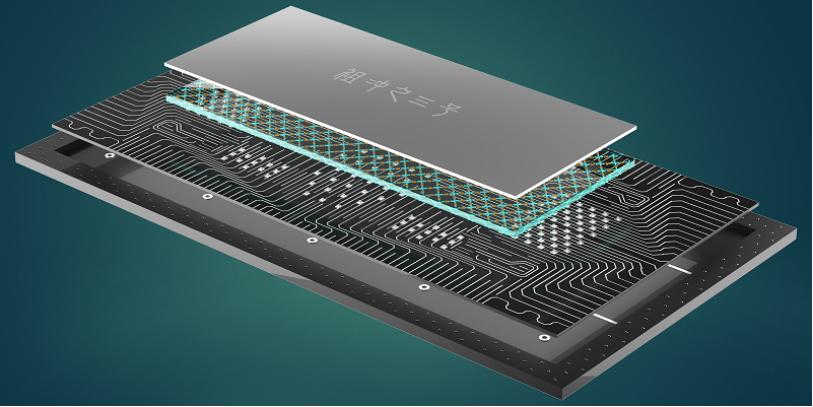
Schematic diagram of the Zu Chongzhi 3 quantum processor demonstrated by the team of Pan Jianwei.
Two days before and after Google released its new - generation quantum chip "Willow," on the campus of the University of Science and Technology of China in Hefei, the team led by Academician Pan Jianwei announced the successful development of the "Zu Chongzhi 3.0" processor of the same specification. These two processors, released almost at the same time, have the same number of qubits but different architectural designs.
The first route is superconducting quantum computing. This is currently the most mainstream and commercially - developed technology route. Google, IBM, Intel, Rigetti, and Origin Quantum in China have all invested a lot of resources in this direction. The basic principle of superconducting quantum chips is to use the "Josephson effect" in superconducting circuits to create qubits in an extremely low - temperature environment close to absolute zero. The advantages of this route are: fast quantum gate operation speed, compatibility with existing semiconductor manufacturing processes, and easy scalability. The disadvantages are: the need for extremely expensive cryogenic dilution refrigerators, limited coherence time of qubits, and extreme sensitivity to environmental noise.
In June 2025, Microsoft announced the latest progress in its four - dimensional topological quantum error - correction code technology, claiming to have reduced the qubit error rate by a thousand times, and for the first time, a quantum computer had the reliability to handle complex tasks.
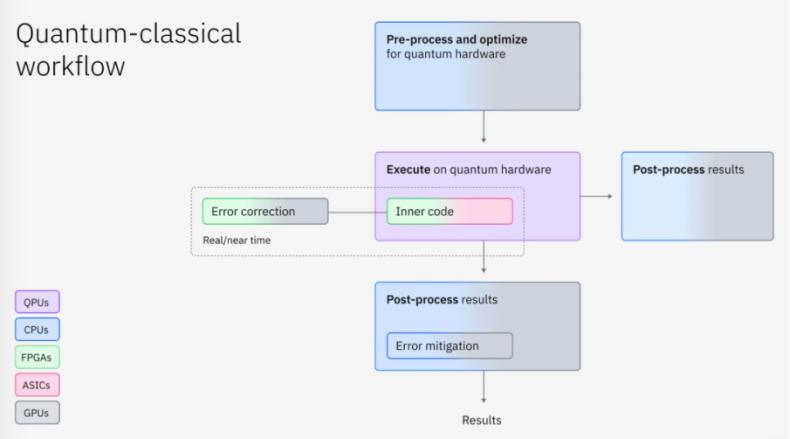
Quantum - classical data flow (Source: IBM)
IBM adopted a more radical commercialization strategy. IBM proposed the concept of a "quantum - centric supercomputer," integrating quantum processors, CPUs, and GPUs into the same computing structure. The QPU is used to handle quantum circuits that require exponential classical memory to simulate.
The second route is photonic quantum computing. This is the technology direction where China currently leads. Represented by the team of Pan Jianwei from the University of Science and Technology of China, the "photonic quantum school" uses photons as carriers of qubits. The advantages of photons are: long coherence time, no need for extremely low - temperature environments, and relatively low sensitivity to environmental noise.
In February 2025, a joint team from Peking University and Shanxi University made a major breakthrough in the field of integrated photonic quantum chips. They first realized a "continuous - variable" quantum entangled cluster state on a chip. This achievement was published in the Nature magazine, filling a key gap in the development of photonic quantum chips.
This is the most core tension in the current field of quantum chips: behind the competition of technology routes is the collision of two innovation philosophies. The superconducting route relies on the existing semiconductor industry foundation, with high technological maturity and a clear commercialization path, but obvious physical bottlenecks; the photonic quantum route performs amazingly in specific problems, but there is still a long way to go before general - purpose computing.
On a deeper level, this competition is evolving into a confrontation between two camps.
The U.S. camp has tech giants such as Google, IBM, and Intel at its core, along with startups like IonQ and Rigetti and top research universities such as MIT, Stanford, and Harvard. The United States has deep accumulation in both superconducting quantum chips and ion - trap routes. In 2022, the U.S. Department of Commerce included quantum computing in the export control list, restricting the export of advanced quantum technology equipment and materials to China.
The Chinese camp has the University of Science and Technology of China, Origin Quantum, and Huawei and other institutions and enterprises at its core, making efforts in both photonic quantum computing and superconducting quantum computing. China's advantages are: efficient government decision - making, large R & D investment, and rich talent reserves. In 2025, a subsidiary of China Telecom completed the change of controlling stake in Guodun Quantum, marking that China's quantum industry is entering a new stage of resource integration.
It should be noted that the quantum computing track has never been limited to one or two options. Currently, global quantum computing is in a critical period of scientific and technological research for frontier scientific research and prototype development. Multiple technology routes such as superconducting, ion - trap, neutral atoms, photonic, silicon semiconductor, and topological are developing in parallel and competing openly. Each route has its unique physical advantages and engineering challenges, and the industry has not yet reached a conclusion on which route will lead to general - purpose quantum computing.
The Story of Chinese Quantum Chips
To understand the current situation of Chinese quantum chips, we need to go back to the 1980s, which is an almost forgotten starting point.
In the early 1980s, Chinese research on quantum computing was almost non - existent. At that time, China had just started its reform and opening - up, with limited research funds and backward experimental equipment. Most research universities didn't even have decent low - temperature laboratories. Under such conditions, a group of young Chinese physicists began to try to enter the field of quantum computing.
Guo Guangcan is one of the founders of China's quantum computing cause. In the late 1980s, when he was communicating with international scholars in Italy, he came into contact with the theory of quantum information and immediately realized that this would be a field that would change the future. In 1999, Guo Guangcan founded the Quantum Information Laboratory at the University of Science and Technology of China and started a long pioneering journey.
In 2001, Guo Guangcan applied for the "973 Program" for the fourth time and finally succeeded, obtaining the country's first 973 Program in the field of quantum information and 25 million yuan in research funds. As the chief scientist, he not only had to consider his own team but also the future development of the country's quantum information. "For China to compete in the world, one team is not enough. We must unite all domestic forces to participate in the competition."
In 2017, Guo Guoping founded Origin Quantum, China's first quantum computing company. Origin Quantum chose superconducting quantum chips as its main research direction, which is a technology route that directly competes with Google and IBM. The process from 0 to 1 was difficult: high - end refrigerators were embargoed, so the Chinese team had to develop low - temperature equipment on their own; the manufacturing of quantum chips requires advanced semiconductor processes, and the domestic supply chain was not perfect.
In 2021, Origin Quantum released "Wuben," China's first superconducting quantum computer prototype. This processor with 24 qubits, although smaller in scale than Google's "Sycamore," was significant in that it was China's first breakthrough from 0 to 1 in the mainstream technology route of superconducting quantum chips.
In 2024, the Chinese quantum chip industry entered an accelerated development period. The year 2025 was a milestone year. In November, the superconducting quantum computer "Tianyan - 287" equipped with the same chip as the "Zu Chongzhi 3" was completed, which was China's first quantum computing system with the ability of "quantum computing supremacy." In the same year, the "Tianmu 2" 100 - qubit chip achieved a "hot" topological edge state, significantly improving the stability of quantum information and promoting the practical application process of superconducting quantum chips.
Currently, is China's quantum chip on par with the international level?
Objectively speaking, the current situation of Chinese quantum chips is: leading in specific technical indicators, still having a gap in overall capabilities, and relatively lagging in the industrialization process.
In terms of quantum computing, the gap between China and the United States is about 3 to 5 years. The number of qubits is not the only indicator - coherence time, gate fidelity, quantum volume, etc. are all key parameters for measuring the performance of quantum chips. In these comprehensive indicators, the gap between China and the international advanced level is still obvious.
What's more worthy of attention is the gap at the industrial chain and industrialization levels. The commercialization of quantum chips requires a complete ecosystem, including hardware manufacturing, software development, cloud services, application implementation, and talent training.
Conclusion
According to the report of the global frontier technology consulting company ICV, in 2027, dedicated quantum computers are expected to achieve performance breakthroughs, driving the overall market scale to reach $10.54 billion; from 2028 to 2035, the market scale will continue to expand rapidly. Benefiting from the technological progress of general - purpose quantum computers and the wide application of dedicated quantum computers in specific fields, the total market scale is expected to reach $811.7 billion by 2035.
Since 2026, there have been multiple financing projects in the domestic quantum computing field with a scale of over 100 million yuan. Specifically at the enterprise level, judging from the scale of investment and financing projects since 2026, the investment and financing projects in the quantum technology track have the characteristics of "increasing in number and gradually increasing in scale." As of now, in February, 3 enterprises have received 3 rounds of financing respectively, and in January, 6 enterprises received a total of 7 rounds of financing.
With the continuous breakthroughs in theory in the research and development of China's quantum technology field, investment and financing are quickly being transformed into projects. In 2026, the quantum computing technology has entered a critical window period from laboratory research and development to industrial application.