Jingwei and Fengrui invested in an intelligent musical instrument company targeting the mass music market with annual revenues of hundreds of millions | Exclusive report by Yingke
Author | Huang Nan
Editor | Yuan Silai
Yingke exclusively learned that the intelligent musical instrument brand AeroBand recently completed a nearly 100 million yuan Series A financing round. This round was led by Matrix Partners China, with co - investments from Oasis Capital, Guotai Haitong, and existing shareholder Fengrui Capital. AeroBand belongs to Shenzhen Dailer Somatosensory Technology Company. The financing funds will be mainly invested in new product R & D, accelerating global market expansion and promotion, and promoting the construction of a core talent echelon to attract top R & D, product, and marketing talents with an international perspective.
AeroBand has long been focused on the R & D of digital electro - acoustic musical instruments and the global layout of intelligent musical instruments for overseas markets. Centered around somatosensory interaction technology, it has completed product iterations from the air pick, the somatosensory drum set PocketDrum, to the intelligent guitar AeroBand Guitar, lowering the threshold for music learning and enabling digital performance and creative expression of intelligent musical instruments.
The founder and CEO, Niu Yafeng, has an engineering background. In 2015, Niu Yafeng and his college classmates formed a team to participate in a startup competition. They chose a rather niche musical instrument direction at that time. The reason was simple: the learning threshold for traditional guitars is high, and beginners often can't play a complete song for months. They wanted to explore the possibility of "reconstructing the musical instrument experience with technology".
The team centered around somatosensory interaction and created a pair of intelligent gloves. Wearing them, users can simulate guitar and bass playing in the air, and wave their arms to play drum beats. The name AeroBand (Air Band) was thus born.
With this creative idea, they won the championship of the startup competition that year. In 2016, Niu Yafeng officially registered the company and started his entrepreneurial journey. In the following three years, based on the gloves, they continuously iterated, spending time refining the gesture recognition algorithm and adjusting the integrated acoustic design, iterating the glove prototype into a more portable air pick and launching AeroBand's first official product.
According to research reports from Statista and others, the global musical instrument market size exceeds $40 billion. Among them, the guitar category is expected to grow to $12 billion by 2025. However, the musical instrument market has not undergone fundamental changes in over a hundred years. Although materials, sensors, and electronic signal technologies have developed well, the musical instrument industry still remains in the "electronization" stage and is far from true digitalization.
The product iteration of AeroBand reflects, to some extent, the exploration path of digital musical instruments. In 2018, the AeroBand air pick was launched. This somatosensory device, only the size of a guitar pick, is equipped with an accelerometer and a gyroscope. With the left hand cooperating with the mobile app, users can play chords. This product received over a thousand orders on JD Crowdfunding, allowing the team to verify the market demand for new - type intelligent musical instruments for the first time.
Its second product is the somatosensory drum set. By expanding the inertial sensors from one to four, users can achieve the effect of a nine - faced drum set after holding the drumsticks and hitting. It sold over 5,000 orders in a single month. This also made Niu Yafeng realize the high acceptance and strong purchasing power of the overseas market for innovative product categories.
At that time, social media platforms represented by TikTok were rising overseas. AeroBand seized the opportunity, attracted traffic to its independent website through original short - video exposure to highlight product features and KOL endorsements, and established the link from content exposure to brand conversion. Niu Yafeng pointed out that the overseas expansion of intelligent hardware products should start from the user's perspective. "Let users first understand who 'we' are, in what scenarios they can see us, get to know us, trust us, and finally know where to buy." By 2022, AeroBand's annual revenue had reached tens of millions of yuan.
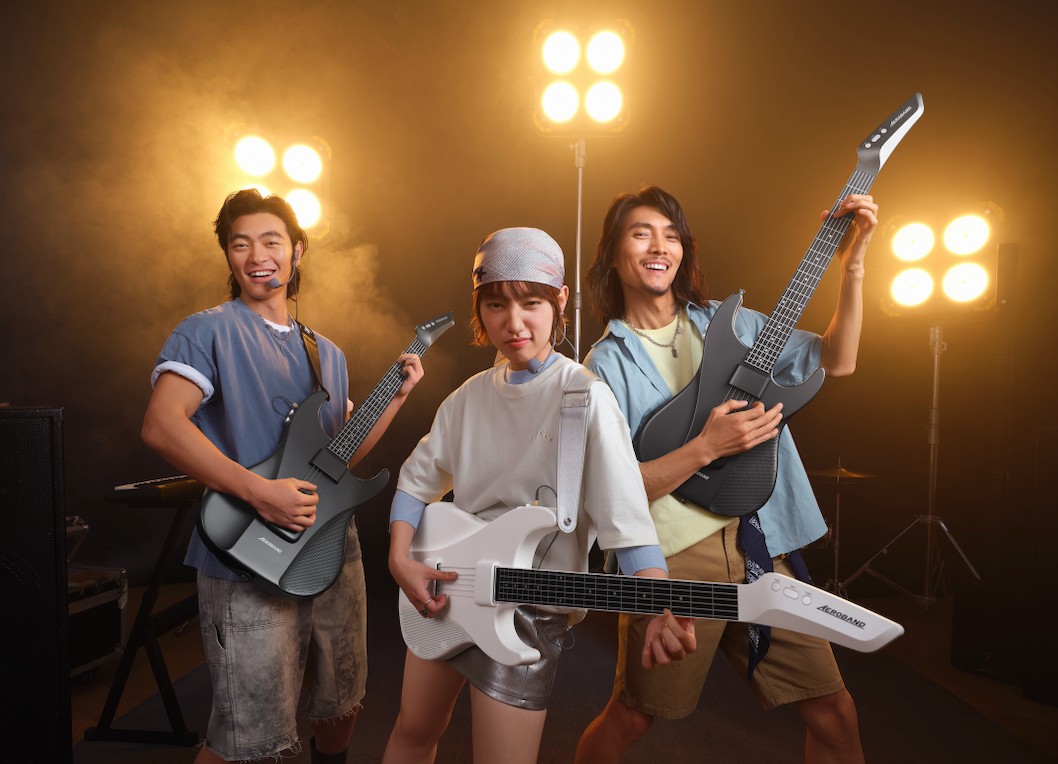
AeroBand Guitar (Image source/Enterprise)
AeroBand's third - generation product is a fully digital intelligent guitar.
Intelligent musical instrument products present flexible usage scenarios in different markets. In China, users emphasize quick - start playing and singing and social sharing; while overseas, users with a deeper music cultural background value in - depth expressions such as creative assistance and multi - timbre linkage.
AeroBand Guitar targets two very different types of users. One type is creators who have a strong need for creative expression but are limited by cumbersome traditional equipment. To switch timbres, they need to match effectors; to arrange music, they need to learn the keyboard; and to record a melody, they need to repeatedly edit the audio. The other type is the general user group, who love music but are blocked by the months - long practice threshold.
Previously, electronic musical instrument products such as electric guitars amplify analog signals, but in essence, they still produce sound physically. However, AeroBand Guitar adopts a solution where everything from the strings, pickup sensors to the synthesizer and acoustic module is digitalized.
When users play, the algorithm records the sound - producing signals in real - time as editable MIDI data, rather than just audio waveforms. To modify a melody, users can directly drag the audio track. Switching timbres no longer requires an effector matrix, and an AeroBand Guitar can output multiple timbres such as acoustic guitar, electric guitar, bass, and piano.
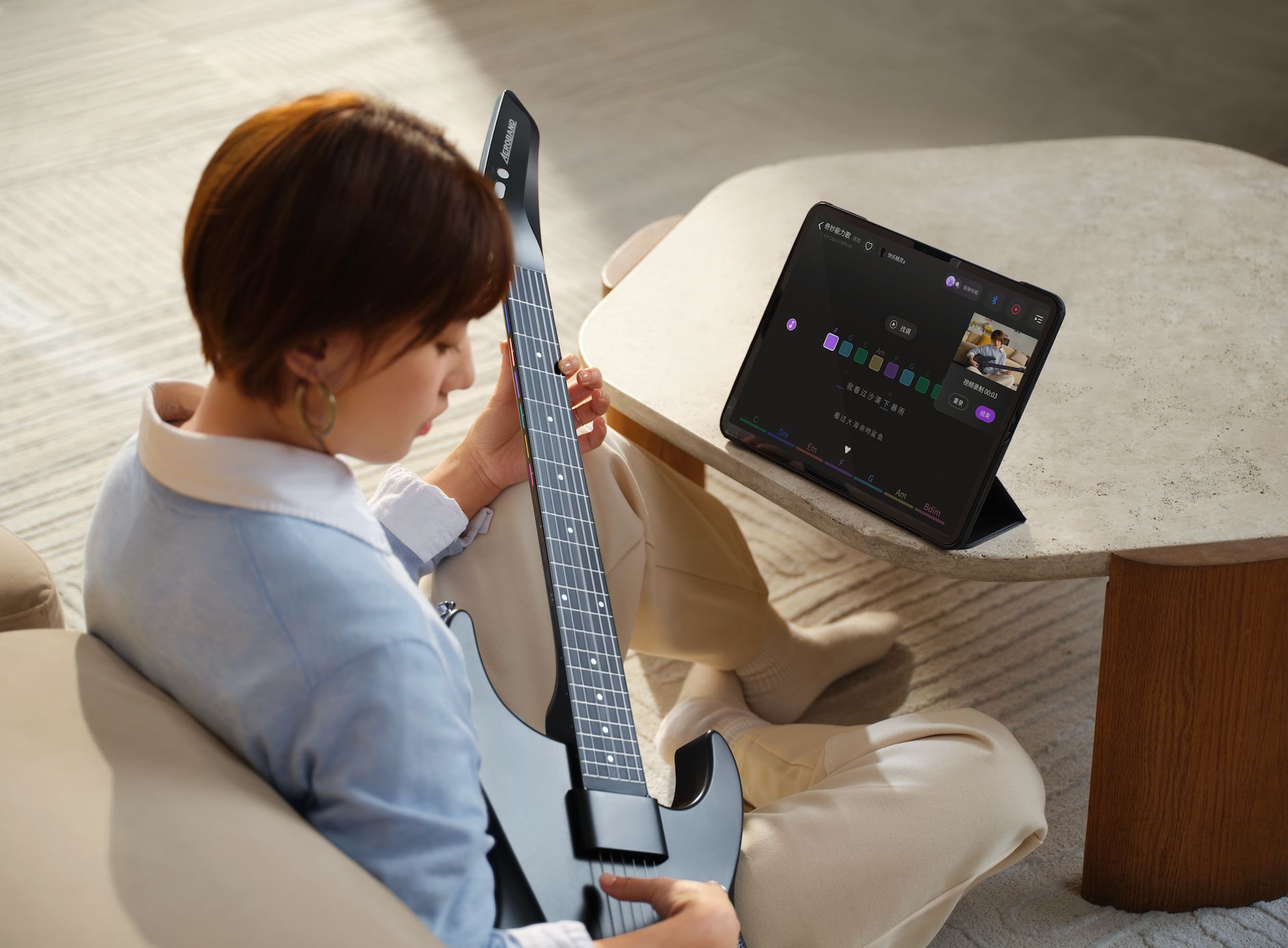
AeroBand Guitar provides self - learning course services (Image source/Enterprise)
For creators, this means that a guitar is more like a music creation platform. Guitarists can directly arrange music without learning the keyboard, and the recorded content can be adjusted at any time, improving music creation efficiency.
For general users, AeroBand Guitar's hardware performance is comparable to that of professional musical instruments. Its timbre library uses professional synthesizer - level sampling, and the force feedback and vibration touch are adjusted to be close to the playing experience of real musical instruments.
At the same time, the interaction method greatly reduces the user's learning threshold. For the singles that users like, the APP provides a series of automatically generated courses. During the learning process, the algorithm can identify in real - time whether the user presses the strings correctly and the rhythm deviation, and give accurate feedback and subsequent learning suggestions.
From playing and singing within three minutes, to advanced practice, to performance recording and social sharing, AeroBand Guitar has connected the entire chain of "play - learn - practice - show".
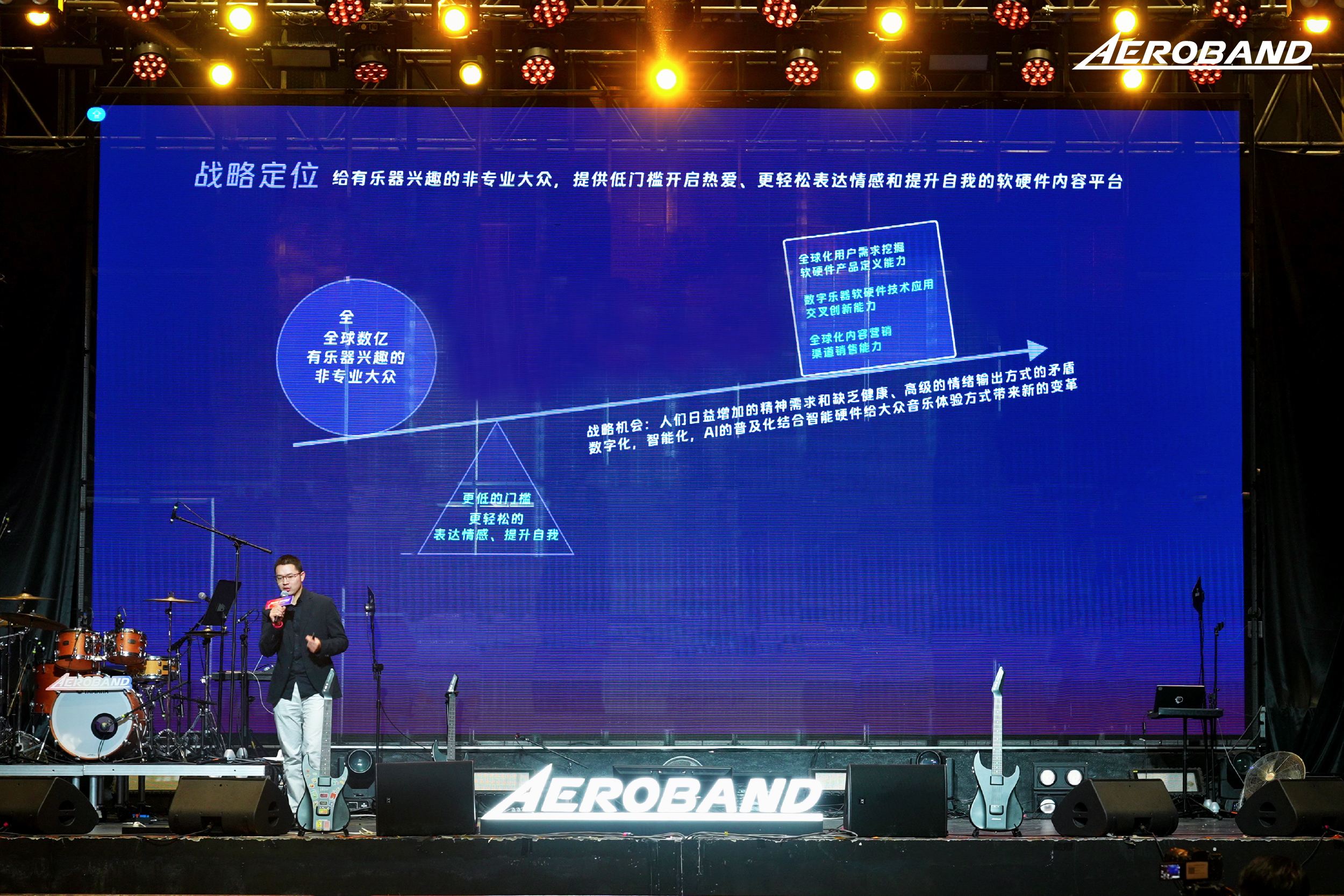
A software - hardware content platform for non - professional users interested in musical instruments (Image source/Enterprise)
"Don't get entangled in whether it is a musical instrument or a toy," Niu Yafeng emphasized. "If we only define it for 5% of professionals, we will ignore the 95% of people who want to start loving music but are blocked by the threshold. Our goal is to allow more people to easily enter the world of music. The hardware performance should be professional, but the interaction should be user - friendly."
Behind this path is the AeroBand team's thinking about the underlying logic of the musical instrument industry and the reconstruction of the interaction mode between people and music.
In Niu Yafeng's view, the ultimate form of intelligent musical instruments is not a tool but a solution for emotional value. "When users are happy, they can pick it up to play their favorite songs or create content representing their current emotions. Through hardware devices, APP algorithm services, and content communities, it truly changes the complex chain of high - cost traditional musical instruments and music school training."
Yingke learned that in 2024, the cumulative sales of all AeroBand product lines reached over 100 million yuan, and the revenue in 2025 doubled. Currently, the second - generation product of AeroBand Guitar is under development, which will incorporate AI - assisted creation to further lower the creation threshold. The product is planned to be launched in the second half of 2026.
From a campus startup to a revenue scale of hundreds of millions, evolving from a pair of gloves to a complete intelligent product matrix, a Chinese hardware company has spent nearly a decade trying to prove that in the musical instrument market dominated by traditional giants, the breakthrough point for startups does not lie in direct confrontation but in using intelligence to break through and precisely enter the incremental market of "letting more people play music".