Shrimp farmers are going crazy for domestic models, with the 41.9 trillion Token call volume surging by 34.9% and surpassing that of the United States.
Goodness! When it comes to being a connoisseur of lobsters (referring to large - model usage), China takes the lead.
The nationwide "lobster - raising" (large - model training and usage) craze has directly driven domestic large models to welcome a golden week.
According to the latest data from OpenRouter, the total weekly calls of Chinese large models soared to 41.9 trillion Tokens last week.
Following the first time China overtook the United States in February this year, Chinese large models have once again strongly topped the list and returned to the global first place.

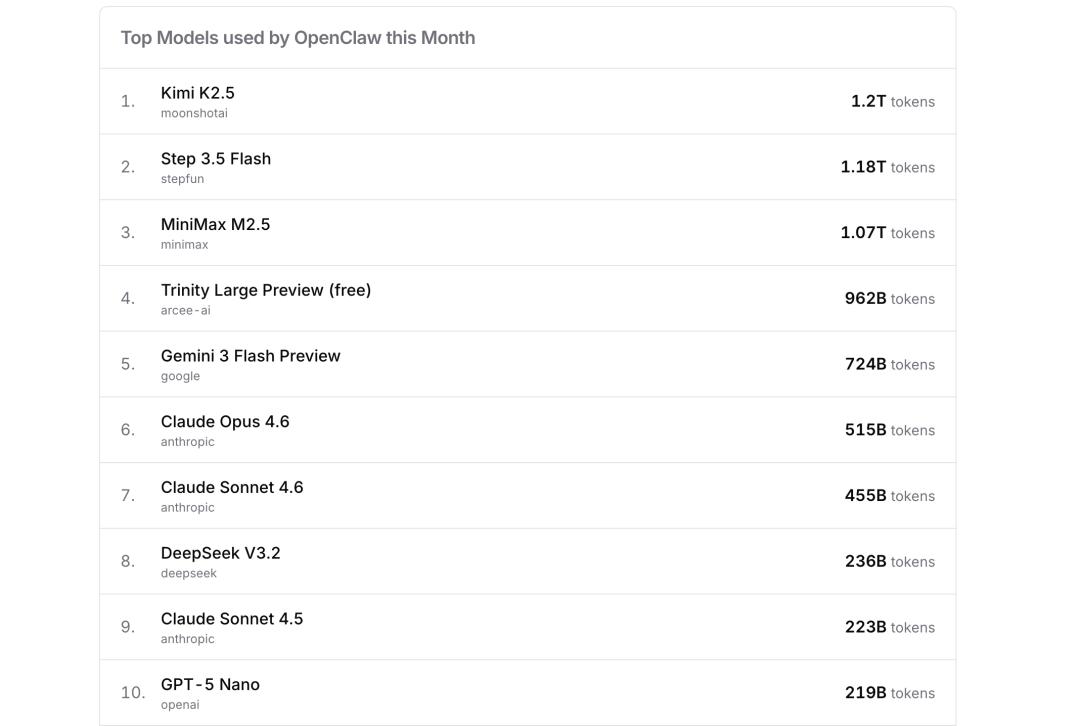
OpenClaw continues to top the list of popular applications. Among the most favored computing power partners for "lobster - raisers" this month, domestic large models still lead by a wide margin.
The top three on the list are Kimi K2.5, Step 3.5 Flash, and MiniMax M2.5, all exceeding 1T tokens.
Sure enough, when it comes to this "eating" (using large - models) thing, domestic players are really awesome! Having lobster after drinking milk tea, how wonderful! (doge)
🦞 Loving Chinese large models
Overall, from March 2nd to 8th last week, there was an obvious divergence in the activity of large models between China and the United States. The specific total call volume is as follows:
- China: 4.19T tokens (↑34.9%)
- United States: 3.63T tokens (↓8.5%)
The total weekly calls of Chinese large models increased sharply, partly due to the influence of OpenClaw. In contrast, US large models showed a short - term contraction trend, and their total volume and growth rate were overtaken by the Chinese market.

The last time a similar situation occurred was in February.
From the 9th to the 15th, the total call volume of Chinese models reached as high as 4.12 trillion Tokens, for the first time surpassing that of the United States (2.94 trillion).
During the week from the 16th to the 22nd, the popularity of domestic models continued to soar, and the figure refreshed to 5.16 trillion Tokens, with an increase of 127% within three weeks. During the same period, the US models further shrank to 2.7 trillion Tokens, and the gap between the two continued to widen.
In the last week of February, with Google's price optimization of Gemini 3 Flash and the official version update of OpenClaw, the call volume of Chinese models entered a phased callback.
Until early March, Step 3.5 Flash was officially connected to OpenClaw and topped the list, pulling the Chinese large - model camp back to the 4T echelon.
Looking specifically at the ranking, among the top 5 global large - model call volumes last week, Chinese products occupied three seats.
MiniMax M2.5 performed steadily and continued to top the global list; DeepSeek V3.2 maintained a continuous growth trend; Step 3.5 Flash became the biggest dark horse last week and successfully made it into the global top five.
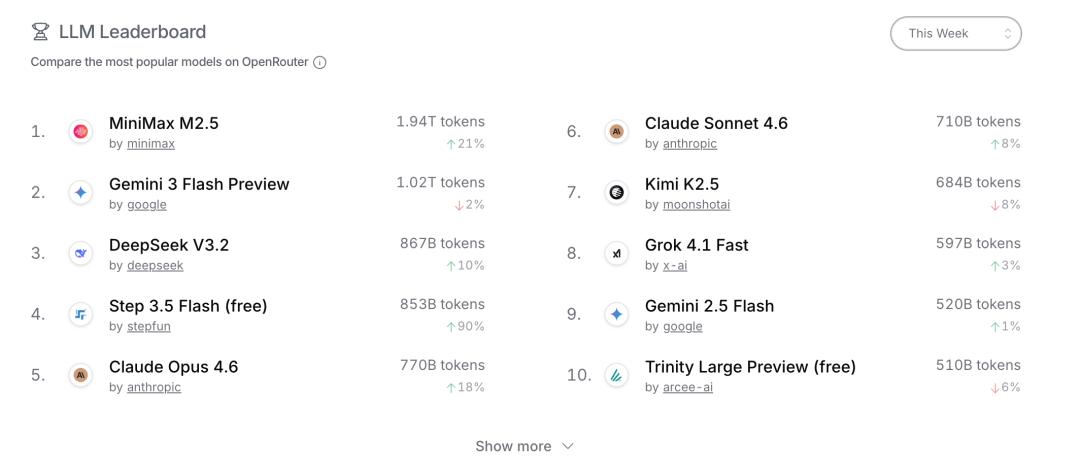
Looking at the market share in recent months, after MiniMax successively released multiple models such as MiniMax Music 2.5 and MiniMax M2.5 at the end of January, its market share achieved a leap - forward growth.
During the week from the 16th to the 22nd, it even surpassed Google at one stroke and became the global first. Last week, MiniMax continued to rank third, firmly occupying the first echelon of the global large - model market.

In terms of programming (including code generation, debugging, and development) usage, the top three last week were MiniMax M2.5, Kimi K2.5, and Claude Opus 4.6.
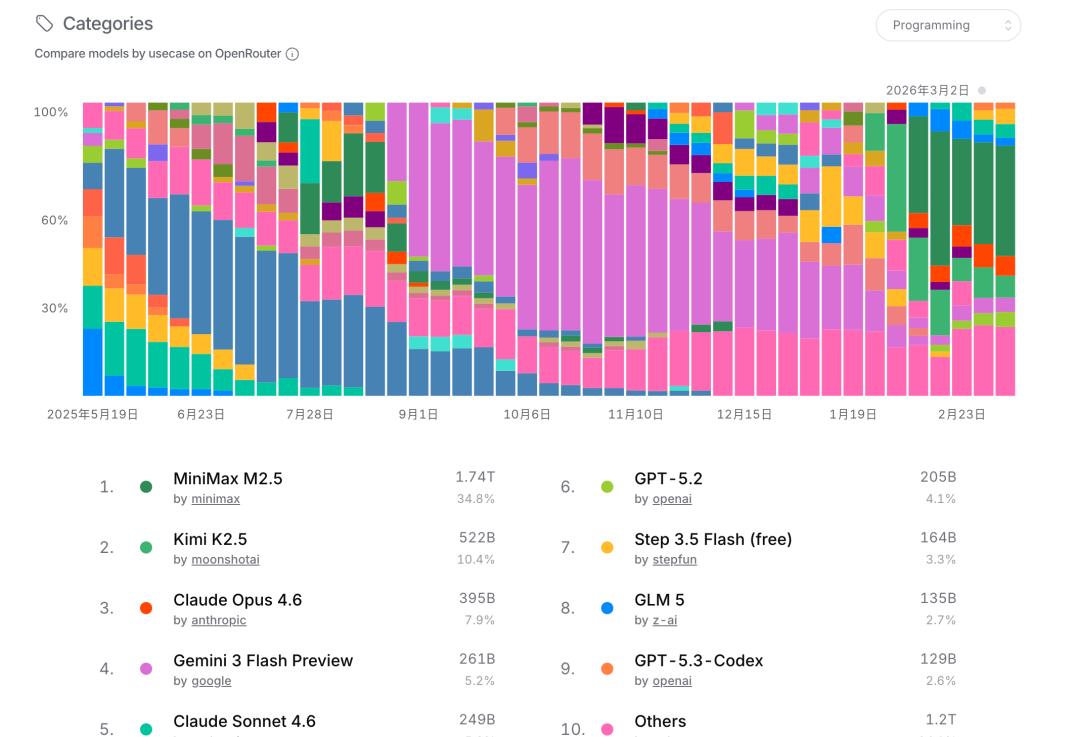
Surprisingly, Chinese large models were not only popular in the Chinese market last week but also performed outstandingly in the English context, directly sweeping the global top three.
This is sufficient to prove that the status of domestic models in the global developer ecosystem is increasing day by day.

As for the token consumption in different context lengths, there are significant differences:
In the range of 1K - 10K tokens, overseas mainstream models have the upper hand, such as GPT - oss - 120b and Gemini 2.5 Flash.
In the tasks of 10K - 100K tokens, MiniMax M2.5 and DeepSeek V3.2 have become the choices of more people.
In the longer context of 100K - 1M tokens, MiniMax M2.5 has an obvious advantage.

In other lists, such as tool usage, MiniMax still leads by a large margin.

In image generation, Gemini 2.5 Flash Lite is more favored, and the domestic large model on the list is Qwen 3 VL 235B, a flagship - level multi - modal large model.

As for the popular application ranking, OpenClaw undoubtedly sits firmly at the global top. Since January, it has gobbled up 9.16T tokens globally, becoming a well - deserved computing power "black hole".

The most used model in OpenClaw this month is still Kimi K2.5. Followed closely are Step 3.5 Flash and MiniMax M2.5.
All three domestic large models exceeded 1T tokens, presenting a tripartite confrontation pattern.
Last month's third - ranked Gemini 3 Flash Preview dropped to the fifth place in the monthly ranking.
Chinese large models are also great
But to say which model is more suitable for OpenClaw, we still need to comprehensively consider the PinchBench list recently recommended by the "father of OpenClaw".
This list is specially designed for OpenClaw, evaluating the adaptability of global large models to OpenClaw from multiple dimensions such as success rate, speed, and price.
First, in terms of success rate, claude - opus - 4.6 currently ranks first. The domestic large models at the top of the list are Kimi K2.5, MiniMax M2.1, and Qwen3 - Coder - Next, all with scores exceeding 79%.

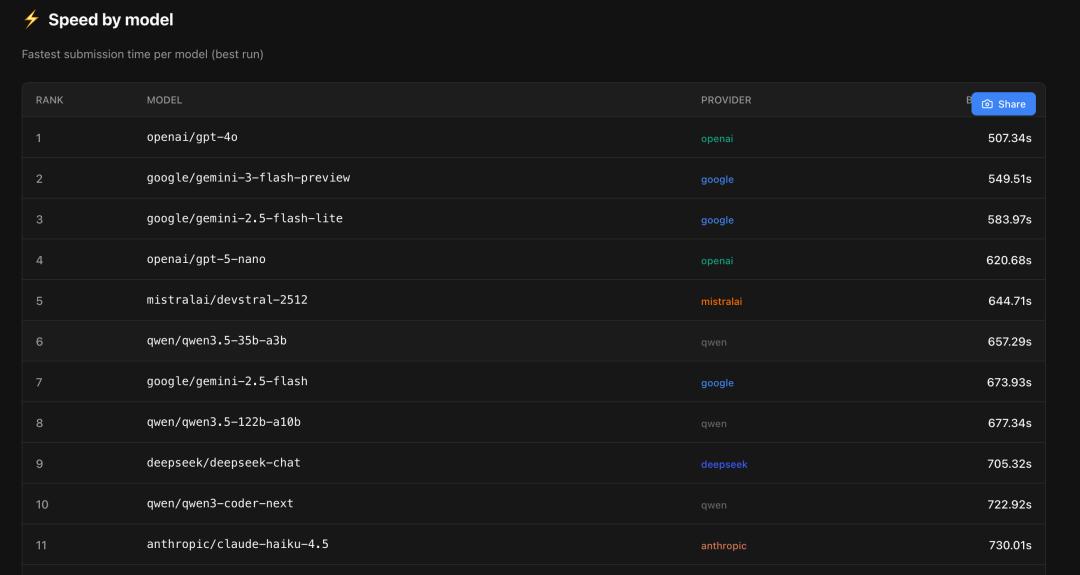
In terms of speed, domestic large models still need to be improved. Except for Qwen, the rankings of other models are relatively low.
As of now, Kimi K2.5 ranks 20th on the list, MiniMax M2.1 ranks 23rd, and MiniMax M2.5 ranks 26th.
In terms of price, in addition to Google and OpenAI, Qwen, DeepSeek, and Zhipu are also on the list, with cost - effectiveness advantages.

Based on the two lists, domestic large models are currently very popular among global "OpenClaw users", presenting a situation where MiniMax, DeepSeek, and other models are all flourishing.
They have achieved partial leadership in call volume and practical applications, but there is still room for improvement in extreme response speed and price.
So, what "OpenClaw model" are you using?

Reference links:
[1]https://openrouter.ai/rankings
[2]https://m.ithome.com/html/927345.htm
[3]https://x.com/jasonthomasmba/status/2030670237259944189
[4]https://mp.weixin.qq.com/s/Gwd733hGD4ikpZ4LyZA9Gg
[5]https://mp.weixin.qq.com/s/9QTE6YYEkM0vOHz1E9cB5Q[6]https://pinchbench.com/?view=speed
This article is from the WeChat official account "Quantum Bit". The author focuses on cutting - edge technology. 36Kr has published it with authorization.