Zeroone Auto Secures Another $1.2 Billion in Funding, Aims to Be the "Tesla" in the Heavy Truck Sector | Exclusive from 36Kr
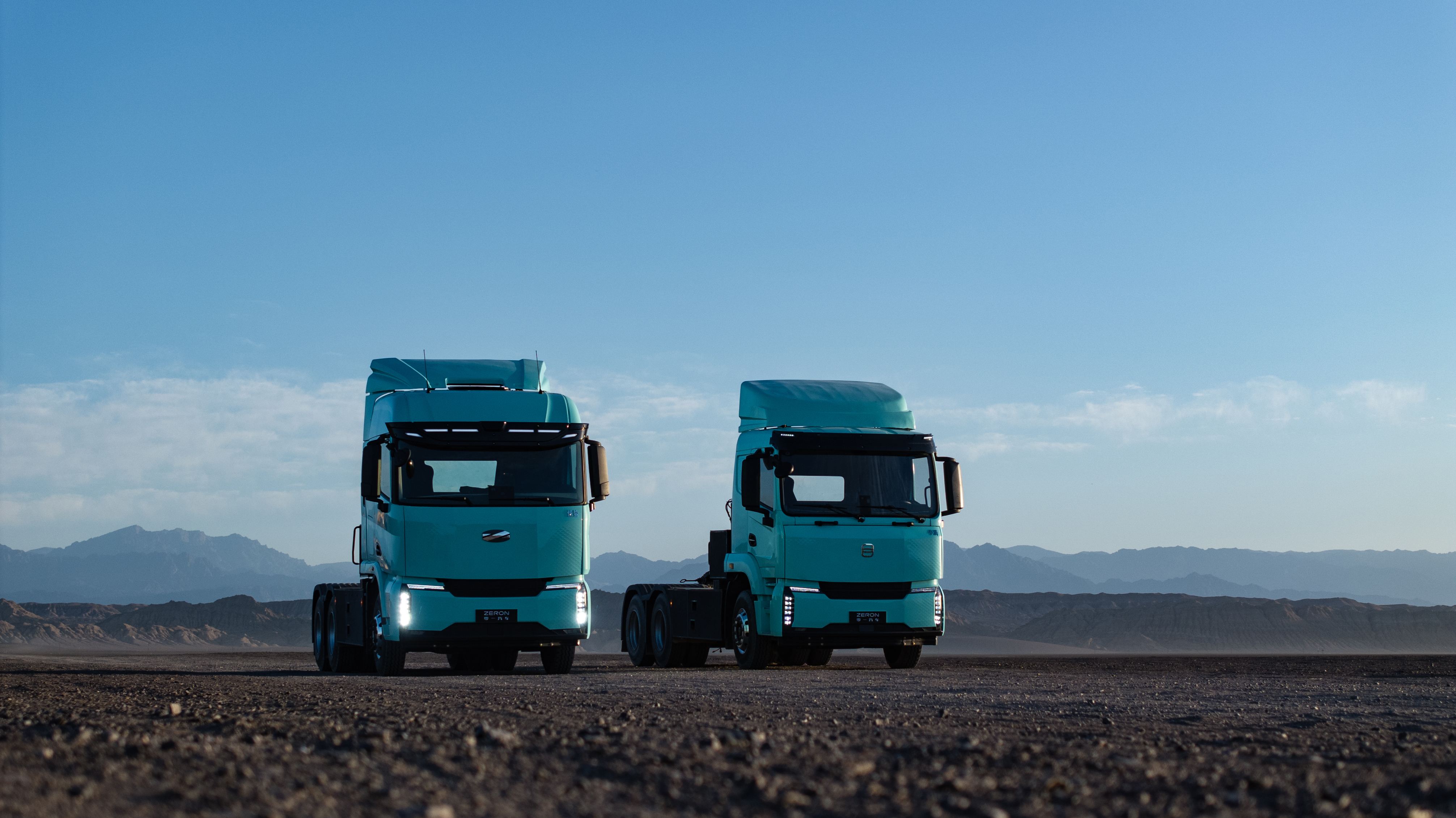
Lingyi Automobile
Text | Xiao Man
Editor | Li Qin
36Kr learned that Lingyi Automobile, a new energy intelligent heavy truck company, has completed a new round of financing of 1.2 billion yuan. This round of financing was jointly led by Puquan Capital (the only industrial investment platform under CATL), Momenta, and NIO Capital, with Anhui Lingtong Group, Fangguang Investment, Yifeng Capital under Temasek, Joy Capital, Shenneng Chengyi, and Blue Lake Capital participating in the investment, and the old shareholder Huoshui Capital continuing to follow up.
This is the second round of financing completed by Lingyi Automobile within the past six months. In mid-2025, the company just completed a Series A financing of 500 million yuan, and the cumulative amount of financing in two consecutive rounds exceeded 1.7 billion yuan.
Founded in 2022, Lingyi Automobile is a startup company that simultaneously focuses on new energy heavy truck vehicles and autonomous driving technology. The company was co-founded by Huang Zehua, the former co-founder of TuSimple, Zhang Hongsong, the former general manager of Sinotruk and vice president of Foton Daimler, and Zhang Wei, the former executive director of CNHTC and executive vice president of Foton Daimler. Currently, the team has nearly 300 people.
Before starting his business, Huang Zehua worked in the North American team of TuSimple. From engaging in technology to personally starting a business, Huang Zehua's greatest experience is that to develop autonomous driving heavy trucks, one must first root in the industry and start from reconstructing a complete vehicle product.
Since its establishment, Lingyi Automobile has launched two new energy heavy truck products, "Jingzhe" and "Xiaoman". As of the end of 2025, the company's cumulative sales volume was nearly 1,600 units. In the second half of 2025, the sales volume increased by nearly 300% compared with the previous period, making it one of the fastest-growing companies in the new energy heavy truck track.
"To build an intelligent heavy truck, one must start with the heavy truck first."
When Huang Zehua returned to China to start his business, the first practical problem he faced was the positioning of the company.
In the extremely vertical and closed field of heavy trucks, companies that simply sell algorithms lack the support of truck hardware. Vehicle manufacturers have their own plans, and component suppliers have their own rhythms. It is very difficult for a startup company with only algorithms to require the other party to modify the vehicle architecture to match its sensor layout.
Huang Zehua realized at that time that there was a lack of a company that focused on product development and technology in the heavy truck industry. On the first day of Lingyi Automobile's establishment, Huang Zehua had already made up his mind: without mastering the vehicle platform, the so-called intelligence could only be an "add-on".
In order to achieve this in-depth collaboration, Lingyi Automobile started the forward design from the vehicle architecture level. It conducted self-developed research and development in all dimensions, from battery chassis integration, electric drive axle architecture to thermal management systems. This approach of integrating software and hardware is essentially to lay a solid foundation for autonomous driving at the hardware level. Without this foundation, no matter how good the algorithm is, it is like building a building on a sandpile.
This is a path that extremely tests the patience of the organization. In the traditional and heavyweight heavy truck industry, establishing a complete vehicle business system is as difficult as reinventing the wheel.
Traditional heavy truck companies are more like integrators of the supply chain. To a large extent, the role of vehicle manufacturers is to undertake the final assembly. Huang Zehua compared this model to the computer city in the early days: it is not difficult to assemble a working machine, but it is completely different in terms of difficulty to create a product like a MacBook that is highly integrated from the underlying logic to the ultimate experience.
This "assembly model" could still be maintained in the fuel era, but in the era of new energy and intelligence, it has strong limitations. The "fuel-to-electric" path of traditional automakers often simply replaces the engine with a battery pack, still limited by the inherent architecture of the traditional fuel platform, making it difficult to be compatible with the new generation of technologies, and having inherent shortcomings in space, safety, and energy efficiency.
Lingyi Automobile attempts to break this integrator logic. Through forward development, it precisely calculates every joule of energy and every kilogram of weight of the truck. For example, Lingyi pioneered the battery chassis integration architecture, with the battery directly integrated into the chassis; independently developed an intelligent control system to achieve vehicle-level intelligent torque control, energy management, and thermal management; equipped with the industry's first mass-produced four-in-one integrated electric drive axle, integrating the motor, gearbox, axle, and power take-off, significantly improving the transmission efficiency; the vehicle uses a T700 high-strength steel integrated frame and a 710L high-strength steel frame, with the strength increased by 25%-100% and the weight reduced by 20%-30%. In addition, the vehicle pre-installs sensors and wire-controlled redundancy for L4 intelligent driving, enabling hardware plug-and-play and software upgrades.
Last year, Lingyi Automobile delivered approximately 1,200 vehicles throughout the year, crossing a key node. According to Huang Zehua, Lingyi Automobile's sales target for the whole year of 2026 is 5,000 units, and it will achieve break-even at that time.
"To become the Tesla in the heavy truck field."
Huang Zehua believes that for automakers, it is crucial to master the design and R & D capabilities of core component systems, which is also the concept of "VERTICAL integration" proposed by Tesla. In Lingyi Automobile's strategic vision, building cars is just the first step. Its value lies in:
Firstly, by providing a reliable hardware foundation, it solves the problem of high failure rates of heavy trucks, thereby improving the user experience, promoting the implementation of intelligent driving, and achieving better matching of software and hardware;
Secondly, it can continuously accumulate a large amount of real operation data, feeding back to the running-in and iteration of the unmanned driving model, forming a data flywheel effect;
Thirdly, as an important commercial fulcrum for the enterprise, while bringing abundant funds, resources, and talents to support the R & D of intelligent driving, it also enhances the enterprise value and profitability, achieving experience optimization and scale expansion.
Huang Zehua predicts that around 2030, autonomous driving will truly enter the unmanned era.
Currently, the road transportation market in China is extremely fragmented, with millions of small fleets forming the capillary vessels of the industry. Since human management has its limits, when the scale exceeds 10 vehicles, the management cost will increase exponentially. However, when vehicles become a kind of "unmanned asset", they can break through the bottlenecks of management, safety, and efficiency, enabling transportation enterprises to obtain economies of scale, reduce capital costs and operation and maintenance costs, form a transportation capacity pool, and better adjust supply and demand. The economies of scale brought about by this integration will completely reshape the logistics efficiency in China and even the world.
The foundation of unmanned heavy trucks is data accumulation and vehicle model iteration, and the barriers in this track are extremely high, with players highly concentrated.
Lingyi is the earliest and most determined enterprise in the heavy truck field to layout the end-to-end route. Currently, each new energy intelligent heavy truck sold is continuously accumulating real operation data in commercial operation, which has the potential to provide scenario-based and large-scale actual combat data support for intelligent driving and unmanned driving businesses.
For Lingyi Automobile, starting from new energy heavy trucks, accumulating autonomous driving capabilities, and finally building an unmanned transportation network is a path with high certainty but also full of thorns.
But what Huang Zehua values is the current dual wave of intelligence and electrification in this track. "This disruptive change can give rise to a world-class enterprise in the truck industry," he said.
In Huang Zehua's vision, Lingyi's goal is to become the Tesla in the heavy truck field.
Since the early stage of starting his business, Huang Zehua has been thinking about two questions: "Why do we need a company like Lingyi?" and "What value does this company bring to the industry?" In this process, Huang Zehua believes that whether in intelligent driving or new energy, the current truck industry lacks a benchmark or a "catfish" like Tesla, and this is exactly what Lingyi wants to do.
"From the perspective of the endgame of autonomous driving heavy trucks, the four elements of vehicles, brains, data, and business forms are indispensable. Looking at the current intelligent heavy truck track, enterprises that simultaneously possess these four elements are very scarce. To become the best company in this industry, Lingyi needs to steadfastly do difficult but correct things," Huang Zehua said.