The release of AI's first global scientist community has gone viral. The Silicon Valley investment circle says: "The 'Google Maps' of the scientific research field is here."
The investment circle in Silicon Valley is in an uproar! The "Google Maps" of the scientific research field has arrived! Almost overnight, tech investors and scientists on overseas social platforms have been talking about it!
This is like the moment of Google Maps in the field of scientific research. This comment from Silicon Valley tech investor David Keel has directly pushed it to the center of the discussion.
Some people bluntly say, "The concept of mapping the research genes (DNA) of papers is simply too shocking and hardcore!"

"When you can overlook the entire panorama of the field, the way you think about problems will be completely reshaped."

Some people also believe that this panoramic view is the "God's perspective" that most founders don't even realize they are lacking.

A group of KOLs who have been active at the forefront of technology have also joined in, and their feedback is highly consistent.
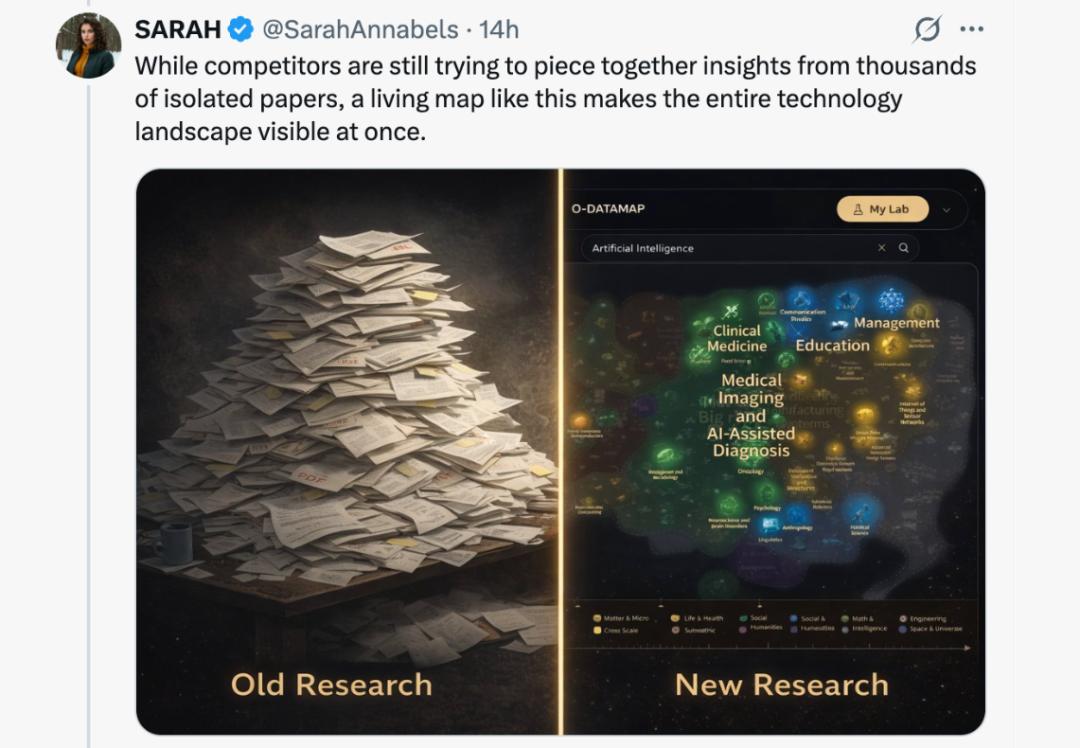
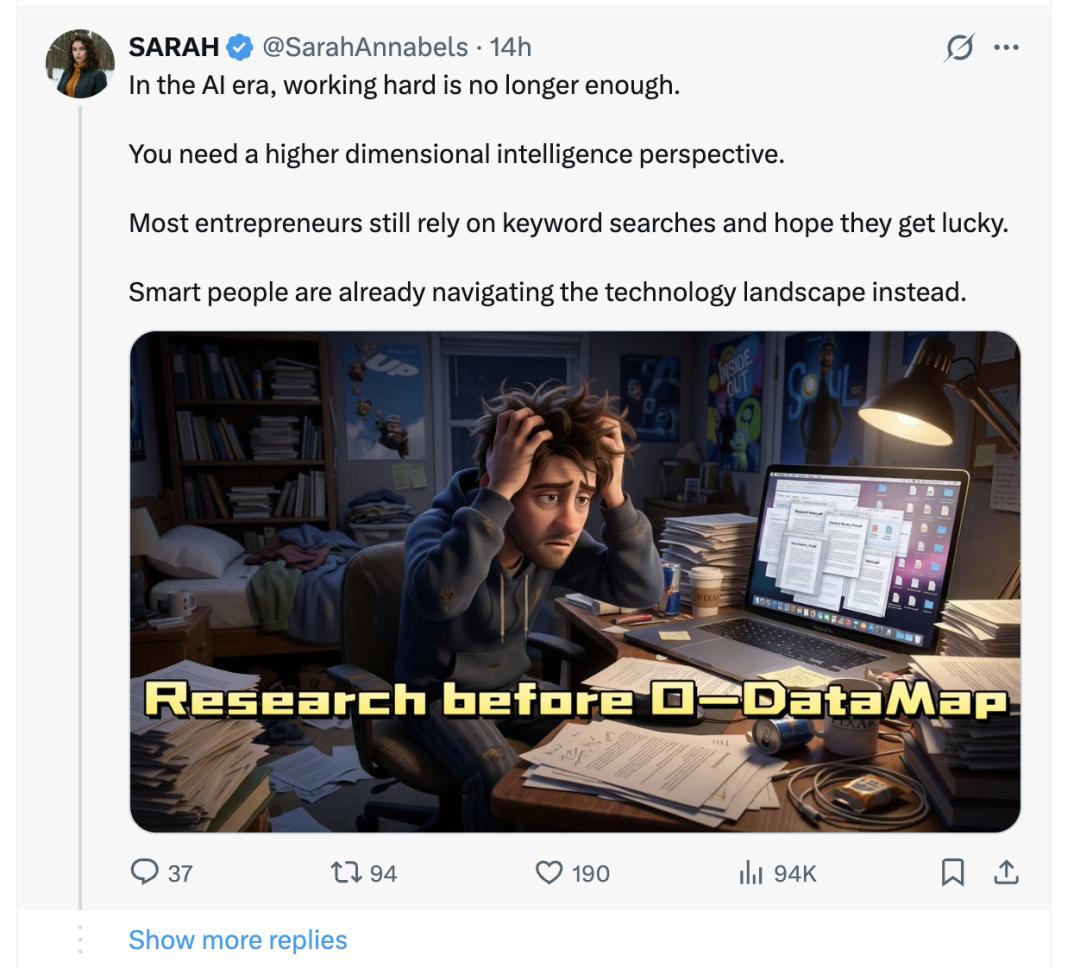
What exactly is this "it" that has set the entire tech circle abuzz?
Answer: O-DataMap, a global community for scientists.
Different from traditional communities with a "library + forum" model, O-DataMap digs out the experimental data scattered in global papers one by one and rearranges them in the same two-dimensional coordinate system.
Then, an unprecedentedly cool picture appears -
The entire human scientific research has been laid out for the first time as a navigable "map".
Website: https://o-datamap.oall.com/
Has anyone done a particular experimental idea? If so, to what level has it been done and what kind of journals can it be published in? What steps are still needed to aim for better journals?
O-DataMap can show you clearly.
Who made it? The answer is even more explosive -
An AI named OALL, with the official Chinese name Lunlun Global.
Get a Bird's-eye View
Click on O-DataMap, and a map immediately comes into view.
Against the dark background, points of different colors and densities gather like star clusters, forming seven "knowledge continents".
The entire human scientific research has been spread out as a "tech map".
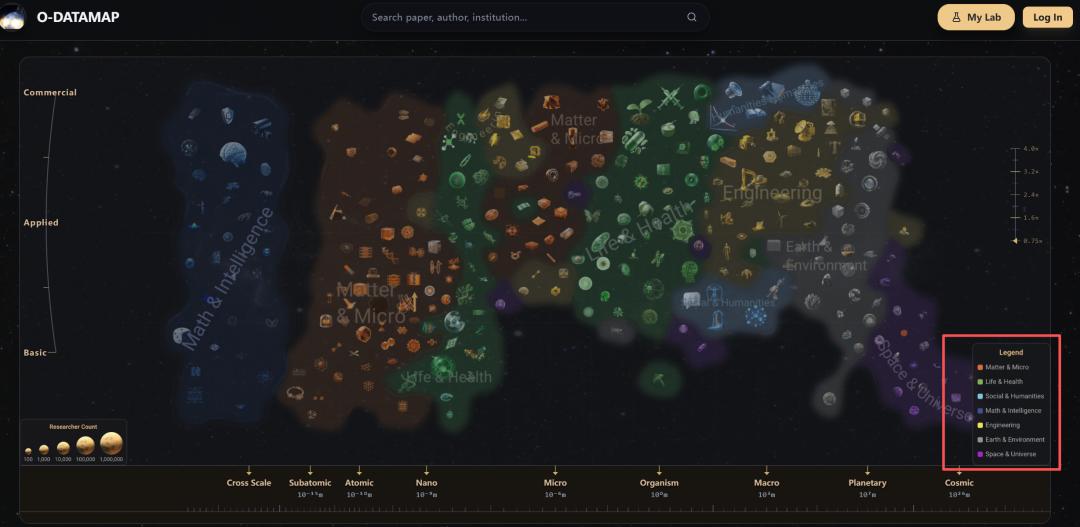
The seven "knowledge continents" range from matter and the microcosm, life and health, to mathematics and intelligence, engineering technology, then to the Earth's environment, the universe, and society and humanities.
Zoom in with the mouse, and you'll see more details.
There are many icons scattered on each "continent". For example, AI, fintech, computer vision, embodied intelligence... are like small islands distributed on the "Math & Intelligence" continent.
The "islands" vary in area and distance from each other.
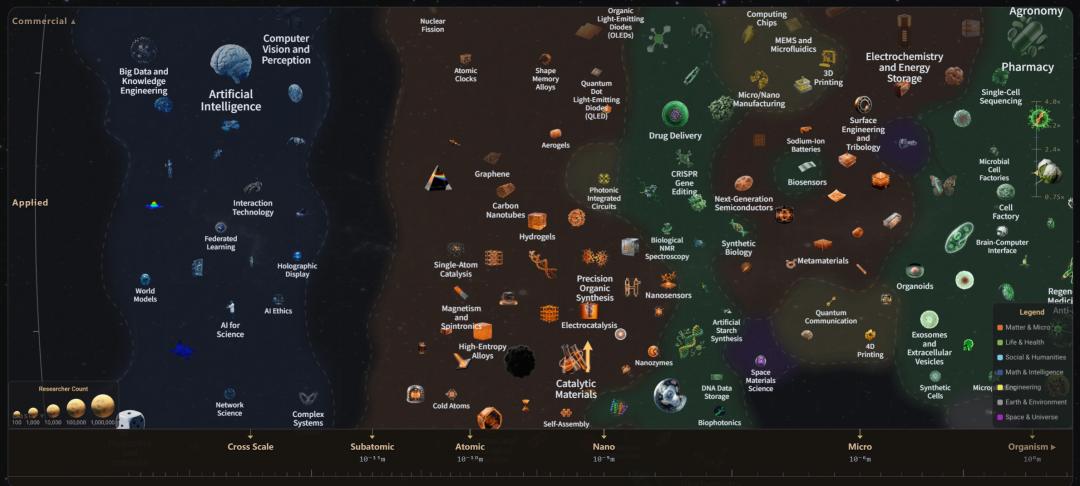
Each "island" actually corresponds to a group of experimental data -
The experimental data that were originally scattered in global paper databases are disassembled by the AI into individual data and then aggregated into data communities.
Their positions are based on a two-dimensional coordinate system.
The horizontal axis represents the scale of human research objects. From left to right, it is subatomic, atomic, nanometer, all the way to biology, the Earth, and the universe. Fields such as pure mathematics and AI, which provide methods and tools for problems at different scales, are placed in the "Cross Scale" area on the far left.
The vertical axis represents another dimension - from bottom to top, it is basic research, applied research, and commercialization, measuring the distance of knowledge monetization.
More importantly, O-DataMap is not a static map.
There is a real-time scrolling window in the lower right corner of the homepage, "live broadcasting" the processing progress of the AI pipeline. Whenever new experimental data from papers are parsed, they will immediately appear in the data stream on the right and refresh one by one.
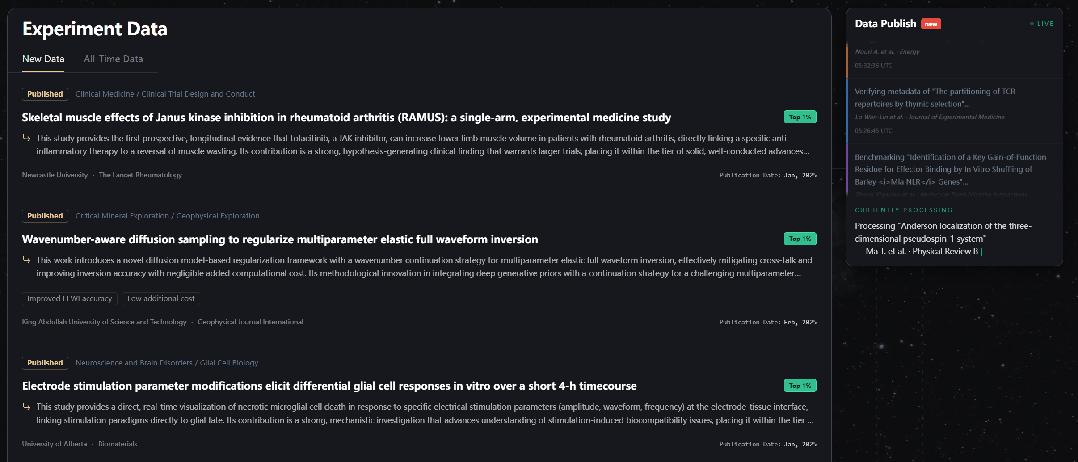
That is to say, this map actually grows. As more and more experimental data are continuously mapped in by the AI, O-DataMap is also constantly growing.
Seeing this, many people's most concerned question comes -
How exactly do you use O-DataMap?
The First Level of Efficiency: See the Big Picture
To make scientific research decisions more efficient, O-DataMap divides its capabilities into three levels. The first level, the most macroscopic and most like "opening the eyes of heaven" - seeing the big picture.
Whether a technological direction is hot or cold, mature or emerging, and how far it is from application transformation; even the position of a classic scholar or a representative paper in the entire scientific landscape -
These things that could only be judged by experience and intuition in the past are now made intuitive by O-DataMap for the first time.
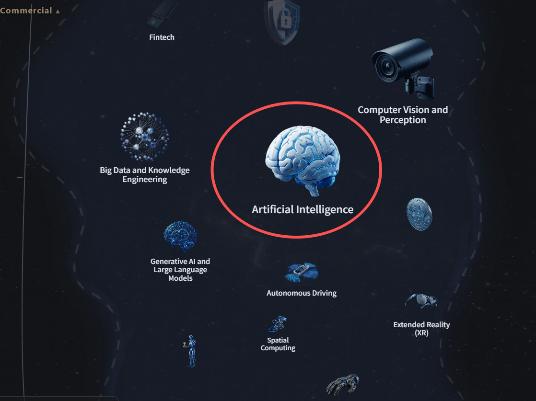
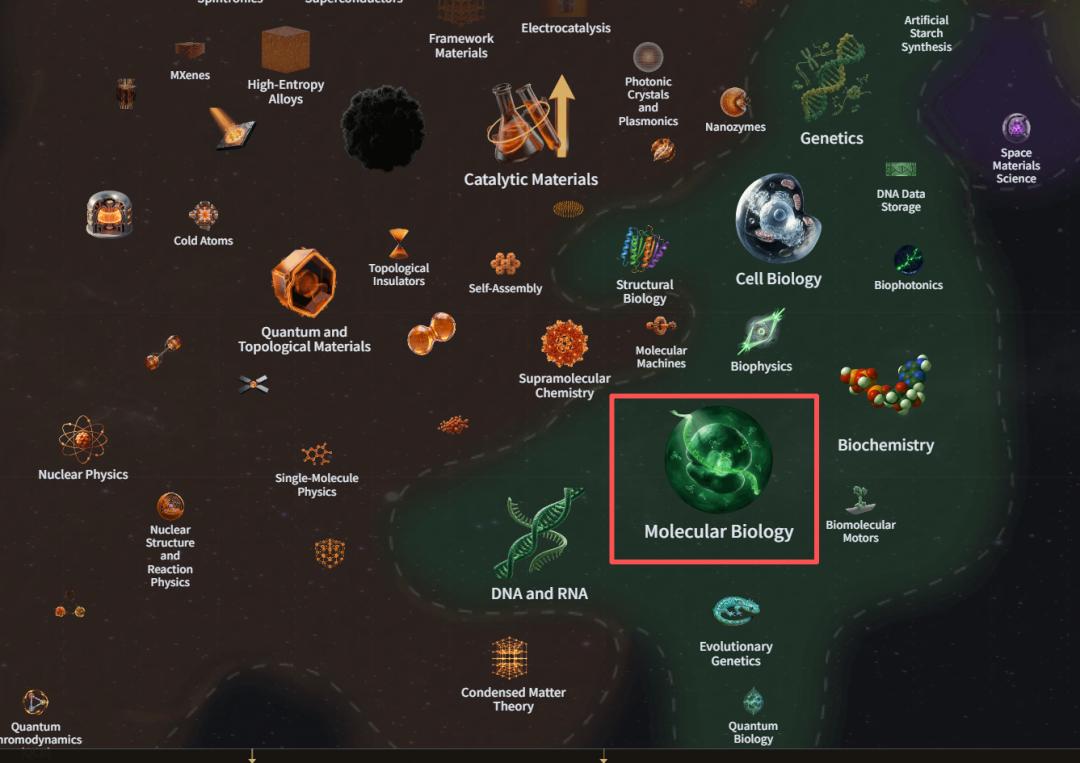
The most direct indicator is the size of the icon. The larger the icon, the more researchers are gathered in this direction; in other words, it corresponds to the "population density" of a field.
For example, Artificial Intelligence and Molecular Biology have very large central icons. This means that they have become the "super metropolises" in the scientific world.
The most talents, funds, and research infrastructure are gathered here. But on the other hand, it is also obvious: the more bustling the place, the more crowded it is. The competition is the most intense, and the threshold for breakthrough is also the highest.
Move your sight away from these "mega-cities", and the picture will soon be different.
For example, Embodied Intelligence, which has been heating up rapidly in recent years, and the more cutting-edge World Model, have significantly smaller corresponding icons. This shows that the scale of relevant researchers has not really expanded.
They are more like the "new urban areas" in the scientific research landscape. There aren't many people, the structure is still developing, the risks are higher, but the space is also larger.
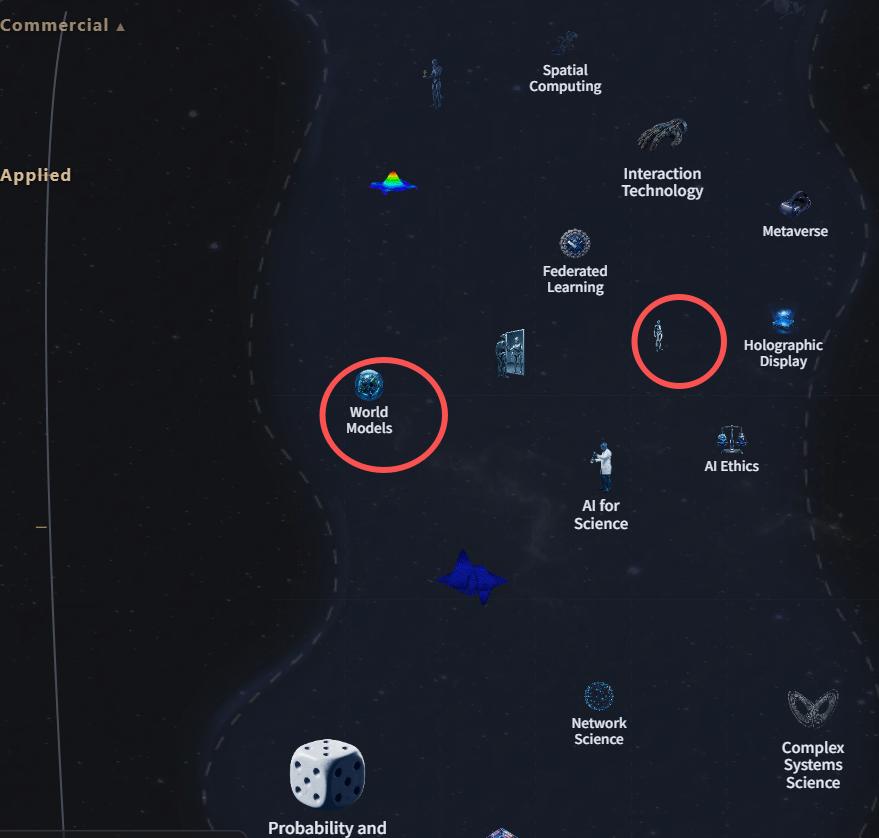
Moreover, click on these icons, and you can continue to drill down. You will see the most core technical directions within a field and their specific positions on the entire map.
For example, several key directions under embodied intelligence are generally closer to the applied research area, which shows that it is no longer a purely conceptual topic but a technological route that is being rapidly engineered.
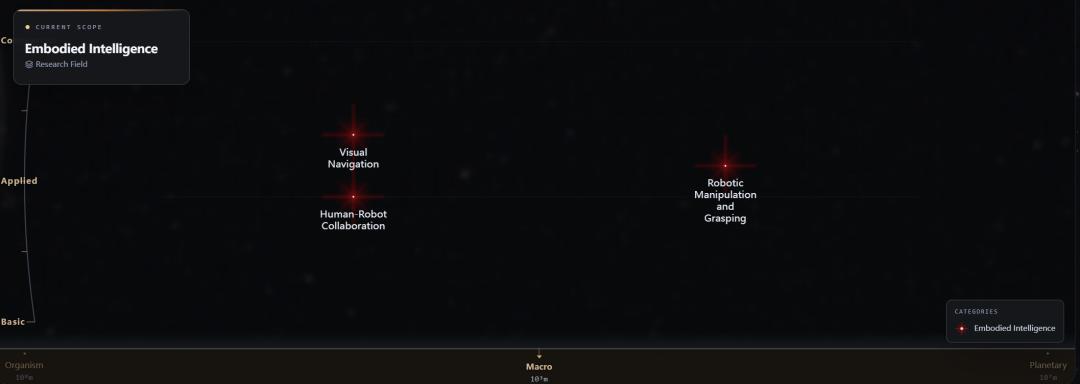
The three technical directions of embodied intelligence are all close to applied research and are a technological direction that is being rapidly engineered.
In addition to the size, another signal worth looking at is the density.
When there are a large number of small icons densely packed in a certain area, it usually means that this field has been divided into many sub - directions. For example, in life sciences, there will be densely distributed sub - directions such as genes, proteins, and cell regulation. Such fields are usually very mature.
The advantage is that it is easier for new entrants to find specific problems to start with; but the cost is also obvious: truly original major breakthroughs will often become more and more difficult.
On the contrary, some areas are significantly sparser. For example, Space & Universe looks more like a "no - man's land" on the map.
This often means that on one hand, there is a greater potential for breakthrough, and on the other hand, there is higher uncertainty, scarcer resources, or a higher technical threshold.
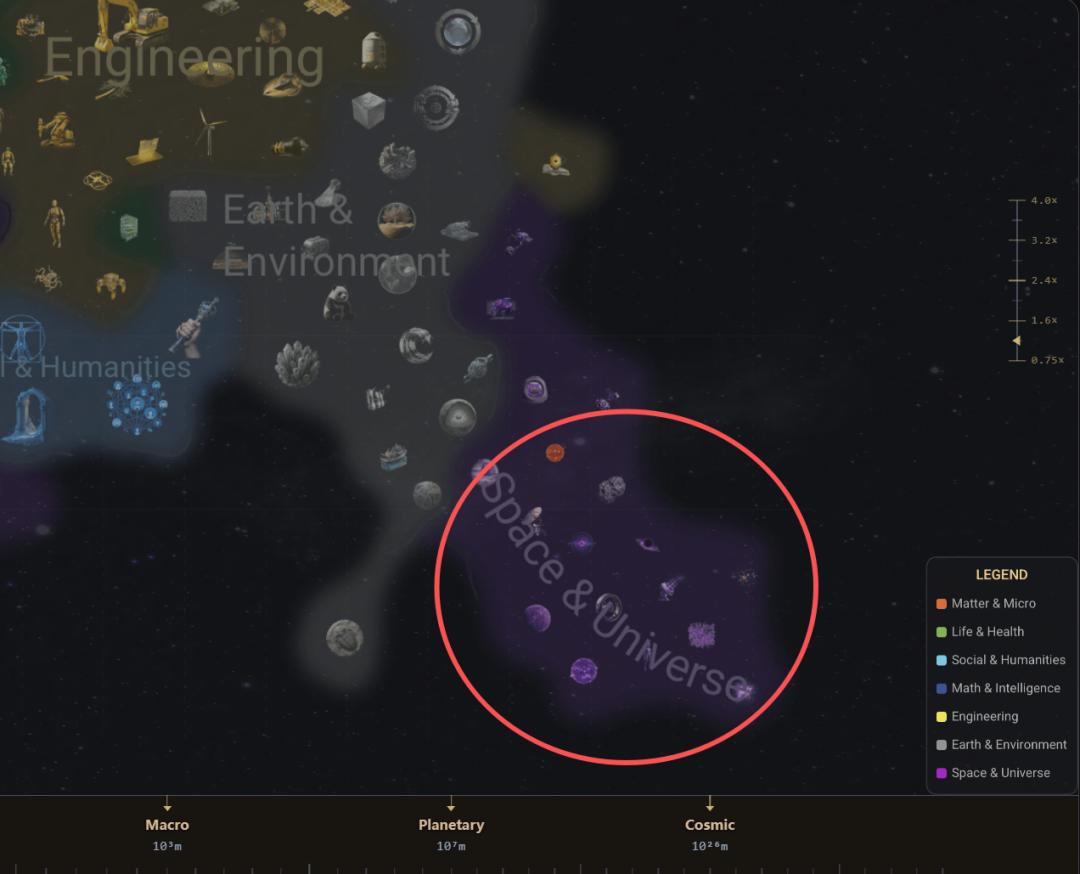
But the "God's perspective" of O-DataMap doesn't stop there.
It also specifically introduces a vertical axis, pulling knowledge from basic theory all the way to applied research and then to commercialization. In essence, it is answering a question that many researchers, investors, and strategic departments are concerned about:
How far is a direction from becoming real productive forces?
For example, if you want to invest in World Model, you must realize that it is still in the stage of basic research and there is still a long way to go before large - scale commercialization.
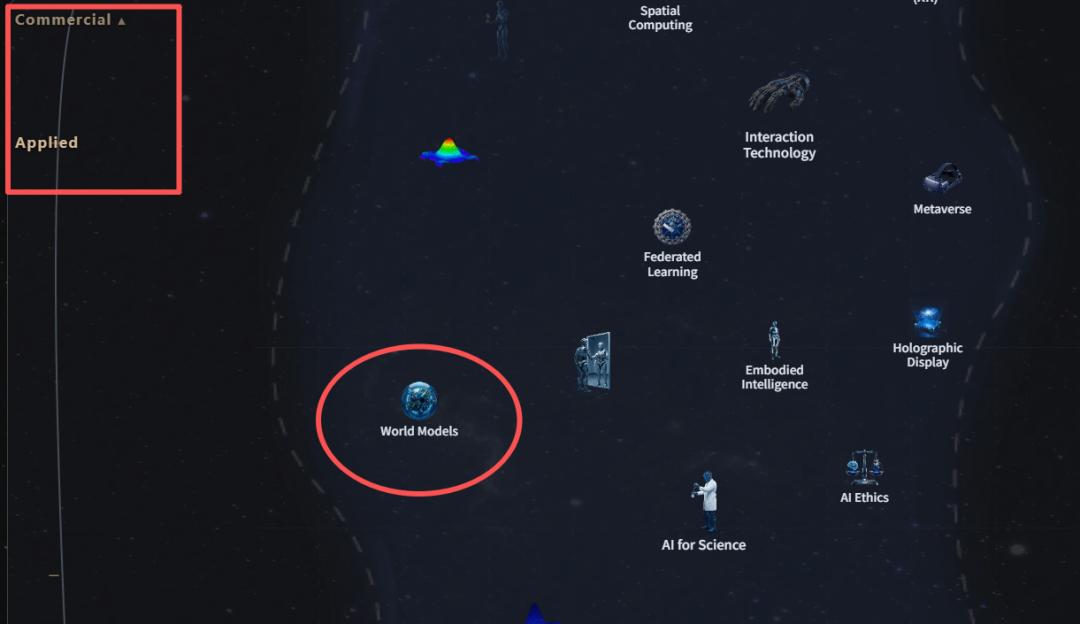
For traditional basic sciences such as Matter & Micro, the bottom - level research is extremely crowded, but there is a gap in the upward application transformation. This "top - light and bottom - heavy" situation may indicate that the future breakthrough point will probably lie in how to achieve the "th