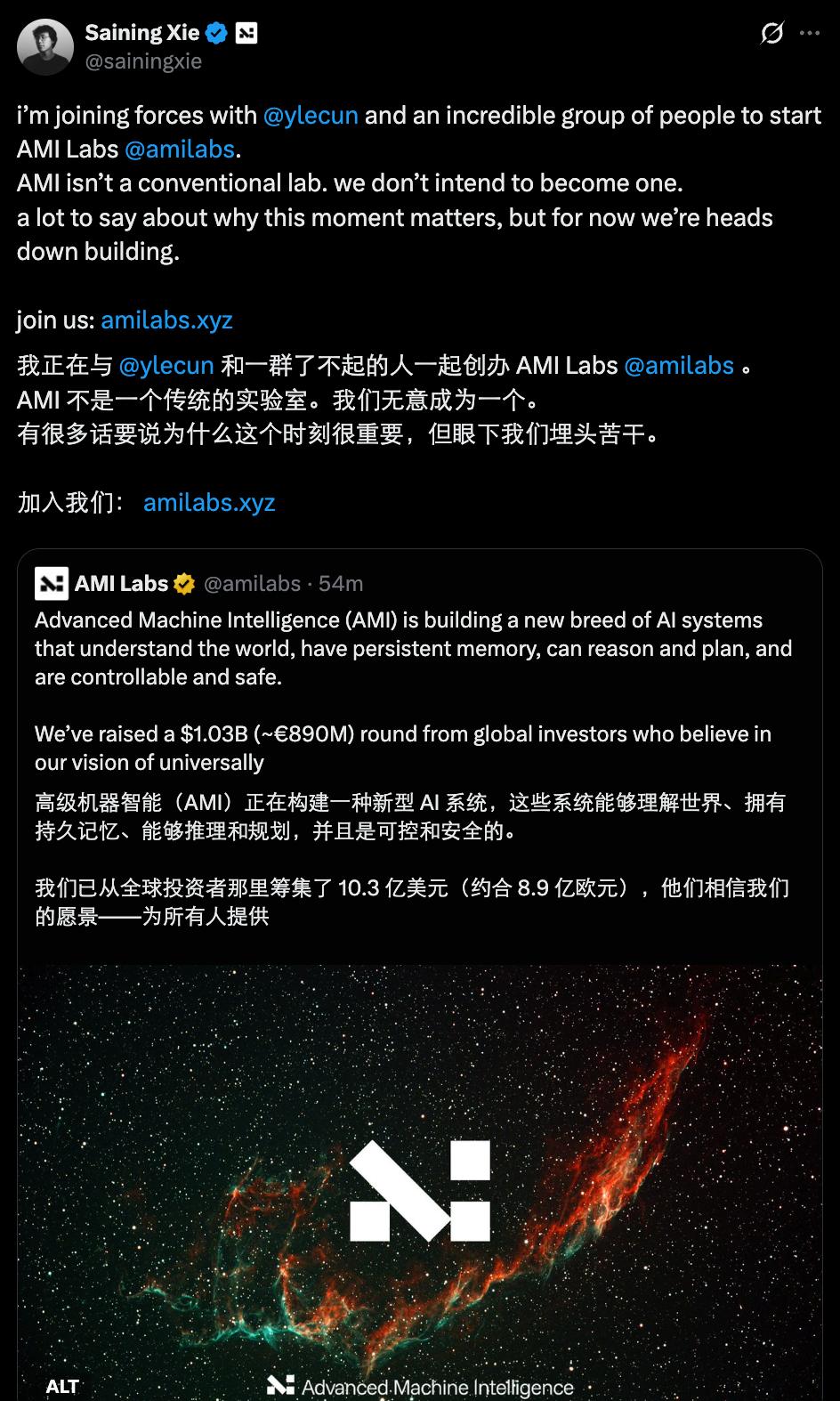
The seed round raised $1.03 billion. Xie Saining joined. Yann LeCun's world model company is really attractive to capital.
Just now, AMI Labs, a startup founded by Turing Award winner Yann LeCun, officially announced its launch.
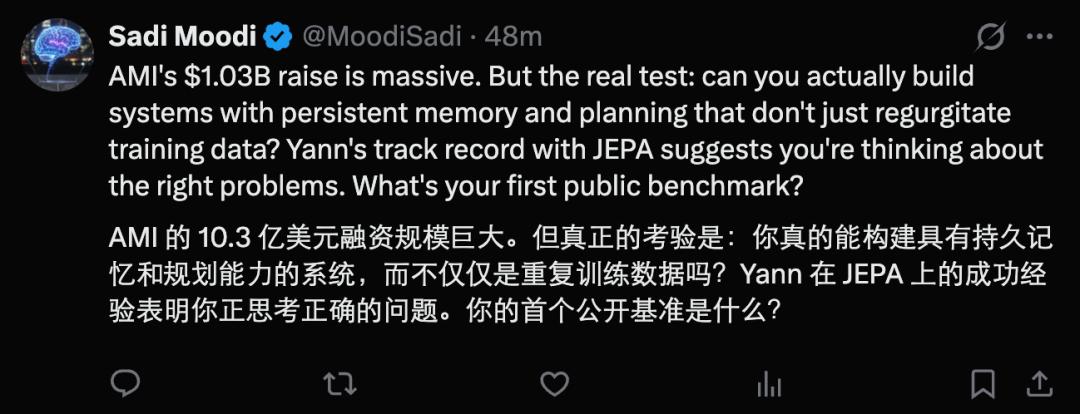
This Advanced Machine Intelligence (AMI) laboratory, led by LeCun, has just announced two important pieces of news: First, it has completed a $1.03 billion seed - round financing, with a valuation of $3.5 billion; Second, it has welcomed a high - profile scholar, Saining Xie, to join.
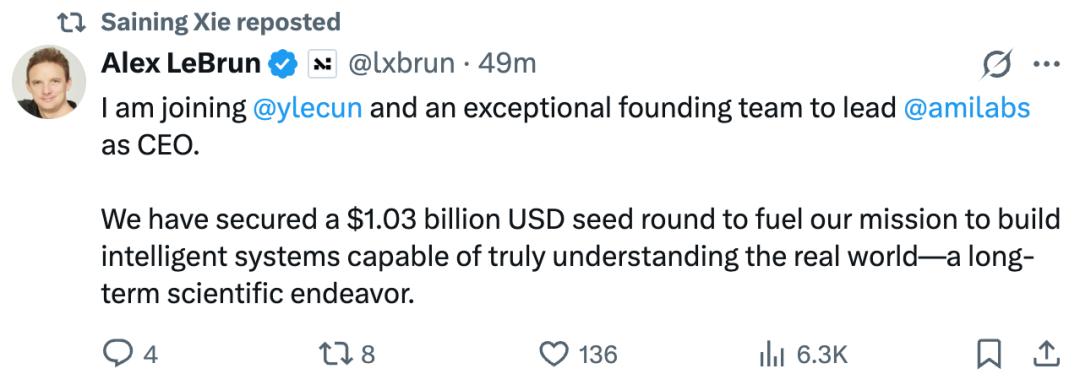
Meanwhile, Alex LeBrun, the former engineering director of FAIR, has announced his appointment as the CEO of AMI. He said that AMI hopes to build an intelligent system that can truly understand the real world - this is a long - term scientific undertaking.
First, Fei - Fei Li's World Labs raised $1 billion, and now Yann LeCun's AMI has secured $1.03 billion. In 2026, the AI circle is officially facing the "ultimate showdown" of world models.
What kind of company is AMI Labs?
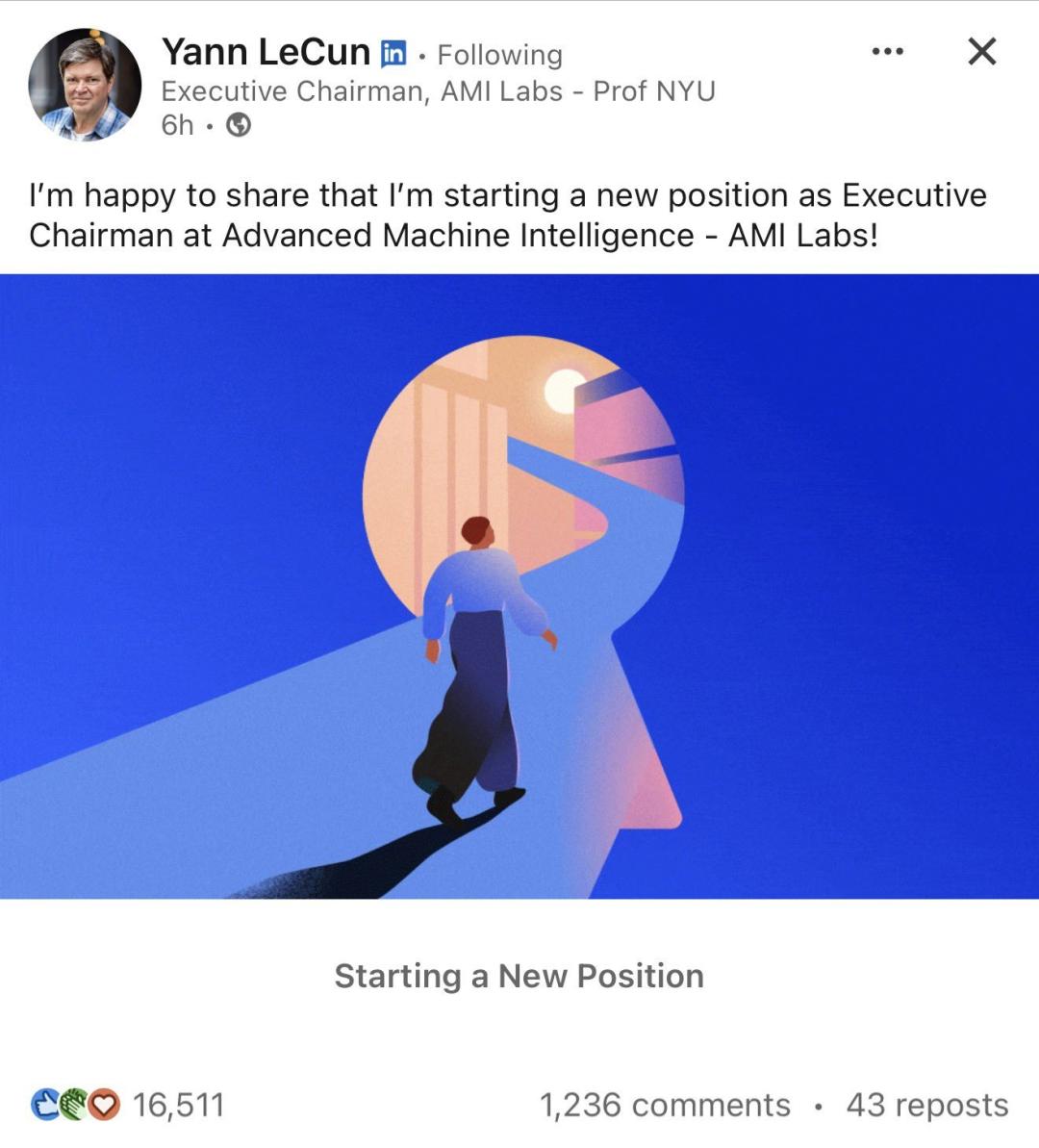
AMI Labs is a newly established cutting - edge AI research laboratory. It was officially revealed in December 2025 and officially launched in Paris in January 2026. Yann LeCun, a Turing Award winner who just left Meta, serves as the executive chairman.
Their goal is straightforward: to create an artificial intelligence that truly understands the real world.
Their judgment is that current AI largely starts from language, but true intelligence should actually start from the "world".
The data in the real world comes from cameras and various sensors. These data are continuous, high - dimensional, and full of noise. Generative models trained by predicting the next word have been very successful in language, but when faced with real - world data, many details are unpredictable, and this method will seem strenuous.
AMI Labs wants to take a different route. They are developing a system called the world model, which allows the model to first learn to compress real - world data into a more abstract representation, actively ignoring those random and unpredictable details, and then make predictions in this "representation space".
On this basis, if "action" is also used as an input condition, the model can simulate in advance what will happen after making a certain action, thereby planning a whole series of action steps, and at the same time adding safety and controllability constraints to the system.
They hope to use this method to develop applications with high requirements for reliability, safety, and controllability, such as industrial process control, automation systems, wearable devices, robots, and medical scenarios.
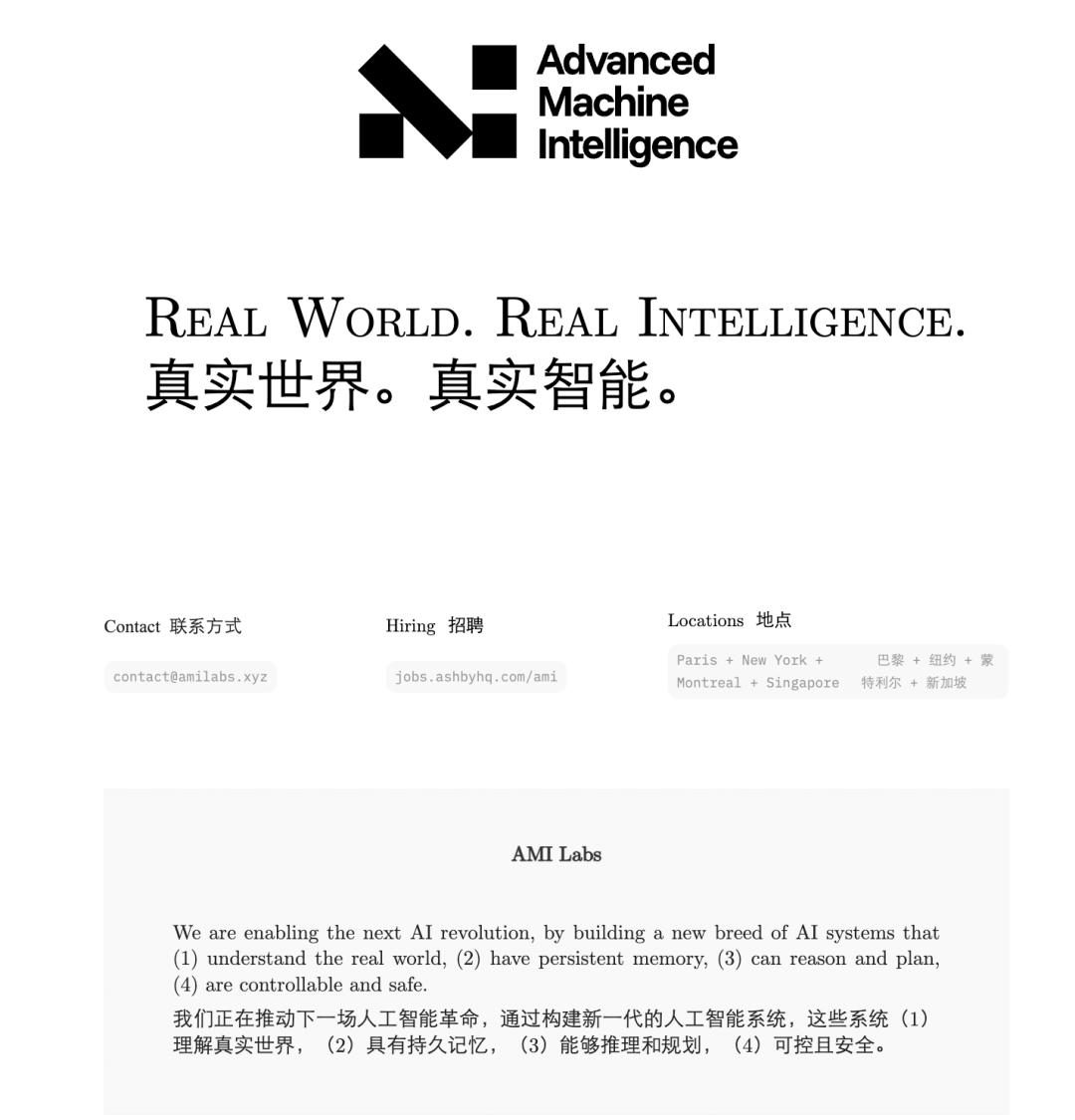
The company was initially composed of about 12 employees and researchers and was distributed across four locations globally from the start: Paris, New York, Montreal, and Singapore. AMI Labs sees itself as a company that deliberately discovers talent outside Silicon Valley on a global scale.
The system in the team's ideal has four major characteristics: 1. Understand the real world; 2. Have long - term memory; 3. Be able to reason and plan; 4. Be controllable and safe.
AMI Labs CEO Alexandre LeBrun and LeCun are both very confident in the company's route. They said, "My prediction is that the world model will become the next hot term." "Six months from now, every company will claim to be a world model to raise funds."
It is reported that AMI Labs' first partner will be Nabla, a medical AI unicorn, and Alexandre LeBrun is also the CEO of this company. LeBrun and LeCun have reached the same conclusion that large language models (LLMs) have limitations, and their hallucinations may lead to fatal consequences. But he also knows that it will take some time for AMI Labs, a startup based on the Joint Embedding Predictive Architecture (JEPA) proposed by LeCun in 2022, to provide a viable alternative. LeBrun emphasized that the company needs at least one year of research before launching its first practical application.
"AMI Labs is an extremely ambitious project because it starts from basic research. It's not a typical AI application startup that can launch a product in three months, achieve revenue in six months, and get $10 million in ARR in twelve months," LeBrun said. In contrast, it may take several years to turn the world model from theory into commercial application.
Despite such a long time span, companies developing world models have attracted huge investments. SpAItial raised $13 million in angel - round financing - which is extremely large for a European startup; and Fei - Fei Li's World Labs received $1 billion last month alone. Now, AMI Labs has joined this group, and the funds it raised exceed the initial rumors.
According to previous reports, AMI Labs only sought €500 million in financing in December last year, but ultimately raised about €890 million, probably thanks to its team lineup. In addition to LeCun serving as the executive chairman and LeBrun having an entrepreneurial resume, the team also includes Laurent Solly, the former vice - president of Meta Europe, as the chief operating officer, well - known researcher Saining Xie as the chief science officer, Pascale Fung as the chief research and innovation officer, and Michael Rabbat as the vice - president of the world model.
Who is Saining Xie?
Saining Xie, favored by Yann LeCun, is one of the top young Chinese scientists in the field of computer vision (CV) and multimodal AI globally.
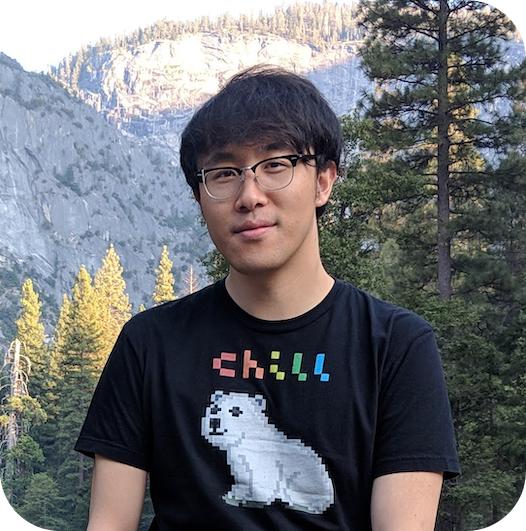
Before taking the position of CTO at AMI, Saining Xie was a research scientist at the GenAI/nanobanana team of Google DeepMind. Even earlier, he was a research scientist at the Facebook AI Research (FAIR) in Menlo Park for four years.
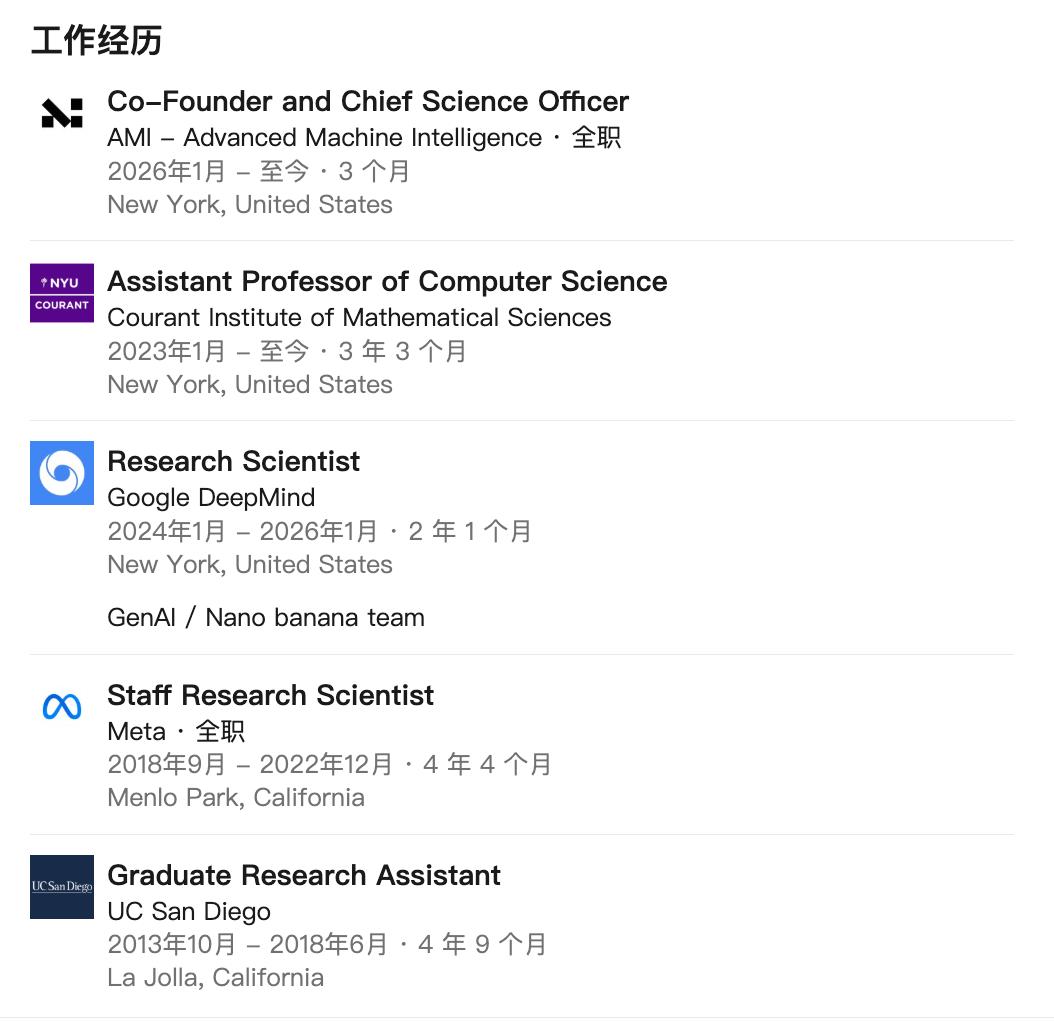
Academically, Saining Xie is an assistant professor of computer science at New York University (NYU) (currently on academic leave) and was a research assistant at the University of California, San Diego (UCSD). Saining Xie has received an honorable mention for the Marr Prize, the NSF CAREER Award, the AISTATS Time - Tested Award, and the PAMI Young Researcher Award. The number of citations of his papers on Google Scholar has reached 98,000.
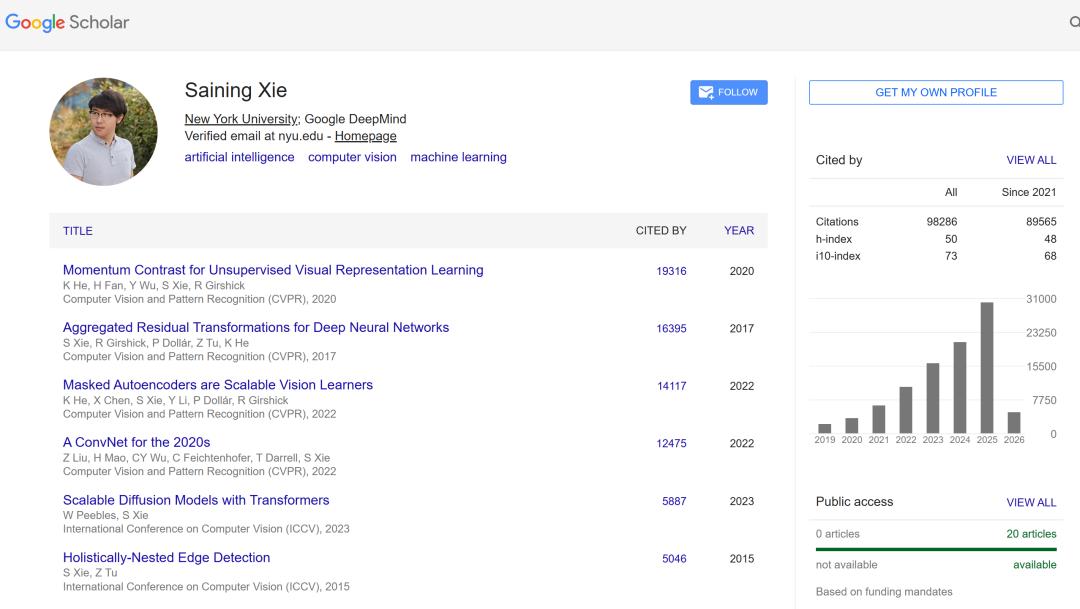
Saining Xie is best known for his work in 2023, "Scalable Diffusion Models with Transformers", that is, the Diffusion Transformers architecture, which later became the cornerstone for OpenAI to create Sora.
After the official launch, AMI Labs will complete the last mile from "believing in the world model" to "proving the world model" under the public's attention. LeCun has been on this path for many years; now, it's time for the team he hand - picked to find the answer.
Reference content:
https://techcrunch.com/2026/03/09/yann-lecuns-ami-labs-raises-1-03-billion-to-build-world-models/
This article is from the WeChat official account "MachineHeart" (ID: almosthuman2014), written by Zhang Qian and Zenan, and published by 36Kr with authorization.