AI Leadership: Manage AI Like a Team
In the current era when the AI wave is sweeping across all industries, we are experiencing an unprecedented "in - situ upgrade": AI does not replace jobs but requires all practitioners, especially leaders in management and architecture positions, to re - examine and upgrade their leadership paradigms. This article is compiled from the speech "AI Leadership: Managing AI Like a Team" by Jie Guangfa, a Tencent expert engineer, at QCon Shanghai 2025. He delved into how to manage AI in a more efficient way, just like managing an efficient team.
We are well aware that for architects and senior executives, managing teams, coordinating resources, and driving projects are the core of their daily work. However, traditional human resource management often comes with challenges such as delayed feedback and uncontrollable processes. Curiously, "managing AI" can precisely resolve this paradox.
The instant feedback and high controllability of AI not only bring about a huge management leverage effect but also provide an unprecedentedly efficient management model. It enables leaders to drive "digital employees" to achieve goals in a more precise and controllable manner, and regain the sense of control and achievement as a "commander".
To achieve this goal, we will explore the four core pillars of "AI leadership". This includes assembling an AI team with the same wisdom of knowing people and assigning them suitable tasks as in team management, setting high - level goals, strategically managing the process, and expertly accepting the results.
AI will not weaken the value of technical leaders; instead, it will amplify it infinitely. In the future, excellent technical leaders will be those "super commanders" who can efficiently manage and orchestrate human - machine hybrid teams to jointly deliver outstanding results.
The following is the transcript of the speech (edited by InfoQ without changing the original meaning).
In March at the beginning of this year, when Manus was released, I widely mentioned an idea: Now when we use AI, we no longer just regard it as a tool but truly treat it as a person who can help us with work. Although AI itself has no emotions, all the key points involved in managing people are also essential when managing AI. This is the core content I want to convey today.
Vibe Coding —— The Return of "Flow" in Coding
First, let's talk about Vibe Coding. For those engaged in technical work, especially technical leaders, this is an area directly related to AI that can significantly improve work efficiency. Using AI to write code has become quite common and has been the mainstream trend in the past one or two years. I'll give examples later, but it can be said that the participation rate of AI in the code I write is almost 100%.
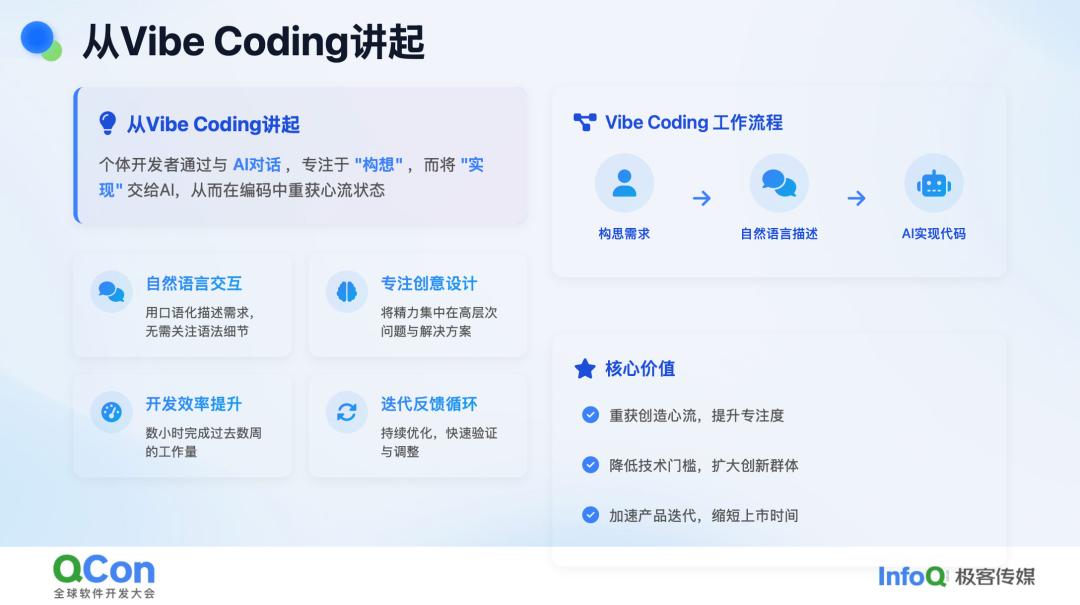
The concept of Vibe Coding actually doesn't need much explanation. It mainly involves describing requirements in natural language and then letting the AI Agent write, test, and run the code. In this process, you don't need to pay too much attention to the specific implementation details of the code. You just need to continuously provide feedback, point out "this doesn't work here", and tell it what to do next. Eventually, through collaboration with AI, the entire software is delivered. This is Vibe Coding. In fact, it is an activity frequently involved in the daily work of AI and engineers, even technical leaders.
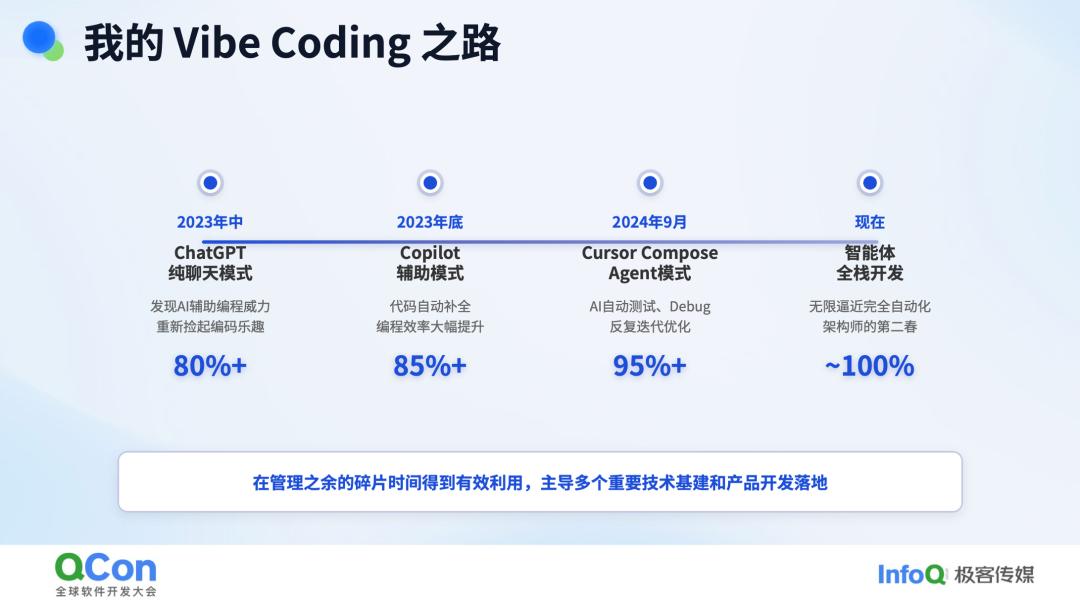
Let me introduce my own experience in Vibe Coding. After ChatGPT was released in 2022, we found that besides chatting with it and watching it write code, there were more applications. In the early days of 2023, we started communicating with it on the ChatGPT webpage and asking it to write some code snippets. At that time, people began to think that AI really performed well in this wave of development. However, the real large - scale application of AI in the production process started after the GitHub Copilot plugin was launched at the end of 2023. By then, the proportion of AI in the code I wrote had reached 85%. To put it simply, I started writing code again in March 2023 because I could realize my ideas with the help of AI without writing the code myself. This led to the emergence of many small - scale projects, especially tool - based technical products, through AI. After Cursor appeared in September last year, I was more daring and truly wrote code in an Agent - based way until now. Currently, almost 100% of the code I write is done by AI. Unless I find that a line of code can be deleted to save tokens, I won't write it myself.
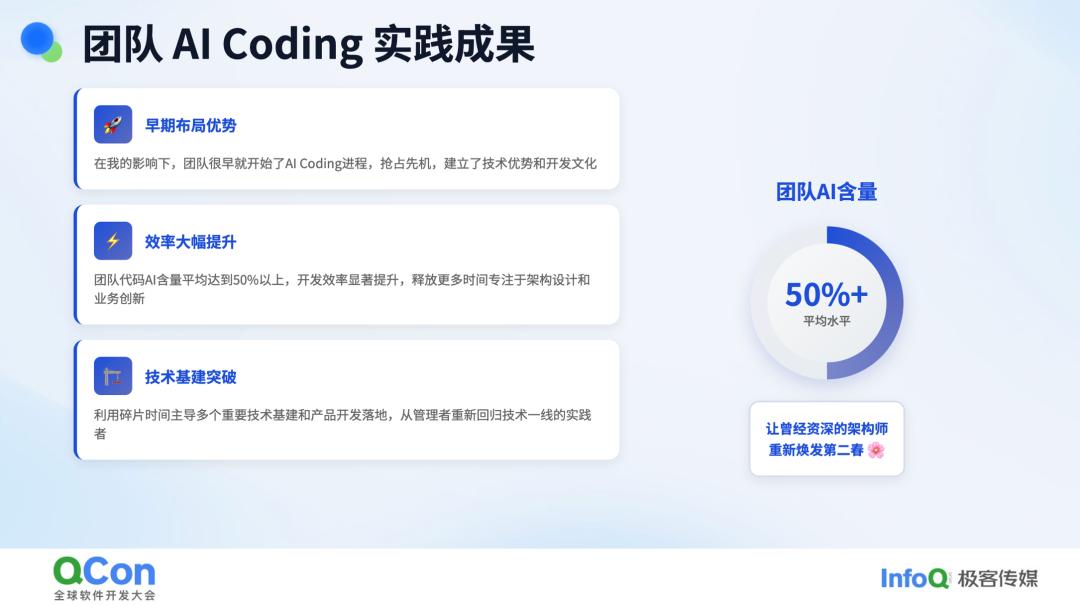
Driven by me, my team has also actively engaged in AI Coding. Currently, about 50% of the code in the team is written by AI. The reason it doesn't reach 100% is two - fold. On the one hand, for some front - end projects, the restoration degree of AI is not high. Due to the natural gap between visual models and text models, which has not been well resolved yet, there are still deficiencies in visual restoration ability, so this part of the work still requires manual participation. On the other hand, some team members don't want AI to handle all the work completely. They want to retain a certain sense of control. They will write the general framework and then let AI fill in the details. In this way, if there are problems or failures, they can quickly fix them themselves without turning to AI again. This active reduction of the AI proportion results in not all team members reaching 100% AI content.
In the company where our team is located, there is a low - code project called loki. In 2023, I led the team to build a cross - language logical orchestration platform, which includes runtime environments for three front - end and back - end languages: Golang, Python, and Node.js. This project was initiated when I started writing code again in 2023, and one or two colleagues participated in their spare time. In addition, we also used an AI Agent low - code building platform internally. This might be around the same time as or earlier than Coze or Dify, around the middle to late 2023 to the early 2024. I started this project when I found that AI Agents were about to rise and would have wide applications. I led the interns who had just joined the team to promote it. In this project, most of the back - end code was written by AI under my guidance, and more than 95% of the code was generated by AI. However, I must emphasize that although AI completed most of the code writing, it doesn't mean I didn't invest effort. I'll explain this in detail later.
One of the recent cases is a large - scale front - end component refactoring and migration project. We migrated a large - scale project from Angular to React. As we all know, Angular is not particularly popular in China, and its technology stack is relatively outdated. During the migration process, we needed to deeply understand the logic of the original code and conduct a large number of tests to ensure the accuracy of the migration. We used AI for the migration. The specific logic is as follows: First, write unit tests in the old component code. After completing the unit tests, convert the old code into new component code and migrate the unit tests synchronously. But that's not enough. We also used a large amount of online data (hundreds of thousands of records) as back - testing data for testing. Throughout the process, from code translation, test writing, and test running, including writing test data verification scripts, almost everything was done by AI. What might have taken one or two people more than half a year to complete was compressed to one or two months through AI collaboration. Of course, during this process, we also conducted manual spot checks to ensure the accuracy of the migration.
I'd like to introduce the concept of "flow". One day, when chatting with a friend, I mentioned that I hadn't experienced a certain feeling for a long time, but it had come back recently - that is, I found the flow. I think every programmer has had such an experience: wearing headphones, concentrating on typing code, and before you know it, a whole morning has passed. During that process, you are immersed in the code world, undisturbed. From writing code, testing, running, to continuous debugging, you have a strong sense of control throughout the process, and time passes unconsciously. This is the flow state. In fact, all creators will experience this state. But why did I not experience this feeling for a long time and then suddenly find it again? After becoming a team leader, you'll find that managing a team and writing code are two completely different things. When you assign a task to team members, you need to wait for their feedback, which is often a long process. There are also many meetings and communication and coordination in between, and the whole process is not smooth. Therefore, after becoming a leader, I lost this sense of flow for a long time. However, through Vibe Coding, this feeling has returned. What might have taken more than ten days to complete a project can now be completed with AI collaboration. After I give instructions, I can get preliminary results in one or two minutes, and then I continue to give feedback. The closed - loop time of this feedback chain is very short, so I have regained the sense of flow at the management level.
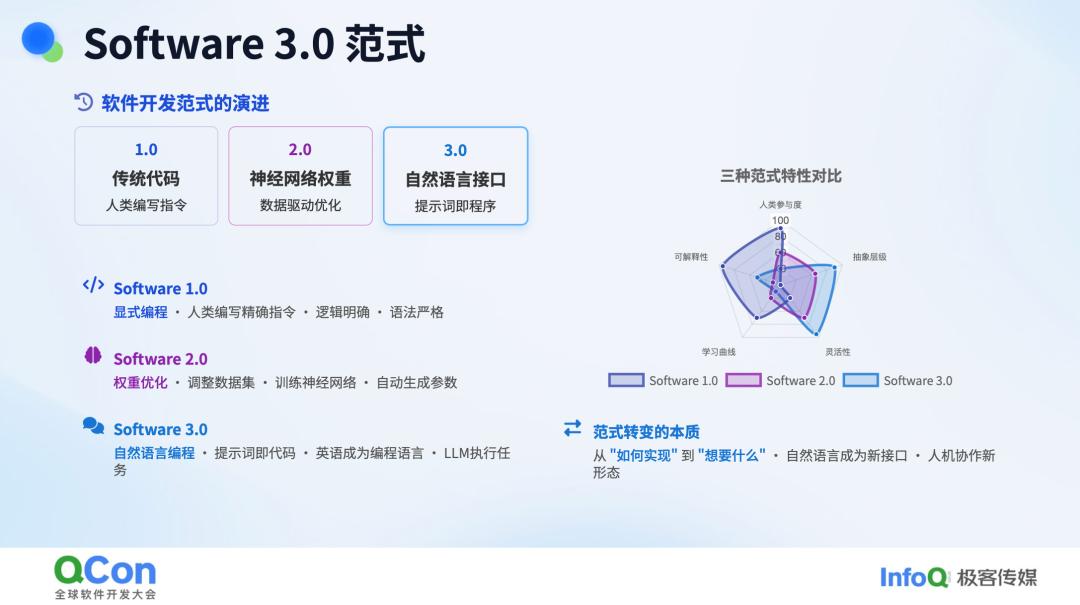
When talking about Vibe Coding, we also have to mention Software 3.0 because when we say we are working with AI, the AI here almost always refers to Agents. And the essence of an Agent is a form of software. Both Software 3.0 and Vibe Coding are related to the concepts proposed by Karpathy, so I mention them here together. So, how did the three paradigms of 1.0, 2.0, and 3.0 evolve?
In the 1.0 era, we manually wrote code, compiled it, and then ran it. The logic in the code was clearly written. For example, to implement the sentiment judgment of some words, we would use if - else statements to write the logic: if the text contains "amazing", it is judged as positive.
In the 2.0 era, a small model trained through neural networks or machine learning emerged, such as a pure visual recognition model. This model was not implemented by writing code but was obtained through data training. For sentiment judgment, we would use the trained neural network model to predict the sentiment tendency of words.
In the 3.0 era, what we see is a derivative program based on large - language models, that is, agents. Taking sentiment judgment as an example, we directly give a passage to the Agent and interact with it in natural language, asking it to judge the tendency of words in the text. The Agent will directly give the judgment result of the large - language model. The essence of Software 3.0 is an intelligent agent system, which uses natural language as an interface to enable AI to understand human intentions and execute tasks autonomously.
Vibe Working — The Extension of "Flow" to All Work
What I mentioned earlier was mainly about programming, and we are already very familiar with it. Now I'd like to further talk about Vibe Working, that is, the concept of "everything can be Vibe". Nowadays, everyone is discussing how AI penetrates into various fields, and I also want to share some examples of my collaborative work with AI in other aspects.
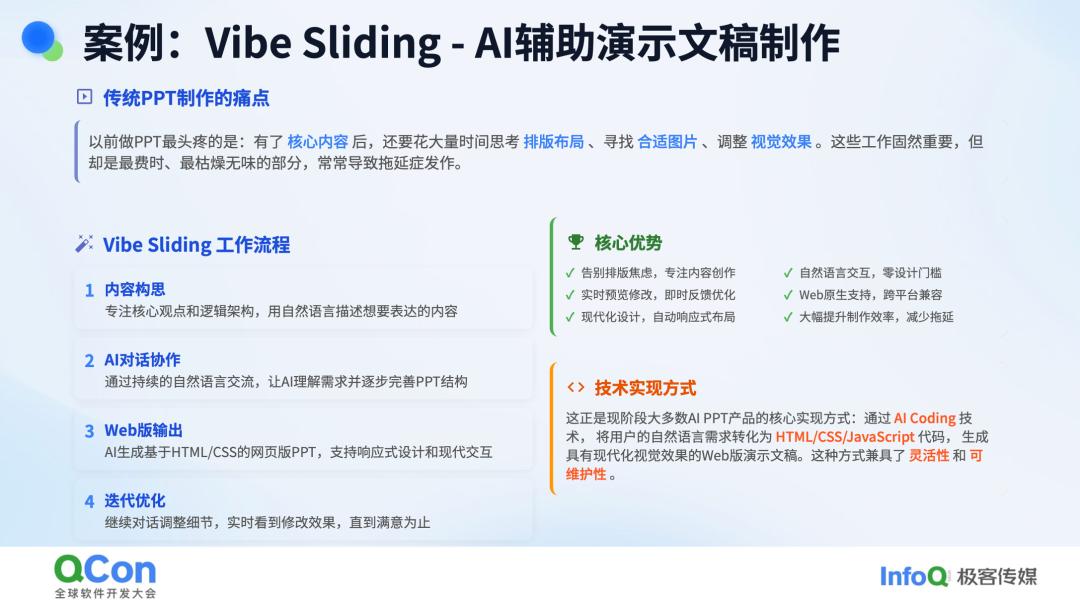
For example, Vibe Sliding for making slides. Since this year, I've never been anxious about preparing PPTs again. In the past, I always procrastinated until the last one or two days to start making slides because although I already knew the content of the speech well, the tedious work of typesetting, drawing graphics, finding pictures, and typesetting them made me headache. This PPT of mine was completely generated by AI. You can tell from the style. Theoretically, a manually made PPT wouldn't use so many colors, but it still has good readability and can clearly convey information. The whole process of making the PPT is like programming, completed by AI. Even elements such as the inserted logo were added by AI. And since a PPT is essentially a webpage, AI is already very proficient in writing webpages. Now, I can no longer go back to the era of manually making PPTs. I basically use AI to complete this work.
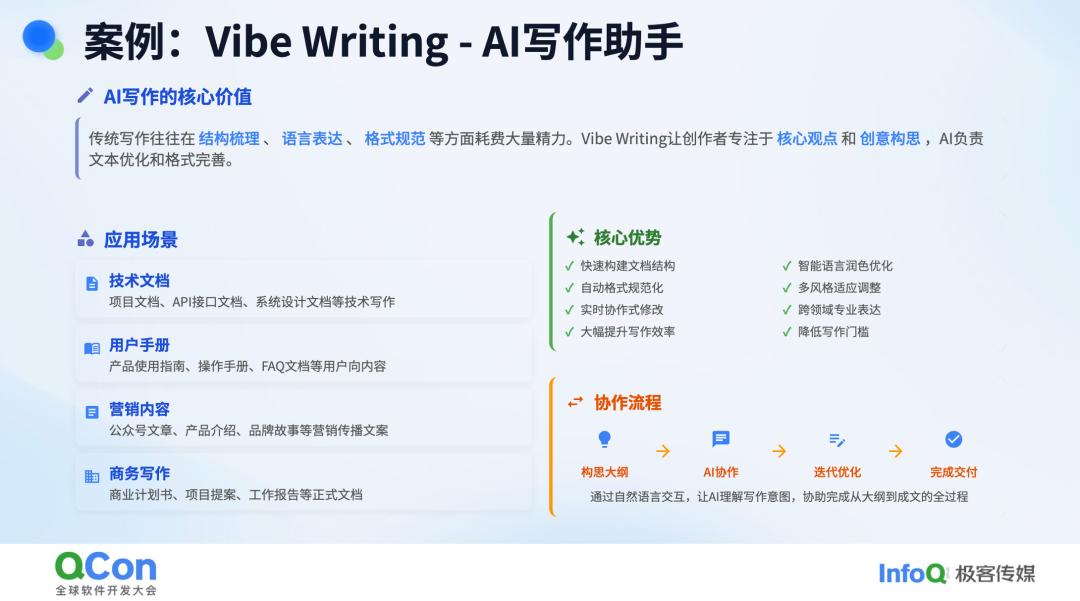
There is also Vibe Writing, which is a writing assistant. Many documents or official account contents you see now are basically generated by AI in a pipeline - style. Especially this year, AI can split different chapters through a multi - Agent approach, allowing different sub - Agents to write different chapters respectively. This makes writing large - scale documents a breeze, and even writing papers, patents, etc. is no problem. I also use this method to write product documents, instructions, and even API interface documents are all completed by AI.
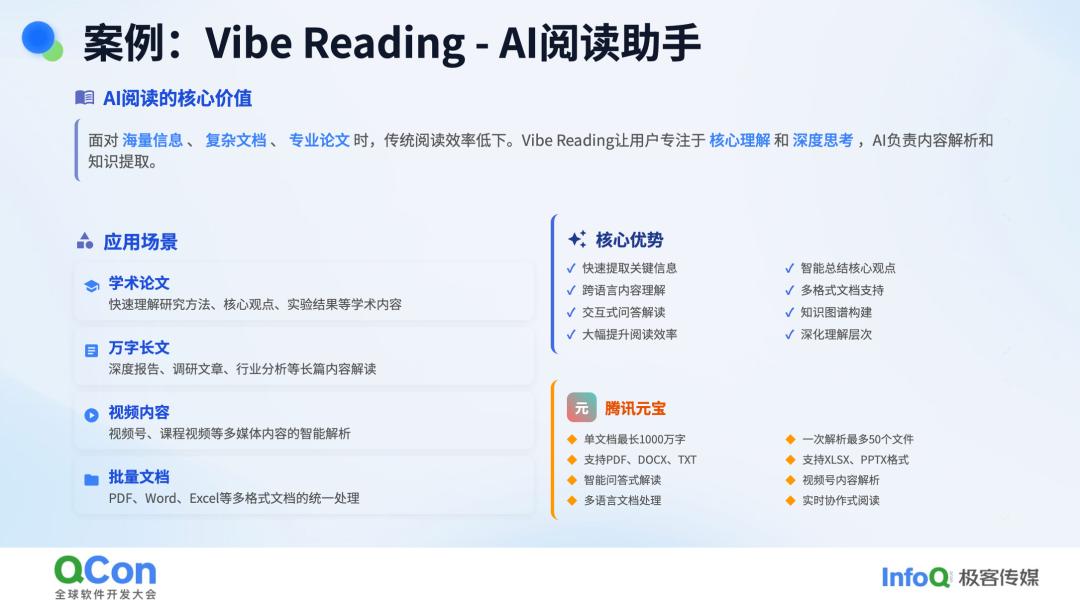
Reading papers used to be a painful thing. In the past, it took a lot of effort to read a long PDF and understand all the content. Now, we usually let AI read it on our behalf. For long - length official account articles or newly published papers, we first forward them to an AI tool, such as the robot account of Tencent Yuanbao official account, which will summarize the content for you. This is also a good example of AI usage.
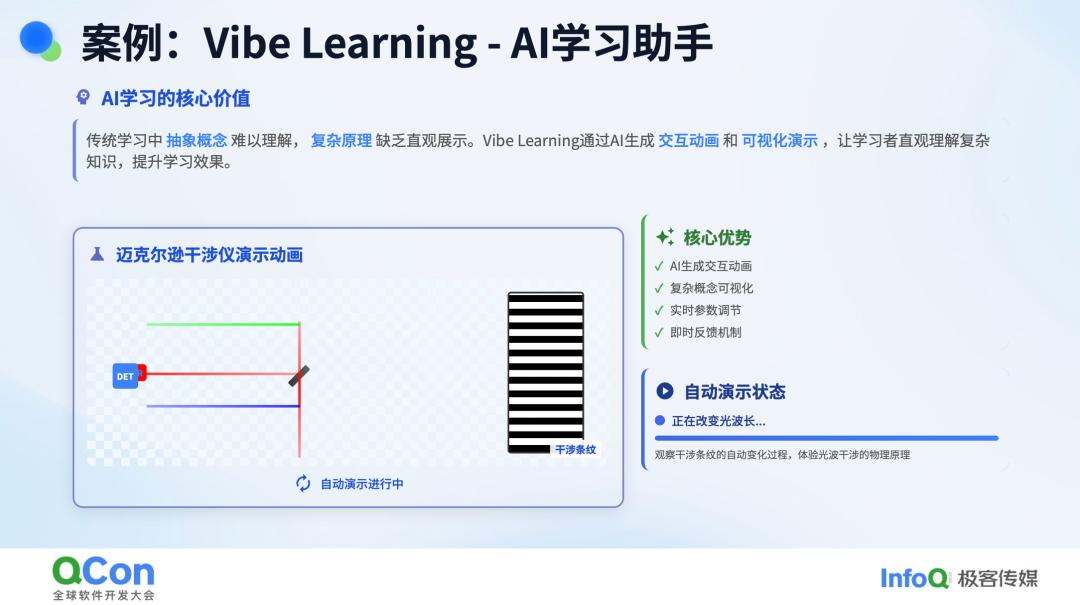
There is also an interesting application scenario, which is learning new concepts. For example, when we learn the working principle of large - language models, if there is an animated visualization to show its key actions, we can understand it more intuitively. AI can play a big role in this aspect. For example, it can generate an animation for me to show the method of measuring the speed of light or the influence of light stripes of different colors in the Michelson interferometer. At the learning level, this allows me to have a very strong interaction with AI and vividly demonstrate the knowledge points I want to understand. For me, I don't need to read thick books anymore. I just ask AI directly, and it will provide me with answers.
For example, my personal secretary has also gone through multiple iterations. The earliest version was based on Gemini CLI, which was almost free. It could record my daily work, arrange schedules, etc. All these could be done by chatting with it through the command line. This is completely different from the structured Todo List we usually use. The Todo List requires you to check and record by yourself, while this secretary is more like a real secretary.