Who is driving up the enthusiasm for embodied AI financing with 20 billion yuan in just two months?
At least six embodied intelligence startups have plans to go public this year. The expectation of a sharp rise in stock prices after going public makes investors reluctant to miss out.
Just over two months into 2026, the Chinese embodied intelligence track has witnessed a wave of intensive financing.
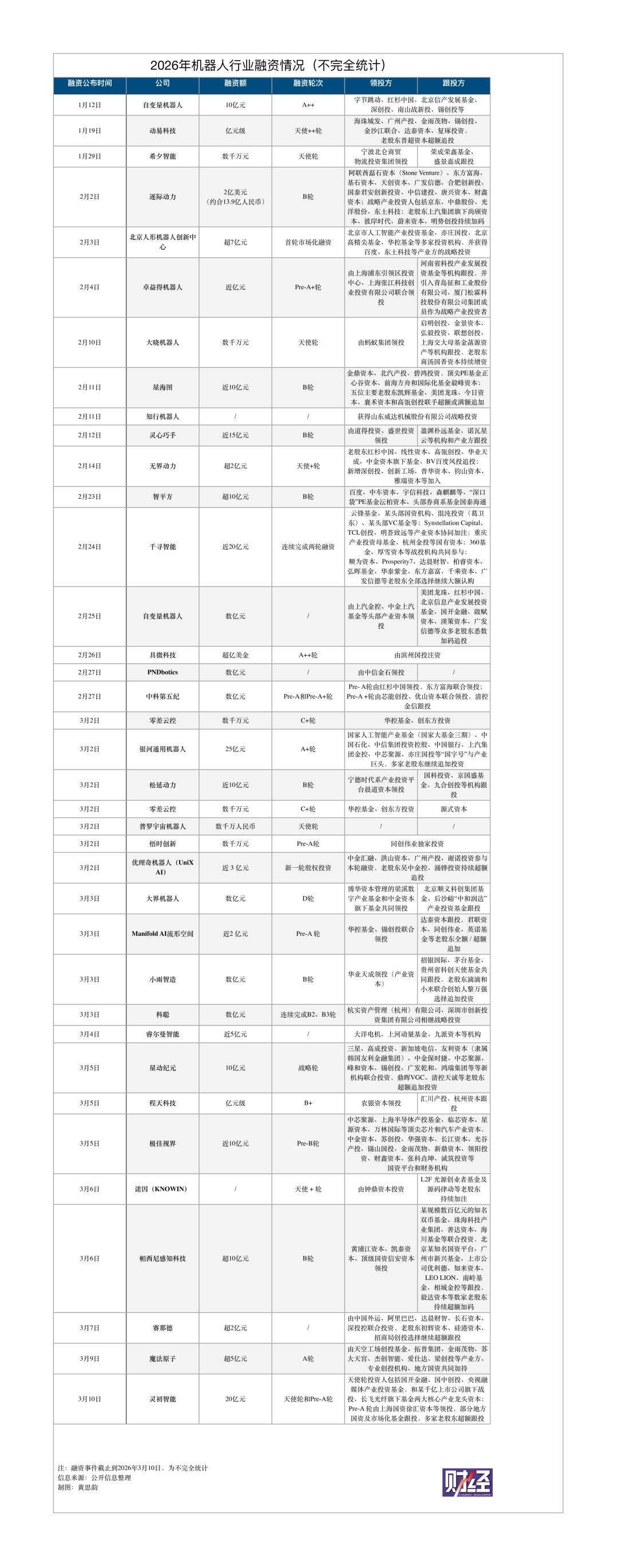
According to incomplete statistics from Caijing, since the beginning of 2026, there have been more than 30 disclosed financings in the Chinese embodied intelligence and robotics track, with the total disclosed financing amounting to approximately 20 billion yuan.
The financing enthusiasm has increased significantly compared to previous years. According to data from the third - party research institution IT Juzi, the financing amount in the Chinese robotics industry in the first quarter of 2025 was about 12.6 billion yuan, and in the first quarter of 2024, it was about 7 billion yuan.
In March 2026, Galaxy Universal announced the completion of a 2.5 - billion - yuan Series A+ financing, becoming the largest single - financing event in the Chinese robotics industry to date. The investors in this round include the National Artificial Intelligence Industry Fund (the third phase of the National Big Fund), Sinopec, CITIC Group Investment Holdings, Bank of China, SAIC Group Financial Holdings, SMIC Juyuan, Yizhuang State - owned Investment, Future Industry Investment, Kunpeng Fund, Wuxi Venture Capital, Fujian Industrial Investment, etc. The current valuation of the company exceeds 20 billion yuan.
Many startups have achieved financing on a scale of one billion yuan. Qianxun Intelligence announced the completion of nearly 2 billion yuan in two consecutive rounds of financing. Lingxin Qiaoshou announced that it had received nearly 1.5 billion yuan in Series B financing. Zhujidongli announced that it had received 200 million US dollars (approximately 1.39 billion yuan) in Series B financing. Companies such as Zibianliang Robotics, Xinghaitu, Zhipingfang, Xingdong Jiyuan, Jijia Shijie, and Pasini Perception Technology have also successively disclosed financings of about one billion yuan.
This wave of financing has given rise to seven new unicorn companies with a valuation of over 10 billion yuan, namely Zibianliang Robotics, Xinghaitu, Lingxin Qiaoshou, Zhipingfang, Qianxun Intelligence, Xingdong Jiyuan, and Pasini Perception Technology. In 2025, there were three embodied intelligence companies that had exceeded a valuation of 10 billion yuan, namely Unitree Technology, Zhiyuan Robotics, and Galaxy Universal.
The core driving force behind this round of financing boom is the imminent listing. Caijing has learned that many embodied intelligence companies already have clear listing plans, and several have secretly submitted listing applications and plan to complete the listing within this year. Many investors who have invested in embodied intelligence companies told Caijing that they believe the first batch of listed embodied intelligence companies can be compared with previously listed domestic chip and large - model companies, and "the market value will be quickly pushed up."
The financing enthusiasm for embodied intelligence continues to rise, and investors don't want to miss out.
IPO Is Imminent
Caijing has learned that at least six embodied intelligence companies have relevant listing plans this year, namely Unitree Technology, Zhiyuan Robotics, Galaxy Universal, Xinghaitu, Songyan Power, and Leju Robotics. Among them, Unitree plans to list on the A - share market, while the other companies plan to list on the Hong Kong stock market. An investor who has invested in multiple robotics companies mentioned that Unitree is most likely to be the first to go public, "around May - June this year, and the other companies are expected to list on the Hong Kong stock market in the fourth quarter of this year."
An investor who recently participated in the investment of Galaxy Universal told Caijing that this 2.5 - billion - yuan financing is a Pre - IPO round. As of press time, Galaxy Universal has not responded to this.
Investors in the primary market believe that after the embodied intelligence companies go public, their valuations will continue to rise. Although the commercialization capabilities and technological strengths of some of these companies have not been fully proven, they have been following this field for a long time and are clear about the value. However, "the secondary market will definitely be enthusiastic about the concept of embodied intelligence."
The two waves of IPO booms from 2025 to early 2026 seem to prove this. At the end of 2025, Moore Threads, the "first domestic GPU stock," listed on the A - share market. Within just 35 days, four domestic GPU companies, namely Moore Threads, Muxi Co., Ltd., Biren Technology, and Tianshu Zhixin, listed one after another, with the highest increase on the first day of listing exceeding 7 times. In January 2026, large - model companies Zhipu and MiniMax listed on the Hong Kong Stock Exchange one after another. The market values of the two companies once exceeded HK$300 billion, even surpassing the veteran Internet giant JD.com.
Therefore, in this wave of embodied intelligence financing boom, it is the investors who are in a hurry, not the startups. An investor mentioned that currently, well - known embodied intelligence companies have relatively sufficient cash on their books. It is the investors who are trying every means to get a share of the financing, and they are even willing to raise the price multiple times.
To ensure a smooth listing as much as possible, most embodied intelligence companies currently choose to secretly submit listing applications.
Unitree Technology completed the listing guidance in November 2025. The listing guidance filings of Leju Robotics and Yun Shenchu have been accepted, and they plan to enter the capital market in 2026. Zhiyuan Robotics, Galaxy Universal, Fourier Intelligence, Zhongqing Robotics, and Xinghaitu have completed the shareholding reform.
The ten embodied intelligence startups with a valuation of over 10 billion yuan can be roughly divided into three categories. One category includes complete machine manufacturers such as Unitree Technology, Zhiyuan Robotics, Galaxy Universal, and Xingdong Jiyuan. Another category includes companies such as Zibianliang Robotics, Qianxun Intelligence, Xinghaitu, and Zhipingfang that focus on robot brains and models. There are also core component companies such as Lingxin Qiaoshou and Pasini Perception Technology that target dexterous hands and tactile sensors.
Most of the startups have been established for less than three years and are emerging forces in the industry. In the ecosystem of unicorn companies with a valuation of over 10 billion yuan, Zhiyuan Robotics, Galaxy Universal, Xinghaitu, Zhipingfang, Xingdong Jiyuan, Zibianliang Robotics, and Lingxin Qiaoshou were all established in 2023, and Qianxun Intelligence was established in 2024.
This trend of youthfulness is also reflected in this round of financing boom. Some new companies established in 2025 have completed several rounds of financing or financing on a scale of hundreds of millions of yuan in a short period. Manifold AI, which has been established for only ten months, received nearly 200 million yuan in Pre - A round financing. Wujie Power has accumulated 800 million yuan in three rounds of financing in one year.
Meanwhile, the financing rhythm has also accelerated. Zhipingfang completed 12 rounds of financing in one year, becoming the embodied intelligence enterprise with the fastest financing rhythm globally. Zhongke Fifth Era, as the supplier of Unitree's "embodied operation brain," completed 6 rounds of financing in one year. Jijia Shijie completed 4 consecutive rounds of Series A financing totaling 500 million yuan within three months.
State - owned Capital Increases Investment
In this round of financing boom, the penetration rate of state - owned enterprise capital and industrial capital has increased.
Different from the early - stage projects in the AI boom, which were mostly led by US - dollar funds, in the embodied intelligence track, RMB funds play a leading role.
Both state - owned enterprise capital and local state - owned capital are entering the market. There are not only national - level funds such as the National Artificial Intelligence Industry Fund (the third phase of the National Big Fund), but also central enterprises and central financial institutions such as the Bank of China and CITIC Group. Beijing, Shenzhen, Shanghai and other places have successively established special industrial funds for embodied intelligence. Cities such as Hangzhou, Suzhou, Guangzhou, Chongqing, and Binzhou are also promoting the development of the embodied intelligence industry in multiple locations through policies and funds.
National policies strongly support the development of the embodied intelligence industry. 2026 is the beginning of the 15th Five - Year Plan. Previously, the "Proposal of the Central Committee of the Communist Party of China on Formulating the 15th Five - Year Plan for National Economic and Social Development" mentioned that it is necessary to make forward - looking arrangements for future industries, explore diverse technological routes, typical application scenarios, feasible business models, and market supervision rules, and promote quantum technology, biological manufacturing, hydrogen energy and nuclear fusion energy, brain - computer interfaces, embodied intelligence, sixth - generation mobile communications, etc. to become new economic growth points.
On February 28, China's first national - level "Standard System for Humanoid Robots and Embodied Intelligence (2026 Edition)" was released. This is the first top - level design of standards covering the entire industrial chain and the entire life cycle of humanoid robots in China, marking a new stage of standardized development for the relevant industries.
In addition to the continuous investment of Internet technology companies, a number of manufacturing enterprises have also started to enter this track. Automobile industry capitals such as SAIC Group (SAIC Financial Holdings, Shangxin Capital, etc.) and China Jinmao Porsche have become important investors. Songyan Power received a leading investment from Chendao Capital under CATL. Computing power and semiconductor funds have also entered the market.
This has also attracted the attention of international capital. The investment fund Prosperity7 under Saudi Aramco's venture capital appears among the investors of Qianxun Intelligence. Xingdong Jiyuan received a joint investment from Samsung, Singtel, and Woori Capital under the South Korean Woori Financial Group. The investors of Zhujidongli include Stone Venture from the UAE.
2026 will be a listing boom for humanoid robots. Currently, Unitree Technology has completed the listing guidance. Leju Robotics and Yun Shenchu have disclosed the progress of their IPO guidance and plan to enter the capital market in 2026. Galaxy Universal, Xinghaitu, and Ruierman Intelligence are in the Pre - IPO financing stage. Gu Shitao, the co - founder of Magic Atom, said at the beginning of the year that Magic Atom may have new news in the secondary market as early as 2026, and the company is arranging the listing schedule at the fastest speed.
Under the Boom
The financing boom also partially reflects the market enthusiasm. Caijing has learned that many embodied intelligence startups received more orders in the first quarter of 2026 than in the whole of 2025.
According to incomplete statistics from the Humanoid Robot Scene Application Alliance, in 2025, there were more than 292 publicly disclosed winning bids for humanoid robot projects in the Chinese market, including 84 in the first half of the year and more than 208 in the second half. The total disclosed contract amount exceeded 1.81 billion yuan.
Among them, educational institutions and the government are the main purchasers. Among the 292 projects, 187 are from educational institutions, and about 78 are from government and public projects, such as museums, science and technology museums, data collection bases, and demonstration parks.
Specifically for leading companies, Ubtech received orders worth 1.4 billion yuan in 2025, making it the robot company with the largest publicly disclosed order volume last year. Unitree Technology ranked second with orders worth nearly 1.2 billion yuan. Companies such as Yuejiang Robotics, Yun Shenchu Technology, and Zhiyuan Robotics received orders worth about 1 billion yuan.
The order scale of startups such as Galaxy Universal and Xingdong Jiyuan is between 600 million yuan and 1 billion yuan.
Among the 292 winning bid projects counted by the Humanoid Robot Scene Application Alliance, 235 have an amount of less than 5 million yuan, and there are only four projects with a single - order amount exceeding 100 million yuan.
Many investors mentioned that the orders of embodied intelligence companies "contain water." Currently, song and dance performances and data collection are the main sources of income for some embodied intelligence companies. "If you want to generate income, data collection is the fastest way."
Currently, the orders for embodied intelligence data collection mainly come from local governments. The lack of real - world physical data for embodied intelligence is one of the bottlenecks in the current industry development. "Data is very important, but if a company that makes robot brains or dexterous hands mainly earns income from local governments through data collection, we will worry about the value of the company's core technology." An investor who has invested in multiple embodied intelligence companies told Caijing.
An embodied intelligence entrepreneur in Shenzhen told Caijing that many orders in the industry often only pay a deposit, and then nothing comes of it. However, when enterprises promote themselves externally, they still package these intended orders or framework agreements as actual delivery volumes.
The main reason is still the sub - standard performance. He revealed that a robot company initially delivered several robots after signing a contract with a manufacturing enterprise, but the customer found that the performance did not meet expectations after testing and it was difficult to replace manual labor on the production line. Eventually, the customer only paid the deposit and terminated the contract.
In 2026, embodied intelligence has also begun to enter real industrial scenarios. JD.com has invested in multiple embodied intelligence companies. Caijing has learned that some embodied intelligence companies have cooperated with JD Industrial to complete some simple in - factory logistics work in factories.
Some industry insiders mentioned that currently, embodied intelligence cannot achieve millimeter - level accuracy, only centimeter - level accuracy. Therefore, it is still difficult to complete relatively delicate work such as screwing.
A reshuffle period will also occur. There are currently more than 200 embodied intelligence enterprises in China, among which more than 100 are humanoid robot enterprises. Investors who focus on the robotics field told Caijing that after leading enterprises quickly obtain funds, they may squeeze the living space of second - tier companies.
The fact that embodied intelligence startups choose to secretly submit listing applications during the IPO stage is also partly related to industry chaos. Many industry insiders mentioned that there are two relatively obvious problems in the industry at present, one is the intellectual property issue, and the other is the issue of revenue recognition.
Caijing has learned that many embodied intelligence companies had an income of about tens of millions of yuan in 2025, but in just over two months in 2026, they received orders worth hundreds of millions of yuan. Many industry insiders and investors mentioned that "there are many related - party transactions in these orders."
Under the high - profile financing, there have been many embodied intelligence startup projects born for the purpose of financing. Investors are very clear about the current market situation. For startups to obtain more financing, they need to tell a differentiated story.
An investor mentioned that to start an embodied intelligence business today, one needs to be a "hexagonal warrior," which refers to model, data, ontology, commercialization ability, financing ability, and team. If a startup only claims to have strong model capabilities, it is easy to be surpassed by competitors. "You need to have strong basic capabilities and your own core competitiveness."
He believes that currently, there are two types of embodied intelligence companies that are easy to finance in the primary market. One type is newly established companies that can quickly complete two rounds of financing while the market is hot. The other type is star companies with clear listing plans. Investors are worried about missing out and will rush to invest. "Companies in the middle stage, especially those with a valuation of over 5 billion yuan, will have relatively more difficulty in financing."
However, some of the embodied intelligence startups that this investor mentioned as "relatively difficult to finance" have all recently disclosed the completion of new financing. "Maybe we are in a relatively crazy stage now."