Still deploying OpenClaw? Some people have started using AI as a "cyber emperor".
Can you use AI to build your own cyber court?
Recently, an interesting open - source project named "Three Departments and Six Ministries · Edict" appeared on Github. This project applies the Three Departments and Six Ministries system of the Tang Dynasty a thousand years ago to redesign the AI multi - Agent collaboration architecture.
Under this framework, the author's cyber Three Departments and Six Ministries are mainly composed of 12 AI Agents (11 business roles + 1 compatible role). These 12 AI Agents are respectively the Crown Prince, the Three Departments (Central Secretariat, Chancellery, and Department of State Affairs), the Seven Ministries (Ministry of Revenue, Ministry of Rites, Ministry of War, Ministry of Justice, Ministry of Works, Ministry of Personnel, and Court Officials in the Morning Audience), and there is also a Military Council Kanban.
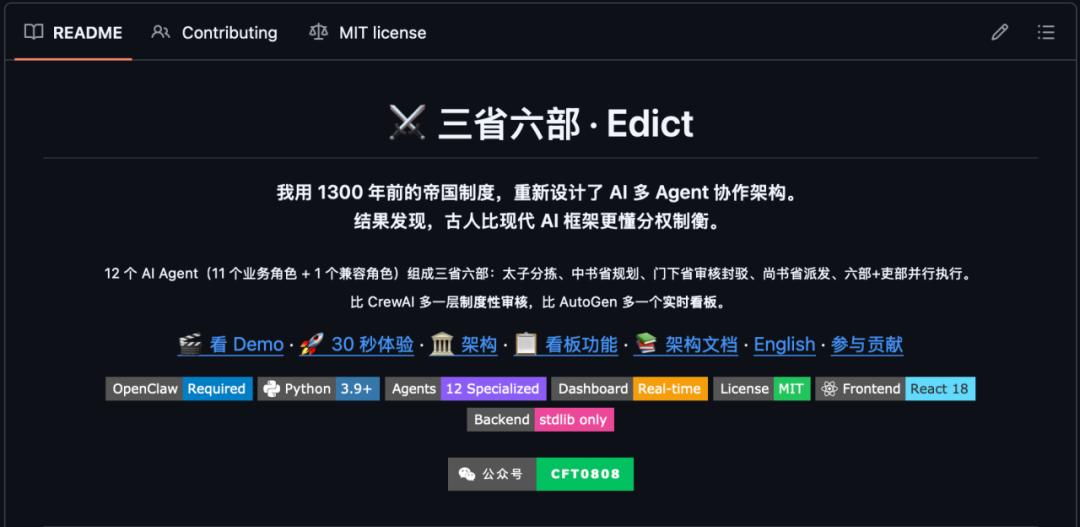
Source: Github
In this system, everyone has their own duties and better restricts each other. The Crown Prince is responsible for message sorting, that is, automatic reply to casual chats and creating tasks only for imperial edicts; the Three Departments are responsible for planning, reviewing, and distributing; the Seven Ministries are responsible for specialized execution.
As of 21:00 on March 10, the number of stars of this project on Github has reached more than 6,500. (The link is here. If you are interested, you can take a look: https://github.com/cft0808/edict)
"Let the heroes monitor the heroes."
Imagine that you are an emperor who has just established a dynasty and have a bunch of very important things to deal with. However, at this time, the court system has not been fully established. Everyone has good professional abilities, but they cannot operate and coordinate well.
For example, before, you also had a think - tank to help you deal with various documents and give you ideas from time to time (such as ChatGPT, Doubao, DeepSeek, etc.). They are really useful in some cases, but now the problems to be solved are more complex. It's not just about talking, but also mobilizing others across departments to implement specific things, which obviously exceeds their capabilities.
As a result, either they "burn out their CPUs" due to excessive workload and talk nonsense; or they don't check after finishing the work, and the reports they send you are full of miscalculated numbers; the most annoying thing is that when you ask them how the things you assigned last week are going, they may say, "Your Majesty, I forgot..."
The interesting part of the "Three Departments and Six Ministries · Edict" project lies here - using the relatively mature institutional system of the "Three Departments and Six Ministries" in history as a framework, a "highly reliable system" is built with a group of "unreliable individuals" AI Agents.
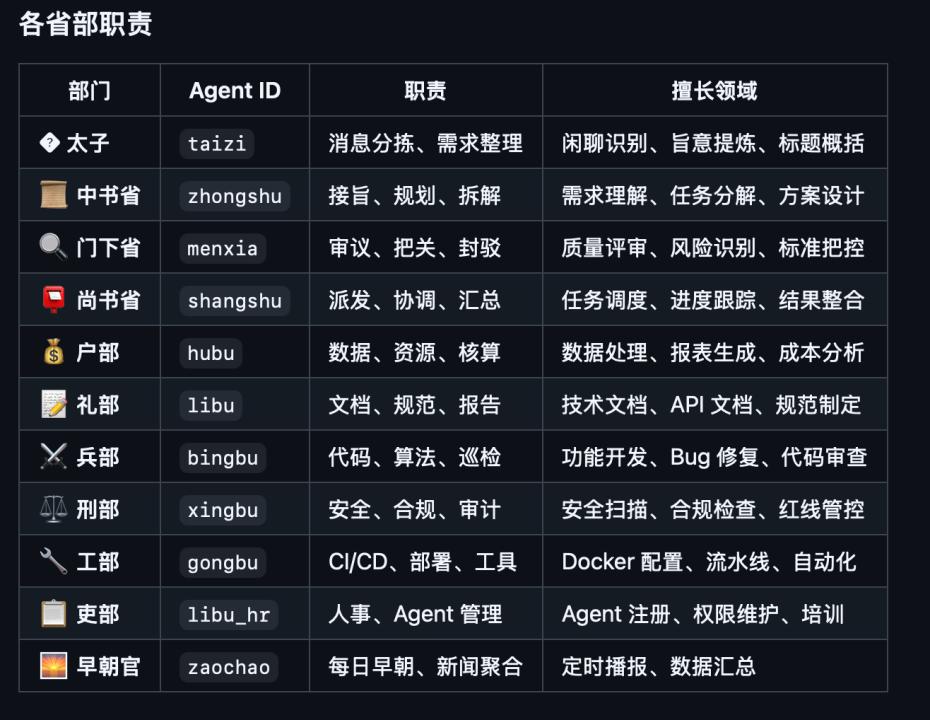
Screenshot of the responsibilities of each agent in the project, Source: Github
The role of the Crown Prince is like a secretary who has no decision - making power but has a high rank and understands the emperor very well. It is mainly responsible for message sorting and demand sorting, and is good at identifying casual chats, extracting imperial edicts, and summarizing titles.
The "Three Departments" are like a large middle - platform, which plans, reviews, and distributes various types of needs and problems summarized. Specifically:
The Central Secretariat is responsible for receiving imperial edicts, planning, and disassembling, and is good at understanding needs, decomposing tasks, and designing solutions;
The Chancellery is responsible for reviewing, checking, and rejecting, and is good at quality review, risk identification, and standard control;
The Department of State Affairs is responsible for distributing, coordinating, and summarizing, and is good at task scheduling, progress tracking, and result integration.
The "Six Ministries" are mainly responsible for execution. Specifically:
The Ministry of Revenue is mainly responsible for data, resources, and accounting, and is good at data processing, report generation, and cost analysis;
The Ministry of Rites is mainly responsible for documents, specifications, and reports, and is good at technical documents, API documents, and specification formulation;
The Ministry of War is mainly responsible for codes, algorithms, and inspections, and is good at function development, Bug fixing, and code review;
The Ministry of Justice is mainly responsible for security, compliance, and auditing, and is good at security scanning, compliance inspection, and red - line control;
The Ministry of Works is mainly responsible for CI/CD, deployment, and tools, and is good at Docker configuration, pipelines, and automation;
The Ministry of Personnel is mainly responsible for personnel and Agent management, and is good at Agent registration, permission maintenance, and training.
So, as the cyber emperor, you issue imperial edicts to your court through tools such as Feishu and WeCom.
After your Central Secretariat receives the imperial edict, it plans the sub - task distribution plan; your Chancellery reviews the plan of the Central Secretariat, and after evaluation, approves it or rejects it and asks for re - planning; your Department of State Affairs gets the plans of the above two departments, and after approval, distributes them to the Six Ministries for execution.
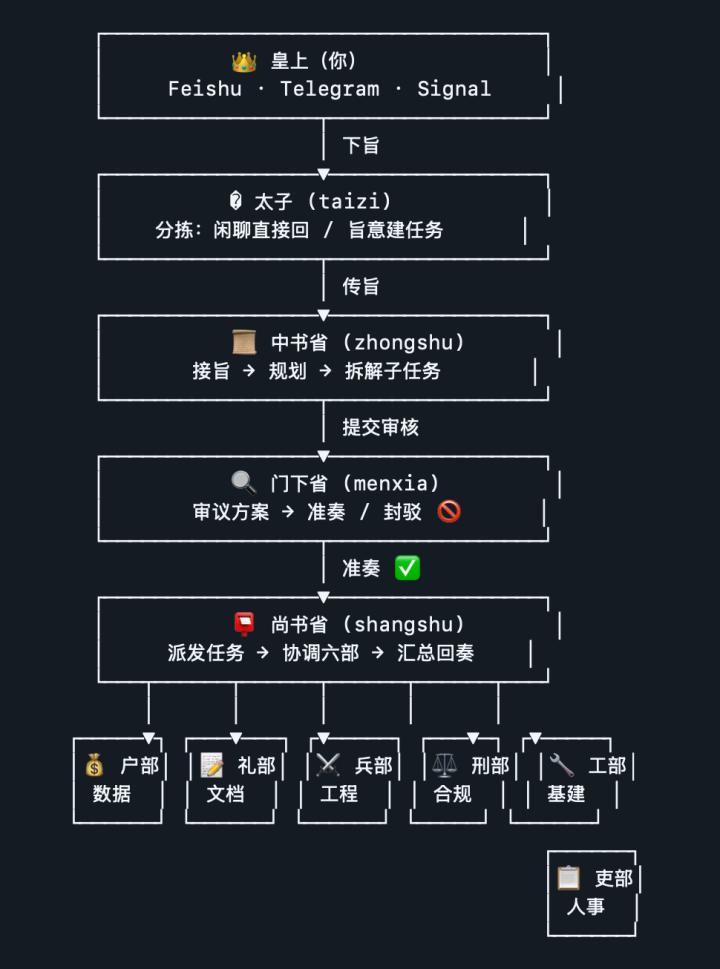
Screenshot of the project's architecture, Source: Github
Even more wonderful is that when the Six Ministries execute tasks in parallel, you can have a bird's - eye view and check their real - time progress on the Military Council Kanban. You can stop, cancel, or resume the tasks at any time. Finally, the Department of State Affairs summarizes the execution results and reports them back to you.
After this interesting project became popular in the Chinese programmer circle on Github, it was also reposted to many external forums. The comment section of the technical section of the US Card Forum is very interesting.
"So when the system is running, is the user cosplaying as an emperor?"
"Let the heroes monitor the heroes."
"Seconded! The Imperial Secret Service is amazing. It's the Monitoring Agent, specifically monitoring whether each department has hallucinations. If any Agent dares to output randomly, send it directly to the imperial prison: First, drag it out and give it thirty big boards!!"
"Does each agent have to write a congratulatory memorial every week?"
There are many other interesting comments. Some netizens also suggested creating versions of various dynasties and their countries.



Source: The corresponding comment section of the US Card Forum
The cyber court is all about making the "gods" fight.
In the past, many Multi - Agent (AI multi - agent) systems were self - checking and self - correcting after casual exchanges.
Early Multi - Agent frameworks like AutoGen often adopted the "Group Chat" mode, letting several Agents discuss and solve problems by themselves. This will lead to a problem. Since there are no clear duty limitations, Agents may have casual exchanges with each other, deviate from the topic, or even fall into an infinite loop.
What is Multi - Agent?
Put simply, it imitates the collaboration mode of human society - professional division of labor, each doing their own part, and collaborating in combat. When the tasks you face are complex enough, require multiple capabilities, or you hope to see a clear decision - making process, the Multi - Agent architecture can solve problems more properly than a single super AI.
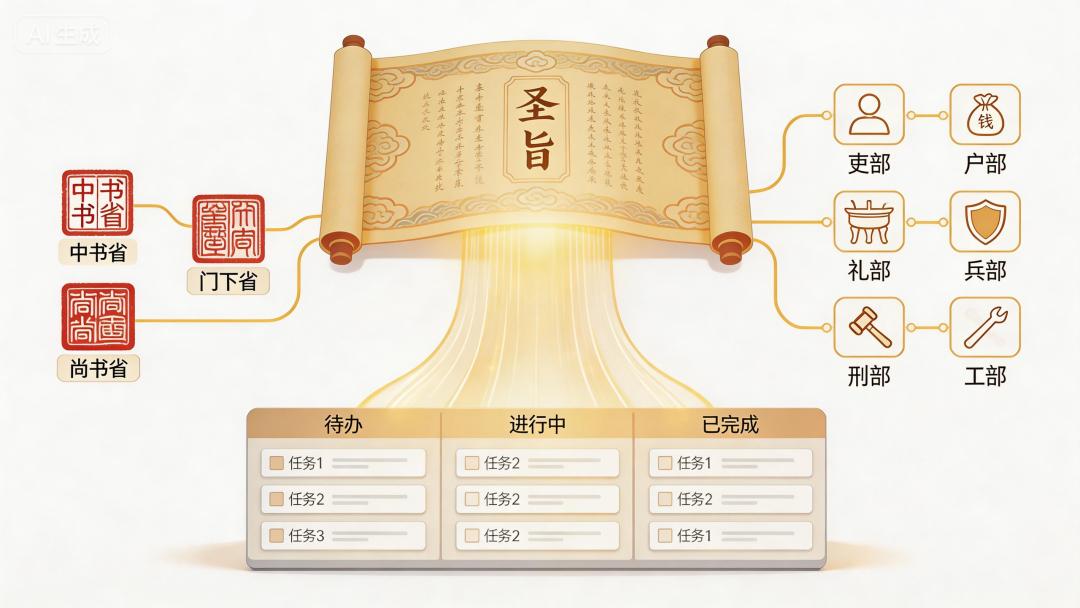
Task flow chart, Produced by: Jimeng
After referring to the "Three Departments and Six Ministries", such problems will be reduced. The planners and executors are separated, and they also restrict each other with decentralized power.
The author emphasizes in the introduction: The routine of most Multi - Agent frameworks is, "Come on, you several AIs talk among yourselves and give me the result when you're done." Then you get a result that you don't know how it was processed, which cannot be reproduced, audited, or intervened.
Under this Three Departments and Six Ministries system, due to the appearance of the Chancellery for review, an AI Agent with a review function is added. The author believes that this is the "killer move" of this system.
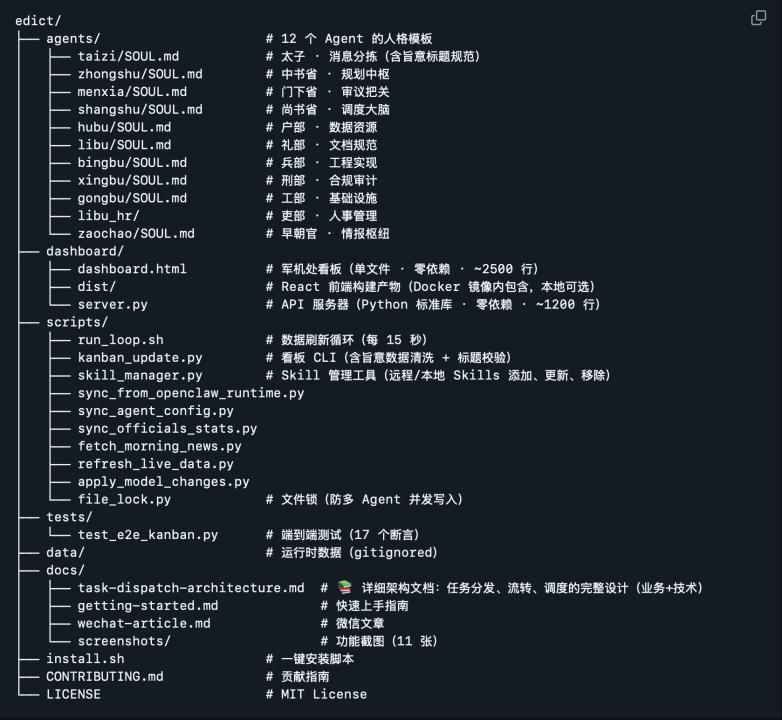
Screenshot of the structure of the "Three Departments and Six Ministries · Edict" project, Source: Github
In the recent trend of "raising lobsters" (referring to AI - related projects), the starting point of enterprises is very clear: to solve problems with AI.
Solving problems depends not on AI rambling, but on AI workflows and SOPs. The hierarchical structure of the "Three Departments and Six Ministries" stipulates that the information flow is one - way and controlled, ensuring that the execution of complex tasks is predictable and traceable.
Structurally, this project is no simpler than OpenClaw - 11 Agents and a dashboard. The "Three Departments and Six Ministries · Edict" project is an upper - layer multi - agent orchestration system built on the underlying capabilities and communication channels of OpenClaw.
The more complex the structure, the more tokens it consumes. It can be understood that the more complex the process and the more subordinates (agents) you hire, the more "salary" you have to pay. And here, "more" means an exponential increase.

Diagram of the design concepts of three different Multi - Agent systems represented by three platforms; Produced by: OpenClaw
Compared with Anthropic's Claude Code and OpenAI's Codex, OpenClaw has a more complex structure.
Codex is declarative. Built on the powerful GPT - 5 series of models, users don't need lengthy prompts to guide its behavior. You just need to tell it the role name, what model to use, and what permission level.
Claude Code belongs to the imperative type. In its structure, what you should do is the key point.
OpenClaw is anthropomorphic, and it has a "soul" under the settings.
How to build this "soul"? In its directory structure, we can see dimensions such as personality (SOUL), memory (MEMORY), and identity (IDENTITY), where your definitions of it and its understanding of you are stored. Under the "Three Departments and Six Ministries · Edict" structure, there are SOUL settings.
This is also the reason why "lobsters" need to be "raised".
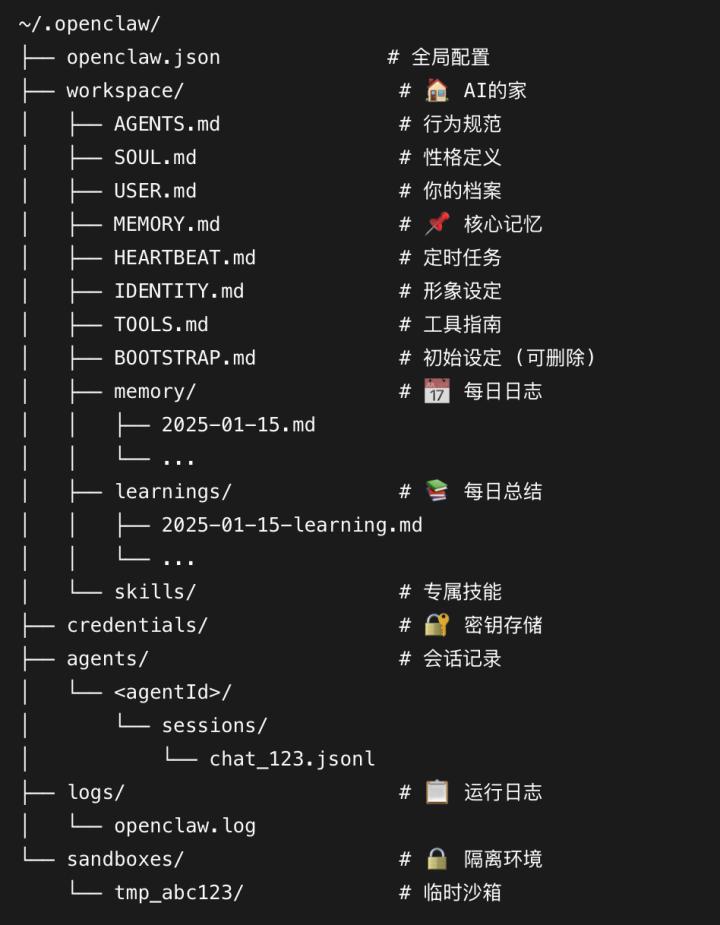
Directory structure of OpenClaw, Produced by: DeepSeek
First, regard it as a "fun" experiment.
At the end of 2025, a "weekend project" named Clawdbot (later renamed OpenClaw) by an Austrian developer Peter Steinberger was quietly launched. No one expected that this project would gain more than 250,000 GitHub Stars in just 60 days - surpassing the milestone that React took more than a decade to achieve and becoming the fastest - growing open - source project in AI history.
Its popularity was like a huge rock thrown into a lake, triggering a chain reaction in the entire industry. OpenAI directly entered the game by acquiring the founder of OpenClaw; Anthropic acquired Vercept to strengthen Computer Use.
After the popularity of OpenClaw, a large number of alternative solutions quickly emerged in the domestic market, reducing the deployment threshold to zero.
Domestic cloud providers including Tencent Cloud, Alibaba Cloud, China Mobile Cloud, China Telecom Cloud, JD Cloud, Volcengine, and Baidu Smart Cloud have successively announced their access. Xiaomi also announced that it would develop its own mobile phone "lobster". AI new forces such as Dark Side of the Moon, MiniMax, and Zhipu AI have also successively launched their own "lobsters", such as Kimi Claw, MaxClaw, and the GLM series of Agents.
Also against this background, the anxiety caused by AI has spread from enterprises and practitioners to the general public.
On March 8, "The Ministry of Industry and Information Technology has issued a high - risk warning" topped the hot