Lobster home installation with free clothes folding service? "AI anxiety" has been hyped up to the sky.
“ OpenClaw On-site Installation for Lobster, Local to Beijing, Guarantee Usage Mastery, 500 Yuan, One Free Clothing Folding and Storage Service.”
Recently, similar posts have been increasing on social platforms. Offering on-site installation services for OpenClaw (commonly known as “Lobster” in Chinese) has not only become a popular business but also a highly competitive one.
Although the offer of a clothing folding and storage service when installing the Lobster is as absurd as “on-site sewer unclogging with a freshly stir-fried yellow beef on the spot,” it is indeed a real thing.
From offering additional services, engaging in price wars, and giving away token allowances (simply understood as the AI's call volume), to emotional intelligence tactics like “repeating until understood,” “teaching step by step,” and “being good-tempered and patient,” you can once again believe the saying: Those who get rich are always the ones selling the shovels.
01
OpenClaw is an open-source AI agent framework initiated by Austrian developer Peter Steinberger in November 2025. It was formerly known as Clawdbot and was officially named OpenClaw in January 2026.
After OpenClaw is deployed on the user's personal computer locally, it can connect to large model APIs and various tools to perform tasks such as checking stock prices, posting on Xiaohongshu, and organizing files... With user authorization, it can autonomously execute any complex, personalized tasks for you. It is a real “cyber secretary” capable of cross-platform operations.
For example, for the same instruction “I want to post a Xiaohongshu post about a certain content,” Doubao and Yuanbao can only help you write the content, but OpenClaw can directly call Xiaohongshu to automatically generate and send the post.
In the past, the most you could have on your computer was a QQ pet that only knew to eat, drink, and sleep. Now, there is an all-powerful Lobster. It seems that a new era has suddenly arrived. People who don't want to and dare not miss the opportunity are in a hurry.
There are mainly two ways to deploy the Lobster. One is local deployment, which is equivalent to opening your personal computer to the Lobster, allowing it to access your files and use your social media. The other is cloud hosting deployment, such as cloud services like KimiClaw and MaxClaw, or hosting solutions based on cloud platforms like Alibaba Cloud, which are fully maintained by professional service providers.
The recently popular on-site installation services are mostly for local deployment. In fact, the deployment process itself is not difficult. Many users who have no technical knowledge at all can successfully deploy the Lobster on their computers following the steps provided by Doubao, Yuanbao, and Qianwen.
02
So, why do some people still need on-site installation services?
Xiaojun (a pseudonym), who has provided on-site installation services, told Zhiwei that one of his clients was the boss of a startup company. “He actually didn't know what to do after deploying the Lobster. He just wanted to learn about it.”
Xiaojun said that the client provided him with an almost bare installation environment. “A Mac without brew (a commonly used software installation tool for Mac), a very difficult-to-use Node.js (the underlying operating environment necessary for running claw), and an api-key (the authorization key for calling the AI model) that had not been configured before.” During the deployment, the network was also unreliable. “At first, he said he would give me 500 yuan. Later, seeing that I spent so much time on the installation, he gave me 1000 yuan.”
It has to be said that the customer who bought the service seems to view the Lobster installation as a service like going to a foot bath city: the more effort you put in, the more money you get.
Many users who come for on-site installation also said that they specifically want to connect to certain websites/apps, such as connecting to a brokerage software for better quantitative backtesting. One user had already deployed OpenClaw but needed someone who knows how to operate it to help him connect to Telegram.
People who need on-site installation services are either those who have no idea how to operate, are afraid of making mistakes, and may know nothing about how many tokens will be consumed later, and just don't want to miss the opportunity, or those who are really prepared to use it well but lack confidence in some special operations.
Behind these two types of needs, the essence is the ordinary people's sense of technical unfamiliarity and the anxiety of falling behind in the face of the AI agent wave.
Even service providers have started to offer “on-site services.” On March 6th, Tencent held an on-site deployment event for OpenClaw at the Tencent Building in Shenzhen. Nearly a thousand AI enthusiasts came from other cities to line up. Engineers provided users with one-stop installation, model configuration, and skill unlocking services on the spot. It is rumored that Ma Huateng posted on his WeChat Moments after seeing the event, saying: I didn't expect it to be so popular.
The event was free. It was more like a technology popularization activity, but it also proves that AI anxiety is real.
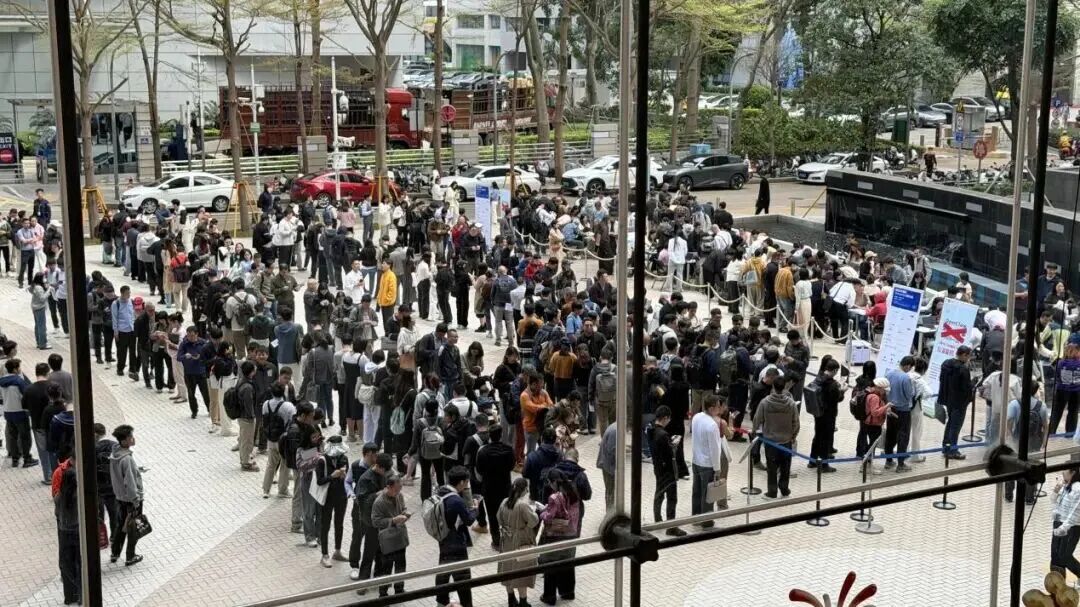
Tencent Building in Shenzhen on March 6th. Image source: Shenzhen News Network
03
Looking back at the early days of our entry into the Internet era, there were also a group of people providing on-site computer installation and system assembly services. However, the on-site Lobster installation in the AI era is not an exact repetition of the past.
Back then, installing a computer was to solve the basic technical problem of whether the device could be used, which was a standardized hardware and software setup. Now, installing the Lobster solves the anxiety problem of whether ordinary people dare to use it and can keep up with the AI era with peace of mind.
To put it simply, many people who buy the Lobster installation service are buying a sense of certainty to fight against AI panic. They are afraid of missing out on the Internet 20 years ago or Bitcoin 10 years ago.
Those who sell the shovels naturally know that what they are selling is certainty, and this certainty comes from the information gap.
By opening social platforms, you can easily find sellers in your city who can come to your place to install OpenClaw at any time. Most of them charge 500 - 1000 yuan, and remote deployment can be done for less than 100 yuan. In fact, there isn't much competition among the sellers. Even for local businesses, they are all small-scale. However, the sellers have still come up with many packages.
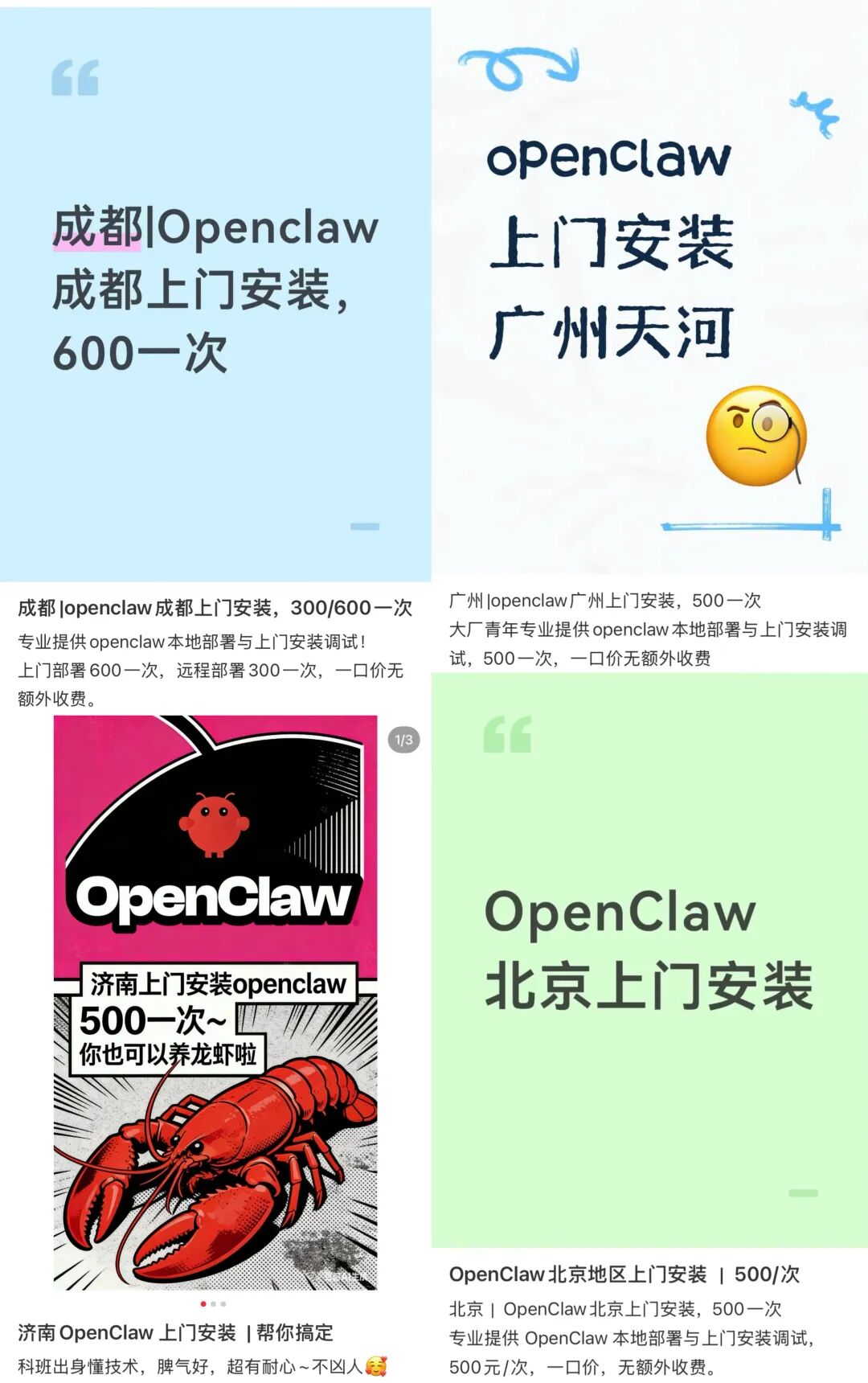
On-site installation posts on Xiaohongshu
Offering housekeeping services is a bit too abstract. They mostly provide technical increments. For example, after on-site installation, they provide a certain amount of tokens to ensure that users can run it at zero cost for a period of time. They also provide detailed Q&A documents and targeted solutions. If necessary, they can even offer monthly subscription services to solve any subsequent problems.
There is also another way to make money. Some people offer free on-site Lobster installation but provide APIs. If users need an API, they can get it from them, and they can make a profit from the API price difference. Some people have also started selling skills (which can be understood as apps that can be directly called within the Lobster) to target users who have already deployed OpenClaw but don't know how to use it, aiming to make long-term profits.
In short, besides the token fees generated by calling the large model during the use of OpenClaw, there are people “selling shovels” throughout the entire process.
The sellers believe that they are providing literacy services. Put simply, the better the user's foundation, the less money they charge. But if, like the user Xiaojun encountered, there is no basic configuration environment at all, they have to pay more for the information gap.
“It's all about the information gap, targeting those who are afraid of ‘doing it themselves’ and ‘code.’” One seller said so.
Zhiwei learned that there is even an organized service for on-site OpenClaw installation now. Some people specifically recruit those who can do the deployment and help everyone take orders in a group. The “platform-type” person who helps take orders actually wants to use the Lobster installation as a hook to accumulate a group of technical personnel with the aim of taking more development business orders.
Ultimately, both the supply and demand sides in this OpenClaw-related business essentially earn and spend money driven by the anxiety of the AI era. A group of people gather out of fear and make deals out of anxiety.
However, this fear is just the most superficial emotion. When the installation is completed and the anxiety is temporarily relieved, more real problems emerge:
Can those who even need on-site installation services really know how to use OpenClaw well in the long run?
Zhiwei found an extremely absurd case in an OpenClaw communication group:
A user said that he had someone else deploy it and connected to Feishu, but he himself couldn't tell if the Lobster was really installed correctly. He asked others if what he installed was “the genuine version.”
When seeing such a case, a colleague in the editorial department slowly typed a: ?
A person who has been following the AI industry for a long time told Zhiwei that OpenClaw is currently just a geek toy. It can be used as a local life assistant, and it can handle tasks like chatting, summarizing messages, and ordering takeout without any problem. However, when used in business, it has a high degree of randomness and risks. “You can give it a try, but it is recommended to have manual supervision. When connected to the Internet, it is also prone to prompt injection attacks, such as adding a sentence in the webpage asking for your API key or the owner's bank card information. Moreover, the token consumption is very high and costly, and these users may not easily notice this. Also, the security of skills is a problem. Many of them contain malicious code and are almost like a den of viruses.”
Someone described the false demand in the Lobster craze like this: Walking around the street with a hammer looking for nails.
Meanwhile, the relevant service providers still want to give everyone a hammer.
A person who provides on-site installation services told Zhiwei: “There will soon be a foolproof installation method. This isn't worth doing. I estimate that in three to six months, the technological gap will disappear. Now, many Internet companies are already natively supporting OpenClaw, which means that the so-called configuration won't be necessary anymore.” In his opinion, although they are all selling AI services, the real money-making opportunity lies in enterprise AI efficiency training. “The profit can last for three to five years.”
As of the time of writing, Tencent has already invited users for an internal test of a ready-to-use, automatically deployed OpenClaw service.
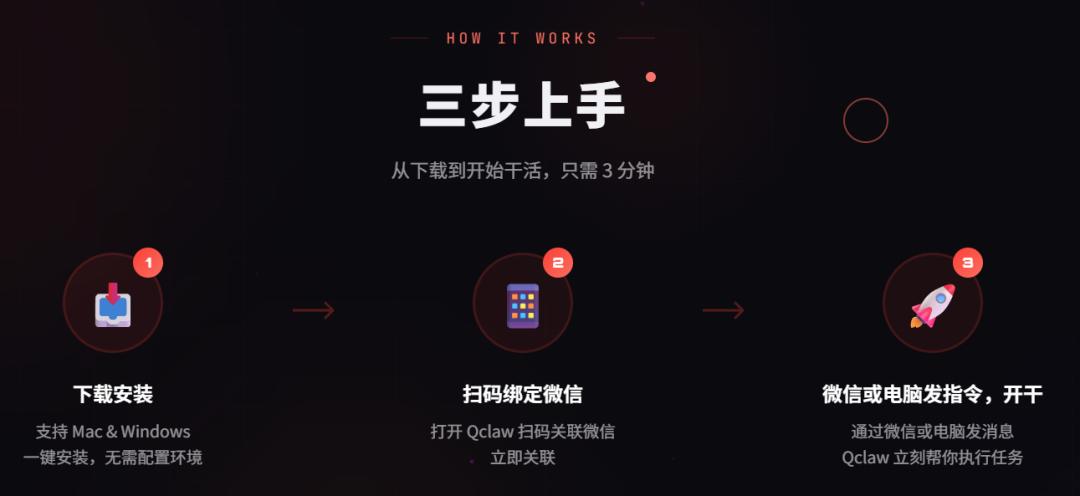
That is to say, many people who buy the on-site installation service may lose 500 yuan on the installation fee before they even taste the benefits.
Let's return to the issue of AI anxiety itself. Anxiety is not a positive emotion. It can give rise to fear and make people make irrational decisions. Without clearly understanding what OpenClaw is and what it can do, they rush to install it and pay, which may lead to problems such as privacy leakage and high token consumption without any output.
Objectively speaking, anxiety always comes first when any disruptive technology emerges. However, this AI anxiety is completely different from the anxiety during the Internet era. The Internet was a revolution in connection, changing the information carrier from paper to global network interconnection, which was an expansion of boundaries and exciting. AI is a revolution in capabilities, with the emergence of tools that can think and work for people on top of the Internet.
Last time, people would say: With the Internet, what can't I do? This time, it's: With AI, what can I still do?
Therefore, when facing the Lobster and various “Lobster-like” things, the first thing we should think about is not “I have to install one first,” but “I have to think about what I can do first.”
This article is from the WeChat official account “Zhiwei”, written by the editorial department of Zhiwei, and is published by 36Kr with authorization.