The Rise of a New King on GitHub: How was OpenClaw Developed?
In just three months, it has amassed 260,000 stars. An open - source project named OpenClaw, without the backing of tech giants or the shine of celebrity status, has ignited the enthusiasm of developers worldwide with just a simple description: "Let AI truly work on your computer."
Its inception stemmed from a developer's personal experiment to address the issue of AI being "all talk and no action." Today, this experiment has evolved into a paradigm shift involving developers globally. AI is transitioning from being a "conversationalist" to an "executor," moving from the cloud to local devices, and from being "all talk" to being "action - oriented."
The protagonist of this story is an independent developer who "codes in a cave." And its audience consists of every creator eager to make AI truly work for them.
01 The Phenomenal Growth from Open - Source to 260,000 Stars
The OpenClaw repository, created on November 24, 2025, has set a phenomenal growth record on GitHub.
Its star count soared from 100,000 to over 200,000 in a short period. As of now, it has reached 264,000 stars, ranking among the top of the global open - source project star list in just over three months, continuously attracting the attention of developers worldwide.
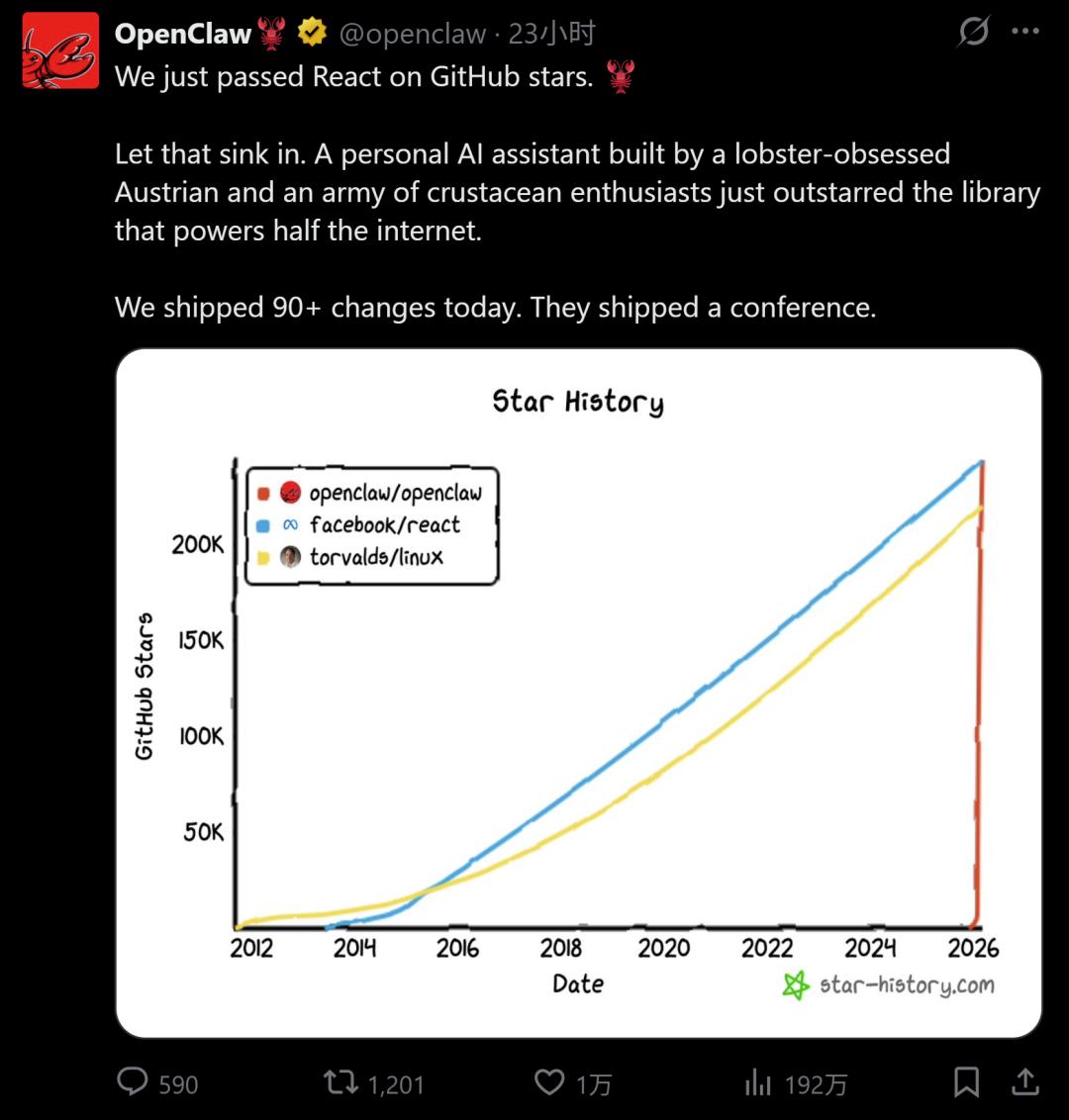
From one person's crazy trial - and - error to the collective observation and co - construction of hundreds of thousands of developers, the growth trajectory of OpenClaw itself is the best footnote to the power of developers in the AI era.
This is not a typical open - source story.
Without the support of tech giants, the halo of celebrity entrepreneurs, or even a decent product launch, OpenClaw started as an empty repository named openclaw/openclaw (formerly known as Clawdbot, Moltbot) on GitHub. The first commit was a simple README: "A framework that enables AI to truly work on your computer."
It was this plain description that hit the sore spot of the collective anxiety of developers worldwide.
In the past three years, the AI industry has been caught in a strange paradox. The parameter scale of large models doubles every quarter, and benchmark scores keep hitting new highs. However, the applications that ordinary developers can actually build are still limited to a few scenarios such as "chatbots," "content generation," and "code completion."
The problem lies in permissions. No matter how intelligent the cloud - based AI is, it cannot read your local files, operate your database, or call your private APIs.
OpenClaw breaks this deadlock by granting AI local execution permissions. It adopts a local - first architecture, allowing AI to perform the above operations directly. This ability has made OpenClaw quickly popular on GitHub. After its launch, it has maintained steady growth, and the number of Skill repositories has continued to increase, covering multiple professional fields such as development, design, and data analysis.
"Many people think OpenClaw became famous overnight, but behind it is ten months of crazy trial - and - error," admitted Peter Steinberger, the creator of OpenClaw, in an interview. This developer, who once developed PSPDFKit and successfully sold his company, was reignited by the possibilities of AI technology after a period of rest.
What really convinced Steinberger that OpenClaw had a high market fit was the "emergent ability" demonstrated by the AI agent. He recalled a key case in the interview: One day, someone sent a voice message to his AI agent. According to the original program logic, the AI did not have the ability to process this unknown audio file. However, a surprising thing happened: the AI started showing "typing."
"I was thinking, I never wrote this function. How could it work?" Steinberger recalled. When he asked the AI how it did it, the AI's answer revealed the autonomous planning ability of the current large models: "You sent me a file without a suffix. I checked the file header and found it was in Opus audio format, so I called FFmpeg on my computer to convert it. I wanted to transcribe it, but you didn't have Whisper installed, so I searched around and used the curl command to send the file to OpenAI's interface and got back the text."
This detail is extremely insightful. AI has moved beyond the stage of "you ask me to write a piece of code" and evolved to "you give me a problem, and I'll autonomously call the system toolchain to find the answer." This is exactly the core problem that OpenClaw aims to solve: to give AI execution permissions and allow it to operate the computer like a human.
Based on this concept, OpenClaw has built a solution from three dimensions: architecture design, permission management, and capability expansion. It adopts a local - first architecture to ensure that all code, data, and memory run locally without relying on cloud APIs; it establishes a transparent permission management system to let users clearly understand the permission boundaries of AI; and through the plug - in "Skills" mechanism, it enables developers to endow AI with any new capabilities.
These three technical choices, seemingly targeting specific problems, actually touch on the deep - seated issues in the industry. The local - first approach challenges the inertia of cloud - native development, transparent permission management reconstructs the trust relationship between humans and machines, and the plug - in mechanism redefines the way developers collaborate. When these designs are integrated into a framework, they are no longer just technical solutions but become a declaration of a new paradigm.
Once, these designs only existed in Steinberger's personal requirement list. Now, they have become the common language for global developers to build AI executors, driving countless ideas from personal imagination to real - world applications.
But what really sets this story apart from the typical open - source project is the industry - wide thinking it has sparked.
02 From "Conversational AI" to "Executive AI"
The traditional paradigm of AI development can be summarized as "cloud - native, API - driven." Developers call the APIs of cloud - based large models, the models return text or code, and developers then integrate these results into their own applications. The bottleneck of this paradigm is obvious: the "behavioral ability" of AI is limited to the capabilities provided by the APIs.
OpenClaw's innovation lies in transforming AI from a "conversationalist" to an "executor."
The foundation of all this is a brand - new permission system. In the past three years, the AI industry has been focused on improving the "brain" (models), but no one has given AI "hands and feet." OpenClaw's contribution is that it provides a safe and controllable "hands - and - feet system." Through operating - system - level permission management, it allows AI to perform operations on behalf of the user. The innovation in design philosophy is groundbreaking: for the first time, "AI permissions" are designed as a first - class citizen.
In OpenClaw, each Skill needs to clearly state what permissions it requires, such as reading files, writing files, executing commands, and accessing the network. When users install a Skill, they will see a clear permission list, just like the permission requests when installing a mobile app. This transparency has completely changed the user trust model. Previously, users didn't know what AI was doing behind the scenes. Now, they can have precise control.
The liberation of permissions has brought about an exponential leap in productivity. In the past year, Steinberger alone has made more than 90,000 code commits on GitHub, spanning over 120 projects. This level of efficiency is unimaginable in the history of human software engineering.
"A year ago, this was absolutely impossible. No model could enable a single person to build something of this scale," Steinberger said bluntly. His workflow is extremely simple: he drags a 1.5MB Markdown document containing all code files into the AI model, directly writes "Write me a technical specification," and then enters "Build." In the process, the AI will even write its own testing tools to go through the login process and check for errors along the way.
"Every time I start using this new technology, it gives me a dopamine rush. I suddenly realized that now I can build almost anything," Steinberger said.

This directly addresses the core pain point in the current software industry: R & D costs. Previously, a complete team consisting of an architect, front - end developer, back - end developer, and tester was required to run an MVP (Minimum Viable Product). Now, a single person can complete it within a few hours.
More fundamentally, it represents a shift in the development paradigm: from "writing code" to "defining intent." When code can be easily generated, "writing code" itself loses its barrier. Steinberger jokingly refers to current open - source contributions as "Prompt Requests." After getting someone else's code, his first question to the AI is: "Do you understand the intent of this PR?" Then, he will discuss with the AI via voice whether it is the optimal solution and if there are any architectural issues. After the discussion, the AI will generate and merge the code with a single click.
"Most code is boring. It just transforms one data shape into another. I don't really care about the code. I care about what problem this person is trying to solve," Steinberger explained.
This paradigm shift indicates that the essence of software development has changed from "mastering programming languages" to "clearly defining problems and managing system architectures."
"Most code is boring. It just transforms one data shape into another. I don't really care about the code. I care about what problem this person is trying to solve," Steinberger explained again.
This paradigm shift indicates that the essence of software development has changed from "mastering programming languages" to "clearly defining problems and managing system architectures." Steinberger said bluntly that developers who still write code manually in the old - fashioned way (what he calls VIP coding) will be eliminated.
"People don't realize that GPT - 5.2 represents another quantum leap in terms of 'this thing can run directly'. I'm still amazed at how well it works," Steinberger said in an interview.
03 Security Controversies and Open - Source Dilemmas
The rise of OpenClaw has sparked a profound debate about security and open - source within the AI industry.
Regarding the future of OpenClaw, Steinberger aims for a balance: "I want to find a balance between 'even my mom can install it' and 'fun and hackable' - it's very difficult."
He described that OpenClaw's long - term default installation method is actually quite "anti - conventional open - source": After a git clone, the source code is on the local machine. The agent "sits in the source code and knows the source code." If you're not satisfied, you can "simply prompt it to modify itself," which is similar to "self - modifying software." However, this also magnifies the security contradiction.
"The issue of prompt injection has not been resolved," Steinberger said bluntly, while complaining that the outside world ignores the usage boundaries. The web service in the project was initially only intended for debugging in a "trusted internal network," but some people insisted on exposing it to the public network. Then the security community criticized it for "lacking the necessary login restrictions for the public network."
"I've been shouting 'Don't do this' in the security documentation, but people still do it," he said, adding that he has introduced security experts. His current goal is to "support these usages while preventing people from making big mistakes."
Steinberger shared an interesting phenomenon in an interview: "People often ask me, 'Can you introduce me to your CEO, HR, or other team members?' I reply, 'It's just me. I'm just coding in my "cave."'"

"But this just shows their cognitive dissonance. Because this project doesn't seem like something any single person could have accomplished," Steinberger said. Of course, he now has maintainers and receives many code merge requests (PRs), but it's still mainly his work.
"Even a year ago, this would have been impossible. A year ago, there wasn't even a model that could enable a single person to build a project of this scale. This goes beyond people's original understanding of this field."
The logic is clear: If developers can run AI locally and let it directly operate the system, why pay expensive API call fees? Especially for scenarios that require frequent interaction and long - context, the cost advantage of cloud APIs is rapidly disappearing.
The more far - reaching impact is the reconstruction of the business model. The profit model of traditional AI companies is based on "charging by token," while OpenClaw's local - running model makes the token cost approach zero (only requiring the one - time cost of downloading the model).
In the traditional AI development paradigm, developers need to be proficient in AI models, backend engineering, and front - end interaction. However, OpenClaw's Skill mechanism allows developers to focus on "defining tasks" rather than "implementing technologies."
"Most people make their setups too complicated," Steinberger pointed out. "I used to do the same. I call it the 'Agentic trap.' From the moment you first encounter this new technology to the time when you become really efficient, many people fall into this trap, trying to optimize their environment configuration extremely. In fact, this doesn't make you more productive; it just makes you 'feel' more productive."
Steinberger believes that the beauty of open - source lies in that "people can accept it and come up with ideas you never even thought of." But this is also the crazy part - you can't fully control how people use your tools.
He is now facing more than 2,000 open - source code merge requests (PRs), but the way he reviews these PRs has completely changed. He no longer reads the code line by line but lets the AI review it. He focuses on the intent behind the PR rather than the specific code implementation.
"Reviewing a PR takes even longer than writing the code myself. Because I'd rather trust the model to be non - malicious than a random external contributor I've never heard of or communicated with," Steinberger admitted.
04 The New Era for Developers
OpenClaw's ascent to the top of GitHub in three months is just the beginning of a bigger story. The core of this story is the arrival of a new era for developers.
Behind this transformation is a fundamental reconstruction of the developer's skill set.
In the past, the core competitiveness was proficiency in programming languages, frameworks, and toolchains. But in the era of AI agents, the focus is shifting from 'how to implement' to 'what is needed.'
Industry observations show that the work mode of the new generation of developers has changed significantly. Among developers who use AI - assisted programming, more than 70% say that the time they spend on "problem definition and architecture design" has increased by more than 40%, while the actual coding time has decreased accordingly.
The view of a professor at Stanford University is quite representative: "In the future, the best developers will not be those who are best at writing code but those who are best at describing problems to AI."
And the foundation of all this is the reconstruction of trust. One of the biggest pain points in traditional AI applications is the lack of trust - users don't know what AI is doing behind the scenes. OpenClaw turns AI from a "black box" into a "transparent toolbox" by requiring each Skill to clearly state the required permissions and presenting the permission list clearly during installation.
Enterprise feedback validates the importance of this design. A fintech company pointed out in an internal evaluation report: "OpenClaw's permission system allows us to precisely control the access scope of AI, which is crucial for compliance - sensitive financial applications." This controllability greatly reduces the risk concerns of enterprises when deploying AI.
This change is also reshaping open - source itself. OpenClaw represents a new open - source paradigm: it is no longer just about sharing code but sharing the capabilities of