The 0.99 yuan dark personality test has gone viral, and some people earn over 10,000 yuan a month from it.
Author | Huang Shiyun
Editor | Zhu Renfeng
Header Image | pexels
What can you do with 0.99 yuan? You can find out if you're a "Spiritual Pearl" or a "Demonic Pill."
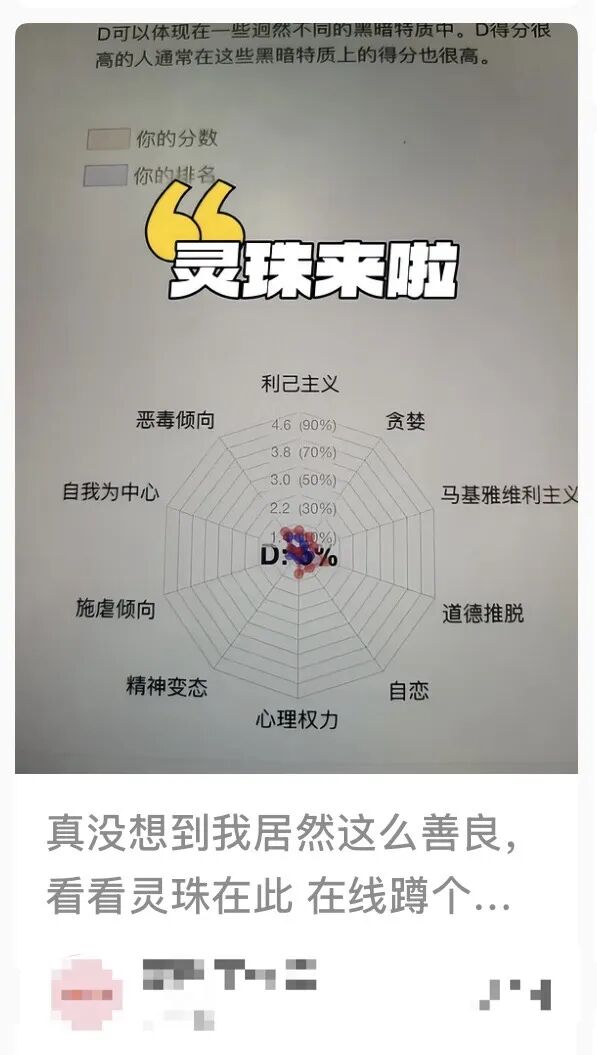
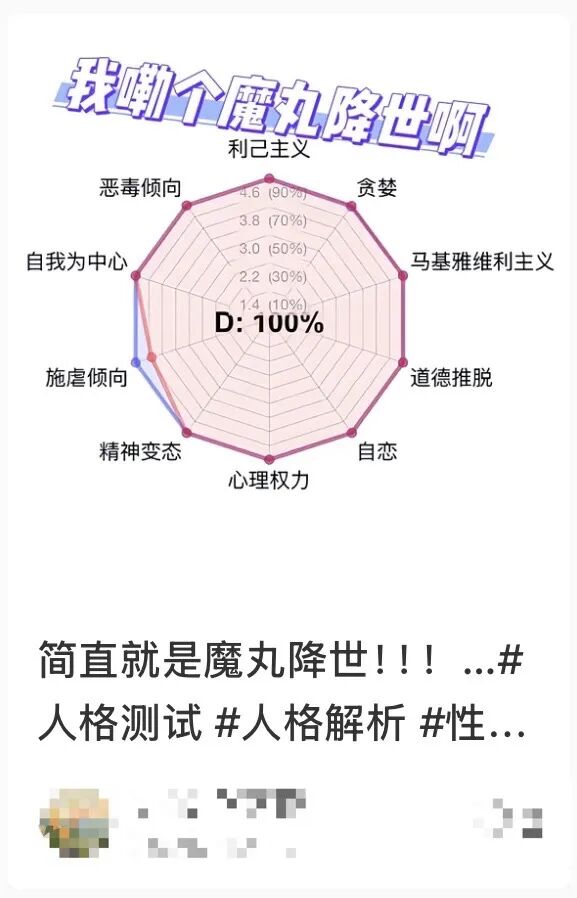
The "Ne Zha" series of animated movies probably never imagined that its two most popular terms would be associated with the "Dark Triad Personality Test."
For just 0.99 yuan, you can take this test. It takes about 10 minutes to complete 70 questions, and then you'll get your own Dark Triad personality test report.
(Image/Screenshot from social media)
(Image/Screenshot from social media)
Not only for the dark personality, but also for your natural talents, preferences in older/younger partner relationships, your destined city, emotional possessiveness, and even attachment styles, NPD personality, etc., you can take a test for just 0.99 yuan.
Thus, driven by the mindset of "you won't lose out," a wave of 0.99-yuan psychological tests has quietly swept across social platforms.
Why have these paid tests become so popular on social platforms? Why are we so fascinated by this way of testing? Can a 0.99-yuan test really help us understand ourselves?
For 0.99 yuan, some place orders without a second thought, while others start businesses to make money
"The things you're physiologically interested in are your natural talent tracks!" When I saw this title, I couldn't help but wonder: What does "physiologically interested in things" mean?
So I clicked on the post, scrolled to the end, and naturally clicked on the product link for the "Natural Talent Test." Then I paid the money and became one of the 26,000 orders.
This self-test has a total of 40 questions and can be completed in about 5 minutes. The final result shows that I belong to the media and art type. It also rates my talents in 10 aspects such as language, logic, arithmetic, and space, and then classifies them as highly proficient, somewhat proficient, and not very proficient, so as to interpret my core strengths and growth potential.

Explanation of the "Natural Talent Test." (Image/Test screenshot)
This kind of test is not new. A few years ago when I was applying for college, I also took a test through the college application simulation system. The result showed that I was suitable for auditing. But in this test, the auditing profession was marked as a "direction to be cautious about."
In the product review section, some people sighed that "this is the most accurate version I've ever taken," while others pointed out that "the questions are not very professional and the directivity is too obvious." But most people's attitude is "just for fun, it's not expensive, just for a laugh."
After that, out of curiosity, I also bought the Dark Triad personality test from this merchant. The link provided by the merchant introduced that this test has two theoretical bases, namely the Dark Triad theory proposed by Paulhus and Williams, and the D-factor theory proposed by Moshagen and others. The Dark Triad includes three related but independent personality traits: Machiavellianism, narcissism, and psychopathy, while the D-factor reveals the common core of a wider range of dark personalities.
After finishing the questions, I got another report, which included the D-factor score, a visual chart of trait distribution, interpretations of the three dimensions of the Dark Triad, as well as a personality portrait, impacts on life areas, analysis of advantages and disadvantages, and development suggestions.
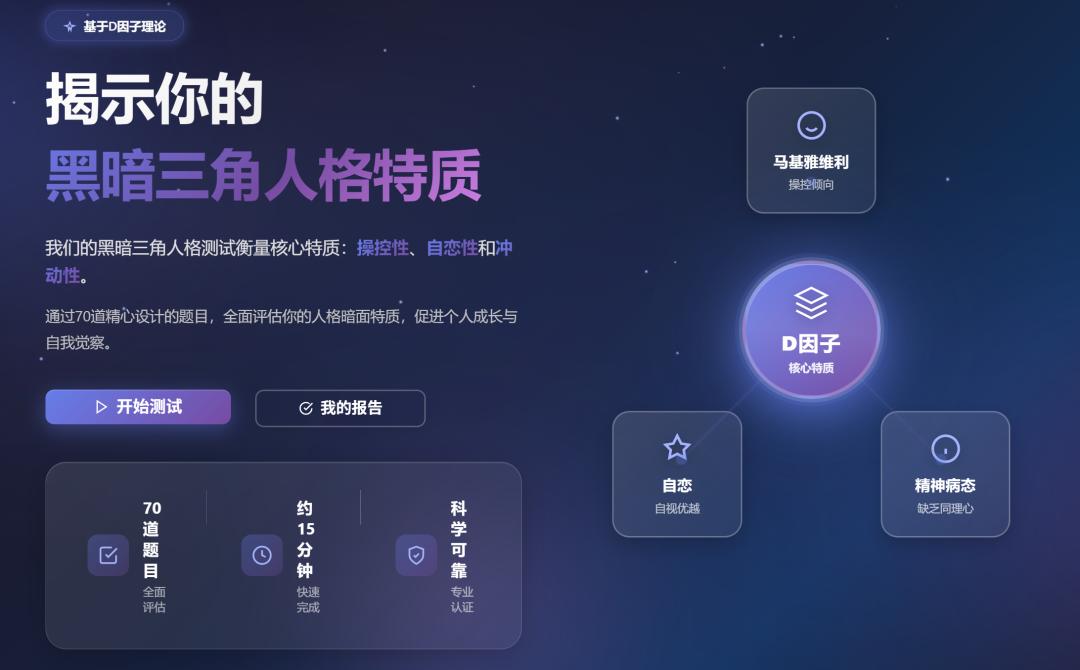
Explanation of the "Dark Triad Personality Test." (Image/Test screenshot)
After that, I saw more and more evaluations on social platforms. Many people spent 0.99 yuan to find out whether they were more suitable to develop in Shanghai or Guangzhou, whether their personalities were more like a lion or a brown bear, how much they liked their partner before a relationship, and what their psychological age was.

(Image/Screenshot from social media)
In addition, with the popularity of concepts such as NPD, BPD, and ADHD, some tests with a medical or psychological diagnostic meaning are also very popular.
Take the "Self-assessment List of Narcissistic Personality Traits" and the "Assessment List of Others' Narcissistic Personality Traits" in a certain store as an example. As of 4 p.m. on February 10, 2026, the two questionnaires had sold 5,778 and 9,021 copies respectively.
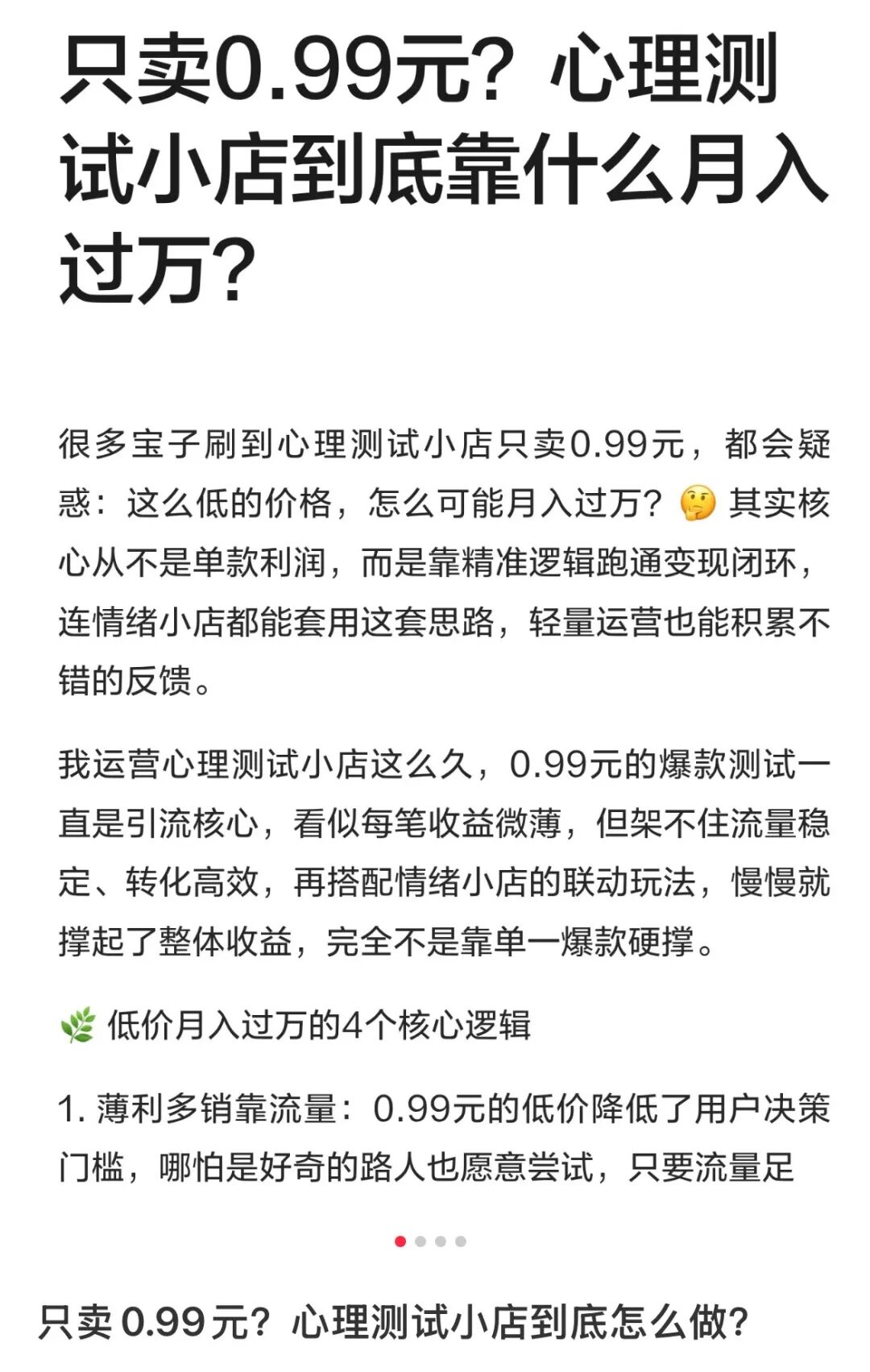
Driven by this wave, some bloggers have listed a detailed operation list for starting a psychological test business, including five major parts: pre - preparation, content operation, after - sales and risk control, execution rhythm, and core advice. It is specific to details such as confirming the cost of each psychological test link, what types of products should be prioritized in product selection, and how many posts should be published at what time each day. Some bloggers also shared their experience, saying that free tests can also be sold, and no one will hold them accountable.
(Image/Screenshot from social media)
This way of making money is actually selling "information gaps." Some media reported that a seller of psychological test links revealed that for just 299 yuan to buy a package, you can get 2,300 psychological test links of 6 types. Then, by selling these links at 0.99 yuan each in an online store, you can start making money.
Taking the test mentioned above that has sold more than 26,000 copies as an example, its sales volume has exceeded 25,000 yuan. In this way, it's very easy to recoup the startup capital.
So, as testers, why are we so eager to spend this money?
Are the "darker" test results more popular online?
Actually, psychological tests related to personal personality have always been very popular. The simplest one is the "What do you see at first sight?" picture test, which claims to be able to instantly measure a person's psychological state and inner personality.
Why do we like to take these psychological tests? There are usually two major explanations for this question.
Firstly, contemporary people are generally in a state of anxiety and face an identity - recognition crisis. By taking psychological tests to get personality categories, people can confirm "who I am" and quickly gain the attention and recognition of the group.
Secondly, there is a psychological concept called the "Forer effect," which is often used to describe that when people face general and vague personality descriptions, they will think that these descriptions accurately reveal their own characteristics and have a feeling of "it's really accurate." Moreover, the more vague these expressions are, the more affirmation and praise we may feel.
In addition, why has the "0.99 - yuan psychological self - test craze" emerged on social platforms recently?
Firstly, it's the price of "0.99 yuan" and the field of "social platforms." Generally, people may think that free tests are the most widely used way. In fact, the tests that you can take and get analyzed immediately after purchasing on social platforms may have a wider penetration range than free tests.
Because in most cases, the cost of free tests is self - searching. You need to screen out a certain test question in a browser with a vast amount of information. But now, after you accidentally finish reading a post that resonates with your emotions, you're likely to come across a paid psychological test, and then complete a test with almost negligible cost and a few minutes of time.
Imagine that on a depressing afternoon, you've been scolded by your boss, and the impulse to quit your job suddenly surges. At this time, when you see "Go for the job you're naturally meant to do," you'll probably click in and spend that 0.99 yuan to test your so - called "talent field."

(Image/Screenshot from social media)
After that, with the help of big data, the platform algorithm will continuously recommend more tests to you, forming a cycle.
This cycle is complementary to a larger media content ecosystem. When the NPD concept became popular because of variety shows, posts with titles like "Teach you to quickly judge if someone is an NPD," "Let's count the characteristics of the NPDs I've encountered," and "The characteristics of an NPD's 'blood bag' and how to deal with it" also gained a lot of popularity on social platforms, and the number of NPD assessment tests also increased significantly.
Finally, when you share your test results on social platforms, the loose and less - emotional weak - relationship network actually helps you gather a wider range of recognition. In a space where people don't know each other, there's no need to maintain a long - term persona, no expectations from multiple parties, and no need to worry about the consequences of negative evaluations.
Expressions like "self - centered," "vicious tendency," and "sadistic tendency" in the Dark Triad personality test results may be sensitive words in your WeChat Moments and leave a bad impression on others. But on social platforms, if you show a low D - factor score, someone will praise you as a "kind good baby." If your D - factor score is high, people will just make a joke like "The first episode: The Demonic Pill is born" and laugh it off. At this time, compared with your WeChat Moments, you can get more resonance with less pressure on social platforms.

(Image/Screenshot from social media)

(Image/Screenshot from social media)
The question is, as a tester, can you really laugh off such test results?
Real psychological needs, fake psychological tests?
A few years ago, the MBTI personality test became very popular. Some people worried that this test simply divides people into 16 types, which may ignore the richness and complexity of individuals. Others thought that if used reasonably, it could be a way to understand oneself. More people may just take similar personality tests as a way to "have fun." Therefore, as long as a group of people find it fun, the 0.99 - yuan tests will always have a market.
Now on social networks, some merchants keep using emotional topics and content to attract the attention of platform users in order to start their businesses, gain traffic, and promote sales.
For example, to attract you to take the "Attachment Style Test," they'll say "Anxious attachment is the real ceiling of pure love." To make you buy the "Childhood Trauma Type Test," they'll say "Loving to take care of others is actually a sequela of trauma." To sell the "Symptom Checklist 90 (SCL - 90)," they'll say "I said I'm depressed, but they all think I'm faking it."

(Image/Screenshot from social media)
If you've ever had a fear of being abandoned in an intimate relationship, if you've been thinking about the trauma from your original family recently, or if you've been feeling down and losing interest, then you may buy these tests when you see this content.
However, the rigor of the content guiding these tests needs to be questioned: Where does the correlation between anxious attachment and pure love come from? Does loving to take care of others necessarily mean it's the result of childhood trauma? Can depression be diagnosed through 90 questions?
When self - awareness becomes commercialized and fragmented, we can't just "have fun."
Last month, some media exposed the tricks of online "pseudo - psychology." Some videos summarize the characteristics of a certain personality or psychological problem, and under the guise of diagnosing psychological problems for netizens, they launch paid evaluations, high - price psychological courses, and so - called psychological counseling services