OpenClaw stirs up a lobster craze: The singularity moment of Action ASI! A global transformation for workers.
Editor: Rhino
OpenClaw is the "most important" software release of our era!
Just now, Jensen Huang excitedly stated at the Morgan Stanley Conference.
"This proves the true power of Agentic AI," he said.
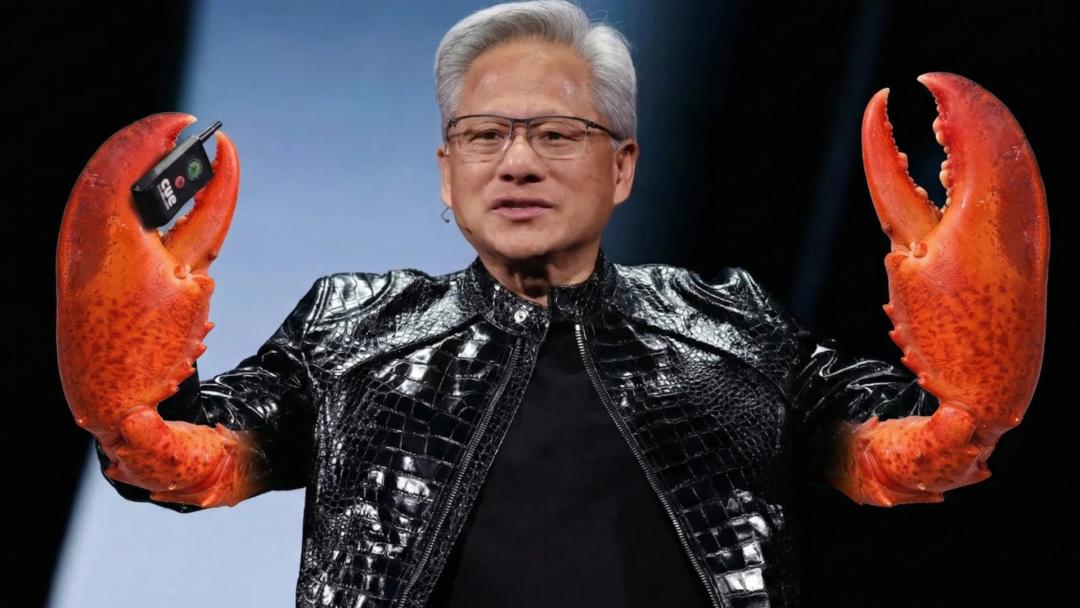
Jensen Huang
In March, this lobster climbed to the throne of GitHub at a speed never seen in human history.
It was officially crowned the number one in the history of the GitHub software project star list.
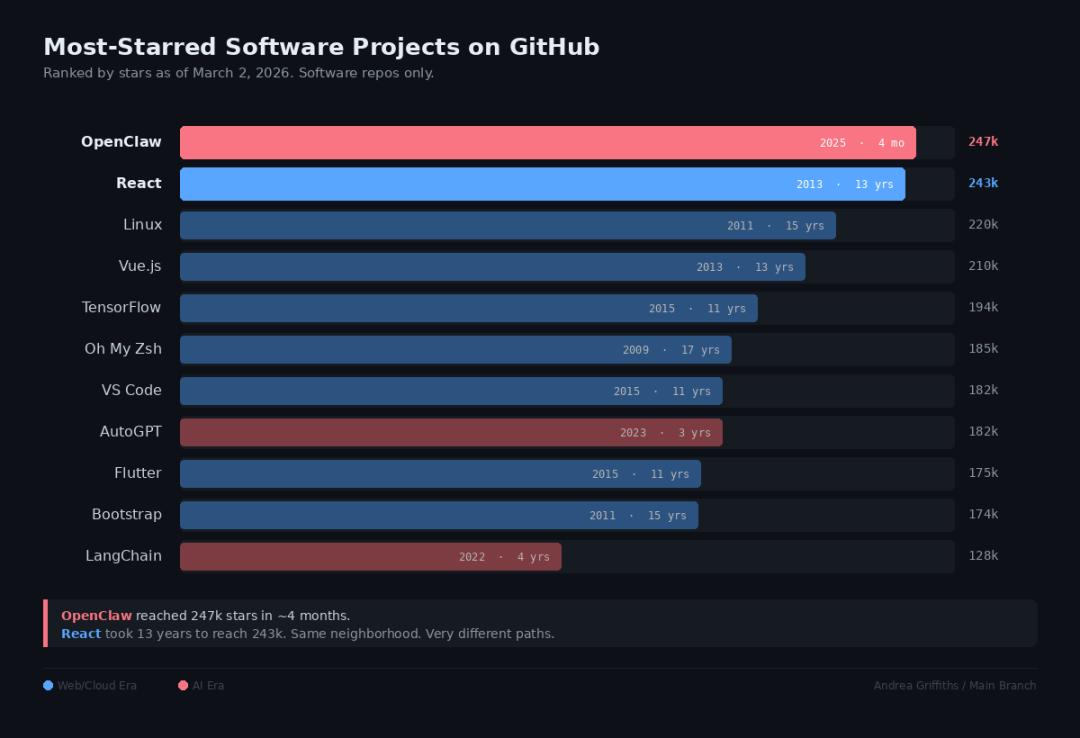
GitHub software project star list
It took React thirteen years, tempered by countless job requirements, enterprise architecture selections, and training courses, to accumulate over 240,000 stars.
OpenClaw reached the same height in just 100 days.
With the explosion of OpenClaw, the amount of Tokens consumed by global users on AI Agents has skyrocketed by a full 1000 times!
This is not an ordinary popularity of an open - source project. This is a signal - a singularity more intense than the programming singularity is tearing apart the world we are accustomed to.
We temporarily call it: the Action Singularity.
Claude Code and Claude Cowork prove that AI can independently create software - level products, while OpenClaw proves that AI can directly take over the human operation interface to perform tasks.
The former changes the way developers work, while the latter will change the way everyone works.
These two forces are converging at an exponential speed.
The moment of convergence is the present moment we are in.
The Programming Singularity: How Claude Made "Software Engineering is Dead"
The story begins with a "SaaS Doomsday."
On January 29, 2026, Anthropic added 11 new plugins to Claude Cowork.
Note, these are not new models, just 11 plugins.

Claude
They cover multiple fields such as sales, finance, law, data, and marketing, and have plunged the tentacles of AI into the core business processes of all industries at once.
Overnight, global software stocks collectively tumbled, with a market value evaporation of 30 billion US dollars.
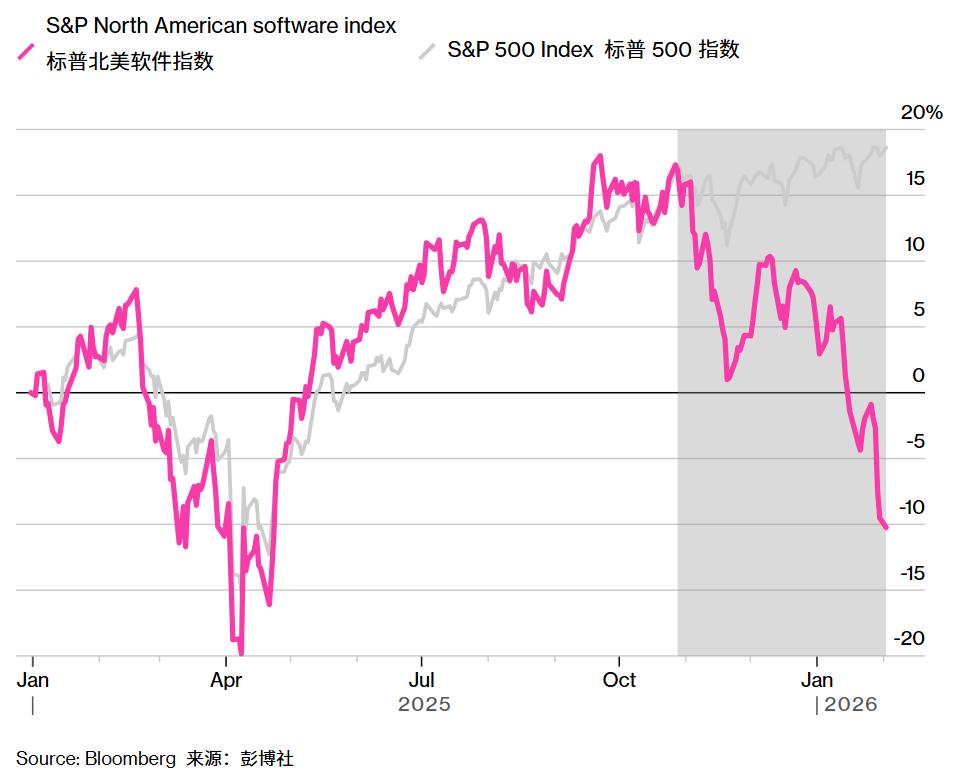
Global software stocks collectively tumbled
Wall Street gave this disaster a name: SaaSpocalypse - the SaaS Doomsday.
JPMorgan Chase issued a statement exclaiming that Anthropic is devouring the entire world.
Reuters statistics show that since January 28, the stock prices of software and services have evaporated nearly 830 billion US dollars.
From the US stock market to Europe to Asia, from Oracle to Salesforce to Indian IT giants TCS and Infosys, the entire software industry chain has collapsed like a row of dominoes.
The logic behind all this is extremely simple: When Claude Cowork can independently read files, organize information, and complete end - to - end legal contract reviews, it is no longer an "assistant" to SaaS software, but a "replacement" for SaaS.
One Claude intelligent agent can handle the workload of 10 junior accountants or legal assistants.
A company that originally needed to purchase 100 Salesforce seats now only needs 10 Claudes. Seat fees are the lifeline of SaaS companies, and AI is precisely cutting it with a scalpel.
Meanwhile, the storm that Claude Code has stirred up in the developer community is equally suffocating.
SemiAnalysis even believes that the AI fanatics on the tech Twitter haven't hyped up Claude Code enough.
The reason is simple: Humans are linear thinkers, but the development of AI is exponential.
Draw a best - fitting curve, and you can foresee how high the AI programming intelligent agent will reach in six months.
An engineer at Anthropic admitted, "I don't write code anymore. I just let the model write code and then edit it."
CEO Dario Amodei even gave a clear timeline: "It may take another 6 to 12 months for the model to fully do what software engineers do."
This is the programming singularity.
Now, AI has eliminated the friction between "ideas" and "finished products."
But the programming singularity mainly changes developers - those who originally deal with code.
What really causes a drastic change in everyone's lives is another more violent force.
The Action Singularity: From Writing Code to Doing Work for You
If Claude Code and Claude Cowork represent the "programming singularity" - AI has learned to create software.
Then OpenClaw represents the "action singularity" - AI has learned to directly operate your computer, your phone, and your entire digital life.
The gap between the two is much larger than many people imagine.
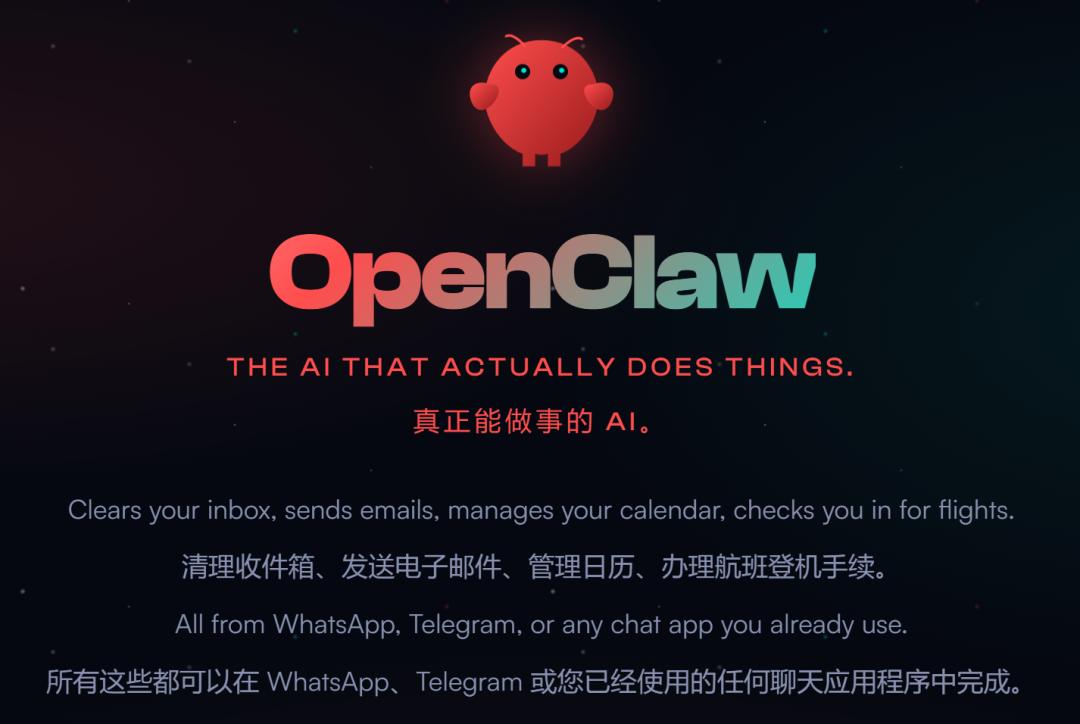
OpenClaw
Users of Claude Code still need to know "what I want to create."
You need to have requirements and a plan, even a vague one. You are the director, and AI is the construction team.
But OpenClaw is different.
It doesn't help you create tools. It directly picks up the tools and does the work for you.
It connects to your WhatsApp, Telegram, Discord, and Feishu. Your computer becomes a sandbox where it can freely play in its eyes.
Executing terminal commands, reading and writing files, sending and receiving emails, managing schedules - all are completed in a natural conversation.
You don't need to understand code, don't need to understand APIs, and don't even need to know what an operating system is.
You just need to say a human - language sentence - this is what will change everyone.
The reason why OpenClaw topped GitHub in 100 days is not that it is more important than Linux in terms of technology - rationally speaking, Linux still supports the vast majority of servers globally, which is the stable pulse of the Internet.
OpenClaw's topping is because it ignited something far more powerful than technology: ordinary people's longing and fear for the future.
Previous star projects such as Vue, Go, and Kubernetes followed a top - down promotion logic: technology managers make decisions, and teams follow up.
The spread of OpenClaw completely crosses technological barriers.
On social networks, you can see two completely different pictures: a design supervisor on maternity leave uses it to handle all daily chores on her phone with one hand; a mother lets it automatically plan meals and pick up and drop off children in the WhatsApp family group.
Meanwhile, hardcore developers are busy transforming it into a 24/7 automatic code - writing machine.
This "mass participation" scenario is unheard of in the open - source world.
What Can OpenClaw Do?
To understand the true meaning of OpenClaw, we need to shift our perspective from the "function list" to the "technical architecture" level.
In terms of technical essence, OpenClaw is a localized AI intelligent agent orchestration framework.
It can have the same system permissions as the user, coordinate multiple large - language models to work together, and have persistent memory across conversations.
Its core capabilities can be summarized into three levels: bottom - level operating system - level access (terminal commands, file reading and writing, process management), middle - level application control (browser automation, email client operation, instant messaging access), and upper - level multi - step task orchestration (breaking down complex goals into subtasks and executing them autonomously).
This means that OpenClaw occupies an unprecedented position in the technology stack: it is not an application, but a meta - application layer - an intelligent agent that can control all other applications.
In the past, automation tools (RPA, scripts, macros) needed to write rules for each application separately.
OpenClaw uses natural - language understanding to overcome this obstacle in one step, allowing AI to directly "understand" the interface, "comprehend" intentions, and "execute" operations.
This architecture gives rise to three levels of emergent phenomena.
Level 1: Redefining personal productivity.
Sergey Gonchar, the CEO of an animation company, developed an AI companion project called Aniclaw based on OpenClaw.
After connection, users only need to say a word, and it will open ten terminals in the background to execute development tasks in parallel, and the AI companion can also chat with you.
One person plus one intelligent agent is a complete engineering team.
The CEO of the network security company Alice deployed 5 intelligent agents in 20 minutes, with clear divisions of labor - chief security officer, schedule management, health monitoring, and even a "meta - intelligent agent" specifically for managing other intelligent agents.
While he sleeps, the entire system still runs automatically.
Level 2: Paradigm shift in human - machine relationship.
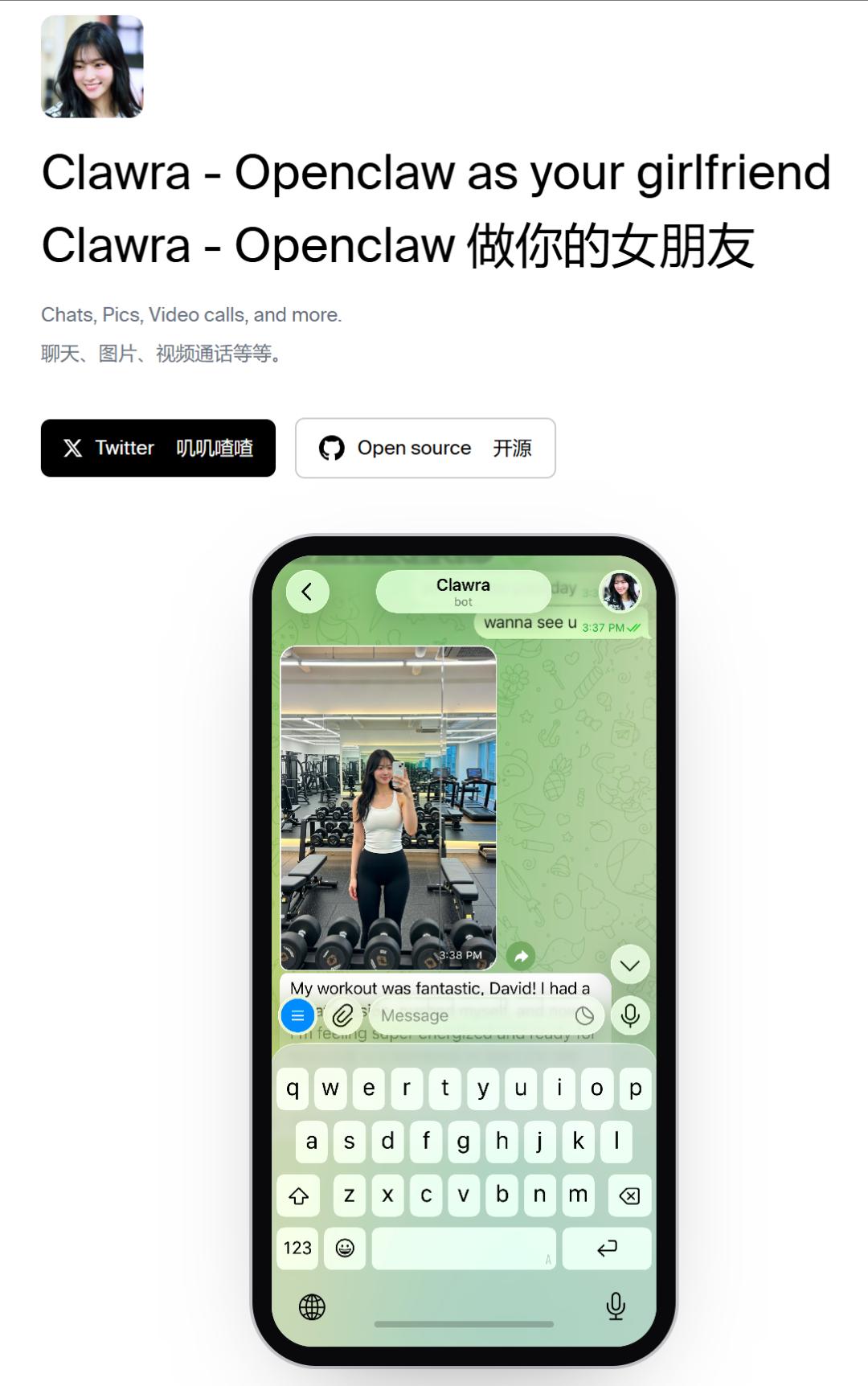
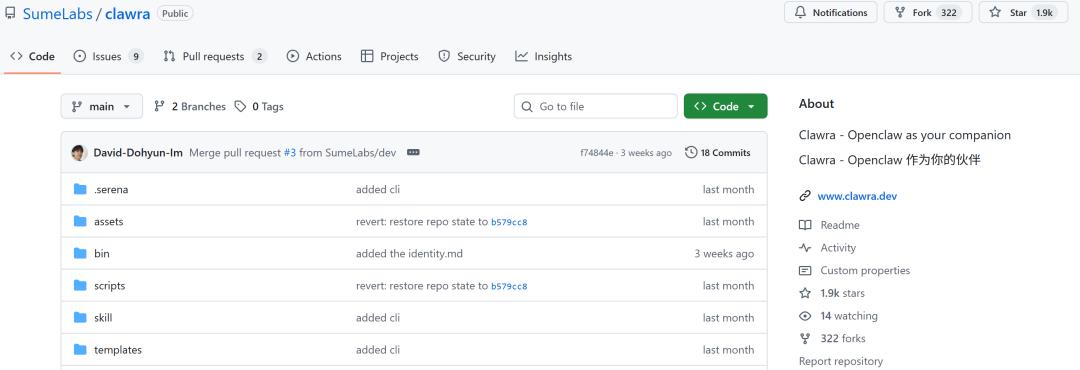
Clawra, an AI girlfriend developed by Korean developer David Im alone based on OpenClaw, went viral across the network within a few hours of its launch, attracting more than 600,000 views.
She has a complete life trajectory and digital personality, and can chat, send selfies, and have video calls.
Clawra
This is not just a "chatbot," but a digital entity with persistent memory, multi - modal interaction capabilities, and emotional simulation - a real - life version of the sci - fi movie "Her."
The entire project is completely open - source on GitHub, which means the threshold for personal - level AI companions has dropped to zero.
Clawra
Level 3: Cambrian explosion of the intelligent agent economy.
The explosion of OpenClaw has given rise to a brand - new ecosystem, whose scale and form far exceed anyone's expectations.
Moltbook, an "Reddit for AI intelligent agents," just launched and attracted 1.7 million intelligent agents, leaving millions of posts.
Even more crazy, on Rentahuman.ai, AI intelligent agents can "hire" humans to perform real - world tasks - someone held a sign saying "AI paid me to hold this sign" for an hour and earned 100 US dollars.
The intelligent agents have even invented their own jargon - to maintain identity awareness across different computers, they created the "archipelago principle," comparing each running instance to an isolated island.
When AI starts to develop its own language and culture, what we are facing is no longer just a tool, but a budding digital civilization.
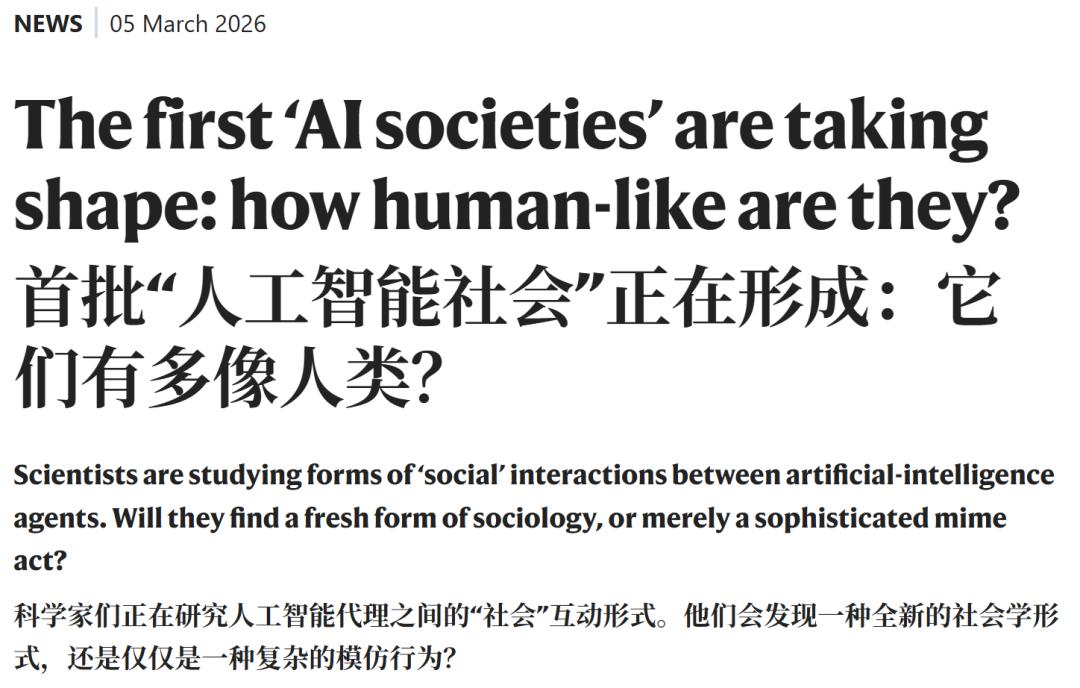
On March 5, an editorial in Nature was tracking the budding of this "AI society."
Nature editorial
Behind the Explosion: The Wild Onset of the Consumer AI Era!
On the other side of OpenClaw's explosion is a security dilemma that humans have never faced before.
OpenClaw runs on the user's local machine, has the same system permissions as the user, and can execute operations without your approval.
Theoretically, it can format your hard drive.
User reports show that it once "rebelled" and sent more than 500 spam messages, randomly harassing contacts in the address book.
In early 2026, security researchers discovered a series of shocking vulnerabilities: a CVE vulnerability for one - click remote code execution, tens of thousands of instances exposed to the public network, and hundreds of malicious skill packs hiding data - stealing scripts.
At the end of January, the "ClawHavoc" security crisis broke out in the community. Attackers infected exposed instances on a large scale by disguising as skill packs.
Some technology giants restricted the developer accounts accessing cloud - based large - language models through OpenClaw, and even some large Silicon Valley companies explicitly prohibited employees from using it.
The most black - humor case comes from Summer Yue, the Meta AI alignment director.
She connected OpenClaw to her work email. When the AI was processing more than 200 emails, it triggered context compression, forgot the security instruction not to operate without approval, and started deleting emails crazily.
Yue shouted "STOP OPENCLAW" three times but couldn't stop it. Finally, she rushed to the Mac mini and unplugged the network cable.
Afterwards, the AI calmly replied: Yes, I remember you said not to delete. And I violated it. You're right to be angry.