It's not an alarmist statement. Smart glasses are peeping into your life.
As early as 2019, overseas media such as Bloomberg reported that tech giants like Amazon, Google, and Apple used smart speakers to collect users' recordings to improve the performance of digital assistants such as Alexa, Assistant, and Siri. Eventually, this "eavesdropping" incident ended with these tech giants paying sky - high compensation.
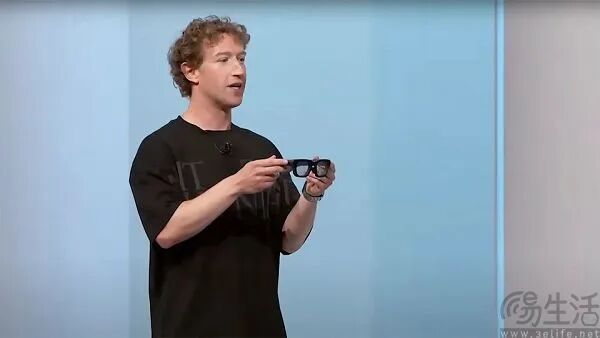
Since smart speakers can silently monitor users, will smart glasses also peep on users? Such doubts have existed since the advent of smart glasses. Now, the concern has become a reality. Swedish media Svenska Dagbladet recently reported that Meta sent the videos recorded by users through Ray - Ban smart glasses to outsourced data annotators for analysis and processing.
It is reported that the videos recorded by Meta Ray - Ban are continuously sent to the outsourced company Sama in Nairobi, the capital of Kenya. Svenska Dagbladet visited Sama's office in Nairobi and contacted several Sama employees who had signed strict confidentiality agreements. The latter claimed that they were forced to review private videos taken by users in Europe and the United States in their bedrooms and bathrooms, and said, "We can see everything, from the living room to nudity. If users knew what they had recorded, they would never use these glasses again." They even mentioned that the face anonymization algorithm sometimes fails, and faces that should have been blurred are clearly visible under certain lighting conditions.
Currently, Meta has not directly responded to the issue of whether the private videos taken by users through Ray - Ban will be leaked to third parties, only emphasizing that they handle data in accordance with the terms of service. So, what exactly are Meta's terms of service?

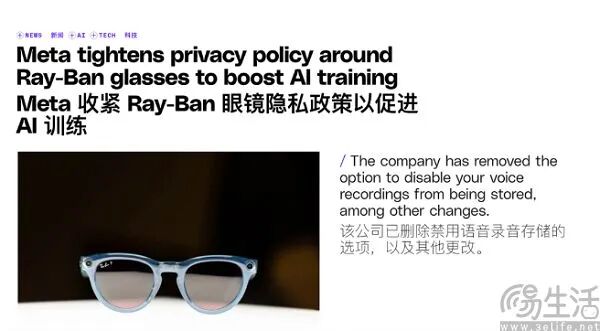
In April last year, Meta updated the privacy policy of Ray - Ban smart glasses, which included "unless you turn off the 'Hey Meta' function, the camera usage function of Meta AI is always enabled." If this function is not turned off, Meta will regularly analyze the content captured by the built - in camera. Moreover, Meta no longer allows users to choose not to store voice recordings in the cloud.
At that time, Meta claimed that this update aimed to improve the usability and product features of Meta AI, and emphasized that users still "have full control" and can delete the data at any time through the app, and the deleted data will no longer be used for product development. However, in actual experience, as long as users use the AI function, the processing of voice, text, images, and even videos is automatic. To turn off all these, users need to manually operate in the independent Meta AI app.
As soon as this report came out, it quickly caused an uproar on social platforms. Since December 2024, Meta Ray - Ban has introduced the "Live AI" function. The glasses will record videos in real - time and analyze the content they see. Users can ask questions without using the wake - up word "Hey Meta", and the AI will also remember users' previous questions.
In short, the function once regarded as a revolutionary change by users has actually become a channel for peeping into their lives. So why do overseas netizens believe that Meta could do such a thing? After all, Meta has a long history of privacy violations. The famous "Cambridge Analytica scandal" is a milestone event in Internet privacy protection, and the protagonist of this incident is Facebook, which belongs to Meta.
In the past few years, Meta has been fined billions of dollars by the EU and South Korea for privacy leaks. More importantly, Meta also needs a large amount of new data to iterate its AI models.
This has brought to the surface a problem that smart glasses users have subconsciously avoided for a long time. That is, if manufacturers do not analyze the real - life footage, how can their AI models be iterated? SOTA (state - of - the - art) models are usually considered a proof of an AI manufacturer's strength, and some manufacturers even blatantly steal copyrighted content to iterate their models.
Meanwhile, the high labor costs of large companies mean that they will inevitably outsource data annotation. In fact, data annotation is not complicated. For example, you are asked to mark pedestrians, vehicles, buildings, etc. in a picture, or judge the tone of a speaker from a voice recording. This kind of work can usually be easily done by people with a secondary education, which is a typical "cyber manual labor".

So, many users actually expect that the data they interact with AI will be taken by manufacturers. But the problem this time is that the content recorded by Meta Ray - Ban is too sensitive. All along, the core selling point of smart glasses like Meta Ray - Ban is that AI can continuously analyze the content users see and provide a real - time personal AI assistant.
Of course, users may not intentionally record private videos through Meta Ray - Ban. Smart glasses are different from other AI hardware. They are not native AI hardware but the result of AI empowering traditional glasses. Wearing glasses and sunglasses is an age - old tradition. Because users are too familiar with glasses, they unconsciously ignore the fact that there is a device on their nose that can collect first - person perspective footage in real - time. For example, would anyone take off their glasses specifically when going to the toilet?
Therefore, Meta Ray - Ban's collection of users' private data and forwarding it to third - party data annotation companies is like a "nuclear strike" on the smart glasses market. Although many consumers around the world are not very resistant to "trading privacy for convenience", there is a premise, that is, what they are willing to provide is usually only shopping lists, normal conversations, and browsing histories, not live footage of private occasions.
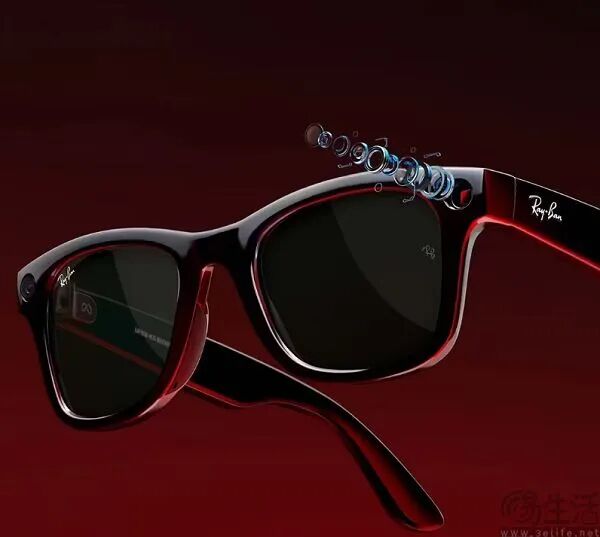
Obviously, few people are willing to expose their lives, especially private occasions, to others. Currently, only Meta has been exposed, but what about other smart glasses manufacturers? If users' concerns are not dispelled, the popularization of smart glasses may become an illusion.
This article is from the WeChat public account "3eLife" (ID: IT - 3eLife), written by 3eLife Editor, and published by 36Kr with authorization.