Since the beginning of 2026, at least 500 million yuan has been invested in embodied intelligence every day.
On March 2nd, Galaxy Universal announced the completion of a new round of financing worth 2.5 billion yuan, once again breaking the record for single - round financing in the domestic embodied intelligence field. On the same day, Songyan Power also completed a Series B financing of approximately 1 billion yuan, and UniX AI received a new round of equity financing worth 300 million yuan.
On March 4th, Xiaoyu Zhizao completed a Series B financing of several hundred million yuan; Ruiman Intelligence also announced that the latest round of financing amounted to 500 million yuan.
On March 5th, Jijia Vision announced the completion of a nearly 1 - billion - yuan Pre - Series B financing, and Xingdong Jiyuan received a 1 - billion - yuan Series A+ financing.
It is worth noting that while financing in the field of embodied intelligence has become increasingly frequent, the amount of single - round financing has also been on the rise. According to incomplete statistics from New Game Theory, since 2026 alone, there have been 9 financing events with a single - round amount of 1 billion yuan or more in the field of embodied intelligence, while in the whole year of 2025, there were 6 such financing events of the same scale.
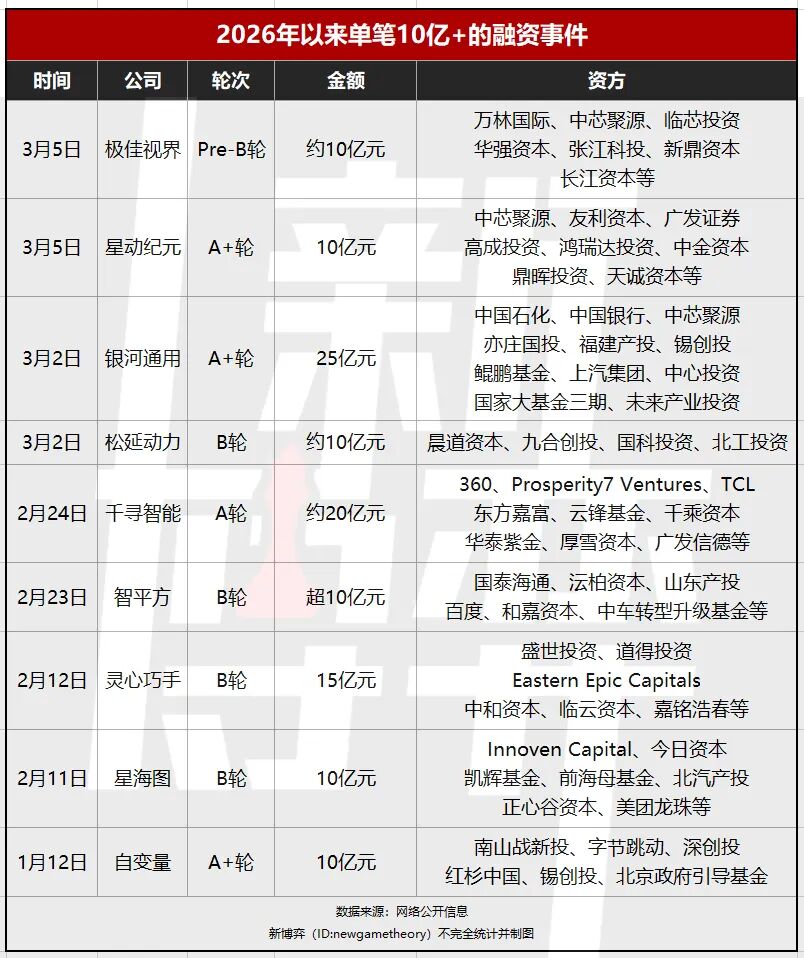
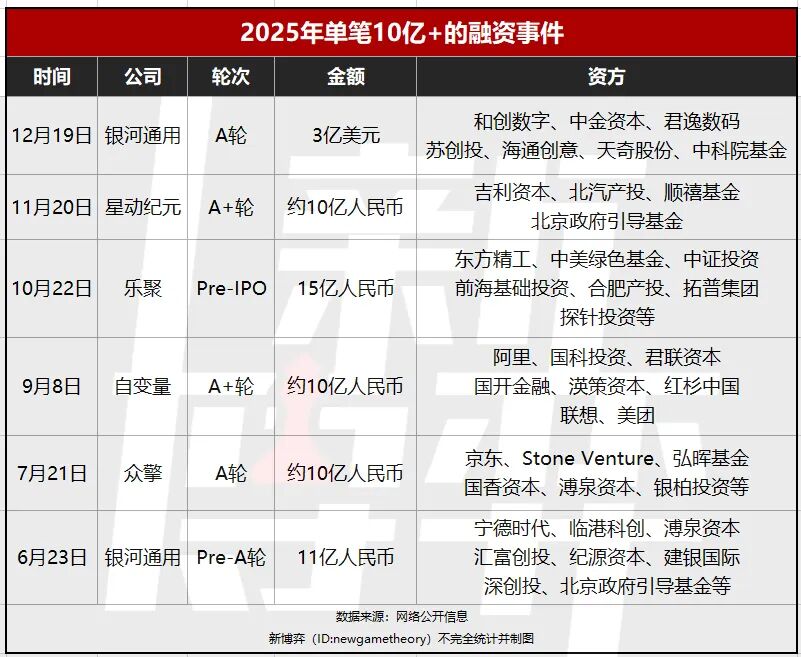
According to statistics from multiple sources, in the first two months of 2026, the monthly financing amounts of enterprises related to embodied intelligence exceeded 16 billion yuan and 15 billion yuan respectively. Coupled with these recent financing events at the beginning of March, the cumulative financing amount in the embodied intelligence track since 2026 has exceeded 37.3 billion yuan. That is to say, in the past two and a half months, at least 500 million yuan has been invested in embodied intelligence every day. Driven by the continuous capital frenzy, this track is accelerating.
(Note: Generally speaking, embodied intelligence means enabling AI to have a "body" so that it can perceive, think, act, and interact in the real world and complete complex tasks autonomously like a human. Currently, humanoid robots are the main representatives of embodied intelligence.)
From conceptualization to commercialization, the betting logic of capital has changed
Looking back, this round of financing boom in embodied intelligence started in 2025. Since the humanoid robots of Unitree Technology appeared on the Spring Festival Gala stage, embodied intelligence has become a hot target for capital. According to data from IT Juzi, in 2025, there were a total of 325 financing events in the embodied intelligence industry, a year - on - year increase of 216%, and the cumulative financing amount was close to 40 billion yuan, a year - on - year surge of 326%.
In this process, it is worth noting that embodied intelligence has rapidly completed the transformation from conceptualization to commercialization in a short period. The turning point was in July 2025 when Zhipu Robotics and Unitree Technology won a huge order of 124 million yuan from China Mobile, and embodied intelligence thus accelerated its entry into the stage of commercial implementation.
With such changes, although the capital's enthusiasm for embodied intelligence has been increasing, the investment logic has changed. Especially in the second half of 2025, it has become difficult for enterprises still in the conceptualization stage to obtain financing. More hot money has flowed to enterprises with commercialization capabilities. This is why enterprises such as Unitree Technology, Galaxy Universal, and Songyan Power have been able to stand out more quickly.
Therefore, in the overall financing in the field of embodied intelligence, the Matthew effect is becoming more and more intense. Data shows that in 2025, the 9 financing events with the top - nine single - round financing amounts involved more than 10 billion yuan. Now, this trend is even more prominent in 2026. In addition to the increasing gap between enterprises due to their respective development, another important reason is that there was an obvious differentiation among embodied intelligence products on the 2026 Spring Festival Gala stage. The capabilities demonstrated by multiple enterprises appearing collectively were different.
For example, on the night of the Spring Festival Gala, the programs involving humanoid robots included various forms such as dance, martial arts, sketches, and micro - movies. Among them, Galaxy Universal's robots completed multiple tasks such as playing with walnuts, picking up glass fragments, taking items from the shelf, folding clothes, and making grilled sausages in the inter - scene micro - movie. It is understood that these operations were all decided and completed autonomously in real - time by the Galaxy Star Brain, rather than through pre - set programs. Multiple products of Songyan Power appeared in Cai Ming's sketch and completed a large number of autonomous human - robot interactions as "actors" in the program.
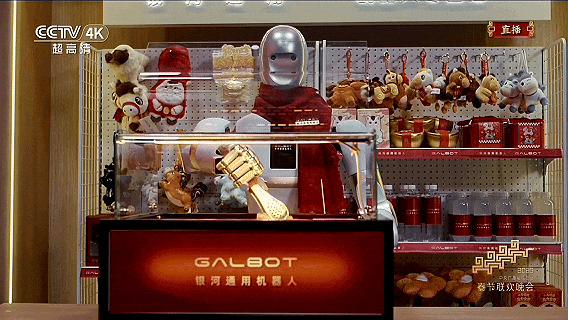
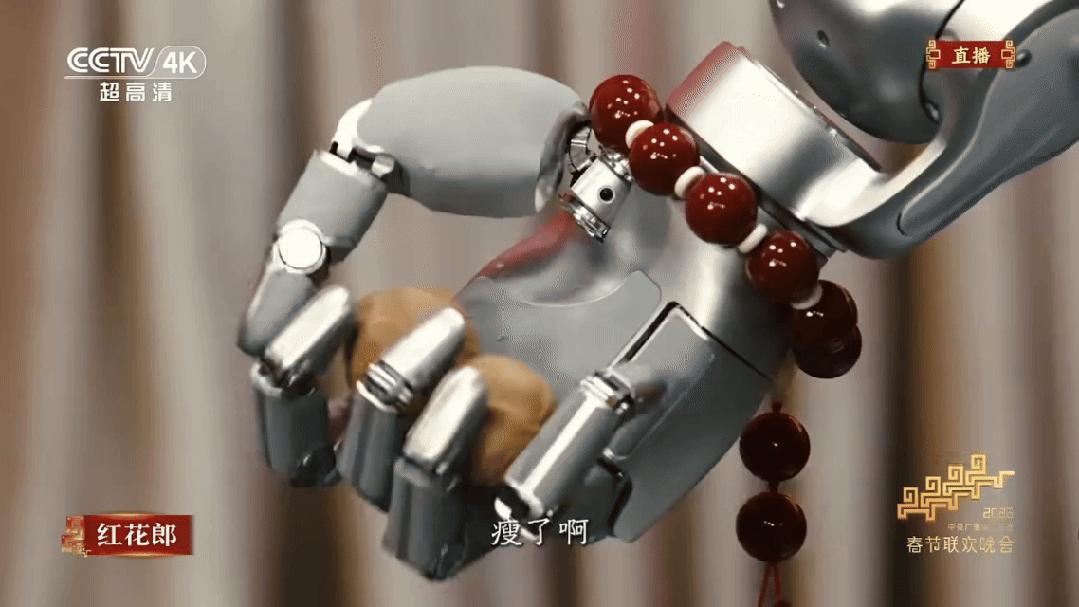
The difference lies in that many products show stronger autonomous capabilities. For example, the humanoid robots in daily - life scenarios can more intuitively demonstrate their ability to complete complex tasks autonomously and interact with the outside world through actions such as folding clothes and making grilled sausages. This means that there are more applicable scenarios for embodied intelligence, and the imagination released in the commercial exploration affects the capital trend, which is the key to this round of capital frenzy in embodied intelligence.
State - owned capital enters the market, and large enterprises increase investment, presenting distinct characteristics of "order - based investment"
Of course, the underlying support for the capital shift is the technological shift. Behind the application breakthroughs with more commercial prospects, what capital is really betting on is the embodied large - model.
Before the emergence of the embodied large - model, embodied intelligence followed a technical route that separated perception, decision - making, and control. Simply put, a robot that has learned to pick up a glass will become "stupid" when it sees a ceramic cup of similar shape and size. Its ability to complete tasks comes from countless scenario presets and repeated training. Therefore, robots at that time could only complete dedicated tasks in fixed scenarios, with weak generalization ability and poor adaptability, and were difficult to handle complex and changeable real - world environments.
It was not until the emergence of large language models represented by ChatGPT that AI with thinking, understanding, and deduction abilities changed the R & D thinking of embodied intelligence. Some practitioners began to try to integrate the training logic of large language models into the R & D of embodied intelligence, gradually evolving into the current more mainstream embodied large - model. The corresponding robots began to have a unified "general brain", with common - sense reasoning and environment - adaptive capabilities. The previously separated technical models have moved towards the end - to - end unity of vision, language, and action. This is also the fundamental reason why embodied intelligence can now achieve autonomous interaction.
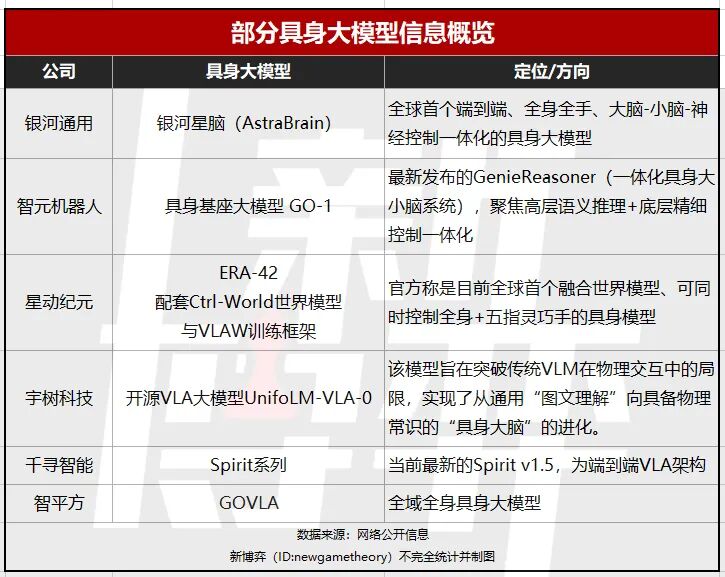
In an ideal state, when the embodied large - model is mature enough, embodied intelligence can achieve efficient multi - scenario switching. That is, a robot that can screw a screw can quickly start working in other scenarios such as logistics sorting with a simple demonstration.
Based on this imagination, the embodied large - model can be said to be the most promising direction in the future, and this certainty has become the key to attracting a large amount of capital. Looking at the overall financing situation in the field of embodied intelligence at present, almost all large Internet enterprises such as Alibaba, Tencent, Baidu, Meituan, JD.com, Xiaomi, and Huawei are involved. In the latest round of financing of Galaxy Universal, the National Artificial Intelligence Industry Fund (the third phase of the National Big Fund) with state - owned capital background also made its first investment in an embodied intelligence enterprise.
It is worth noting that in this process, the overall financing differentiation in the industry has also arisen. Enterprises researching the embodied large - model are more attractive to capital. For example, Galaxy Universal, which has frequently received large - scale financing, has built a robot service ecosystem covering multiple fields such as retail, industry, medical care, and culture and tourism with its self - developed embodied large - model system and humanoid robot body. The company's corresponding valuation has also reached a scale of 3 billion US dollars (approximately 20.7 billion yuan).
However, the R & D of the embodied large - model is very difficult. Although there have been some technological breakthroughs, it is still in the early exploration stage and there is still a long way to go from the ideal state. Due to factors such as complex technology, high R & D costs, and uncertain implementation cycles, the investment in the field of embodied intelligence presents distinct characteristics of "order - based investment".
Specifically, many of the current investors in embodied intelligence are large enterprises with capital strength and actual needs, such as automobile manufacturers, energy companies, manufacturing enterprises, and large Internet companies. They not only invest real money but also open up their factories, workshops, and other work scenarios to allow robots to practice and improve in real - world environments. At the same time, these enterprises' demand for embodied intelligence has become potential future orders. When the relevant robots can be put into use, these investors will naturally become real customers. For the investors, in addition to completing strategic positioning in advance and obtaining robots more suitable for their product lines, the early investment and scenario opening can also give them greater bargaining power, which is a win - win situation.
Multi - scenario implementation, mass production and delivery capabilities become new tests
However, even though the capital frenzy is intensifying, it is not enough to fully support leading enterprises in R & D of their own embodied large - models. Only a few enterprises have independent R & D capabilities. It should also be noted that large enterprises that previously flocked to layout large AI models have now all entered the field of embodied large - models. Many enterprises have integrated large - models from large companies into their products. From this perspective, emerging unicorns in the industry such as Unitree Technology, Galaxy Universal, Xingdong Jiyuan, and Zhipu Robotics, with their outstanding capital endorsements, are also engaged in a two - way strategic positioning.
For example, Baidu follows the route of "brain + cloud + chip" and does not produce complete machines. Currently, its large - model has been integrated into the leading robot products of enterprises such as Ubtech, Zhipu, and Leju. ByteDance's current embodied model has been iterated to GR - 3. While conducting R & D, it also focuses on ecological openness. Its Doubao AloT open - source ecosystem supports third - party robots/hardware to quickly access embodied capabilities...
Alibaba is also committed to open - source. Not long ago, Alibaba's DAMO Academy released the basic model of the embodied intelligence brain, RynnBrain, and open - sourced 7 full - series models including 30B MoE at once. The breakthrough of this model lies in that it introduces spatio - temporal memory and physical space reasoning ability to robots for the first time, enabling them to record and recall historical states during task execution and resume the previous work scenario even if interrupted.
Driven by technological breakthroughs and capital, although the embodied large - model is still in the exploration stage, many products have begun to be implemented in diverse application scenarios.
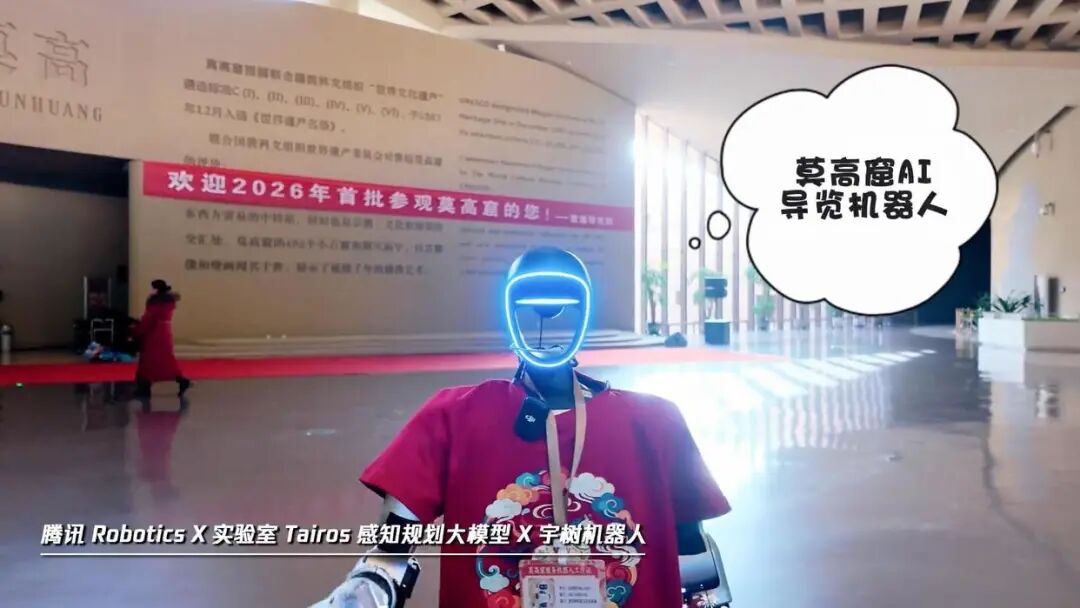
During the New Year's Day this year, the Unitree G1 robots deployed with Tencent's Tairos large - model started working in multiple places such as the Digital Exhibition Center of Dunhuang Mogao Grottoes and the exhibition hall of a law firm in Shanghai. In addition, Unitree Technology cooperated with the Provincial Hospital Affiliated to Fuzhou University and successfully completed the world's first full - process application of human - robot collaboration in multi - disciplinary consultations for adrenal incidentalomas. Xiaomi's humanoid robots have also entered the real production line of an automobile factory for "internship" - achieving 3 - hour continuous autonomous operation at the self - tapping nut loading station, with a bilateral installation success rate of 90.2%.
Driven by this, more large - scale orders have emerged in the field of embodied intelligence. Among them, the industrial heavy - duty robot Galbot S1 launched by Galaxy Universal has obtained in - depth cooperation with customers such as CATL, Bosch, Toyota, BAIC Group, and SAIC Group, with a cumulative order of thousands of units. Leju Robotics signed a strategic cooperation agreement with Schaeffler, a top - ten global parts enterprise. The two sides will focus on typical industrial scenarios such as small - part feeding, factory inspection, and production - line logistics coordination. Ubtech signed a cooperation agreement with Airbus, the world's largest aircraft manufacturer, which has purchased the company's latest industrial humanoid robot Walker S2. According to Ubtech, in 2025, the total order amount of the company's humanoid robots exceeded 1.4 billion yuan, and it is expected that by 2026, the production capacity of its industrial humanoid robots will exceed 10,000 units...
It can be seen that the commercial imagination of embodied intelligence is constantly raising the upper limit. According to IDC's prediction, by 2026, the application scenarios of humanoid robots in China will increase to more than three times the current level, and the market scale will be nearly 1.3 billion US dollars. According to the predictions of multiple domestic institutions, in 2026, the overall shipment volume of embodied intelligent robots is expected to exceed 100,000 units.
Of course, the rapid expansion of the market also puts forward higher requirements for the mass - production and delivery capabilities of embodied intelligence enterprises. While promoting technological development, many enterprises have also begun to devote energy to improving the supply chain. For example, Zhipu Robotics quickly established an efficient supply chain through modular division of labor and the establishment of a joint - venture factory. According to a previous report by IDC, Zhipu ranked first in the industry in 2025 with a shipment volume of 5,200 units. UniX AI takes a heavy - asset route and invests 500 million yuan to build a manufacturing headquarters base integrating complete - machine assembly, R & D testing, and scenario display, with an annual production capacity of thousands of robots.
Remember that in 2025, many humanoid robots were noticed because they created "laughing stocks". Now, just one year later, the rapid technological iteration has brought about earth - shattering changes to them. At present, with continuous favorable policies, continuous inflow of hot money, and the accelerating pace of embodied intelligence, according to the data in the "China Development Report 2025" released by the Development Research Center of the State Council, the market scale of China's embodied intelligence is expected to reach 400 billion yuan in 2030 and is expected to exceed one trillion yuan by 2035. Obviously, this emerging market is in a stage of rapid growth and change. Let's just wait and see!
This article is from the WeChat official account "New Game Theory", author: New Game Theory, published by 36Kr with authorization.