The intelligent unmanned boat backed by LI Zexiang and Alibaba has secured the largest single financing for water surface autonomous driving, with a valuation approaching 2 billion yuan | Hidden Unicorns
Author | Huang Nan
Editor | Yuan Silai
Beyond the wave of AI hardware, a quiet market is quietly growing.
In the past year, there have been quite a few financings for projects related to intelligent waterborne equipment. This blue territory that covers 71% of the Earth's surface still has many untapped markets.
According to data from the China Shipowners' Association, there are more than 120,000 registered motorized vessels in China. Including various non - motorized boats, park cruise ships, and work boats, the total number exceeds 500,000. Among them, the proportion of vessels with intelligent driving capabilities is less than 1%, and those with L4 - level unmanned driving capabilities are even rarer.
The water surface operation scenario also faces a clear labor shortage: the average age of river cleaning workers across the country is over 55 years old, and there is a serious loss of young labor. The labor cost of cruise ship drivers in scenic areas has increased by more than 40% in five years. Scenarios such as marine patrol and hydrological monitoring have long been in a dilemma of "difficult to recruit and difficult to retain people".
This is a neglected blue ocean with a huge stock, an urgent need for manpower replacement, and a low technology penetration rate. At the same time, it is also an extremely difficult market to crack. The physical inertia of ships, the non - standard nature of the supply chain, etc. Each problem to be solved requires passing through a narrow door.
ORCA Robotics is one of the explorers in this field. As a national specialized and sophisticated "little giant" enterprise in the field of unmanned boats, it has never lacked the pursuit of capital. Hard Kr has learned that ORCA Robotics recently completed a nearly 200 million yuan Series B+ financing. This round was jointly led by Houxue Capital and Yuanhe Zhongyuan, with Nanshan Strategic New Investment, Xizhou International, and Yangtze River Collaborative Innovation Technology Research Institute participating.
This is the largest single - round financing in the field of water surface autonomous driving to date. Previously, the valuation of ORCA Robotics reached nearly 2 billion yuan.
This is a typical story of academic talents starting a business. In 2017, Zhu Jiannan, who was still a doctoral student at Northwestern Polytechnical University, jointly founded ORCA Robotics with two other partners, Cheng Yuwei and Chi Yuhao, becoming one of the earliest global teams to engage in the research and development of water surface unmanned driving technology.
Since starting commercialization in 2019, the company has successively received multiple rounds of financing from institutions such as XbotPark and HKX Fund under Professor Li Zexiang, Brizan Ventures under Professor Gao Bingqiang, Turing Venture Capital founded by Academician Yao Qizhi, Alibaba Entrepreneurs Fund, and CSC Financial.
ORCA Robotics has chosen a two - way parallel model of "self - developed intelligent driving system + complete machine products". Centering on water surface intelligent driving technology, they install the ship intelligent driving system into the boat, creating scenario - oriented robots and deriving a product matrix of water surface embodied robots and intelligent cruise ships. Its unmanned boat products have been deployed in nearly a thousand units in 12 countries around the world, with the highest shipment volume in the industry. The intelligent cruise ships cover more than 30 scenic area customers across the country.
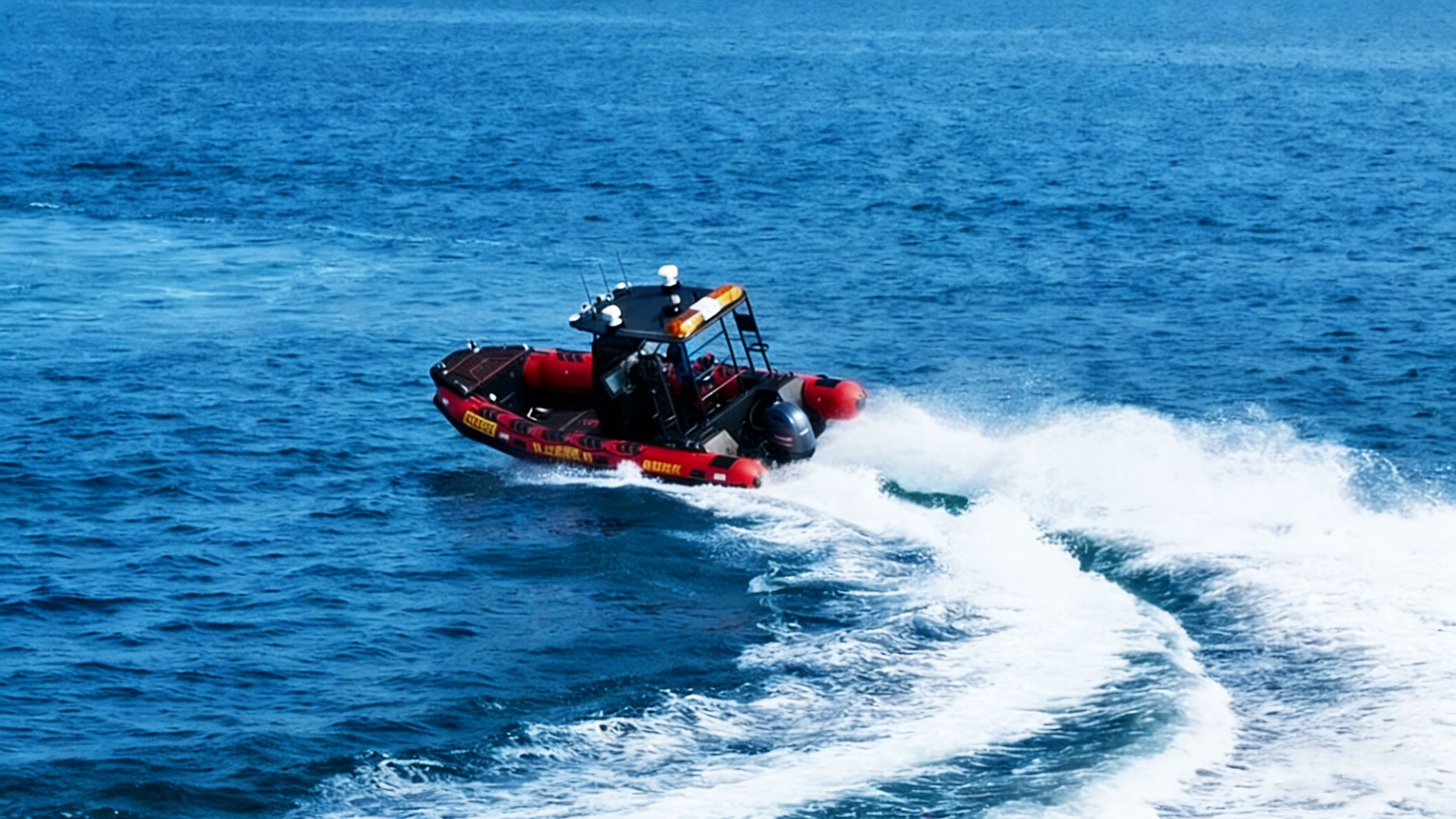
ORCA Robotics' intelligent unmanned boat products (Source/Enterprise)
Zhu Jiannan, the founder and CEO of ORCA Robotics, explained this path to Hard Kr. The word "unmanned boat" rarely appears in his narrative. Internally, they call it a "water surface robot". Externally, to make it easier for users and customers to understand, they mention "unmanned boat" in the industry. This deliberate distinction in terminology reflects the ambition of ORCA Robotics: not to compete within the boat circle, but to look towards a broader market.
Underlying Reconstruction of Water Surface Intelligent Driving
From low - speed to high - speed, from local to global, from indoor to outdoor, this is the evolution path of land - based intelligent driving. To some extent, water surface intelligent driving replicates this rule, gradually extending from low - speed cleaning boats in specific scenarios such as inland rivers and lakes to high - speed yachts on the ocean.
But it goes beyond that. The difficulty of water surface intelligentization is not simply affected by scene translation, but requires the reconstruction of the underlying logic.
The most intuitive difference comes from the physical layer. Land - based intelligent driving faces flat roads, and the friction is also clearly predictable. In contrast, ship navigation has to face random disturbances caused by uncontrollable external forces such as wind, waves, and swells.
For example, due to the large inertia and lagging response of ships, and the fact that they belong to an under - actuated system, that is, lateral movement can only be achieved indirectly through steering. Therefore, ships need to anticipate and operate 50 meters in advance for each turn. When encountering large waves, this anticipation distance needs to be further extended.
The physical differences are also reflected in the upper - layer technology stack. There are fog, reflections, and reflections on the water surface. Directly migrating vehicle - grade sensors is prone to misjudgment, and trees in the reflection may be misidentified as obstacles.
Moreover, waves are unavoidable on the water, which means that the hull must maintain a high control accuracy of 0.05 meters even in complex hydrological environments with wave heights of over 1.5 meters.
The water surface is also an open and unstructured scenario. Obstacle avoidance targets include kayaks, fishing boats, etc., with a large span in volume and type. A single rule model is difficult to cover all navigation decision - making situations.
Based on a deep understanding of the characteristics of the water surface, ORCA Robotics has self - developed a ship intelligent driving system called ORCA - APAS.
To solve the problem of water surface environment perception, ORCA Robotics uses a coupling scheme of vision and millimeter - wave radar. Through a multi - modal fusion algorithm, it cross - verifies continuous frame comparison and radar point clouds.
When it is determined that the shadow of a tree is in the water and the roots are on the shore, the algorithm can control the ship to "see but not stop", reducing the false alarm rate of the system. Facing fog and water surface reflections, the millimeter - wave radar self - developed by the team can detect up to one kilometer, providing sufficient reaction time for the moving ship.
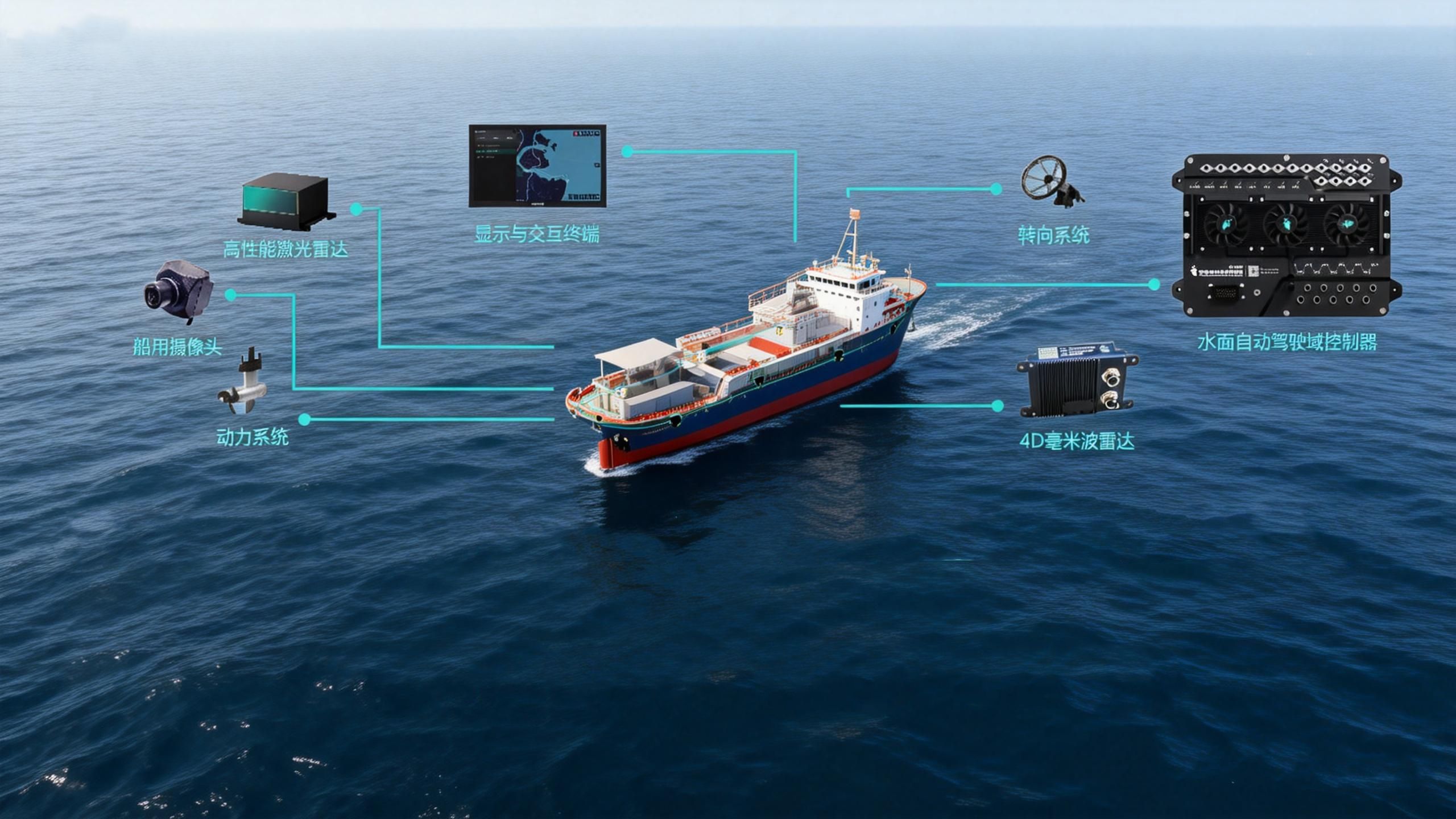
Fully self - developed domain controller, 4D millimeter - wave radar, display and interaction terminal (Source/Enterprise)
In terms of hull motion control, ORCA Robotics has developed an adaptive dynamics prediction algorithm. The system can estimate the disturbances of wind, waves, and swells in real - time and correct the rudder angle and power output in advance, ensuring straight - line navigation with centimeter - level accuracy even in severe shaking.
It can be seen that the core of this algorithm is to iterate the ship dynamics model from "passive response" to "active anticipation", accurately calculating the strength and arrival time of the next wave and taking actions in advance.
When entering the decision - making stage, ORCA Robotics combines the International Regulations for Preventing Collisions at Sea and the experience of ship captains to construct a three - level decision tree.
Its bottom layer is the rule logic, dealing with the judgment of "giving way" and "going straight" in normal situations. The second layer is the behavior prediction model. By observing the historical trajectory and type of the target, such as kayaks like to make detours and cargo ships go straight, it predicts the movement intention of the ship ahead in the next 3 seconds. The top layer is the game network. When both ships have the obligation to avoid, the algorithm will output multiple candidate paths and make a choice after evaluating the risk and efficiency.
Simply put, in actual navigation, when ORCA Robotics' unmanned boat encounters a kayak or a small fishing boat with unpredictable trajectories, the ship driving system ORCA - APAS will choose to make a wide detour. When encountering a ten - thousand - ton cargo ship with a fixed route and high avoidance cost, it will pass by the side quickly.
"It doesn't rigidly apply a single rule, but allows the algorithm to truly learn to make judgments and decisions, knowing when to give way and when to move forward." Zhu Jiannan said.
The key value of this system lies in its modular ability. Hard Kr has learned that the ship intelligent driving system ORCA - APAS has covered the full - stack capabilities from L2 assisted driving to L4 unmanned navigation and has obtained the classification society certification. This is also the only L4 - level certification in the field of small and medium - sized unmanned boats at present. It is adaptable to different ship types from small unmanned boats to ten - thousand - ton merchant ships, has the ability to supply independently, and can be installed on large ships of other shipyards.
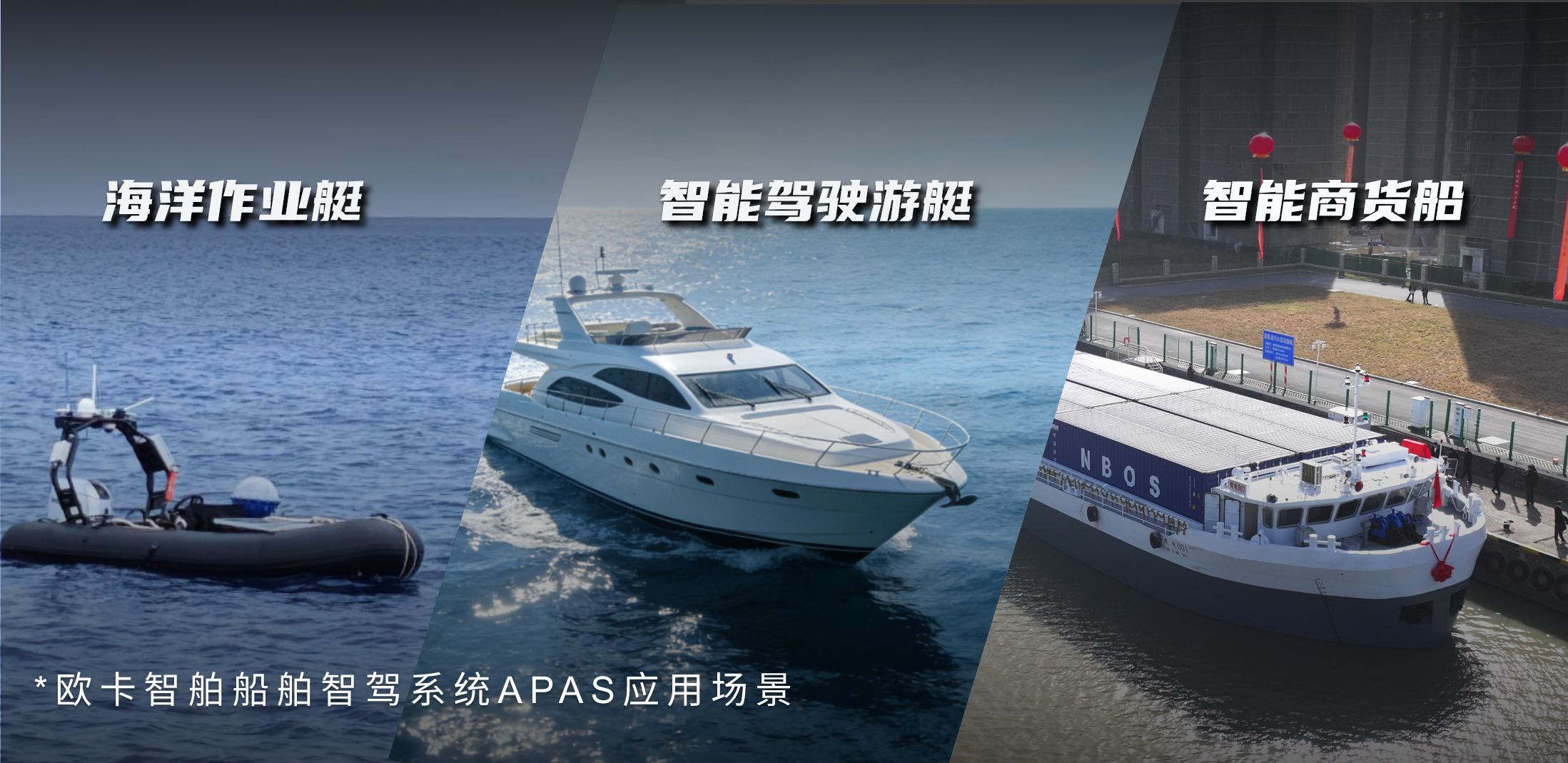
Application scenarios of the ship intelligent driving system ORCA - APAS (Source/Enterprise)
This is a market full of imagination. Data from the Ministry of Transport in 2023 shows that there are more than 120,000 registered merchant ships in China. Calculated at a price range of 200,000 - 500,000 yuan per intelligent driving system, the market scale of water surface autonomous driving has exceeded 30 billion yuan.
Previously, ORCA Robotics has reached cooperation with large enterprises such as COSCO Shipping, China State Shipbuilding Corporation, PetroChina, Zhejiang Erqing, and China Merchants Smart Technology, providing assisted driving systems for ten - thousand - ton merchant ships. On this basis, the company has also launched three types of standardized solutions for assisted driving, advanced assisted driving, and unmanned autonomous navigation, which have been gradually launched overseas and are being explored and implemented in scenarios such as shipping logistics, security patrol, and public safety.
The Next Growth Pole
From the intelligent driving system to the complete machine product, ORCA Robotics' path is clear: use a modular intelligent brain and match it with a standardized hull platform to provide a reusable water surface robot solution.
Among them, the sanitation scenario is the core implementation field of ORCA Robotics. Its cleaning boat products are divided into four standard products according to small, medium, large, and marine patrol categories.
Facing the domestic waterfront consumption market, ORCA Robotics has launched three standard - shaped yachts with replaceable functional modules. For example, the cleaning module can be replaced with a mowing module, a water gun can be added for parent - child scenarios, and a KTV entertainment module can be added for business scenarios, covering different scenarios.
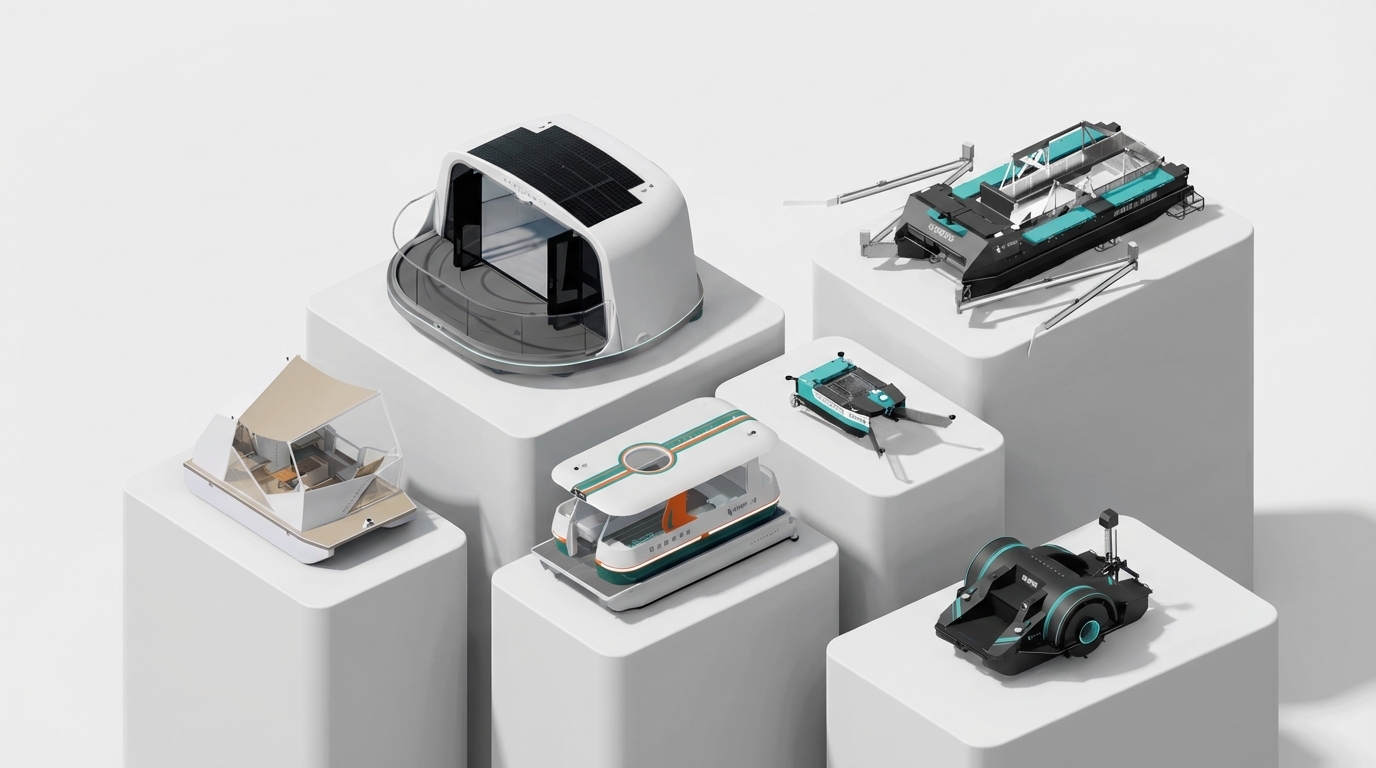
ORCA Robotics' complete machine product matrix (Source/Enterprise)
Behind this seemingly simple standardization is a reconstruction starting from the most basic supply chain.
In the automotive industry, after a century of development, the chassis has already formed clear platform - based classifications such as C - class, B - class, and SUVs, with a clear division of labor in the supply chain. There are Tier1 suppliers specialized in wire - controlled chassis and suppliers specialized in perception. The vehicle manufacturers only need to do integration and definition.
The situation in the ship industry is completely different. Fishing boats, cleaning boats, sightseeing boats, and patrol boats each have different hull lines, different power configurations, and different operation requirements. Inland river cleaning boats need shallow draft and side - by - side operation, so the hull is flat and wide. Marine patrol boats need to resist waves, so they use deep V or RIB hard hulls. Sightseeing yachts need space and comfort, so they have a round and streamlined shape.
This non - standard nature has kept the supply chain of water surface intelligent equipment in a state of high customization and extremely low efficiency for a long time.
Taking the IP67 protection of industrial robots as an example, land - based robots usually only need to pass laboratory tests, and it is sufficient to spray water for 30 minutes under standard working conditions. However, water surface robots need to operate for a long time in different water qualities, water temperatures, and flow rates. Corrosion, biological attachment, and seal aging are all engineering problems that must be overcome. There is no ready - made supply chain to refer to.
"You can find all the parts and assemble an AGV in Huaqiangbei in half a day. But it's not possible for an unmanned boat." Zhu Jiannan said.
Earlier, when ORCA Robotics was just starting the commercialization stage, the R & D team almost spent 365 days in the water to verify the reliability of the IP67 waterproofing of electric drives and motors.
It is precisely because of this investment that ORCA Robotics is one of the few companies that can use the standard product logic in the B - end market and make it work.
"B - end customers don't care about customization. They care about ROI calculation and safety." Zhu Jiannan said. This means that the logic of product polishing must change. "We don't open a mold for a single customer, but the product functions should be iterated at least once a year to avoid the risk of customers not buying. We will collect 80% of the common needs to adapt to 80% of the scenarios, and the remaining 20% will be supplemented by functional modules."
This logic has also received feedback in specific market verifications.
Facing the sanitation scenario, ORCA Robotics has deployed nearly a thousand boats, covering more than 50 cities across the country. According to official data, the average operation efficiency of its sanitation boats is 3 - 5 times that of manual labor, and the comprehensive operation cost is reduced by more than 40%. Enterprise customers can recover their investment in about two years.
The domestic waterfront economy is on the verge of an explosion. According to data from the Ministry of Culture and Tourism, the cruise ships in national A - level scenic areas receive more than 200 million tourists every year, but more than 90% of the existing cruise ships are still traditional fuel - powered ships, with extremely low intelligent and electrified penetration rates. Zhu Jiannan believes that water surface sightseeing is evolving from low - frequency to high - frequency, which means opportunities for waterborne Robotaxi. Currently, ORCA Robotics' intelligent cruise ships have been deployed in nearly 50 scenic areas across the country, with hundreds of ships in total.
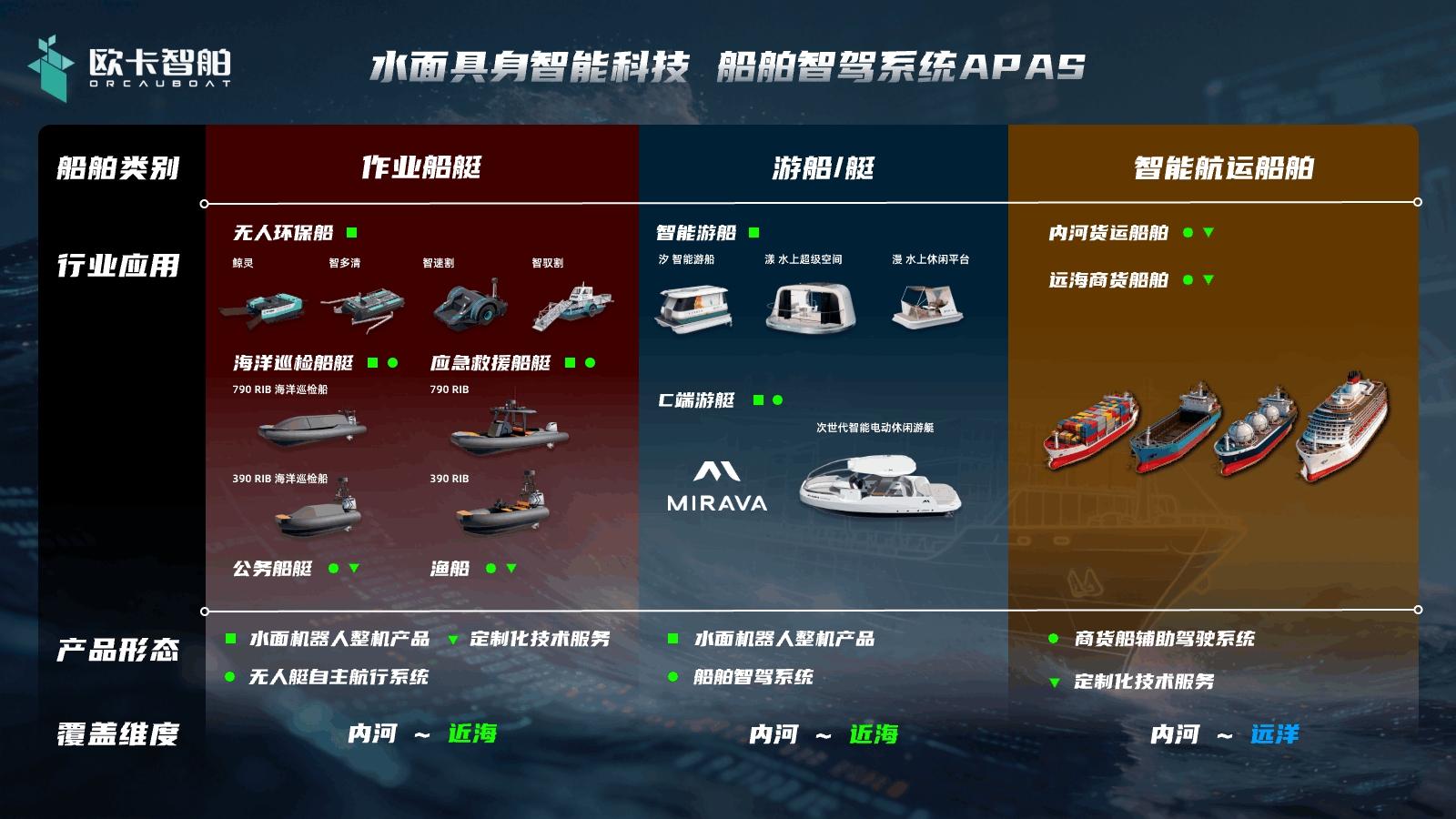
Two - way parallel model of self - developed intelligent driving system + complete machine products (Source/Enterprise)
The overseas market is another piece of cake that needs to be tackled from scratch.
Data from the National Marine Manufacturers Association shows that in 2023, the sales volume of new boats in the United States was 280,000, and the inventory exceeded 17 million. The inventory of yachts in Europe is about 6 million. This is a stock market