Is it a successful brand marketing for robots to appear on the Spring Festival Gala?
01 They Had the Fun, and I Remembered Nothing
After watching this year's Spring Festival Gala, the most common sentiment I've heard is: Robots took over the Gala. Was this a Spring Festival Gala for robots?
Robots dominated the Gala, dancing, somersaulting, wiggling, performing martial arts, and making cameo appearances in skits. It was truly lively and generated a high level of discussion.
But if I were to ask you: What are the names of these robot companies? How many can you name without looking up information right now? Or, do you know which company's brand each robot and its performance represent?
Anyway, after asking around, the answers I got were basically:
I only know there were robots, but I don't know which companies they belong to. There were so many, it's impossible to tell them apart.
They could run, jump, and do somersaults. They were more impressive than last year.
What? There were four companies? I thought they were all from Unitree. (There's a bit more information about Unitree, which will be mentioned later.)
Some people even said: Which company's brand do these robots belong to? Aren't they just props purchased by the Gala?
Of course, these views come from the perspective of viewers and "consumers." From the "producer" perspective, four robot companies participated in the marketing investment for this year's Spring Festival Gala. It's reported that each company invested 100 million yuan in cash (not to mention the human and material resources invested to cooperate with the Gala's display).
So, with such a huge investment, did it only create a "lively" effect? What about brand building?
Look, this touches on the essence of the problem: What on earth are the robots performing on the Spring Festival Gala for?
Is it to make people remember the brand of the Spring Festival Gala? Is it to make the audience remember how lively the Gala was? Or is it to make people remember which brand's robots are the best and most powerful?
I often say: The essence of a brand is information. Brand building is the process of implanting this information into the minds of the audience. The core is to pursue the cost - effectiveness of information dissemination.
Today, let's have a good chat: Is it a successful brand marketing move for robots to dance on the Spring Festival Gala?
My view: This is a brand marketing campaign that "goes through the motions seriously but fades into the background muddle - headedly." The robots enhanced the technological atmosphere of the Spring Festival Gala, increased the overall attention of the robot industry, and boosted the value of leading brands in the robot industry and the potential of emerging brands. However, for the brand owners who paid for it, the cost - effectiveness was average.
02 Data Doesn't Lie
Some people may disagree: How can you be so sure that people didn't remember them? Maybe it's just you who didn't remember.
Let's look at the data.
As mentioned earlier, each of these four robot companies invested at least 100 million yuan to participate in the Spring Festival Gala. We don't need to be too precise about the exact figures, but it's definitely an astronomical amount. This is just the financial investment. There were also many other investments: the human and material resources of the teams, several months of time, and various hidden costs.
With such a huge investment, they performed for a few minutes for the whole nation on New Year's Eve, which was like a huge product demonstration or product launch.
However, the problem is: This was a collective launch event for the industry where no one left their mark.
If the brands don't take follow - up actions, the Spring Festival Gala only brings a one - time "traffic peak" rather than "brand assets" that are accumulated over time.
I checked the recent Baidu Index and WeChat Index of these four companies. The data on the day of the Spring Festival Gala was a typical roller - coaster - like data. Just like a roller - coaster that goes up and then comes down.
Let's first look at the Baidu Index: The search volume of the four companies collectively reached a peak on New Year's Eve and the first day of the Lunar New Year. Starting from the second day of the Lunar New Year, it dropped sharply. By mid - February, it basically returned to the level before the Spring Festival Gala. Especially for the three companies other than Unitree, there were almost no traces left.
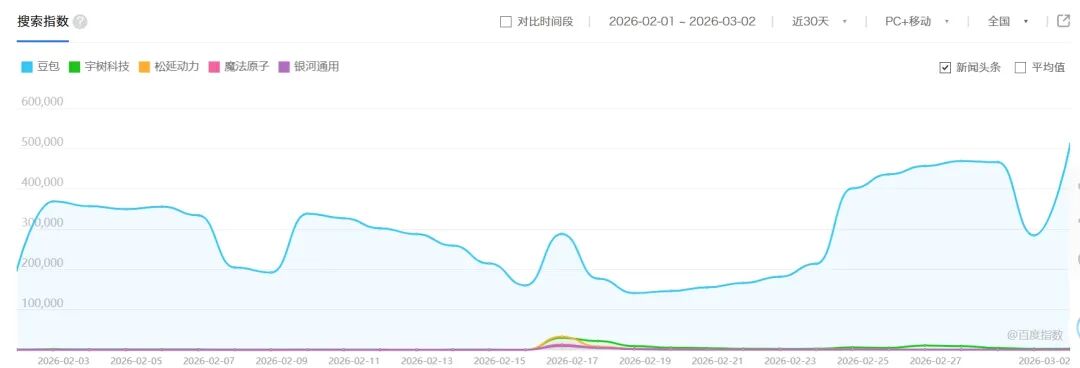
| Baidu Index of four robot companies and Doubao
Now let's look at the WeChat Index. It's even more interesting. For the three companies other than Unitree Technology: Galaxy Universal, Magic Atom, and Songyan Power, they had the same curve: up, down, and back to zero. Unitree Technology did a little better. It went up, came down, and then had a small increase after a few days.
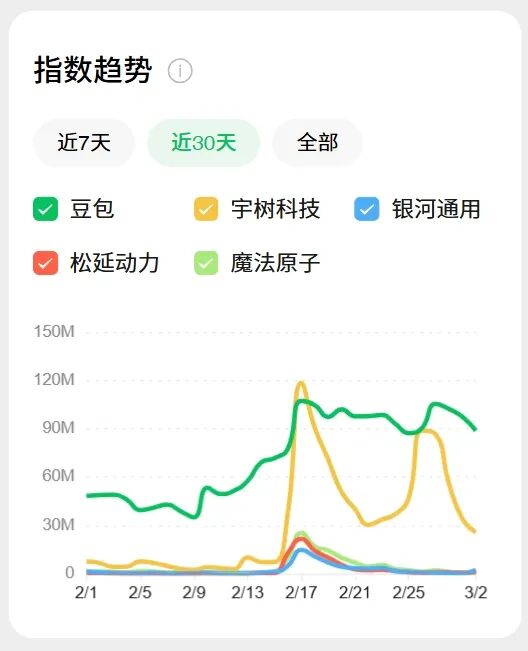
WeChat Index of four robot companies and Doubao
In the above two charts, I also deliberately included a reference brand, Doubao, which also had brand implantation during the Spring Festival Gala. You can compare Doubao's performance.
Although Doubao belongs to AI and the other companies belong to the robot industry, the reason we make this comparison is: As major technology sponsors, in addition to the function demonstration, Doubao also had a large amount of brand exposure and information disclosure through the hosts' announcements.
When giving out red envelopes, demonstrating products, and making advertising announcements, it constantly provided a large amount of information such as brand name, brand function, and brand advantage, constantly repeating the truth that the essence of a brand is information.
Some people may say: Don't worry about these intangible things. The data on sales platforms like JD.com is very good! Two hours after the Spring Festival Gala started, the search volume for robots increased by more than 300% compared to the previous period! Please note! What people searched for was the word "robots".
The industry has caught fire, but each company's share of the market is still not enough.
For ordinary viewers, it's almost impossible to distinguish humanoid robots with synchronized movements in long - shot scenes. This "face - blindness" effect results in extremely low brand recognition. The general feeling after watching the Gala is "The Spring Festival Gala this year had a strong technological atmosphere, and the robots were really amazing." People are curious about what else robots can do, such as doing housework or taking care of the elderly.
But few people can name the brands of the robots.
Except on the day of the Spring Festival Gala, the secondary communication of the brands after the Gala was also rather weak. None of the companies created a big wave of brand information dissemination.
03 What Does Brand Asset Building Really Need?
When it comes to brand marketing, no one does it just for the fun.
After the fun, we still hope to form brand information dissemination and build brand assets.
The process of building brand assets and the process of information dissemination vary from one brand to another. However, if you want to build real brand assets (solidify information in the minds of the audience), you probably need to meet three common conditions: continuity, consistency, and explainability.
Continuity: Brand information dissemination is not a one - time thing. Any brand that wants to build brand assets and retain information needs to appear continuously, repeatedly, and over a long period. It can't just flash by and disappear.
Consistency: Every time a brand appears, the information and image it conveys should be consistent, and its personality should be consistent. It's best not to have "internal strife" in its own performance, being one way today and another way tomorrow.
Explainability: A brand's appearance should have a context and a reason. It's best to complete a closed - loop of explanation in the minds of the audience: "Who are you?", "What do you do?", "What are you doing now?", "What's good about you?" That is to say, in addition to simple exposure, it's better to have some cause - and - effect information for people to explore and associate.
Let's use this simple standard to evaluate the actions of the robot companies during the Spring Festival Gala:
Continuity: There was no prior buildup and no follow - up. It was only on New Year's Eve, and the voice was almost gone the next day.
Consistency: On the Spring Festival Gala stage, they were all "flexible dancing robots". From the appearance to the performance of the robots, the industry perception was quite consistent, but what about the consistency of each brand itself? Where were the characteristics? It was completely invisible. No brand made us feel that this was a very XX - style brand.
Explainability: The conclusion of the audience after watching was basically "The robots are really amazing." They were still in a very shallow state of "public popularization" and "curiosity - driven exposure" (the industry development process is indeed stuck at this stage), rather than "Oh! The robots of this company are good at family companionship, and the robots of that company are good at industrial empowerment." There was too little explainable and associable information about which company was which.
None of the three conditions were met.
From an industry perspective, this was indeed a lively industry popularization and collective marketing event, but for individual brands, it was not a successful brand marketing campaign.
Then why do robots still rush to spend a fortune on the Spring Festival Gala?
One is the need to compete for capital and the Matthew effect of leading brands. The other is the Spring Festival Gala's own demand for technological innovation as a platform.
As participating brands in this "new species" of robots, generally, they need to go through a process of industry market education in the early stage and then emerge as well - known brands in the competition.
However, in recent years, AI and robots have become so popular that the competition has been fierce from the very beginning. Companies are eager to raise funds, make large - scale investments, and compete to occupy the leading brand awareness to continue raising funds.
In this situation, the leading brands will enjoy the Matthew effect of resources and will be able to develop more advanced robot products in the future. So, as soon as the competition starts, everyone immediately enters a tense competition like a 100 - meter sprint. Brand marketing has also been advanced to the same stage as industry popularization.
On the other hand, the Spring Festival Gala as a platform is also happy to see this happen. After all, it needs content and technological innovation support. It's a win - win situation, allowing sponsors to become its technological partners at the same time.
The Spring Festival Gala is definitely a "winner" in this matter. Just like when live - streaming e - commerce was popular a few days ago, the biggest winner was actually the platform. No matter which brand participated, they had to pay fees and commissions, and the brands also offered the lowest factory prices. The platform got two benefits at the same time. Why not?
04 Unitree's Actions and Zhipu's Approach
Of course, not all brands had little gain. Among the four companies, Unitree Technology has enjoyed the Matthew effect.
As mentioned earlier, its search volume had a small increase after the Spring Festival Gala. Why? Because its performance in terms of continuity, consistency, and explainability was better.
Since last year's Spring Festival Gala, Unitree has participated and sparked a wave of discussions. This was a good buildup, which also gave Unitree a first - mover advantage and explainability.
At the same time, after the Spring Festival Gala, it also took follow - up actions. It launched a new product and a series of follow - up content, constantly telling people through continuous actions: "The robot on the Spring Festival Gala was mine, and I have more to show you."
This way of "capturing traffic" and "secondary communication" is obviously more sophisticated than that of the other three companies. It thought: I spent so much money on the Spring Festival Gala. It can't just end like this! I have to make the momentum and content of the Gala continue!
In contrast, the other three companies remained uniformly quiet. Maybe they had used up their marketing budget during the Spring Festival Gala, or maybe the teams relaxed after the Gala and ignored that the real competition was just beginning.
When I searched for their news, all that came up were headlines like "Four robot companies participated in the Spring Festival Gala" and "Robots shined at the Spring Festival Gala", all repeating the fact that "There were robots at the Spring Festival Gala, and they were amazing."
"And then?" Everyone forgot or was too tired to pursue this question. They spent 100 million yuan and only got a momentary buzz, and the buzz belonged to the Spring Festival Gala.
Speaking of this, I think of another company that didn't participate in the Spring Festival Gala: Zhipu Robotics.
This company is quite interesting. Facing such a big stage and traffic of the Spring Festival Gala and the enthusiasm of the industry, its decision was: not to participate. The reason was straightforward: 100 million yuan was too expensive, and with a limited budget, it gave priority to R & D.
Before the Spring Festival, it did something quite interesting. Since it couldn't participate in the Spring Festival Gala, it held its own low - cost "fun night" called the "Robot Wonder Night" Gala (Is this idea learned from Bilibili? Haha).
After the Gala, it simultaneously launched a "999 - yuan national robot experience program" and combined it with offline promotion (such as participating in the New Year's customs activities in Wuxi Ancient Town). It rented out robots through a rental platform, allowing ordinary people to experience robots.
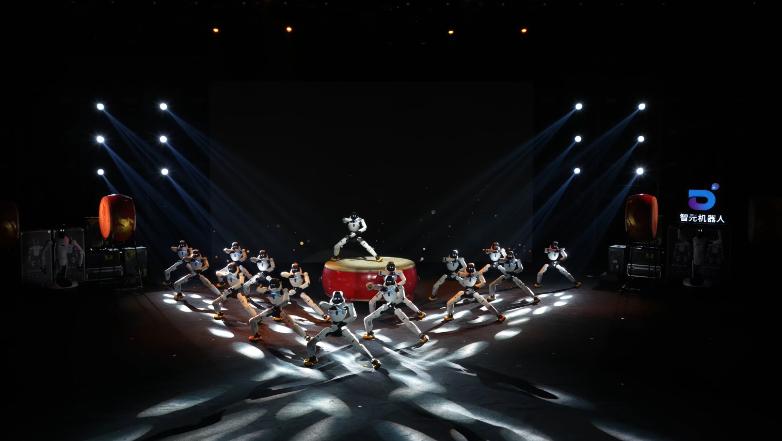
A clip from the "Robot Wonder Night" Gala
This set of actions had a good effect.
First, it didn't spend a fortune but still caught the wave of the super - hot "robot" topic. When the whole nation was talking about robots, it jumped out and said: I have them too. It made good use of the trend.
Second, it offered an "experience". The popularity of the Spring Festival Gala only lasted for a few days, but its experience program could last for several months. This turned one - time traffic into continuous interaction.
Third, it made its brand information clearer. Through the "experience program", it told people: I'm a robot company that allows you to try our products yourself. Isn't this more memorable than just "dancing"?
So, you can see that although Zhipu didn't participate in the Spring Festival Gala, through a series of actions, it associated the name "Zhipu" with the labels of "experiential" and "practical". This brand marketing campaign had a good cost - effectiveness.
Brand marketing is not "I came, I performed, I left." True brand marketing is "I came, remember me, come to me."
05 Why Did the Spring Festival Gala Stage "Swallow" the Robot Brands?
By now, you may have a feeling that the Spring Festival Gala stage is not conducive to the brand communication of the robot industry. But why have so many industries and brands successfully built their brands on the Spring Festival Gala and even made a fortune just by participating in it?
Let's talk about the reasons: