Huawei Builds the "Heavenly Road", ZTE Opens the "Heavenly Eye": Domestic Communication Giants Compete to Reach for the Sky at MWC26
MWC 2026 will be officially held in Barcelona. As one of the world's three major exhibitions, MWC (Mobile World Congress) has always featured mobile phones, operators, and connectivity technologies as its biggest highlights. Compared with CES (Consumer Electronics Show), the technologies on display at MWC are more practical and closer to real - world applications.

Image source: Captured by Lei Technology
This year marks the 20th anniversary of the MWC exhibition. Lei Technology has sent a reporting team led by senior editor Dingxi and anchor A Lei to Barcelona, Spain, to bring you first - hand information and professional reports.
From on - site observations, in addition to a wide range of AI technologies, industry giants such as Huawei, ZTE, China Telecom, and China Mobile have dedicated part of their exhibition booths to the "sky".
It's not satellite communication, but the low - altitude economy, which is lower, closer, and full of more commercial potential.
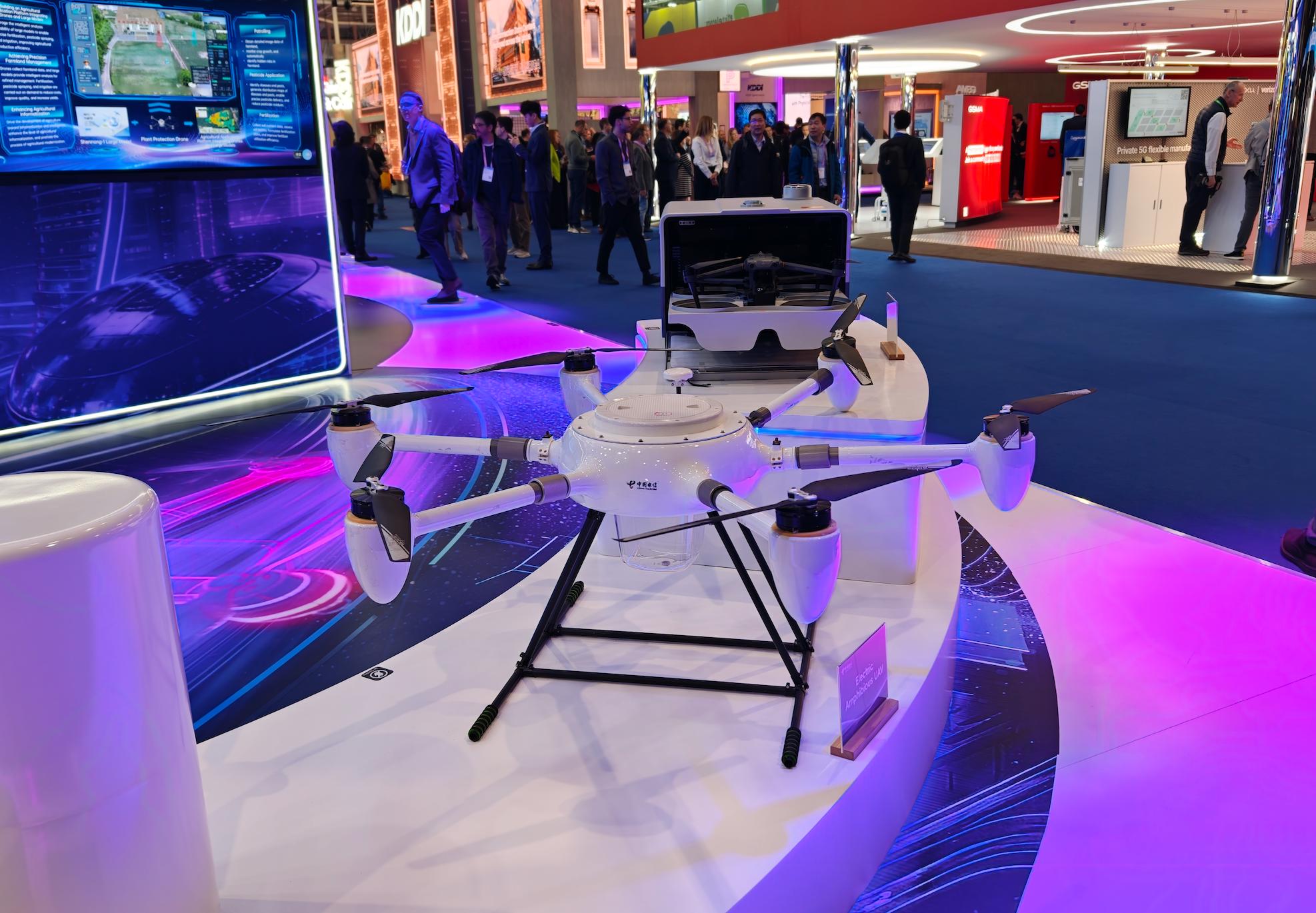
Image source: Captured by Lei Technology
Huawei has introduced a bearer network architecture specifically designed for the low - altitude economy. ZTE has presented a 5G - A low - altitude intelligent connectivity innovation solution. Operators have also brought low - altitude flight - related intelligent networking platforms, along with eVTOL prototypes parked in the corners of the exhibition hall. It's bustling and lively.
The question is, what exactly do these communication giants see when they all "take to the sky" in such a unified way?
At the MWC 26 site, communication giants collectively "take to the sky" to find growth opportunities
Like intelligent vehicles, for the low - altitude economy to thrive, the problem of the "road" needs to be solved first. However, this "road" is not a asphalt road, but a network channel that can transmit the massive data generated by drones and eVTOLs back to the ground in real - time.
To meet the development needs of 5G - A services, Huawei has released a new - generation mobile bearer network architecture with three major features: 10GE/25GE to the station + L3 to the station + end - to - end SRv6 optimization.
In plain language, it means enabling the network to have intelligent scheduling capabilities to ensure that when drones are flying in the sky, data can be transmitted back to the ground via the shortest path with the lowest latency.
This is an architecture specifically designed for high - frequency scheduling, which means that in the future, there may be thousands of drones flying simultaneously over the city. The network must plan data routes in real - time like a traffic control center.
This is a typical Huawei approach. Similar to HarmonyOS Smart Mobility, it doesn't manufacture vehicles but acts as a "shovel seller". When the low - altitude economy booms and all aircraft need to be "connected", Huawei's bearer network will be as essential as air and water.
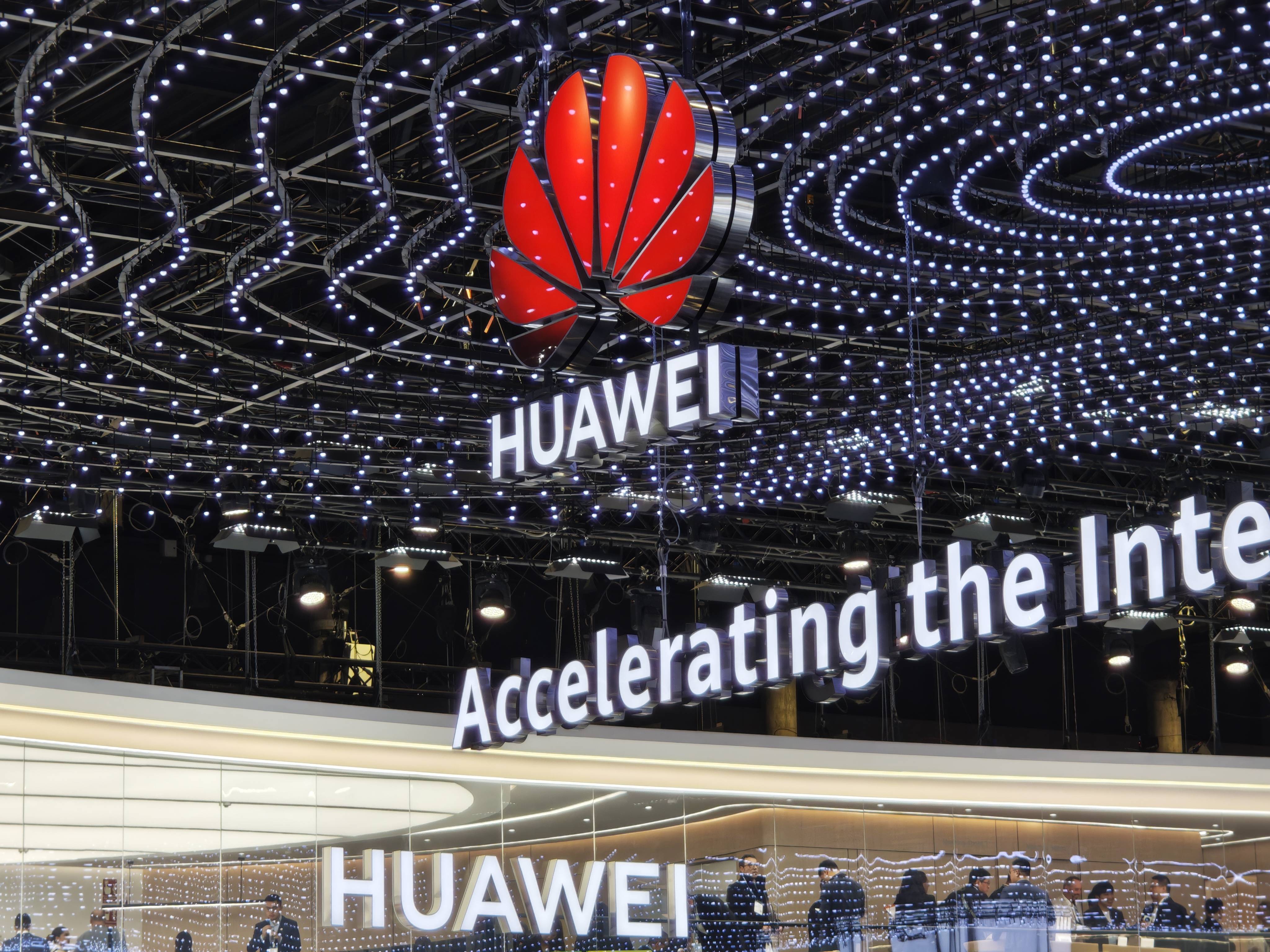
Image source: Captured by Lei Technology
If Huawei is building the "sky road", then ZTE is creating the "sky eye".
Low - altitude communication mainly faces problems such as the inability of point - to - point communication to support non - line - of - sight flight and insufficient low - altitude coverage of 4G/5G networks. In terms of perception, there are issues like low perception accuracy and difficulty in continuous networking.
To solve the above problems, ZTE has introduced the 5G - A communication, sensing, computing, and intelligence integration technology. The most remarkable feature of this technology is that it integrates communication and sensing functions. There's no need to install two separate sets of equipment. One set can meet the communication and sensing needs of low - altitude devices such as drones simultaneously. Compared with traditional technologies, it has high perception accuracy, fast deployment, convenient networking, and can significantly reduce the deployment and operation and maintenance costs of low - altitude applications.
ZTE has developed the industry's first self - transmitting and self - receiving 128TR AAU device specifically for low - altitude communication needs. This device supports a 65 - degree wide - angle coverage, which can not only cover ground communication but also the low - altitude area, perfectly filling the signal blind spots in low - altitude communication and ensuring stable and reliable communication between the ground and low - altitude devices, thus providing strong communication support for low - altitude flight.
In terms of sensing technology, ZTE's 5G - A communication and sensing integration technology uses an intelligent sensing solution with both continuous - wave and pulse - wave waveforms for the first time, and is also equipped with innovative intelligent metasurface technology.
ZTE's logic is that the first step in the low - altitude economy is to "see clearly and manage effectively", and the 5G - A communication and sensing integration technology is the only large - scale solution.
Of course, since the low - altitude economy is related to communication, the presence of operators is inevitable.
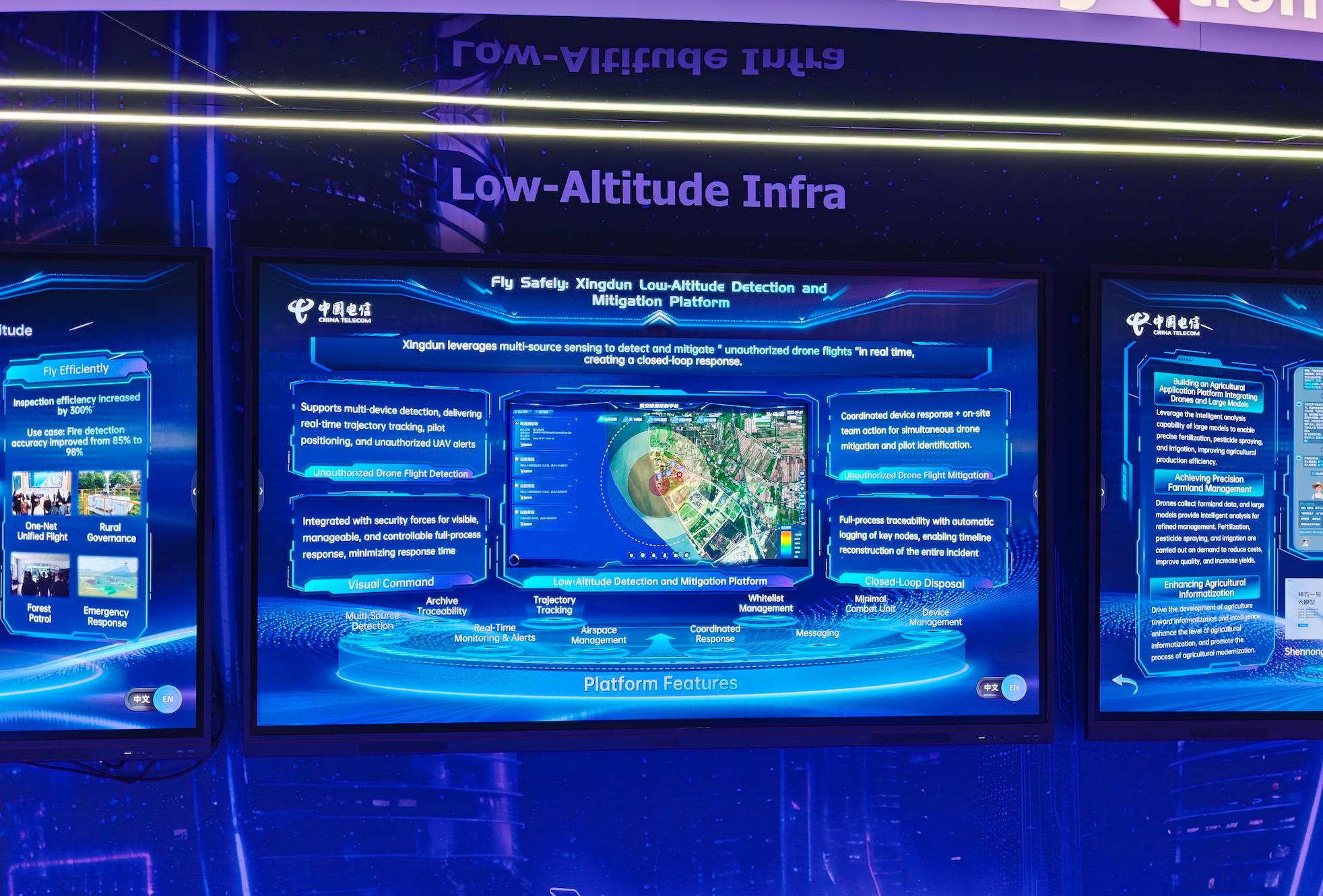
Image source: Captured by Lei Technology
In the low - altitude infrastructure sector, the "1 + 1+4 + N" capability system built by China Telecom has become the focus: In simple terms, this system is based on one low - altitude comprehensive service solution, combined with one low - altitude intelligent network integrating communication, sensing, and computing capabilities, and four collaborative platforms, namely Nebula, Star Shield, Star Patrol, and Star Ocean. It can provide an efficient and safe comprehensive service solution for the global low - altitude economic development.
Official information shows that in the forest inspection project in Inner Mongolia, the Nebula low - altitude operation platform can cover an area of more than 300 square kilometers in a single flight, and the efficiency of wildfire inspection is eight times that of manual inspection, showing obvious advantages.
Currently, China Telecom's low - altitude applications have been implemented in more than 1,000 projects. It has also joined hands with 157 industrial partners to establish the Low - Altitude Economy Industry Alliance to jointly promote the development of the low - altitude field.
China Mobile is also making efforts in the low - altitude field. Its CMCC Lingyun Low - Altitude Intelligent Network platform has extended from the domestic market to overseas.
This platform has a total of nine core capabilities, including wide - area real - time intelligent connectivity, high - precision enhanced positioning, multi - source fusion perception, trusted identity authentication, spatio - temporal calculation and analysis, spatial spectrum calculation, high - real - time micro - meteorology, full - chain security guarantee, and the Lingyun large model for low - altitude applications.
The functions of these core capabilities are comprehensive. They can not only provide solid support for regulatory agencies, such as human - machine identification and traceability, risk perception and early warning, and airspace modeling and planning; they can also assist in the implementation of low - altitude applications in various industries, meeting the needs of connection management and operation, network - connected remote control, and real - time data transmission. At the same time, they can provide professional support for the comprehensive guarantee of the low - altitude field, meeting professional requirements such as spatial spectrum calculation and micro - meteorological services.
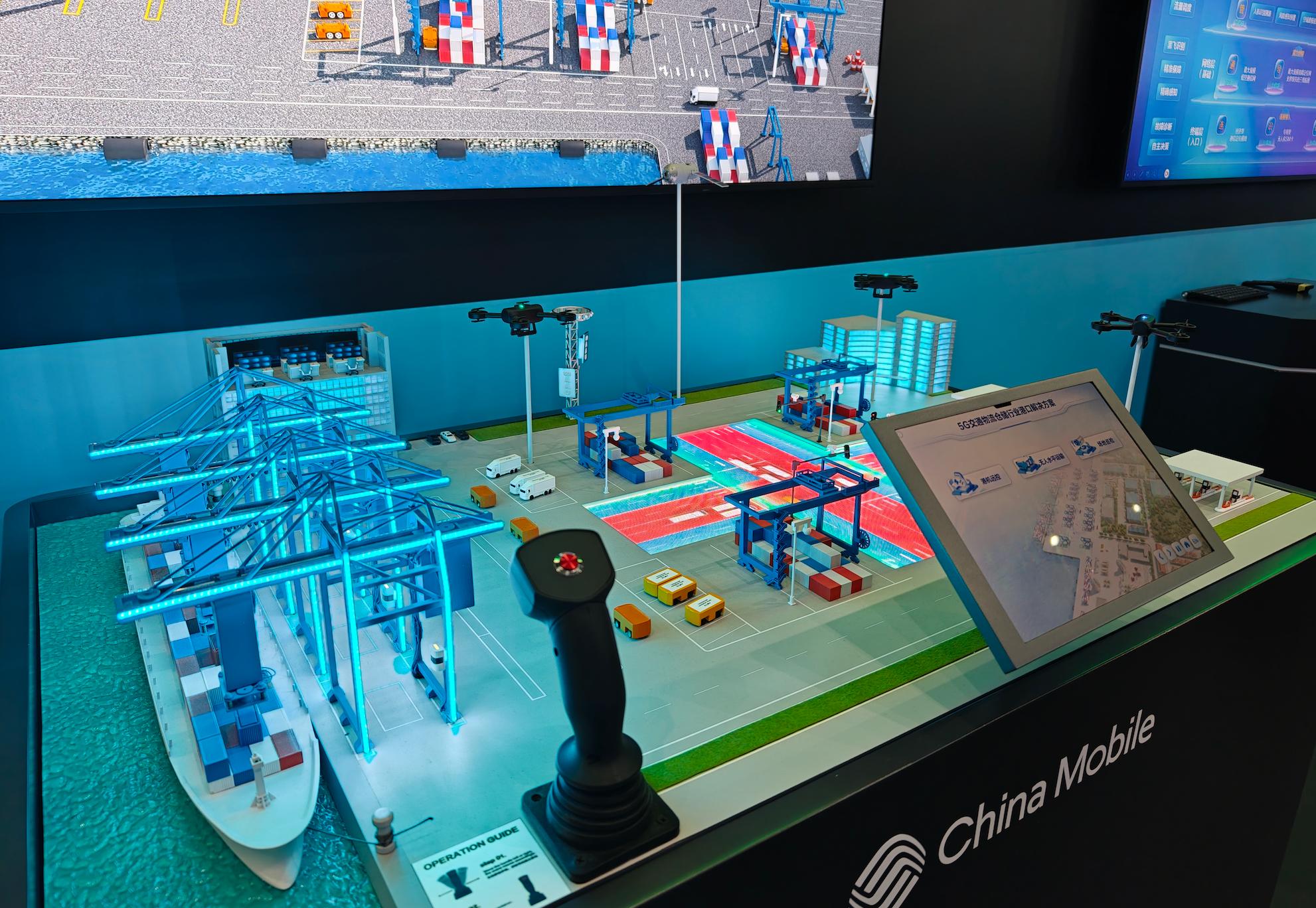
Image source: Captured by Lei Technology
Why has the low - altitude economy become a "must - answer question" for the communication industry?
The communication industry is currently facing a challenge: the construction of 5G on the ground is coming to an end. As of the end of 2025, the total number of 5G base stations in China has exceeded 4.833 million, covering all urban areas of prefecture - level cities and county - level cities. The incremental market has turned into a stock market, with sluggish 5G growth and the peak of the traffic dividend. Both operators and equipment manufacturers are in urgent need of new growth points.
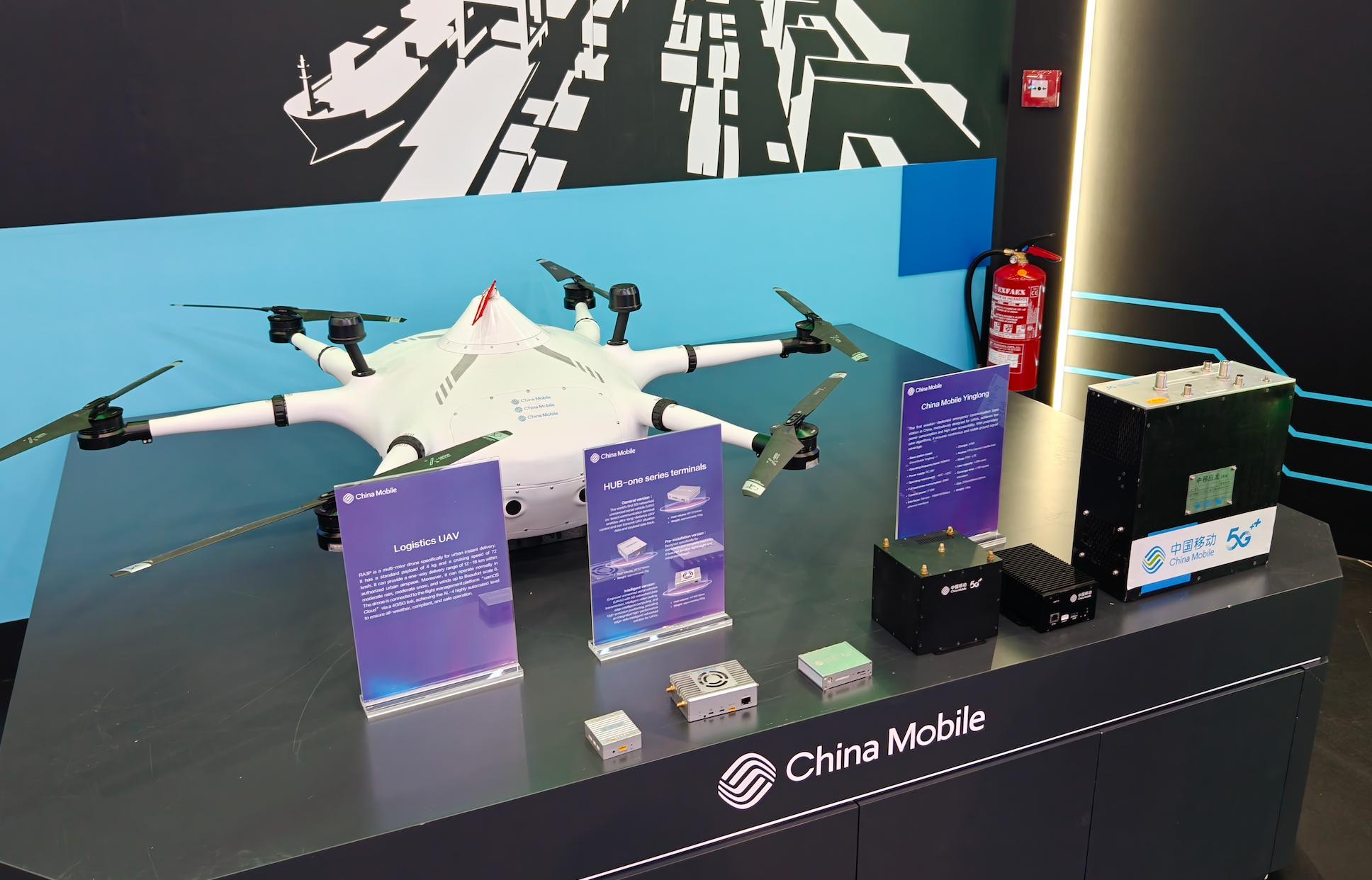
Image source: Captured by Lei Technology
The low - altitude economy provides new growth opportunities.
Firstly, low - altitude communication requires a brand - new network architecture with continuous coverage from the ground to an altitude of several hundred meters. This means a large number of base station renovations, new constructions, and optimizations, which is a new opportunity for equipment manufacturers and operators.
On the other hand, the low - altitude economy involves multiple sectors such as communication, aviation, transportation, and urban management. Whoever can establish technical standards, platform ecosystems, and business models first will gain the upper hand. The collective appearance of communication giants at MWC 26 is a competition to be the "first - mover".
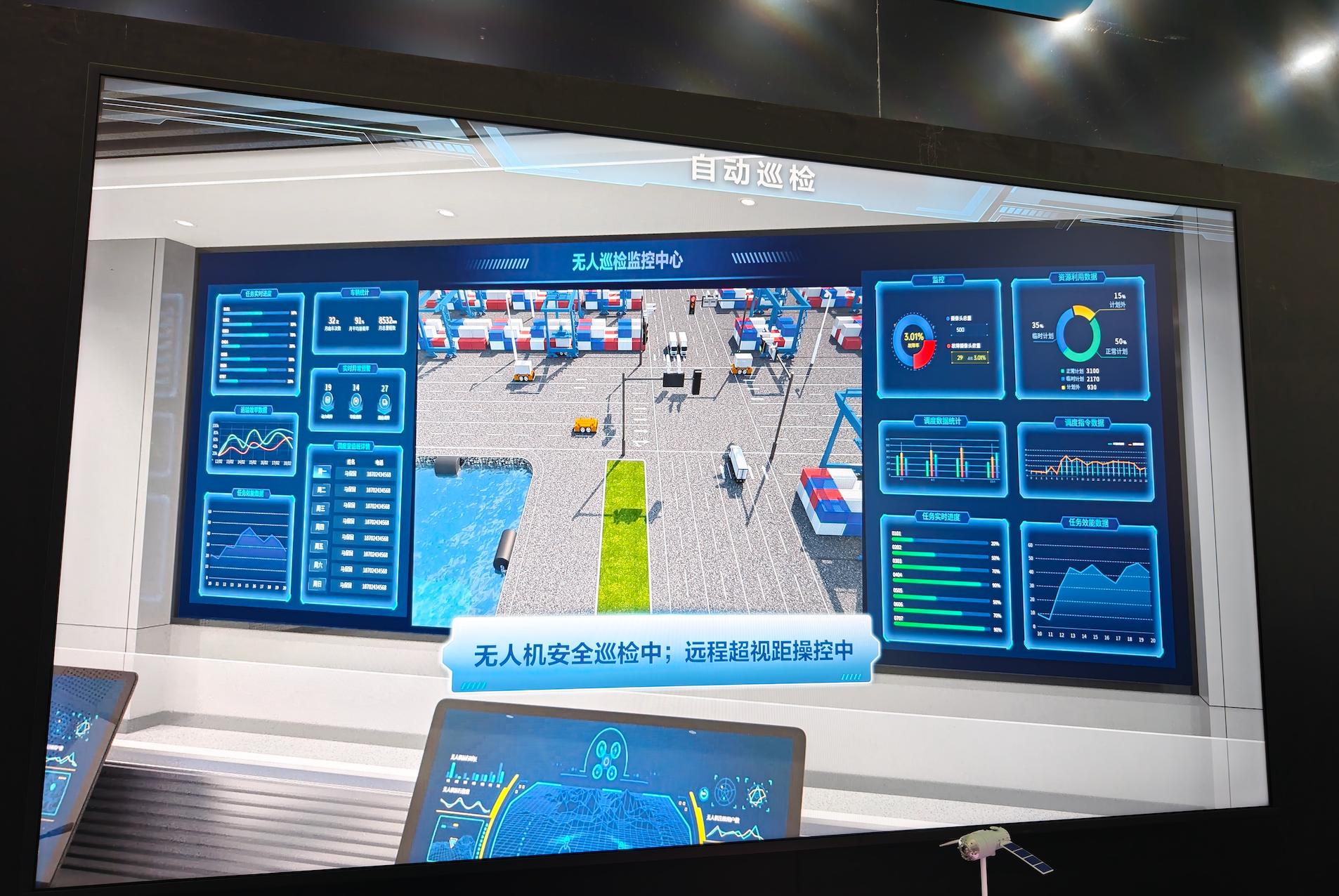
Image source: Captured by Lei Technology
From the perspective of operators, 5G - A, as an intermediate stage in the evolution from 5G to 6G, has always faced an awkward question: Where is the killer application?
On the consumer side, the 10 - gigabit speed of 5G - A is not very noticeable to ordinary users. On the industrial side, the application scenarios are limited. Coincidentally, the low - altitude economy perfectly matches the technical characteristics of 5G - A.
Low - altitude flight requires the integration of communication and sensing. Base stations need to have both communication and radar sensing capabilities, which is the foundation for managing low - altitude aircraft. The centimeter - level positioning ability of 5G - A meets the navigation and obstacle - avoidance needs of drones. The massive data generated by aircraft requires local real - time processing, and the edge computing architecture of 5G - A is a perfect match.
Image source: Captured by Lei Technology
It can be said with certainty that the low - altitude economy is the first truly "native application" of 5G - A. Without 5G - A, the low - altitude economy cannot thrive. With the low - altitude economy, the investment in 5G - A has a clear path to commercial returns. This is also the logic behind the communication giants' investment in the low - altitude economy.
The "sky revolution" in the communication industry has just begun
The low - altitude economy at MWC 26 is just the starting point.
The collective entry of Huawei, ZTE, and operators indicates that the concept of "connecting everything" in the communication industry has entered a substantial stage, and the low - altitude economy is the most imaginative battlefield.
For the communication industry, the strategic value of the low - altitude economy lies in its redefinition of the boundaries of the "network". Traditional communication networks only cover the ground, while the low - altitude intelligent network is three - dimensional, covering the three - dimensional airspace from the ground to a height of hundreds of meters (or even higher). This means a comprehensive upgrade of the network architecture, technical standards, and business models, as well as new growth space and industrial influence.
However, to be realistic, the commercialization of the low - altitude economy is still full of challenges.
The accuracy of communication - sensing integration, the real - time performance of edge computing, and the continuity of network coverage still need to be verified. Issues such as the degree of airspace opening, the definition of safety responsibilities, and the balance of privacy protection remain difficult problems. The cost of eVTOLs, the efficiency of drone delivery, and consumer acceptance need time to develop.
As mentioned above, "taking to the sky" is a must - answer question. As the urbanization process deepens and ground resources become increasingly crowded, it is an inevitable choice to seek space in the air.
In this process, "connection" is the infrastructure of all infrastructures.
After MWC 26, we can expect that more cities will light up the signals of the low - altitude intelligent network, more drones will fly in an orderly manner under the 5G - A network, and more eVTOLs will take off and land from rooftops. In this "sky revolution", the role of the communication industry will be more crucial than in the mobile Internet era. They not only connect the ground but also need to define the sky.
This article is from "Lei Technology" and is published by 36Kr with permission.