At Apple's spring launch, which product can become a money-making asset like the Mac Mini?
Visiting China twice a year, Tim Cook seems to have learned some "new ideas."
For this year's spring product launch, Apple abandoned the traditional approach of having everyone "sit in line" waiting for the press conference. Instead, it directly listed new products on the official website for three consecutive days.
The sales strategy is divided into two steps. For the general public, Apple launched phones and tablets with increased features but no price increase. For heavy - productivity users, Apple, true to its "stereotypical" stance, told them that the most efficient tools don't believe in cost - effectiveness.
iPhone 17e, get a phone with a free chip
Looking at the paper specifications of the iPhone 17e, Apple is indeed quite generous. It aligns well with the current consumer psychology of pursuing "cost - effectiveness." But at Apple, we don't talk about "cost - effectiveness." We talk about "fully - equipped with capabilities and offering great value."
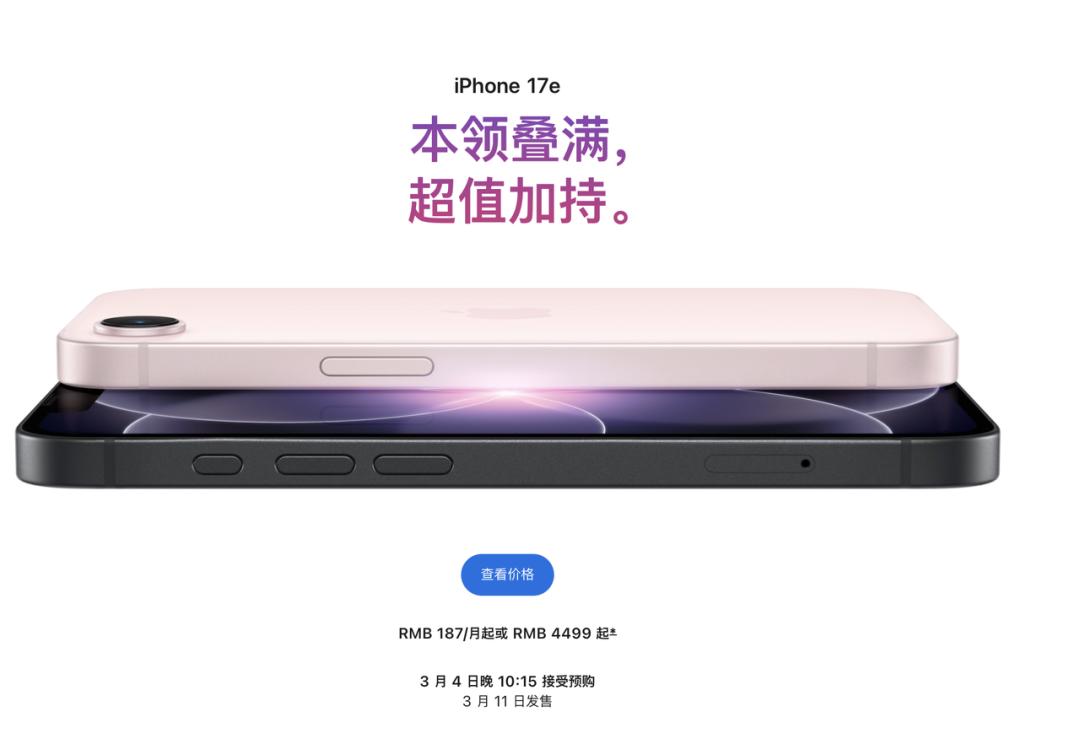
For example, it has a second - generation ultra - ceramic crystal panel with higher scratch - resistance, the latest generation A19 chip, a 48 - megapixel fusion camera, and MagSafe in the era of fast - charging popularity (up to 15W, twice as fast as the previous generation).
The starting storage finally reaches 256GB, with an unchanged price of 4,499 yuan.
But let's think carefully. In 2026, a phone with a starting price of over 4,000 RMB still comes with a 6.1 - inch, 60Hz refresh - rate screen.
No matter how "powerful" the A19 chip is, the viewing experience at the output end is "constrained." Coupled with the large and unappealing bezels and the retro large forehead, it's as if it's screaming "clear inventory."
The marketing filter is easily punctured, and Apple's calculations are extremely shrewd.
The core "mission" of the iPhone 17e is not to sell hardware innovation, but "to expand the user base for subsequent iOS and Apple Intelligence with the lowest comprehensive material cost."

The models compared on the official iPhone 17e promotion page are all iPhone 11 and 12 | Apple
The A19 chip and 256GB storage are the "minimum requirements" for running on - device AI, while the 60Hz screen and old mold are the "moat" for hardware profit. It targets the "loyal users" who have limited budgets but don't want to be left out of the Apple AI ecosystem.
iPad Air, you can skip the update if you're too lazy
After looking at the iPhone 17e, we can at least say "get a phone with a free chip." But when it comes to the iPad Air, my heart sank even more.
The main update point between the new iPad Air and its predecessor is just one thing: the M3 chip is replaced with the M4 (plus the network is upgraded to Wi - Fi 7).
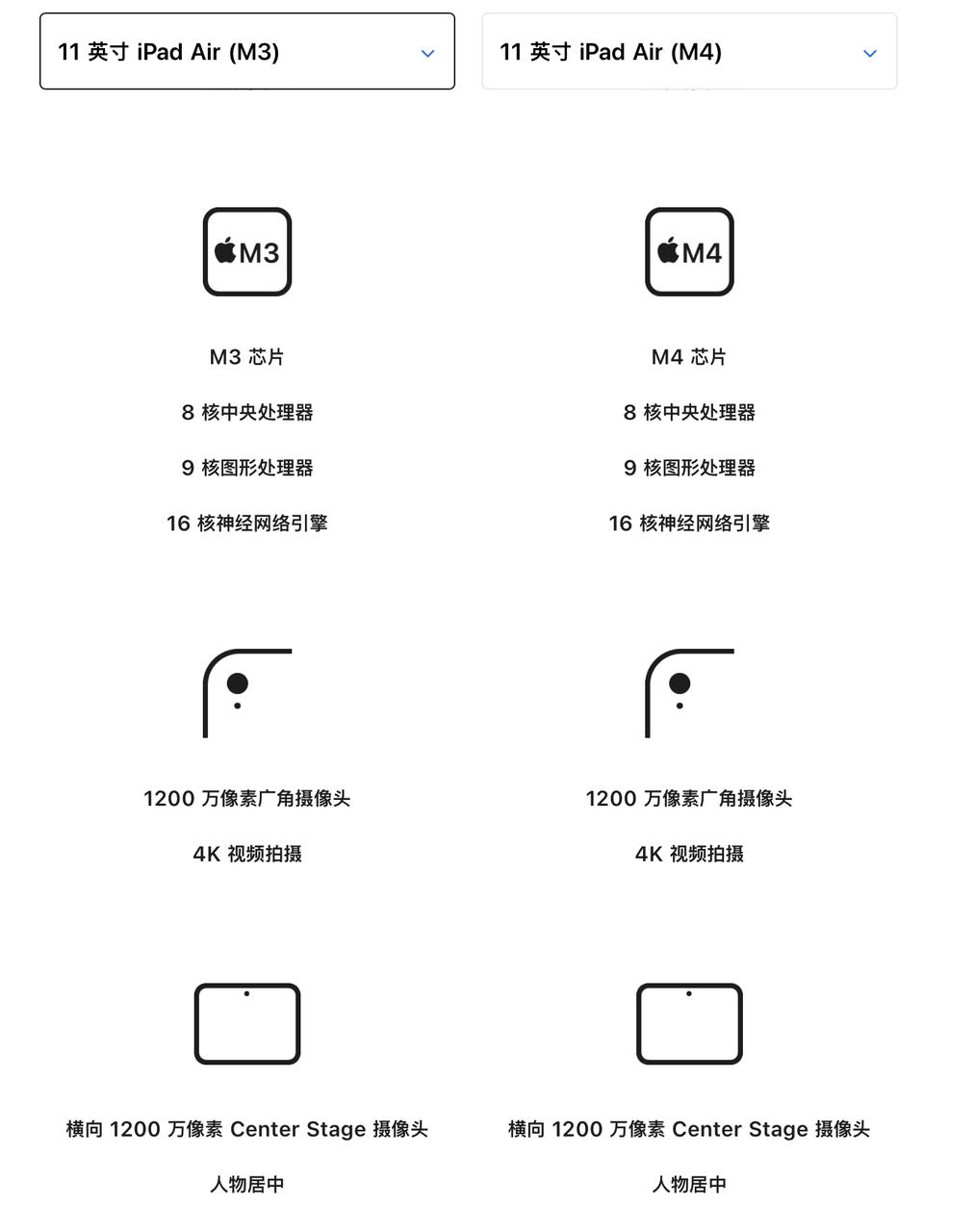
The real notable upgrade of the M4 version of the Air is that the memory is increased from 8GB in the M3 version to 12GB.
Two years ago, the iPad Pro M4 version (256GB/512GB storage) only had 8GB of memory. With the significant increase in memory in the past two years, the M4 version actually offers more with the same price. (There's the cost - effectiveness. Apple, it's so stupid not to promote this vigorously!)
The fundamental reason is that Apple Intelligence is very memory - hungry.
At the same time, this also exposes the awkward positioning of the Air product.
When the most important component of the tablet - the screen - cannot be upgraded due to conflicts with the Pro product line, Apple can only shift the focus of its narrative to the chip.
It definitely can't provide a high - refresh - rate screen. Otherwise, who would buy the more expensive iPad Pro?
Given the reality that iPadOS still hovers in the light - productivity positioning, the upgrade from M3 to M4 is just a numerical increase, not a qualitative change that users can perceive.
With an unchangeable positioning and limited configuration upgrades, the Air is in an awkward situation. But in terms of price, starting from 4,799 yuan for the 11 - inch model and 6,499 yuan for the 13 - inch model, I can see the (blind) confidence of the economic upswing era in the iPad Air M4.
The standard of productivity tools has changed
Without a new mold, no OLED screen, and no long - rumored "touch - screen version," the MacBook Pro M5 series is more in line with the stereotypical image of Apple.
Let's start with the Macbook Air. Like the iPad Air, its update is rather insignificant. If you have an M3 or M4 version of the Air, you can safely close the computer and go to sleep.
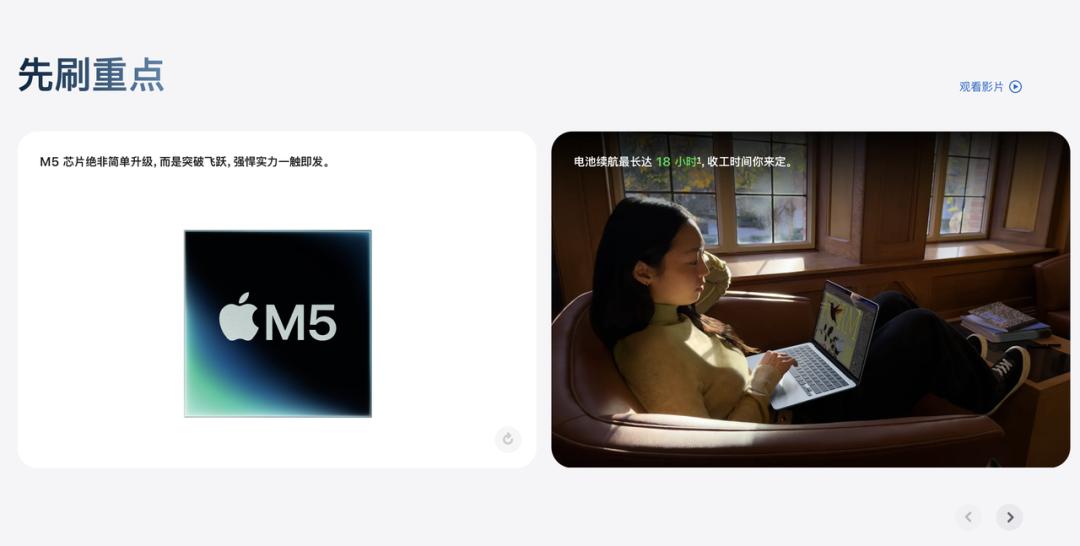
The first update focus is the M5, and the second is battery life... | Apple
The appearance is still that 60Hz LCD screen with a notch. The basic configuration still starts with 16GB of memory. The update point is that it is equipped with the M5 chip, which has stronger single - core performance and double the neural network engine computing power.
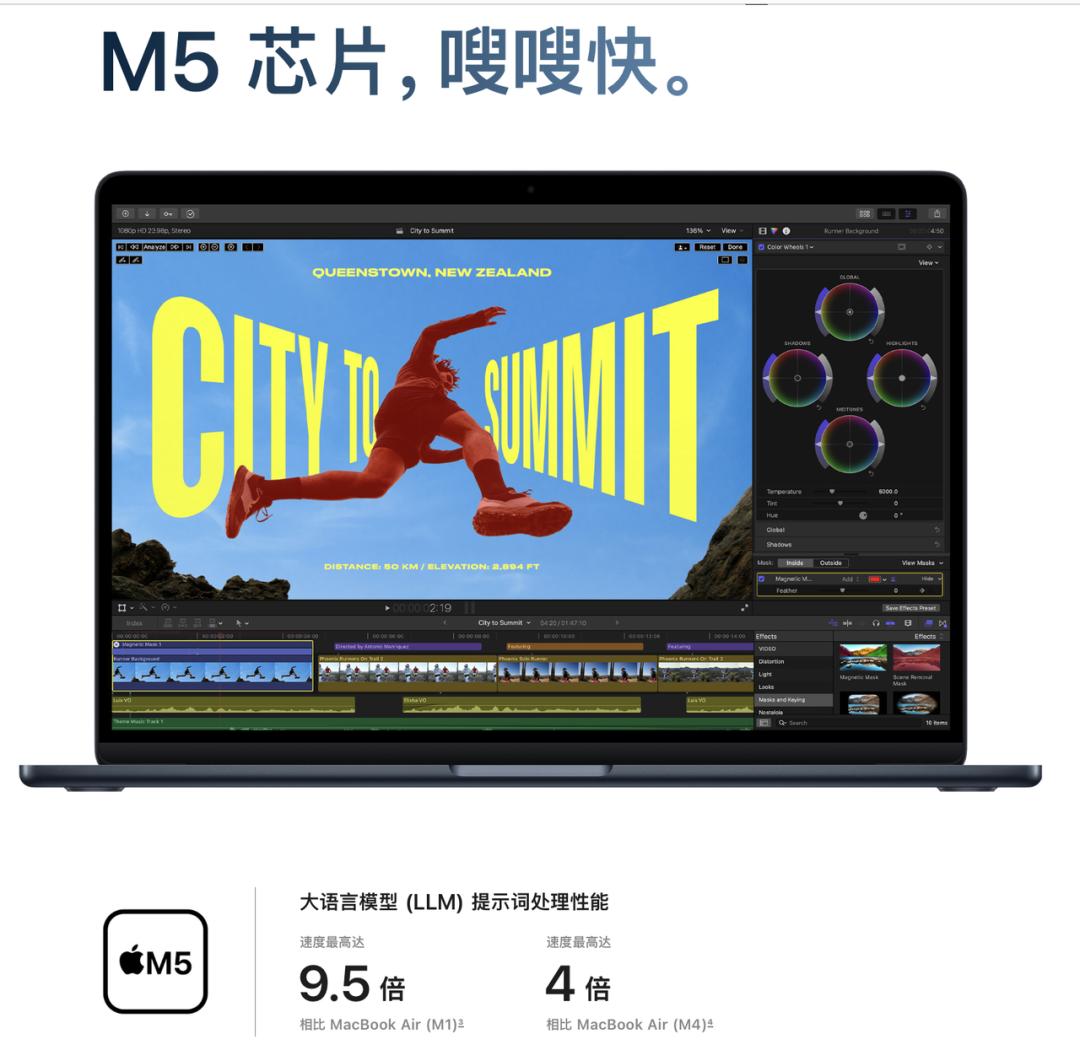
From an industry perspective, the M5 Air doesn't need innovation at all. Its greatest significance is to cooperate with the iPhone 17e and iPad Air M4 launched the day before to completely unify Apple's entire product line with "AI entry - level models."
On the other hand, the MacBook Pro product line is playing a "conspiracy" of "upgrading the configuration and raising the price across the board."
The MacBook Pro still uses three chips, M5, M5 Pro, and M5 Max, to distinguish different versions. The differences between the versions are clear - cut, and the price gaps are huge.
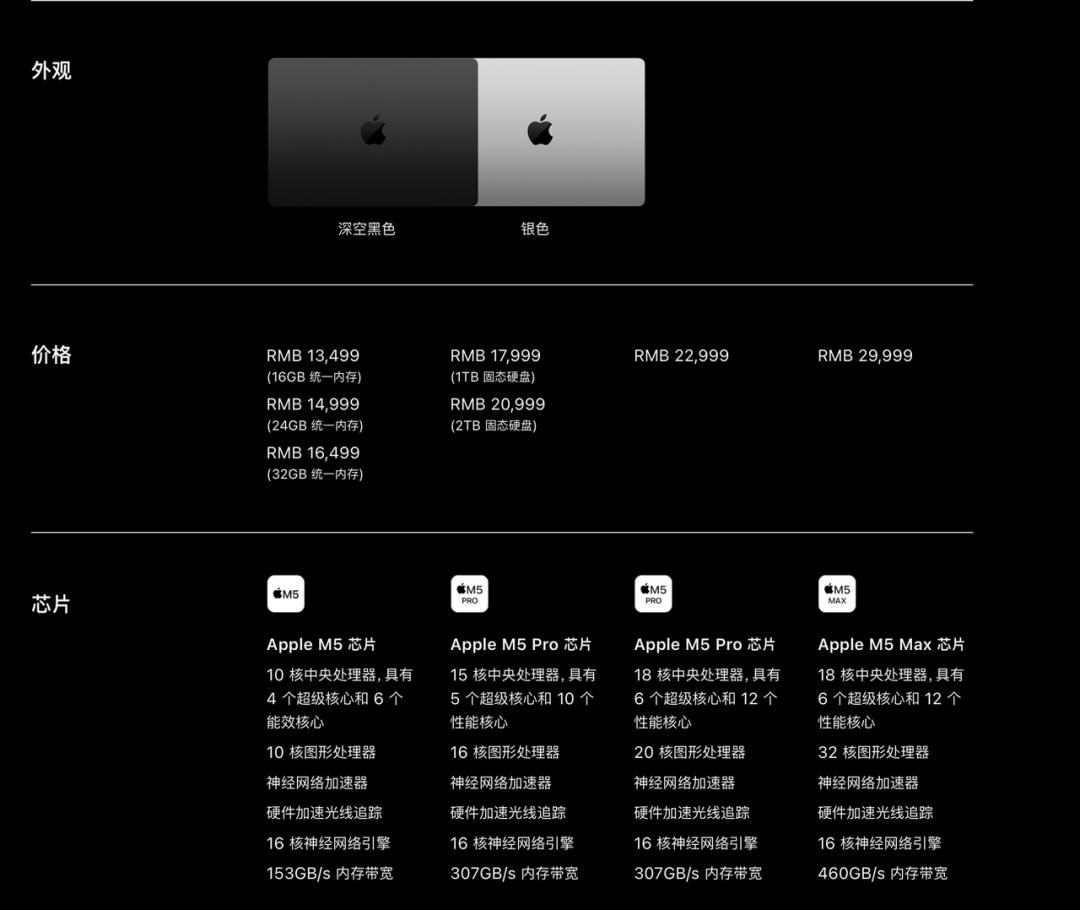
Each version has quietly increased the price by 1,000 yuan | Apple
For the 14 - inch base - model M5 MacBook Pro, the starting price is 13,999 yuan, a direct increase of 1,000 yuan compared to the M4 version two years ago. But what visible upgrades do you get for this 1,000 yuan? Almost none.
It has the same mold, the same Liquid Retina XDR display, and the same battery life. Even its M5 chip has the same core architecture as the Air, still starting with 16GB of memory, and the interface is still locked at Thunderbolt 4.
This machine is essentially a "luxury version of the Air with a top - notch Mini - LED high - refresh - rate screen, better heat dissipation, and high - quality speakers." It is designed for mid - level productivity users who pursue a good screen but don't need to do heavy - duty work and are price - sensitive.
It's not until the M5 Pro version of the MacBook Pro that it becomes a real Pro.
From this version on, you can have a memory starting from 24GB, the M5 Pro chip with performance and core numbers far exceeding those of the M5, and a full - fledged Thunderbolt 5 interface (with a transmission speed of up to 120Gb/s). For the vast majority of video creators, programmers, and 3D designers, it is the middle point between performance and price.
But similarly, its starting price has also reached 17,999 yuan, 1,000 yuan higher than the M4 Pro version.
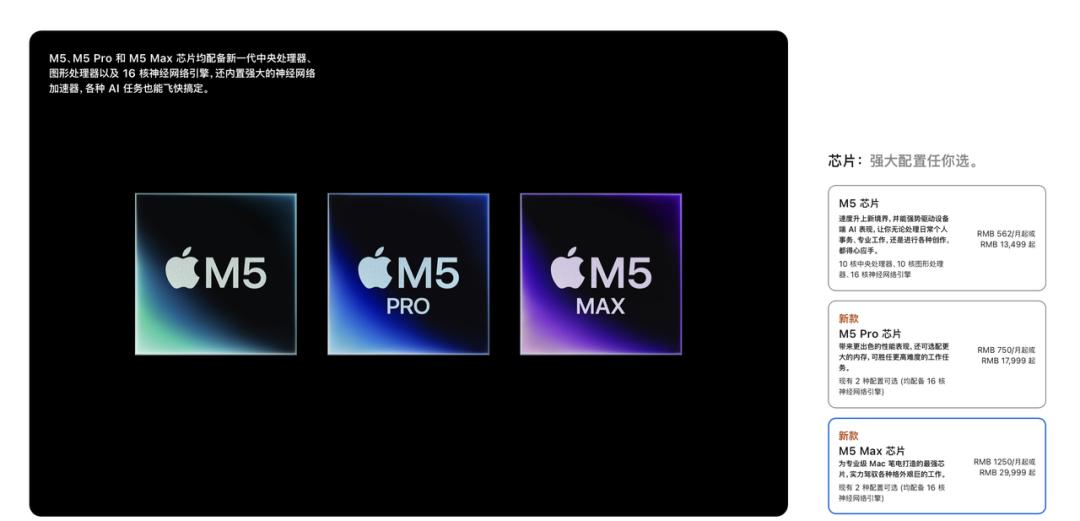
The starting price of the "real" Macbook Pro has quietly reached 17,999 yuan | Apple
The M5 Max can be described as a "performance monster" and a "money - guzzler." Starting with an 18 - core CPU + 32 - core GPU, it also raises the price to 29,999 yuan.
Rather than looking at the configuration highlights, it's more interesting to look at the official website promotion pages when the M4 and M5 were launched. From the M4 in 2024 to the M5 in 2026, Apple's "measurement standards" have changed.
In the past, when Apple sold Macs, it liked to show some comparison bar charts, telling you "how much faster it is to export 8K videos with Final Cut Pro compared to the previous generation" or "how many audio tracks can be opened with Logic Pro." But in the M5 generation, all these traditional skills of creators have been pushed to the corner.
Instead, "AI" has taken the center stage on the official website.
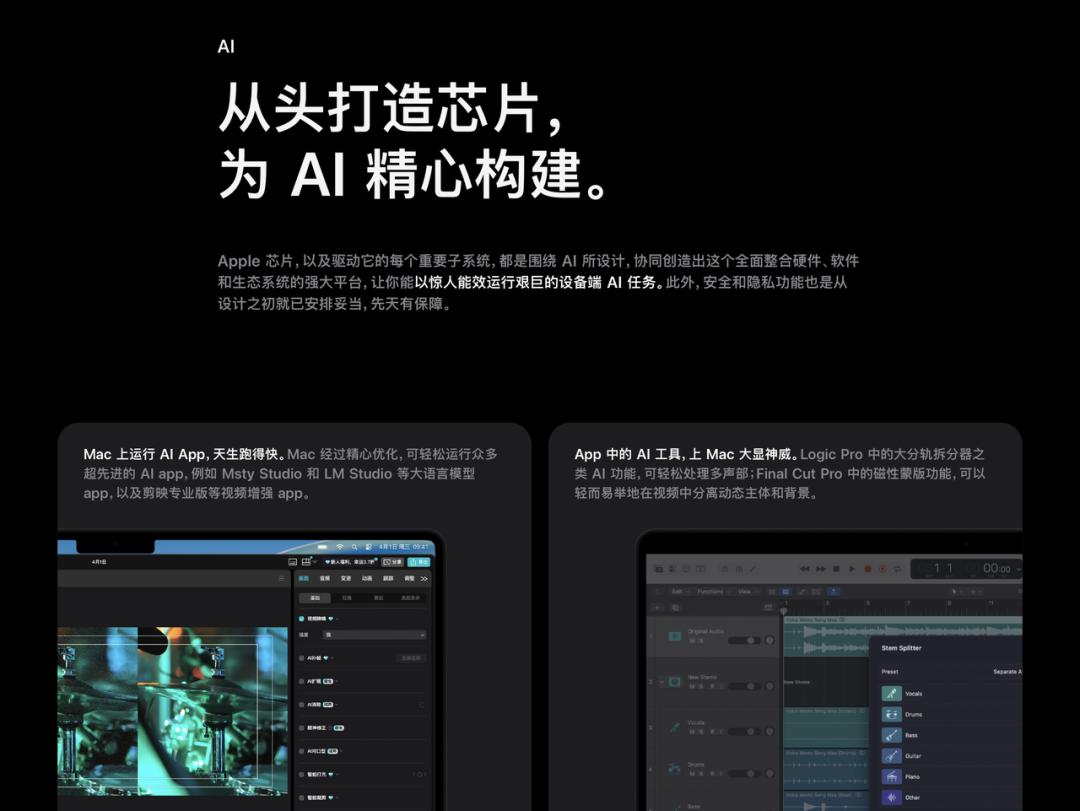
"On - device large - language model (LLM) inference speed," "on - device Transformer model training," "arduous on - device AI tasks," and "generating images with diffusion models" have become the promotional slogans.
So Apple is also sending a signal: from now on, the Macbook Pro is not just a computer for video editing. It is a private computing center that can run large models with billions of parameters anytime, anywhere, even without being plugged in.
Everything points to AI
Why can phones and tablets have a disguised price cut?
The hardware forms of smartphones and tablets have actually reached the limit of competition.
Looking at Apple's financial reports from 2025 to the beginning of 2026, on the surface, the revenue still leads the pack. But looking closely at the structure, in the fourth fiscal quarter of 2025, Apple's revenue in Greater China decreased by 4% year - on - year (down to $14.49 billion).
In the just - released first fiscal quarter of 2026, the revenue in Greater China suddenly soared by 38% to reach $25.53 billion. Where did this amazing rebound come from?
It relied on the real - money "price drops" on major e - commerce platforms at the end of the year and the unprecedented subsidies and discounts from the official.
The most typical example is the iPhone 17 Air last year, which sacrificed the basic user experience in pursuit of extreme thinness and lightness. With a starting price as high as 7,999 yuan, its activation volume was extremely dismal at one point. There were even reports that the supply chain sharply cut the production capacity by 80%. Finally, it barely managed to make a comeback by relying on an official limited - time direct price cut of 2,000 yuan and various subsidies, bringing the price down to the 4,999 - yuan mark.
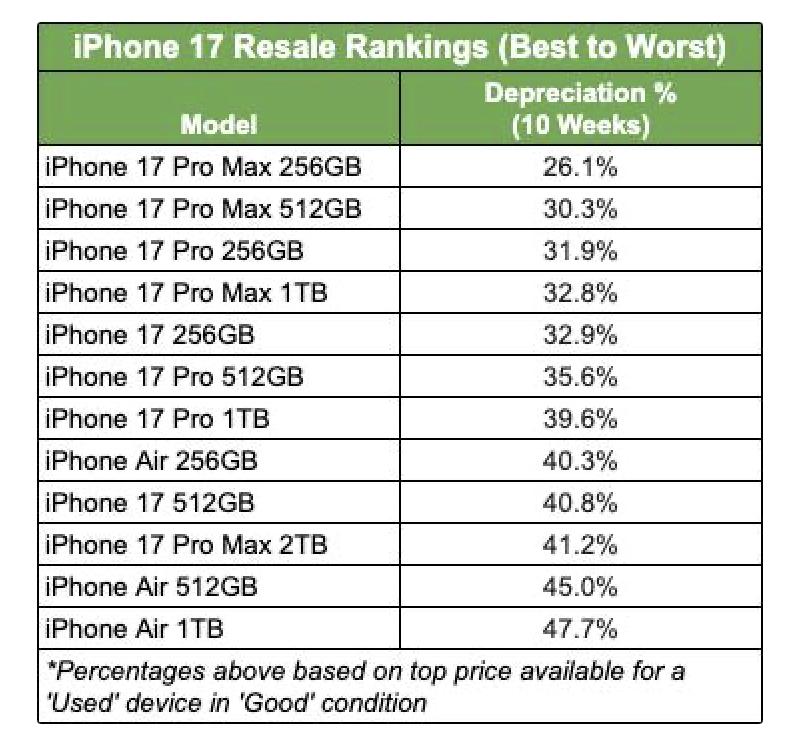
The iPhone Air was also unpopular overseas | SellCell
Although "trading price for volume" boosted the financial report data in the short term, it also completely exposed the dilemma of Apple's high - price strategy.
Many people think that Apple launched the mid - range iPhone 17e to grab Android users in the 3,000 - 4,000 - yuan price range.
Actually, it's not the case. Today's Android flagships at the same price range have long outperformed the entry - level 60Hz Apple phones in terms of hardware experience. Users who are used to the high - refresh - rate screens and localized operating systems of Android are not that easy to "switch camps."
Since it can't grab Android users, why does Apple expand its low - price product line?
Maybe Apple's "imaginary enemy" is not Android phones at all, but the "second - hand Apple market" and hundreds of millions of "loyal Apple users."
Apple currently has more than 2.5 billion active devices globally, among which there are a large number of old users with iPhone 12/13. These old models have too little memory to run the upcoming Apple Intelligence.
When these people want to change their phones but there are no suitable new Apple products, they are likely to go to the second - hand market to buy a second - hand iPhone 14 Pro or 15 Pro.
But in second - hand transactions, Apple can't clear its inventory or make a profit.
Therefore, the A19 chip in the iPhone 17e and the "upgraded" 12GB memory in the iPad Air M4 essentially reflect Apple's "anxiety" - it would rather sacrifice the profit of a single hardware unit to pull new and old Apple users into the Apple Intelligence ecosystem as quickly as possible and with the lowest threshold.
Then why does the MacBook Pro dare to raise the price against the trend?
In the computer