People's Departure and Chess Pieces' Fall: Alibaba's AI Bids Farewell to Idealism
When AI has to step out of the laboratory, transitioning from technology to business, and from software to hardware, what kind of game is Alibaba's AI playing? Why has it specifically chosen glasses?
“I'm stepping down. Bye, my beloved Tongyi Qianwen.” (I've resigned. Goodbye, my beloved Tongyi Qianwen). In the early hours of March 4th, Lin Junyang, the core person - in - charge of Alibaba's Tongyi Qianwen, left this message on social media, shocking the industry.
This person born in 1993, the youngest P10 - level technology leader at Alibaba, is the core promoter of the open - source model Tongyi Qianwen. This decision came "suddenly" - Alibaba had just promoted the unification of its large - model brand, and Lin himself had just led the team to release the Qwen 3.5 series of small models and reposted and liked an interaction with Elon Musk.

It wasn't just Lin Junyang. On the same day, Yu Bowen, the person - in - charge of Qwen's post - training, and others also officially left. The sudden departure of multiple core Qwen personnel left not only regret but also huge question marks. Some attribute it to the confusion over the commercialization efficiency of the open - source model - although Qwen is well - known, there may already be differences within Alibaba regarding how much cloud - based API call revenue it can actually generate. Others mention that Qwen - 3.5, which made its debut on Chinese New Year's Eve, was once evaluated as a "semi - finished product" by internal executives, and Lin Junyang had disagreements in the latest internal meeting.
From a broader perspective, Lin Junyang's departure is by no means a simple personal choice. It is a microcosm of the intense collision between technological ideals and commercial realities after Alibaba's AI strategy and organization have entered the deep - water zone.
Almost simultaneously, Jack Ma appeared to talk about AI, and Alibaba officially announced a strategic increase in the consumer market - among which, the Tongyi Qianwen AI glasses officially started pre - sales, becoming Alibaba's first move to create a "super entrance" through AI hardware. Products such as AI rings and AI earphones are also being intensively planned.
On one hand, there is the departure of the technological soul figure, and on the other hand, there is an important move in the implementation of AI hardware. It's hard to say that there is no connection between the two, and they both point to the same core proposition: When AI has to step out of the laboratory, transitioning from technology to business, and from software to hardware, what kind of game is Alibaba's AI playing? Why has it specifically chosen glasses?
Why does Alibaba choose glasses when AI moves from software to hardware?
In the past few years, the emergence of ChatGPT has allowed AI software to penetrate into all walks of life at an unprecedented speed. Writing copy, drawing illustrations, writing code, and conducting analysis, these tasks that once highly relied on human intelligence are now easily achievable with the assistance of AI.
However, as algorithms gradually reach the ceiling, a more profound trend is emerging - the focus of AI development is accelerating its migration from pure software applications to the hardware field. From smart cars to wearable devices, from AI phones to embodied intelligence, that is to say, AI is moving from the virtual to the physical.
At the beginning of 2026, the battle for the consumer - end layout of AI hardware suddenly intensified. ByteDance chose to enter the mobile phone market, DingTalk bet on recording devices, and Alibaba placed its chips on glasses.
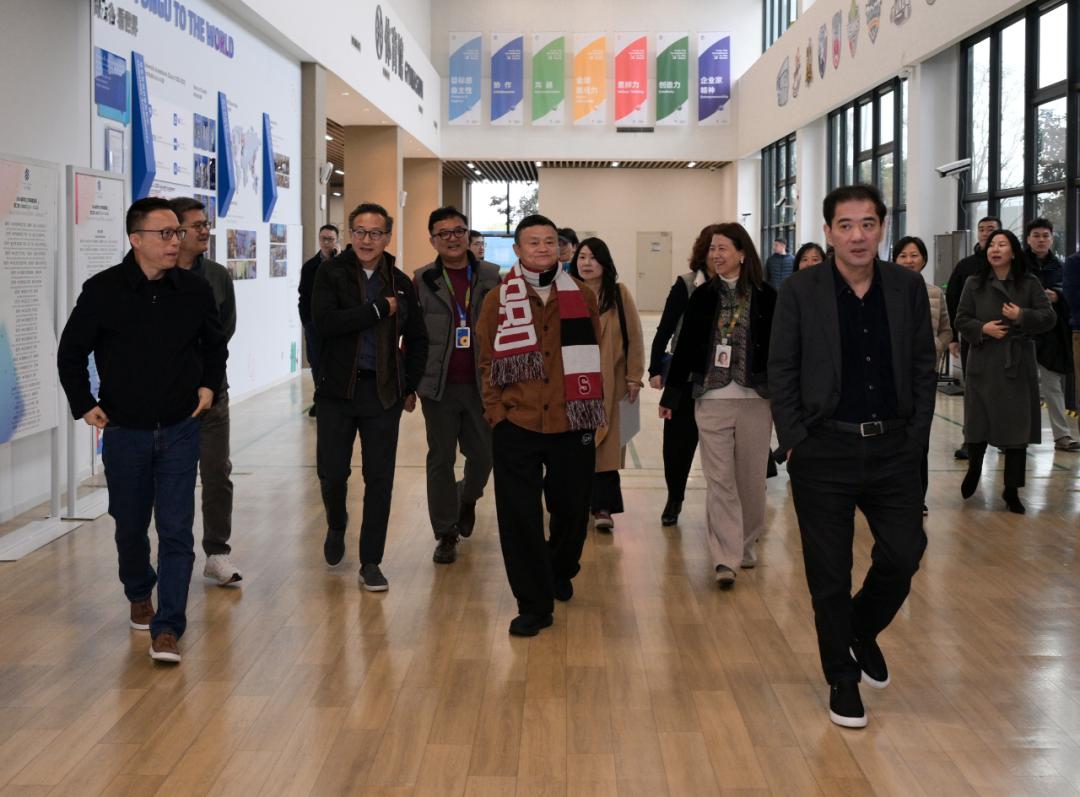
Wu Yongming, the CEO of Alibaba Group, once said: "The greatest imagination of AI lies not in the mobile phone screen, but in taking over the digital world and changing the physical world." This statement points out the essence of the problem - for AI to be truly useful, it must step out of the screen. This means that, perhaps from the very beginning, the influence brought by the so - called global open - source community is not what Alibaba's top management wants.
So why does Alibaba pin the explosion of users of its AI consumer - end products on AI glasses? Because the screen cannot capture information in the real world.
When you want to hail a taxi on a noisy street, your voice command may be drowned out by the noise. When you point at a foreign - language menu and want to translate it, you can't send the menu to the AI in your phone. When you want to record your route while cycling, taking out your phone is a dangerous operation. In these scenarios, AI either can't hear, can't see, or is too late.
In the past, AI could only understand the world through text or voice, and this kind of information transfer itself is a loss of information. Qianwen's foray into hardware is to let AI see and hear for itself - and glasses are the best carrier for the first - person perspective. By capturing what the line of sight reaches through glasses and perceiving the environmental audio through earphones, it evolves from "you speak and I listen" to "I see and I understand."
The gap between "understanding semantics" and "understanding scenarios" is not about algorithms, but about a pair of eyes.

However, there is a huge controversy hidden here - privacy. From the perspective of user experience, one of the biggest controversial points of AI glasses is the privacy issue. When you wear glasses to see the world, the glasses are also seeing everything around you. There are risks of secret filming, data collection, and the right to know from a third - person perspective...
These issues once caused a great stir with Meta's Ray - Ban Stories, and some users even had conflicts due to the glasses' cameras.
How will Qianwen glasses handle the anxiety of being watched? Currently, the official statement still remains at the physical level of "indicator lights indicating the recording status," but the real test is, when the glasses become a 24/7 perception terminal, who actually owns the user's data? What will it be used for? The answers to these questions can determine the product's lifespan more than the hardware parameters.
Competitive difference: Not in hardware, but in the ecosystem
If you only look at the hardware parameters, Qianwen glasses are not really outstanding: dual flagship chips, a five - microphone array, a weight of 40 grams, and 3K recording. Meta, Thunderbird, and Xiaomi can all achieve these configurations, and they may even have more powerful specifications.
At this level, it's hard to have real differentiation. If you stack chips, others can do the same; if you reduce the weight, others can also do it. Simply piling on specifications will ultimately transfer the cost to users - unless the brand is willing to subsidize. Meta and Xiaomi, in particular, have the confidence to "not make money from hardware": the former has a global social ecosystem, and the latter has a large IoT matrix.
Perhaps in Alibaba's view, the real moat lies not in hardware, but in the ecosystem and experience. And the gap in experience is precisely hidden in these areas: ordering takeout, booking hotels, and hailing taxis.

This is the first move of Qianwen glasses - ecosystem synergy. When you stop on the street and your gaze falls on a restaurant, just ask softly: "How is this place? Help me make a reservation," and the glasses will quietly start visual recognition, retrieve Gaode's reviews, and complete the reservation on Ele.me. From the moment you have the idea to the moment the thing is done, your phone lies quietly in your pocket all the time.
This is the power of "what you see is what you get."
Most AI glasses on the market stay at the level of information acquisition: taking photos, recording videos, and asking for directions. Users leave after asking questions, and the relationship between the glasses and users ends with the Q&A. However, the logic of Qianwen glasses is a transactional closed - loop. Qianwen is no longer just a chatbot, but an execution center that can get things done.
Can other manufacturers replicate this experience? The answer is: it's difficult. ByteDance has Doubao, but it doesn't have a closed - loop for local life services; Xiaomi has an ecosystem, but it is scattered in smart home products; Huawei has technology, but it lacks a service network. Alibaba holds a complete service chain of Gaode + Ele.me + Alipay + Fliggy - the integration of this set of assets is extremely difficult, but once it works, it will be the deepest moat.
Of course, the experience doesn't exist naturally.
User habits need to be cultivated, the service network needs continuous operation, and the accuracy of visual recognition under complex lighting conditions needs continuous refinement. In this field, there is currently no product that can lead by a large margin. This is both an opportunity and the biggest challenge for Qianwen.
In other words: Hardware is the ticket to enter the game, while the ecosystem is a marathon. Whoever can turn "understanding" into "accomplishing" can truly enter users' daily lives.
Four - fold test: When the ecological boundary meets the ability boundary
Ambitious as it may be, reality is reality. For Qianwen glasses to truly break through the circle, they face at least four - fold tests.
The first test is the complexity of hardware R & D.
Software can be coded today and launched tomorrow, but the R & D cycle of hardware is measured in years and involves a bunch of fields such as optics, acoustics, and materials science. From a single product to a multi - product matrix, the difficulty of supply - chain management, quality control, and inventory management increases exponentially.
The sentence "Help me make a reservation at this store" involves four links: visual recognition (identifying the store), semantic understanding (understanding the intention), service invocation (querying for available seats), and payment fulfillment (completing the reservation). Any bottleneck in any link will disrupt the experience. Especially the accuracy of visual recognition under complex lighting conditions and the anti - interference ability of voice wake - up in a noisy environment require a lot of real - world scenario refinement.
The second test is the refinement of user experience.
For products like AI glasses, factors such as wearing comfort, battery life, and natural interaction all determine whether users are willing to wear them. The Qianwen AI glasses are equipped with a 272mAh battery and claim a comprehensive battery life of 9 hours. Whether this configuration can support all - day ambient intelligence experience remains to be seen from market feedback. The return rate of some AI glasses is as high as over 50%. Users buy them and then let them gather dust after wearing them for a couple of days, which is the most realistic challenge for such products.
The third test is the continuous operation of the ecosystem.

The "what you see is what you get" experience depends on the depth and breadth of the underlying service network. Gaode, Alipay, and Ele.me are Alibaba's trump cards, but once the hardware is rolled out, users expect more than just Alibaba - affiliated services. For example, if you want to book a niche restaurant not on the platform or use Meituan to order takeout, the experience may be disrupted. How to attract third - party developers and expand the ecosystem together is a long - term issue.
The fourth test is the pincer attack from big - name companies and vertical players.
The field is already crowded with competitors. In terms of technological capabilities, ByteDance is the most direct competitor. ByteDance has the Doubao large model and the content ecosystem of Douyin. Its closed - loop logic of "AI + content + hardware" forms a sharp contrast with Alibaba's "AI + service + transaction." If ByteDance makes glasses, it may focus more on "how to let AI help you record your life and generate content"; while Alibaba focuses more on "how to let AI help you complete transactions." It's hard to tell which approach is better.
In terms of hardware capabilities, Xiaomi is an unavoidable competitor. Xiaomi has years of accumulation in the smart - hardware supply chain and has extremely strong cost - control capabilities. Once its AI glasses gain popularity, a price war is inevitable.
In the vertical field, AR manufacturers such as Rokid and Thunderbird have been deeply involved for many years. Thunderbird has just completed a new round of financing of over 1 billion yuan, and its optical technology accumulation far exceeds that of Internet companies. These players don't pursue comprehensiveness but strive for excellence in specific scenarios (such as movie - watching and office work). This kind of focus may be more down - to - earth than the ecosystem stories of big companies.
In addition, the cooperation between Meta and Ray - Ban has proven the feasibility of "fashion + technology." If users just want a cool pair of glasses that can take photos, Meta has already done a good job. Why should users replace it with Qianwen? Alibaba needs to answer this question.
"Exit" and "Entry": A Planned Exploration and Integration
For the industry, there is still a big question: When the Qianwen AI glasses were officially launched, only three months had passed since the release of the Quark AI glasses. With the same algorithm and the same software - hardware team, why did Alibaba launch AI glasses under two brands in such a short period?
Judging from the public information, the sales of the Quark AI glasses did not meet expectations.
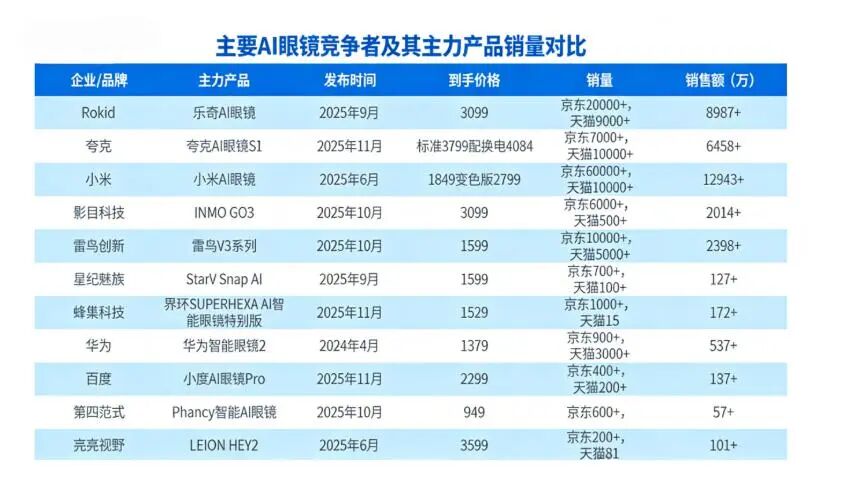
The Quark AI glasses were released on November 27, 2025. They topped the hot - sales lists of smart glasses on Tmall, JD.com, and Douyin within 4 hours of going on sale, and the sales volume approached 5,000 units in 2 days, with the cumulative orders quickly exceeding 10,000.
However, there is a significant gap compared with competitors. In the mainstream e - commerce channels, the sales volume of Xiaomi's AI glasses exceeded 70,000 units during the same period, and the sales volume of Rokid's AI glasses was nearly 30,000 units.