It costs 30,000 yuan for one repair. "Treating a machine is more expensive than treating a person."
Ten days after sending the consumer-grade humanoid robot he bought with an investment of 200,000 yuan to the repair center, Mr. Zhang received a notice to pick up the machine. The bill read: The total cost was 30,000 yuan - among which, the module material cost was 28,000 yuan, and the labor and calibration fee was 2,000 yuan.
Ten days ago, the robot fell when crossing the threshold at home. After being helped up, it could still walk, but its gait changed - it would tremble with each step and its body would involuntarily tilt to one side, like a patient with sequelae of a stroke.
The factory inspection found that the fall caused a micron-level deformation of the harmonic reducer of the robot's hip joint - invisible to the naked eye, but enough to cause a full-line shift of the gait control parameters.
The repair plan was to replace the entire hip joint module. It took 3 days to install the new module. The real challenge came later: The engineers scanned the joint points of the whole body with a laser tracker to complete the accuracy compensation, and then repeatedly debugged the gait algorithm. This process took 7 days.
30,000 yuan is enough to buy an entry-level Wuling Hongguang MINI EV. In the world of robots, this is just the price to replace a joint.
In the past year, a total of 18,000 humanoid robots were sold globally, and dancing robots appeared at various conferences and performance venues. In the first three quarters of 2025, there were more than 600 financings in the robot-related industries. As capital poured in frantically, a huge "aftermarket" was quietly taking shape. Each sold humanoid robot adds a potential customer to this market.
However, at present, there are very few "robot doctors" who can take on this business. Professional repair technicians are even harder to find than the robots themselves. The original factory architecture and spare parts channels have not been opened, which makes the fault diagnosis of robots basically rely on the experience of old masters - this business is more difficult than expected.
Single repair costs over ten thousand yuan
Clang! At the Chongqing Embodied Intelligence Expo last year, five Unitree robots were excitedly performing the Charleston dance. As a result, one of them got too excited after performing continuously for 15 minutes and fell directly in front of the onlookers.
The Charleston dance is one of the commonly used dances for robot performances. This dance places a particularly heavy load on the machine. Therefore, after the robot fell, the motor was damaged. Finally, it cost more than 20,000 yuan to repair the robot, which could not cover the cost of a single rental at all.
Originally, the machine was under warranty. In the past, it only needed to be sent to Unitree's official for factory repair. However, this time, the official refused to repair it, stating that they had retrieved the motor rotation data and determined that the dance was a secondary development by the public, and judged that the motor was overloaded, so it was not within the official warranty period. Therefore, the repair had to be paid for out of pocket.
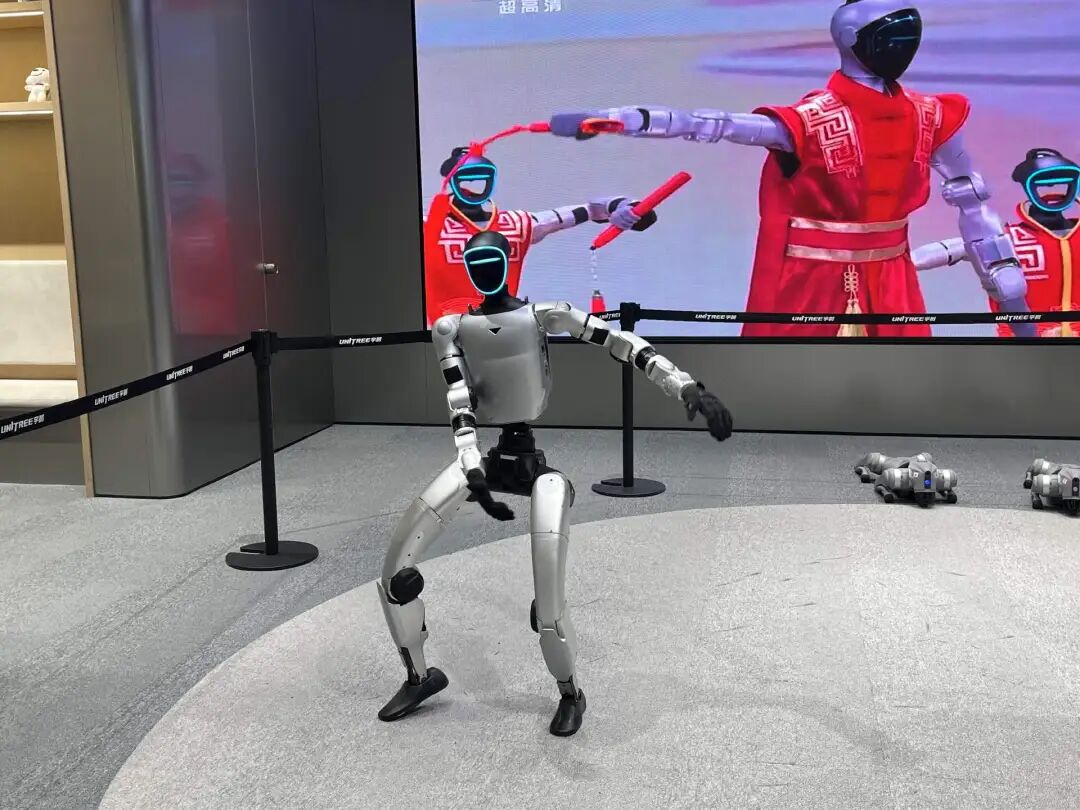
Caption: Robots performing in the offline store of Unitree in JD Mall.
Tech Planet's inquiry found that the warranty period of mainstream humanoid robots on the market is about 1 year. For example, JD shows that the warranty period of the Unitree robot G1, the same model as that in the Spring Festival Gala, is 8 months, while the warranty period of the G1 EDU, which allows secondary development, is 18 months. The warranty period of the Galaxy General G1 is 1 year. After unpacking and inspecting the goods on the spot, 7-day no-reason return is not supported. Once the warranty period is exceeded or it is determined by the official that it is not within the warranty scope, the repair price is inevitably discouraging.
A robot rental agency showed its first repair list: It replaced parts such as the lower shoulder hoop, the 5020R16 front cover, the 7520 front end cover, and the G1-battery cell semi-finished product. Plus the labor fee (200 yuan per hour) of 2,200 yuan, a total of more than 9,000 yuan needed to be paid. Most of these parts are for basic faults and are the cheapest to repair.
A consumer shared that the head of the Unitree robot he bought was deformed after a fall. It cost 1,800 yuan to replace a head bracket, and he had to wait in line for a week. Tech Planet's inquiry found that it costs 4,000 yuan to buy a special battery for the Unitree humanoid robot, and one battery can be used for 2 hours. An industry insider said that machines that have been used for more than two years basically need to have their batteries replaced.
Long Yongming of Huanshi Technology told Tech Planet that according to his observation, when the total repair cost of a robot damaged due to an unexpected situation and not within the warranty scope exceeds 60% of the price of a new machine, more than 70% of individual customers will choose to give up the repair.
"A customer bought a robot for 100,000 yuan. It needed to be repaired due to an accidental injury to its lower limbs, and the quoted price was 35,000 yuan. Finally, the customer chose not to repair it and sold the machine second-hand directly," Long Yongming added. The lower limbs are the parts where the robot moves very frequently and are also the most prone to wear and tear.
In fact, in some special cases, even if it is sent for repair, it is very likely that it cannot be repaired. For example, if the core AI main control chip is burned out and the manufacturer does not provide spare parts separately, the cost of replacing the motherboard may exceed 50% of the price of a new machine.
For old and discontinued models, the original factory spare parts are completely out of stock, making repair impossible. In addition, if the whole machine gets waterlogged, causing large-scale corrosion of the circuit, motor, and sensors, the repair cost often exceeds the price of a new machine. In such cases, the machine can only be scrapped in the end.
Can afford to buy, can't afford to use, and even can't afford to repair
Even without repair, just the maintenance cost is enough to be discouraging.
Tech Planet learned that for consumer-grade models with a purchase price of 100,000 to 200,000 yuan, the annual maintenance cost is about 10% to 30% of the purchase price. This means that, calculated at the highest maintenance cost, the cumulative maintenance cost for 3 years is basically close to the purchase price.
For high-end commercial models, the purchase price can reach about 600,000 yuan. Due to high-intensity use, just the replacement cost of the dexterous hand alone may be as high as 100,000 to 200,000 yuan per year.
The design life of mainstream humanoid robots is 3 to 5 years, which is similar to that of Apple phones - Apple officially estimates that its typical lifespan is 3 years, but because the hardware itself is durable, the research institution CCS Insight predicts that since 2024, the average service life of iPhones has reached 8 years.
However, Apple phones do not require much daily maintenance and repair, but robots are different. Among them, humanoid robots have many vulnerable parts, so they must be replaced on time, such as knees and soles. In order to reduce the wear and tear of the robot's feet and prevent slipping, many people put traditional Beijing cloth shoes on the robots.
Long Yongming said that under normal low-intensity use, the robot needs to be repaired about 3 to 8 times in its entire life cycle. This includes 1 to 2 basic maintenance services per year and medium-scale repairs once every 2 to 3 years, such as replacing the battery or vulnerable joints. If it is used for high-frequency commercial purposes or frequently bears heavy loads and moves, the number of repairs will double, and it may need to be repaired more than 2 times a year.
Enterprise/institutional users are the main force in buying humanoid robots at present. They usually conduct secondary development after buying them back because the basic version of the Unitree robot G1 has limited functions. Previously, China Unicom Payment bought robots to explore beverage preparation.
Tech Planet visited the first offline store of Unitree. The version on display in the store supports secondary development. Whether it is within the warranty scope after secondary development needs to be determined by the official.
Long Yongming of Huanshi Technology told Tech Planet: Generally, the industry charges repair fees according to the parts plus the labor fee. The labor fee ranges from 200 to 500 yuan per hour. Spare parts are charged according to the original factory's guiding price, and an additional service fee of 10% to 30% is charged. For some simple system debugging or calibration faults, a fixed-price model is also adopted. For all major fault repairs, a detection and quotation will be made first, and the repair will only be carried out after the customer confirms and agrees.
Currently, the industry can be roughly divided into three levels according to the fault level.
Basic faults: Involve simple calibration, battery replacement, etc. The total cost is usually between 500 yuan and 5,000 yuan, and it can be completed on-site within 1 to 4 hours.
Medium-level faults: Such as replacing a single joint module, the cost is between 8,000 yuan and 20,000 yuan; replacing the visual or tactile sensor costs 15,000 yuan to 30,000 yuan. On-site repair of this kind of fault takes 3 to 10 days, and if it needs to be sent back to the factory, it takes 15 to 30 days.
Major faults, such as replacing the entire lower limb module, cost as much as 50,000 to 300,000 yuan; replacing a single dexterous hand costs 10,000 to 80,000 yuan; replacing the core motherboard costs 50,000 to 150,000 yuan. This kind of major fault generally requires 30 to 60 days of factory repair.
Robot repair training courses cost 29,000 yuan
In the book "2049, Possibilities in the Next 10,000 Days" by Kevin Kelly, it is mentioned that the robot aftermarket is a future growth area, covering repair, maintenance, and parts supply. In the future, robot repair shops may appear.
At present, the development of humanoid robots is still in the early stage of the industry.
Currently, compared with the cost, the bigger problem is the immaturity of the humanoid robot repair industry chain. If a consumer buys a Unitree robot and wants to repair it, they need to send the machine back to the headquarters in Hangzhou first and then have it repaired at the factory.
Tech Planet learned that there is no large-scale robot repair institution in China. Currently, only JD provides on-site repair services in 10 cities such as Beijing, Shanghai, Guangzhou, and Shenzhen, and repair centers are being built in 8 provinces across the country.
Some training institutions that originally repaired industrial robots or drones have also opened training courses. Tech Planet consulted a training institution in Wuhan. The training fee is 29,000 yuan, the training period is 30 days, and there are 127 classes. Generally, two teachers teach one student.
However, repairing humanoid robots is an industry with extremely high thresholds. Some individual repair masters used to repair high-end equipment, such as spectrometers, mass spectrometers, and medical equipment.
Long Yongming said that repairing humanoid robots is a composite technology of machinery, electricity, software algorithms, and multi-sensor fusion. It requires repair personnel to understand hardware disassembly and assembly, precision calibration, and software debugging at the same time. This is completely different from the logic of traditional household appliance/equipment repair.
More importantly, it is about the industry's openness.
In terms of technological openness, the industrial robot industry has a high degree of standardization, there are sufficient third-party spare parts, and the technical information is also relatively public. However, most humanoid robots use self-developed architectures by manufacturers. Spare parts, debugging tools, and technical manuals are not open to the public, setting extremely high barriers for third-party repair.
The founder of a robot rental company said that most of the current mainstream repair masters are in Shandong and Shenzhen. The former mainly deals with industrial robots, while Shenzhen is the most developed area for electronic components. Most of the repair personnel in the market have switched from repairing industrial robots and drones.
However, just like 25 years ago, the first high-end brand 4S store in Beijing that met global standards, Audi Zhongrunfa, officially opened. Now 4S stores are all over the country. As long as the number of robots in use continues to rise, the repair problem will eventually be solved.
This article is from the WeChat official account "Tech Planet" (ID: tech618). Author: Wang Lin. Republished by 36Kr with authorization.