The exit of 23 brands reveals a truth in the consumer industry.
The consumer market in 2025 is like a long - overdue reckoning.
Twenty - three brands have fallen. Zhong Xue Gao, Xu Liushan, Etam, Triumph, Pet Freshness, Blank Me... Different names, similar fates: they all thought they could keep deceiving consumers, but in the end, consumers refused to play along.
Li Jin dug deep into these 23 brands, and the conclusion is simple: This is not a consumer winter; it's the market finally learning to squeeze out the pus.
In the past decade, there have basically been only two scenarios in the consumer circle. One is that international giants are seizing market shares across the board, leaving no track untouched. The other is that new consumer players are pouring capital - provided funds into generating traffic, hoping to create the next internet celebrity brand.
The essence of both approaches is the same: using speed to cover up poor quality, using scale to hide bad debts, and using stories to replace products. The one who tells the loudest story can secure another round of financing.
When the curtain falls on the final act, some cry about the consumer winter. But in our view, this is the market having a comprehensive physical examination and removing the tumors by the way.
The demise of these brands precisely proves one thing: Chinese consumers have finally woken up.
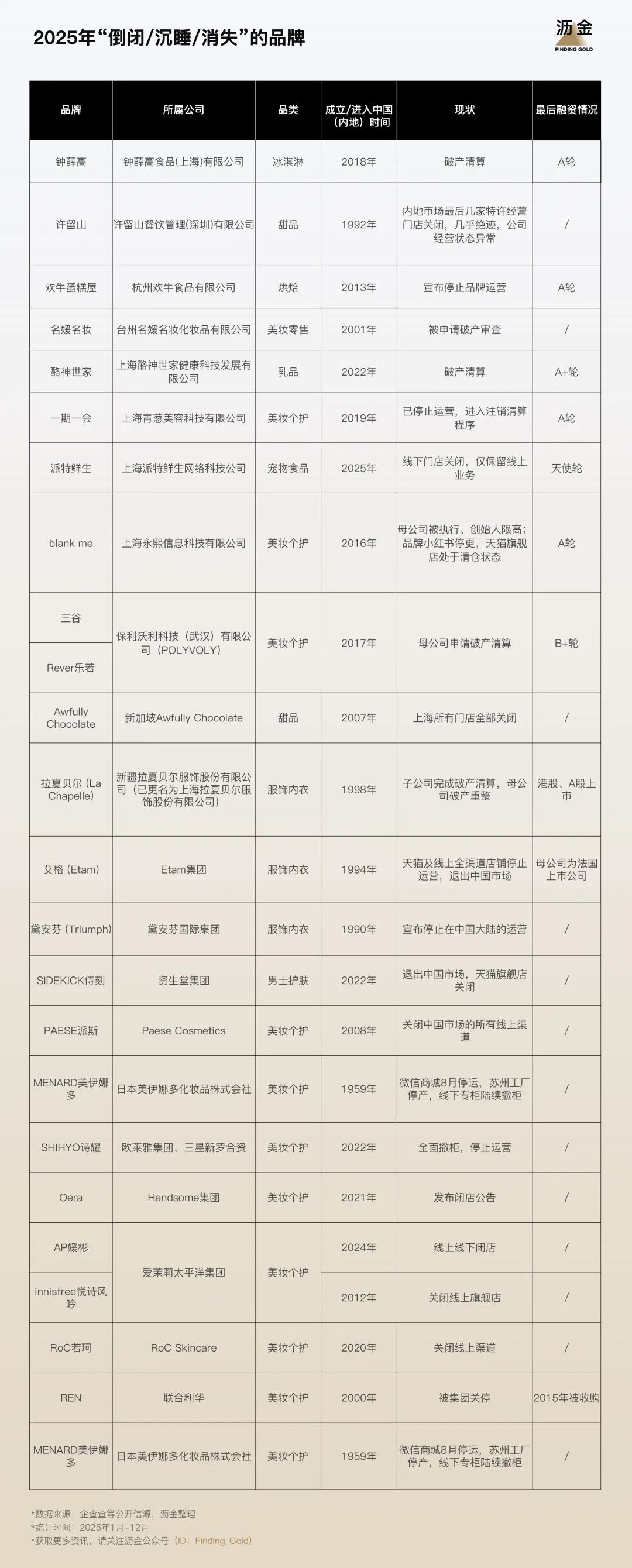
Fallen Brands: The Collective Collapse of Internet Celebrity Brands
How can we define a brand as dead?
Either the company is deregistered in the industrial and commercial system, or it has entered the bankruptcy liquidation process, or the enterprise itself or its founder has officially announced the closure.
The six selected bankrupt brands here are just representatives, but their downfall patterns are surprisingly similar: they received financing within 2 - 3 years of establishment, burned money to expand for 3 - 4 years, and then died.
This is the case for Zhong Xue Gao, Huan Niu, Cheese God's Family, etc. They started as the darlings of capital but ended up as the outcasts of the market.
Capital is just a stimulant; real growth depends on the product itself. Creating a hit product in one year, covering all channels in two years, and preparing for listing in three years - it sounds exciting, but in fact, it uses growth indicators to cover up the fact that the product has no solid foundation. No matter how tall the building is, if the foundation is made of foam, it will collapse at the first gust of wind.
What's even more ironic are those celebrity founders. Guo Benheng of Cheese God's Family was the former general manager of Bright Dairy; Fei Qiwen of Yi Qi Yi Hui was a former senior executive of Pechoin. Their resumes are impressive, but they still failed.
It's not that they didn't work hard; it's that they are too stuck in the past. Guo Benheng still believes in the "channel - first" theory, and Fei Qiwen clings to the formula for creating hit products. But today's consumers are on Douyin and Xiaohongshu. Who still buys their old - fashioned ideas?
There is no path dependence in the consumer circle, only path elimination. Using an old map to find a new continent is bound to end in failure.
The ones that suffered the most are those stuck in the middle.
Zhong Xue Gao can't reach the luxury market on one hand and is out - competed by 3 - yuan ice creams on the other. Xu Liushan is ignored by its old customers on one side and faces the downgraded competition from brands like Heytea and Nayuki on the other.
Being caught in the middle means getting slapped from both sides. In today's consumer market, there are only two paths: either be extremely cheap, making even grandmas feel they've made a good deal, or be expensive but with a justifiable reason, making young people feel it's worth the price.
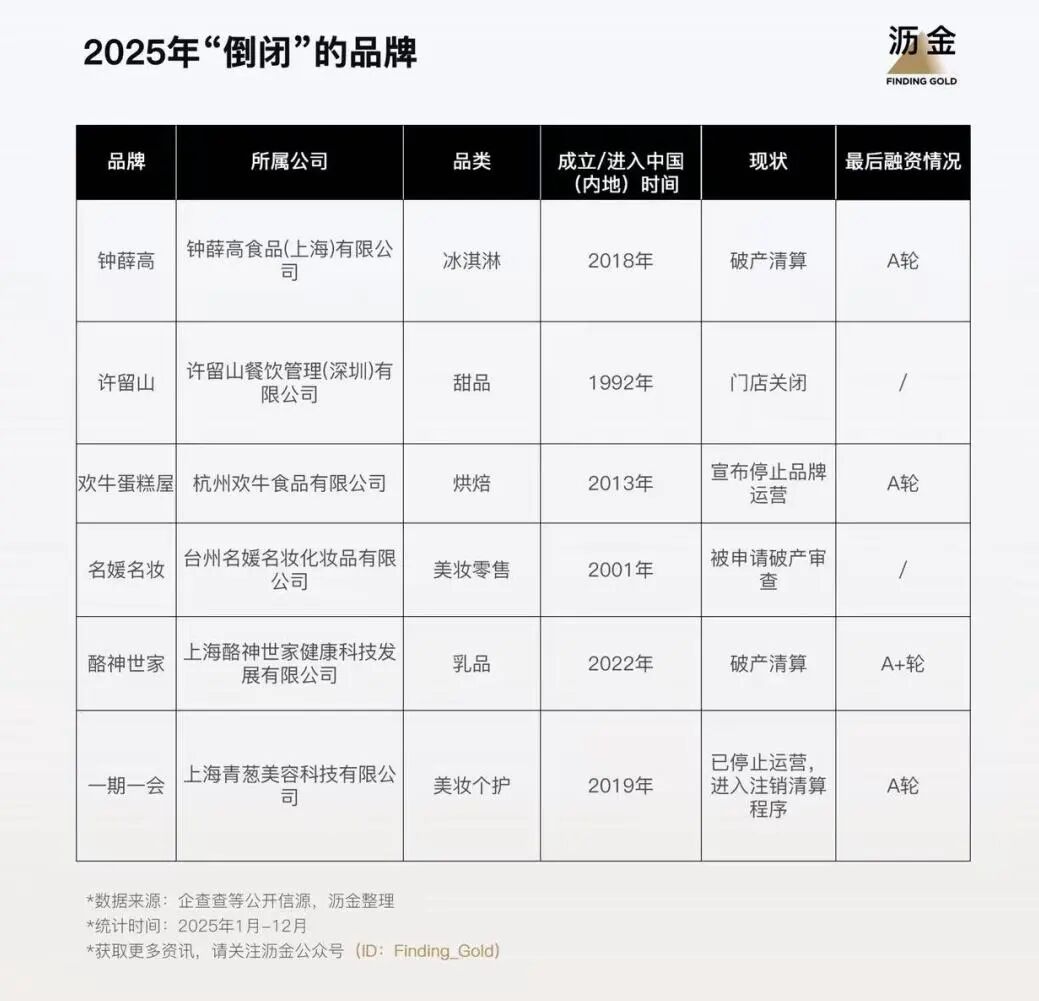
Fallen Brands: The Internet Celebrity Brands' Collective Thunderstorm
How can we define a brand as dead?
Either the company is deregistered in the industrial and commercial system, or it has entered the bankruptcy liquidation process, or the enterprise itself or its founder has officially announced the closure.
The six selected bankrupt brands here are just representatives, but their downfall patterns are surprisingly similar: they received financing within 2 - 3 years of establishment, burned money to expand for 3 - 4 years, and then died.
Zhong Xue Gao, Huan Niu, Cheese God's Family, etc. all followed this pattern. They started as the favorites of capital but ended up being abandoned by the market.
Capital is just a catalyst; real growth depends on the product. The plan of creating a hit product in one year, covering all channels in two years, and preparing for listing in three years may sound inspiring, but in fact, it uses growth indicators to cover up the lack of a solid product foundation. No matter how high the building is, if the foundation is weak, it will collapse easily.
What's even more ironic are the celebrity founders. Guo Benheng of Cheese God's Family was the former general manager of Bright Dairy; Fei Qiwen of Yi Qi Yi Hui was a former high - level executive of Pechoin. Despite their impressive resumes, they still failed.
It's not that they didn't work hard; it's that they are too attached to the old ways. Guo Benheng still adheres to the "channel - first" concept, and Fei Qiwen relies on the formula for creating popular products. But today's consumers are active on Douyin and Xiaohongshu. Who still buys into their old - fashioned ideas?
There is no path dependence in the consumer market, only path elimination. Trying to find a new way with an old map will lead to a dead end.
The worst - hit are those in the middle.
Zhong Xue Gao can't reach the luxury segment and is out - competed by low - priced ice creams. Xu Liushan is forgotten by its old customers and faces fierce competition from new players. Being in the middle means facing pressure from both sides.
In today's consumer market, there are only two options: either be extremely affordable to attract price - sensitive consumers or be high - end and justify the high price to appeal to quality - conscious consumers.
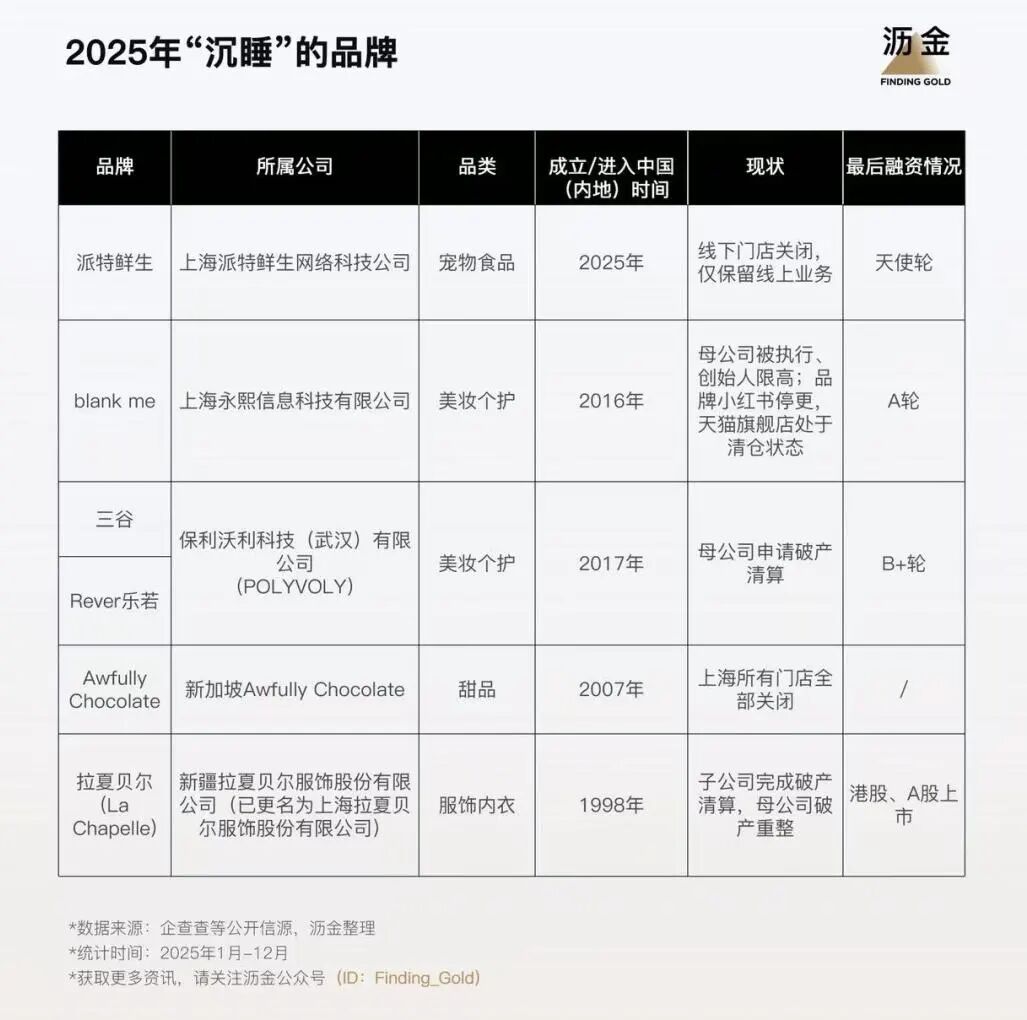
Sleeping Brands: Turned into Specimens of the Times
The criteria for a "sleeping brand" are a bit looser. Usually, it means the brand is in a precarious situation.
Either it shows abnormal business operations in the industrial and commercial system, or it hasn't announced closure officially but has stopped updating its official accounts for more than 6 months and closed most of its major sales channels (online stores, offline stores, etc.).
Although they probably won't survive, we still hope there is a chance for them to turn things around.
Pet Freshness went through the whole process of financing, expansion, and collapse in just 9 months. Its founder, Hou Yi, with the halo of Hema, promised to open a hundred stores within a year. But now, its offline business is almost dead, and it can only barely survive online.
Blank Me's story is even more dramatic. An LVMH - affiliated fund invested in it but unilaterally terminated the agreement in December 2024, citing "unsatisfactory due diligence." So far, it has nearly 20 million in enforcement cases, its founder has been restricted from high - end consumption 15 times, its Xiaohongshu account has been inactive for 9 months, and it has to liquidate its products.
The warmer the capital is when it comes, the colder it is when it leaves.
La Chapelle is the most special one among the "sleeping brands." It's not completely dead - in May 2025, the court approved a reorganization plan, and the parent company is still selling trademarks to pay off debts. But it's not really alive either - its subsidiaries have completed bankruptcy liquidation, and almost all its stores are closed. Do you still remember the last time you visited La Chapelle?
This once - glorious "store king" in the Chinese clothing industry, which had nearly ten thousand stores at its peak, is now just going through the bankruptcy process. It has become a specimen, showing the consequences of not innovating the business model.
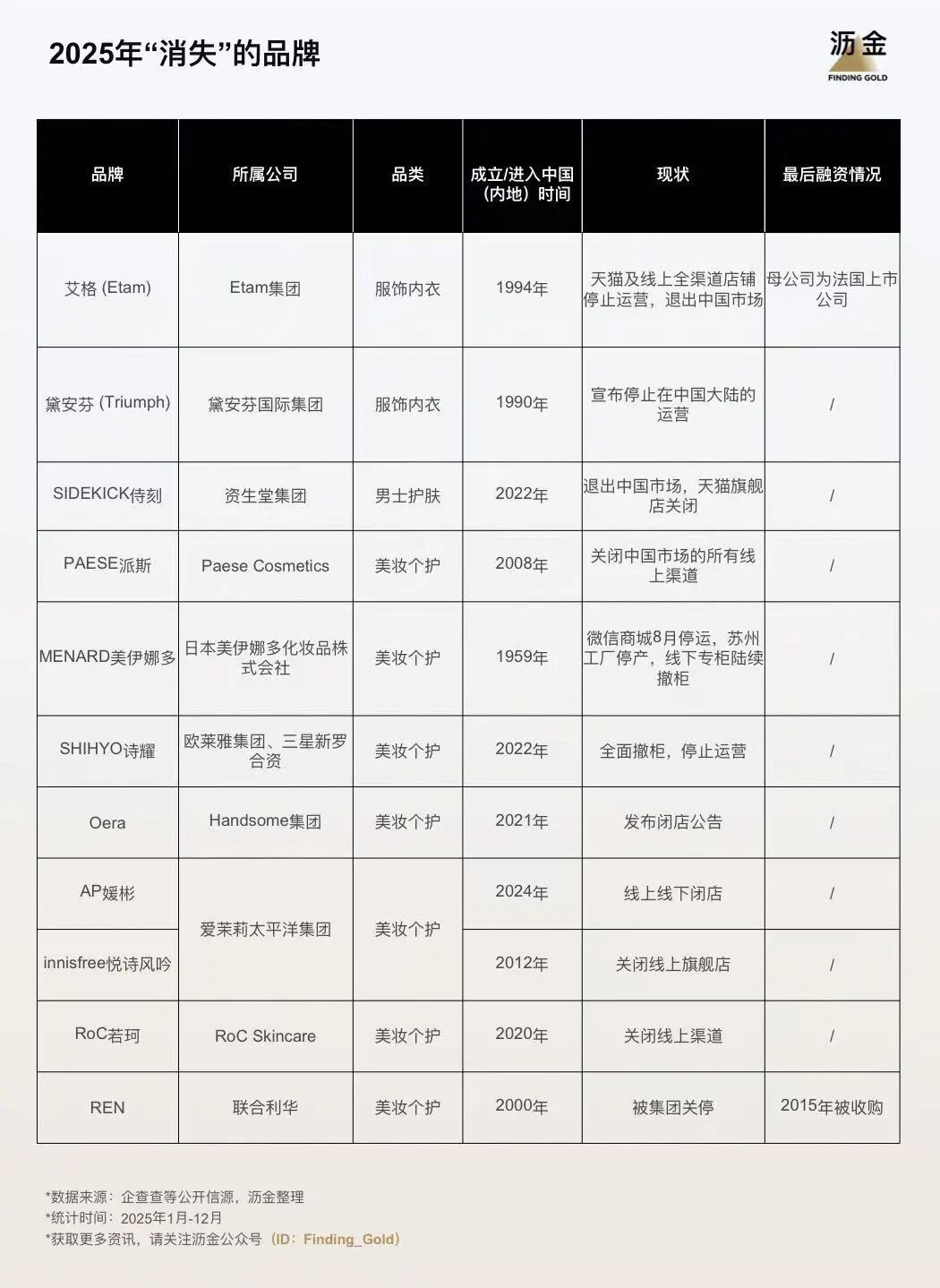
Disappeared Brands: Optimized Due to Low ROI
This last group of brands is quite different from the previous two, reflecting some more macro - level changes in the consumer market.
They didn't lose the battle; they were optimized out. They are all under big groups, but they were still axed.
Foreign beauty giants, mostly targeting the mid - to high - end market and dominated by Japanese and Korean brands, are the main players in this group. Their disappearance, apart from the group's strategic adjustments, also shows that the Chinese market is becoming more challenging.
The market is still growing, but at a slower pace. Domestic brands are pressing from all sides, offering lower prices, faster responses, and better use of Douyin and other platforms. The giants did the math and decided to keep the profitable and promising ones and cut the rest.
RoC was shut down just one year after being acquired by the Bridgepoint fund. REN was axed after ten years under Unilever.
Whether it's a thirty - year - old brand or a newly - hatched one, if it's not on the core list, it's gone. In 2025, the giants declared with their actions that the era of blind expansion is over.
Future growth depends not on how many brands you have but on how competitive your core brands are.
Li Jin's Comments
The fall of these 23 brands is not because they didn't work hard; it's because the rules of the game have changed.
More brands will fall in the future, but this is not the end; it's the beginning of a new era.
The bubbles are bursting at an accelerating pace. Those relying on financing, founder's halo, or category dividends are being cleared out in batches.
The ones that will survive are not the loudest, the ones with the most financing, or the best storytellers. They are the ones that keep focusing on product development, cost - control, and customer retention even in the noisy market.
Only after the market clears out the weak can real growth begin.
This article is from the WeChat official account "Li Jin". Author: Li Jin. Republished by 36Kr with permission.