Insta360 won the legal battle in the United States, but it hasn't won back the confidence of the capital market yet.
Good news has come from across the Pacific Ocean.
Recently, Insta360 issued an announcement disclosing the key results of its participation in the "337" investigation in the United States. Simply put, Insta360 won in this legal battle initiated by GoPro. For a company with overseas revenue accounting for over 70% of its total, the impact is self - evident.
However, the relief from external pressure does not mean that internal problems will automatically disappear.
Just before the final ruling was announced, Insta360 released its 2025 performance report: Although its revenue increased by nearly 80% year - on - year, both its net profit attributable to shareholders and its non - recurring profit declined, a typical case of "increasing revenue but not profit".
Meanwhile, the next growth curve that Insta360 has high - profile bet on, drones, has not yet shown a convincing start. Neither the market feedback nor the user reviews of its first product have met the expectations matching its strategic ambition.
Perhaps for this reason, the secondary market did not respond enthusiastically after the positive news of the "337" investigation was announced.
On the first trading day after the announcement, Insta360's stock price soared by more than 13% in the early trading but quickly fell back, and the final closing increase was less than 6%. Calculated based on the closing price of that day, the stock price has retreated by about 40% compared with the high point in September last year.
What the capital market cares about is obviously no longer just the outcome of the US lawsuit.
Insta360 Won
This cross - border legal dispute started in 2024.
On March 29 of that year, GoPro, the pioneer of global action cameras, filed an investigation application with the US International Trade Commission (ITC) under Section 337 of the Tariff Act of 1930, accusing Insta360 and its US subsidiary, Insta360 USA, of infringing GoPro's intellectual property rights in the United States with their related products, accessories, and camera systems. On May 1, the ITC officially launched the 337 investigation.
The so - called 337 investigation mainly targets intellectual property infringement and other unfair competition behaviors in import trade. Once infringement is determined in the investigation, it may lead to substantial restrictions on the entry of relevant products into the US market.
It is worth noting that according to Frost & Sullivan data, in 2023, Insta360's market share in the global consumer - grade panoramic camera market soared to 67.2%, while GoPro's was only 9.2%. By the third quarter of 2025, Insta360's global market share reached as high as 75%, and GoPro had been squeezed into the "others" category.
In this context, GoPro's actions are hard not to be interpreted by the outside world as a business war in the guise of a legal battle.
To win this legal battle, GoPro spared no expense in hiring Quinn Emanuel, one of the world's largest and most famous pure litigation law firms. This name itself carries a strong aggressive label in the international litigation circle. It is well - known for its "no - compromise" approach and extremely aggressive courtroom style. Its official website slogan is so straightforward that it's almost provocative - "We fight lawsuits not for settlement but for victory."
But the latest result almost means that Insta360 won.
On February 26, 2026, the ITC issued its final ruling. According to Insta360's announcement, the ITC finally ruled that Insta360's products did not infringe on the five invention patents claimed by GoPro, and the patent claims were invalid or partially invalid. The ruling only found that the appearance of an old Insta360 product partially fell within the protection scope of a patent claimed by GoPro. Insta360 said that all its current products on sale have adopted new appearance design schemes, and the new design schemes have been confirmed by the ITC as non - infringing.
Of course, the patent dispute between Insta360 and GoPro is not over yet. GoPro still has the right to appeal to the US Court of Appeals for the Federal Circuit within 60 days after the ITC's final ruling takes effect. In addition, another focus will be the parallel lawsuit in the Central District Court of California that was previously suspended. Different from the "337 investigation", this lawsuit may involve economic compensation issues.
Anyway, Insta360 has temporarily avoided the most fatal blow. And this phased victory is not only important for Insta360 in the legal aspect but also directly related to its business foundation.
In the first half of 2025, Insta360's overseas sales revenue reached 2.63 billion yuan, accounting for as high as 72.38% of its main business revenue. The huge overseas sales revenue means that this US lawsuit is not just an public opinion storm for Insta360 but a real sword hanging over its head.
Now, with the ITC's final ruling showing an almost complete victory, this sword has at least not fallen for the time being. For Insta360, which has just released a report of increasing revenue but not profit, this has at least bought it some precious breathing time.
DJI's Pressing
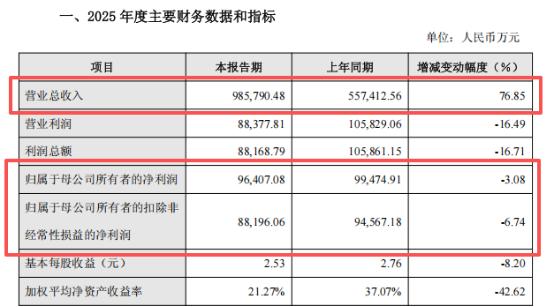
Just before the aforementioned final ruling was announced, Insta360 released a not - so - optimistic 2025 performance report. Last year, Insta360 achieved a total operating revenue of 9.86 billion yuan, a year - on - year increase of 76.85%. However, its net profit attributable to shareholders declined by 3.08%, and its non - recurring profit also declined by 6.74%. It was a case of increasing revenue but not profit.
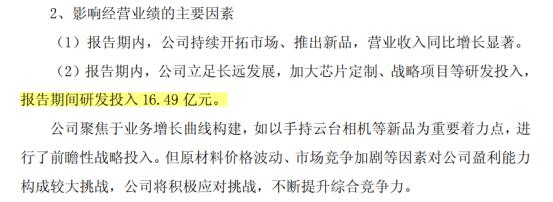
The most direct reason behind this is Insta360's increasing R & D investment. The company mentioned in its performance report that its R & D investment in 2025 reached 1.649 billion yuan. In 2022 - 2024, its R & D expenses were only 256 million yuan, 448 million yuan, and 777 million yuan respectively, with a total of 1.481 billion yuan. In other words, Insta360's R & D investment in 2025 has exceeded the total of the previous three years.
The aggressive R & D investment may be forced by the competitive situation.
On October 28, 2025, a report released by the consulting firm Jiqian Consulting showed that Insta360's market share in the global panoramic camera market dropped from 92% in the second quarter to 49% in the third quarter, while DJI got 43%. Insta360's once - overwhelming leading position is being quickly challenged by DJI.
What's more serious is that DJI is not the only competitor challenging Insta360. According to the self - media account Yingke, at least seven entrepreneurs from hardware companies or Internet giants have entered the intelligent imaging track in the past two years. At the same time, mobile phone giants are also entering the track. For example, OPPO and vivo have been reported to be developing handheld gimbal cameras.
Perhaps for this reason, Insta360 has to continuously invest heavily in R & D. If the previous R & D investment was mainly to expand its leading edge, now the R & D investment has an obvious defensive meaning.
Of course, the money is not spent in vain. From the R & D projects shown in Insta360's 2025 semi - annual report, we can already see the outline of some future technological advantages.
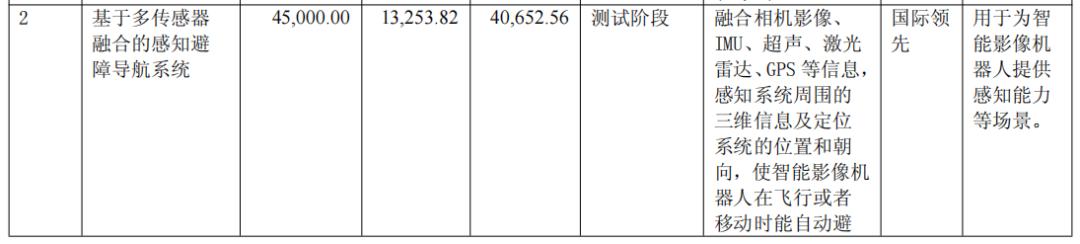
For example, the "Perception, Obstacle Avoidance, and Navigation System Based on Multi - Sensor Fusion" with an estimated total investment of 450 million yuan. The goal of this system is not only to make intelligent imaging devices "take better pictures" but also to enable them to have stronger environmental perception, autonomous path - finding, dynamic obstacle avoidance, and path - reaching abilities during flight or movement.
This means that Insta360's future imaging devices may no longer be just a shooting tool controlled by humans but a "mobile shooting entity" with higher autonomy, and may even point to a more imaginative end - imaging robots.
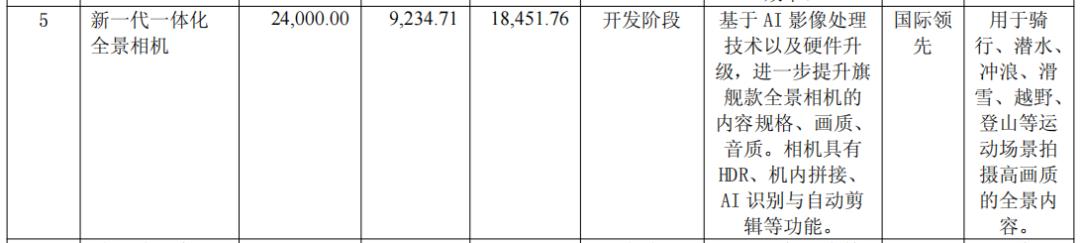
Another example is the "New - Generation Integrated Panoramic Camera" with an estimated total investment of 240 million yuan. This can be regarded as a pre - layout for the next - generation flagship panoramic product. Its significance is not just to launch a more expensive and more powerful new device but to determine whether Insta360 can continue to promote panoramic shooting from a niche tool for enthusiasts and professional players to a more widely - used mass - creation device.
The problem is that all these technological imaginations are still in the high - investment stage rather than the high - return stage. According to the 2025 semi - annual report, the estimated total investment in Insta360's R & D projects is as high as 1.62 billion yuan, and as of now, the cumulative investment has just exceeded 1 billion yuan. In addition, in the technology industry where technology iterates extremely fast, it is very likely that a project has not been completed today, and a new project may be launched tomorrow.
All these mean that Insta360, which is under pressure to make a profit, still has a long period of heavy investment ahead.
The Unfavorable Start of Drones
In the context of increasingly fierce competition in the track, Insta360 obviously can no longer rely solely on "panoramic cameras" to tell its growth story. It needs a new growth narrative. And what Insta360 has bet on is drones.
As early as in its 2025 semi - annual report, Insta360 clearly stated that it planned to launch drone products under two brands, including its own drone brand and the Antigravity panoramic drone brand.
From a strategic perspective, this move does have a lot of room for imagination. After all, the drone market is not a small one. It is a large, mature, and still growing market.
In 2023, the global aerial photography drone market was worth about $7.1 billion. Valuates Report predicts that it will further increase to $12.2 billion by 2030. Although there are giants like DJI in this track, if Insta360 can capture 10% of the global market share in the future with its differentiated product path, it will be a huge increment. So if this line is successful, it will not just be a concept for Insta360 but a new revenue engine close to the level of its current main business.
But Insta360's ambitious attempt has hit a wall as soon as it was launched.
Not long ago, the first panoramic drone, the Antigravity A1, jointly incubated by Insta360 and a third - party, was officially launched. The original price started at 7,999 yuan, and after the national subsidy, the price started at 6,799 yuan. According to the official statement, the Antigravity A1 is the first drone to integrate 360 - degree panoramic imaging, immersive flight perspective, and somatosensory control into the same system. Just from the product concept, this is indeed an eye - catching positioning.
But then Insta360's founder, Liu Jingkang, provided data showing that the Antigravity A1 sold more than 30 million yuan in the Chinese market in 48 hours. It seems okay, but an industry insider said that with a customer unit price of seven or eight thousand yuan and a sales volume of more than 30 million yuan, the sales volume is about 3,000 - 4,000 units. "The sales volume is really average, especially considering the large number of promotion videos on self - media accounts."
In addition, some self - media accounts checked the major domestic e - commerce platforms. As of January 4, the Antigravity A1 had sold more than 500 units on the JD.com self - operated flagship store page, more than 400 units on the JD.com official flagship store, more than 400 units on the Tmall official flagship store, and more than 100 units on the Douyin official flagship store.
On the same day, in the top 30 hot - selling drones list on JD.com, the Antigravity A1 ranked 27th, and most of the list was dominated by DJI products. In the top 20 hot - selling drones list on Tmall, the Antigravity A1 was not on the list.
Obviously, the Antigravity A1 has not shown the impact that a "blockbuster new product" should have. What's more troublesome is that the first impression of Insta360's drones on consumers does not seem to meet the market expectations. Complaints like "The picture quality is indescribable" and "The image transmission is interrupted as soon as there is a little obstruction" have emerged on the Internet.
It should be noted that for technology hardware, especially high - priced new products, the feedback from the first - batch users is often extremely crucial because it not only affects the subsequent sales volume but also directly affects the starting point of the brand's reputation.
It is worth noting that even though Insta360 almost completely won the US 337 final ruling, the secondary market's reaction was still not enthusiastic. On the first trading day after the announcement, the stock price soared by more than 13% at the opening but quickly fell back, and the closing increase was less than 6%. As of the close on March 2, the stock price was 231.31 yuan, a cumulative decline of about 40% compared with the high point of 377.77 yuan in September last year.
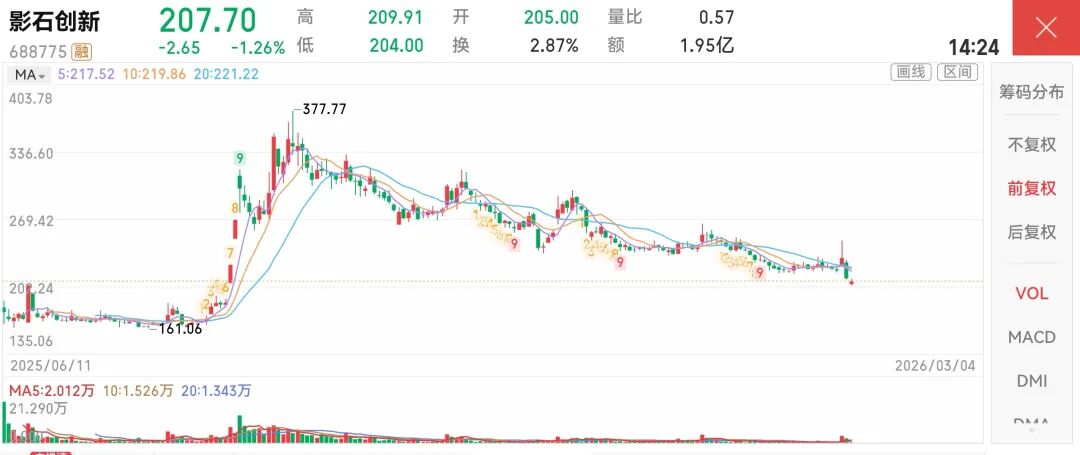
The fact that the stock price rose initially but then fell back after the major positive news was announced essentially means that the market's focus has shifted from "risk clearance" to "profit realization".
For Insta360, the judicial victory has bought it some breathing time. But what really determines the company's valuation and prospects is whether the profit margin can stabilize and whether the new business can deliver results as soon as possible.
References:
Caixin, "Insta360 Wins Most Patent Infringement Allegations in 337 Investigation by Regulatory Agency"
21st Century Business Herald, "Insta360 Wins! Completely