The "clearance" strike of non-price-increased iPhones is causing the disappearance of thousand-yuan smartphones with large memory.
During the Spring Festival, the elders in the family wanted to change their mobile phones. However, when choosing a phone, they found that the once - blooming market for budget phones under 1000 yuan was shrinking rapidly. Almost every mobile phone manufacturer had only one or two models to choose from. During the Spring Festival last year, one could still buy a "high - memory wonder phone" with 12GB + 512GB for 1000 yuan. Now, the price has soared to over 1600 yuan, and both the brands and models are very scarce.
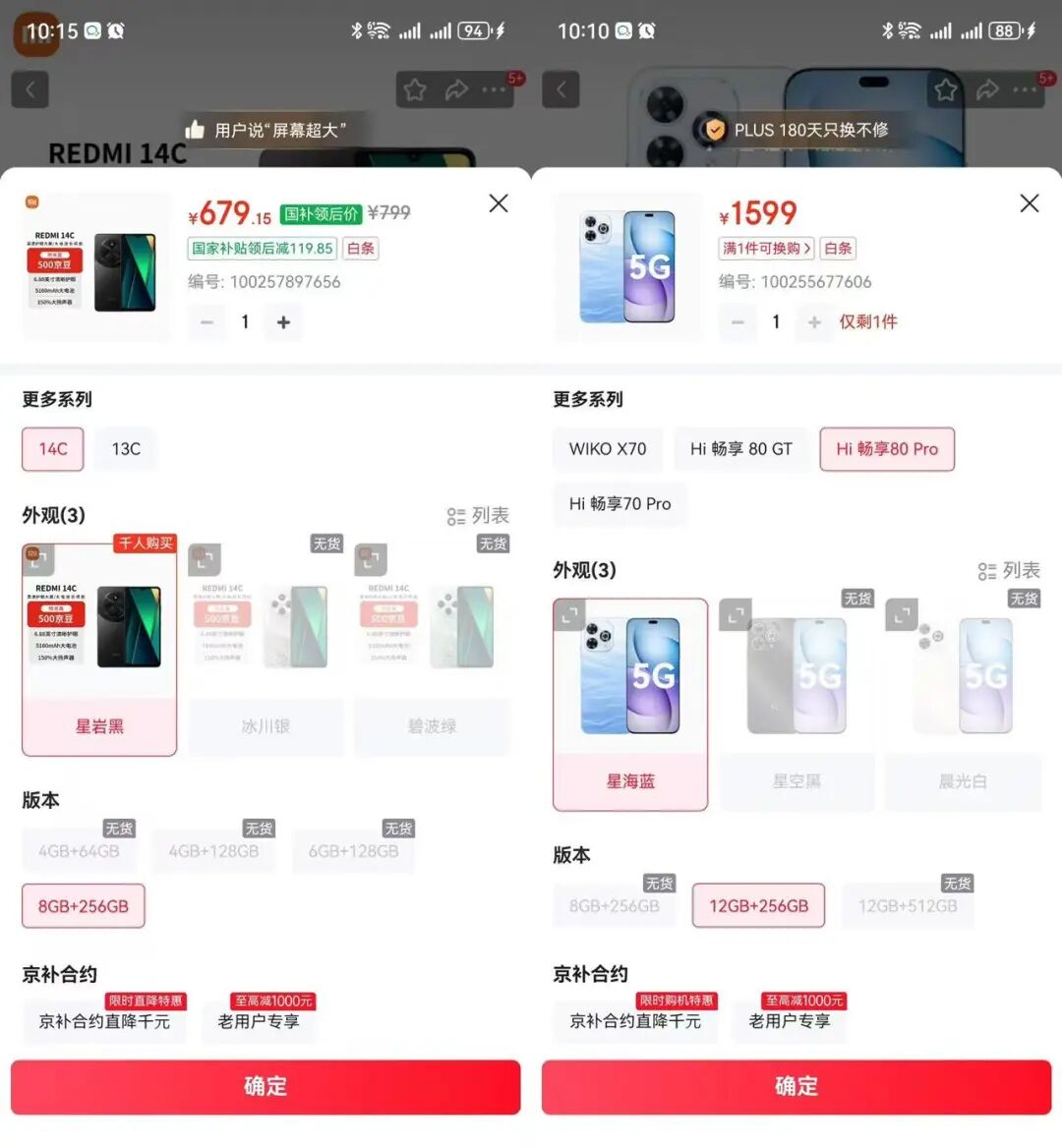
Facing the sky - rocketing prices of storage chips, manufacturers can only cope with cost pressure by using low - memory and old - generation chips. The vast majority of budget phones have reduced their storage space to less than 256GB, and 8GB + 128GB has once again become the mainstream configuration for budget phones.
In other words, budget phones with large memory are almost gone, and budget phones have returned to the "minimalist version" and "basic model". For the elderly, students, delivery riders, or other consumers with a low budget, if they want a better user experience, the minimum threshold for buying a phone has been raised to around 1500 yuan. It's no longer possible to buy a cheap and high - value phone.
Budget phones under 1000 yuan will not disappear completely in the short term, but their "golden age" is over.
The reason behind this is well - known: the crazy price increase of storage chips.
The New Year's Day in 2026 became the first "watershed". After the new year began, the PC market witnessed a comprehensive price increase wave.
In mid - to late January, when a reporter from IT Times visited Huaqiangbei in Shenzhen, it was found that mainstream PC manufacturers such as Lenovo, HP, and Dell had taken the lead in a comprehensive price increase. Not only new products but also existing models had price hikes, with increases of up to several thousand yuan. Some manufacturers adjusted their prices every 15 days. At that time, mainstream mobile phone manufacturers such as Xiaomi, Honor, vivo, and OPPO had started to adjust the prices of newly released phones. New phones with the same storage capacity were about 500 yuan more expensive than the previous generation, with a maximum increase of up to 20%. However, the price increase wave had not fully affected old - model phones.
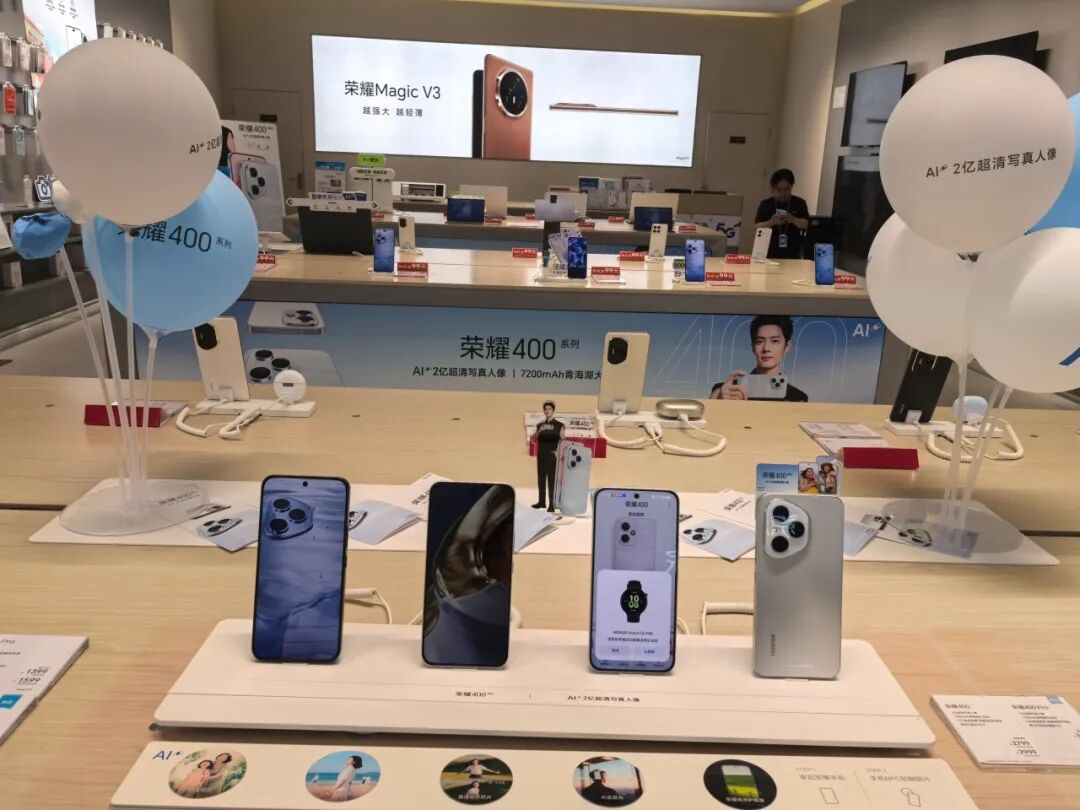
Just after a short Spring Festival, the second "watershed" appeared. The mobile phone industry will face the largest - scale and highest - increase collective price adjustment in five years.
Data from TrendForce in February 2026 showed that the spot price of mobile phone storage chips had increased by more than 300% in the past three months.
"The memory price will double or triple in the future." When Li Feifei, the senior vice - president of Alibaba Cloud and the head of the database product division, made this prediction in February 2026, people present thought it was too radical.
However, the fact is that this prediction is being verified. The market price of a Jinbaida 32GB memory module set (16GB x 2) with Hynix original - factory particles was 880 yuan at the end of September 2025, rose to 2480 yuan in January 2026, and reached 4118 yuan at the beginning of March. It soared 4.7 times in half a year, and the price - increase pace is accelerating.
On March 2nd, Lu Weibing, a partner, president, and head of the mobile phone department of Xiaomi Group, predicted at the MWC 2026 World Mobile Congress that the memory price increase will continue until the end of 2027, which has never happened in history. "In the first quarter of this year, the global quotation of memory was about four times that of the same period last year. If the absolute price continues to rise, it will definitely be reflected in the retail prices of our end - products."
The storage price - increase wave has quickly spread to the consumer end, first affecting the computer market. In January, the stalls for assembled computers in Huaqiangbei were deserted. "The money that could buy a laptop before can now only buy two memory modules. Who would change their computer when it still works?" said an enthusiast in the "computer - assembly circle". Now, assembling a computer no longer has any price advantage, and large PC manufacturers can still bargain based on their scale advantages.
However, this collective price increase from PCs to mobile phones proves that the cost that large manufacturers have spread through economies of scale has also been pushed beyond the bottom line. Hu Xinxin, a product manager of Redmi, recently described this industry dilemma as a "horror story" on Weibo - the cost has increased, the mobile phone price has gone up, consumers are not buying, the manufacturer's sales volume has declined, the unit - cost is higher, and it has fallen into a vicious circle where the higher the price, the harder it is to sell.
According to industry - chain information, many mainstream mobile phone manufacturers such as OPPO, OnePlus, vivo, Xiaomi, IQOO, and Honor may successively raise the prices of their old - model phones.
Yes, Apple and Huawei have not followed the large - scale price increase yet.
On March 2nd, Apple just released the "budget - friendly" iPhone 17e. Although the upgrade is not significant, the selling price remains at 4499 yuan. It is estimated that the price after national subsidy is 3999 yuan, and other platform subsidies can be added. The pre - order price on platforms such as JD.com starts at 3299 yuan. The key is that the storage starts at 256GB.
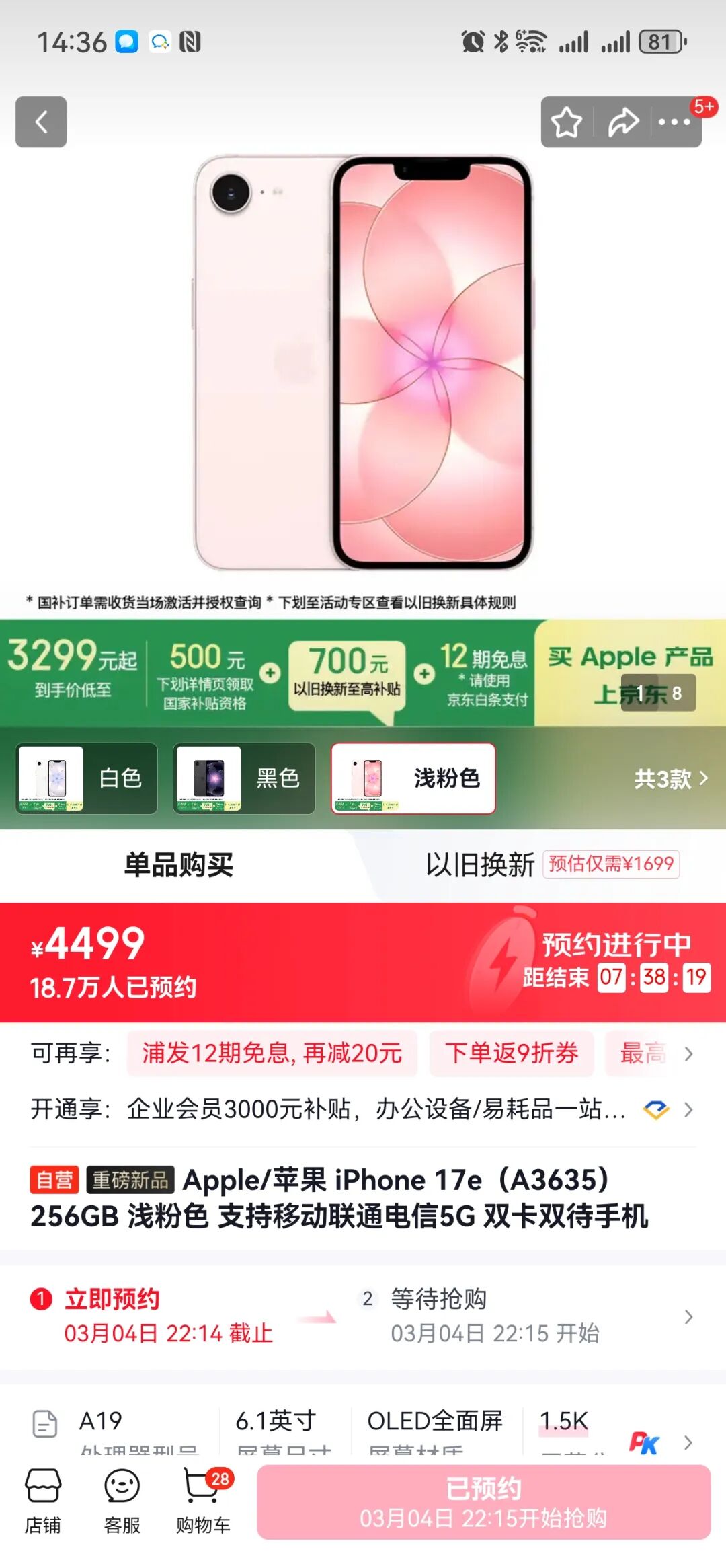
If you plan to buy a new phone this year, the price of mid - range phones has risen to the 4000 - yuan range, which is equivalent to the price of previous flagship phones. In this comparison, iPhone is associated with cost - effectiveness for the first time.
As Hu Xinxin said, if Apple maintains its price without increase from a competitive perspective thanks to its long - term high profits, it will be a further "cleansing" blow to Android manufacturers.
The decline in sales volume will be an irreversible trend. Based on the predictions of multiple analysis institutions, the global smartphone market shipments will decline by about 12.9% in 2026, and the shipments in the Chinese mobile phone market will decline by 2.2%, but the average selling price will increase by about 6.9%. The market segmentation trend is obvious. The share of the high - end market will expand to 35.6%, and the low - end market will be compressed.
In 2026, under the wave of storage price increases, we may rarely see multiple rounds of price increases in the mobile phone industry in a year. No matter what price - range phone you buy, you will face "less quantity and higher price". Manufacturers with high - end brand premiums, such as Apple, Huawei, and Samsung, will perform relatively stably in 2026. After all, in the Chinese mobile phone market in 2025, Huawei ranked first for the whole year, and Apple ranked first in the fourth quarter. On the other hand, the low - end market is making less and less profit, especially for budget phones under 1000 yuan. It is possible that new model releases will be cancelled and inventory will be gradually cleared before exiting the market.
Images / Apple, JD.com, IT Times
This article is from the WeChat official account "IT Times" (ID: vittimes). Author: Sun Yan. Republished by 36Kr with permission.