Turning your iPhone into a universal access key will soon become a reality: Find out which manufacturers are gearing up for Aliro.
Today, mobile phones can easily be used to access the subway and buses, but Apple devices still can't be used to unlock community access control systems or company elevators. Everyone wants their mobile phone to be a universal key and bid farewell to physical cards. As UWB becomes a standard feature in mobile phones, users' demand for contactless unlocking is also increasing.
Recently, the Connectivity Standards Alliance (CSA) released the Aliro 1.0 standard, aiming to connect various access control scenarios such as office buildings, campuses, hotels, single - family homes, and apartments, and achieve full - scene interconnection. By unifying security standards, it enables seamless and convenient access.
So, what exactly is Aliro? What's the difference between this standard and Matter? Which manufacturers are ramping up their efforts in the Aliro layout? EEWorld will give you a rundown today.
Aliro 1.0, Officially Born
Some people may wonder what this new Aliro standard is and how it differs from Matter.
Aliro is targeted at the smart lock and access control ecosystem, including places that require access control permissions such as smart homes, gyms, apartment buildings, offices, and hospitals, allowing users' digital wallets to serve as a universal identity credential.
Aliro is positioned as a supplement to Matter, not a replacement. Aliro focuses on achieving secure mobile access control, while Matter is mainly responsible for command transmission between devices. For example, Matter allows users to lock doors remotely or integrate locks into smart home automation scenarios; Aliro is responsible for securely authenticating users' smartphones or wearable devices when they approach the door to confirm their validity as a credential. Products can support both standards (Aliro and Matter) individually or simultaneously according to requirements.
As early as November 2023, the CSA had announced that it was developing the Aliro communication protocol. It stated that the protocol aims to simplify the process of using mobile and wearable devices to unlock smart locks. Similar to the Matter protocol, Aliro can be compatible with existing smartphones or wearable devices without the need to install additional applications.
On February 26, 2025, the Aliro 1.0 standard was officially released, which means that the industry now has a standardized protocol for exchanging access credentials between digital devices.
The Aliro 1.0 specification is based on asymmetric encryption technology and clearly defines the data format of credentials and their physical transmission methods. This standard integrates three mature wireless technologies to suit diverse application scenarios:
13.56 MHz Near - Field Communication (NFC): As the basic method for access control, users only need to bring their devices close to the card reader. One of the major advantages of NFC integration is that it doesn't require a power source; and when the function is properly implemented on a smartphone, the NFC function can still work even when the device runs out of power.
2.4 GHz Bluetooth Low Energy (BLE): Mainly used for initial communication and identity authentication when users approach the lock system.
Ultra - Wideband (UWB) from 7.75 GHz to 8.25 GHz: Enables precise spatial positioning. Through high - precision distance measurement, UWB can achieve a secure "hands - free" unlocking function. The lock can accurately determine whether the user is in front of the door. This technology can effectively prevent so - called relay attacks, which are security threats where unauthorized access to the lock is achieved by extending radio signals.
The CSA said that this standard was jointly developed by more than 220 member companies worldwide, including lock manufacturers, chip suppliers, and mobile platform giants. Among them, companies such as Apple, Assa Abloy, Google, Infineon, Last Lock, Samsung, and ST (STMicroelectronics) contributed core technologies and innovations to the implementation of Aliro 1.0. Apple, Allegion, Aqara, Google, HID, Kastle, Kwikset, Last Lock, Nordic, Nuki, NXP, Qorvo, Samsung, ST, etc. are expected to be the first brands to pass the Aliro 1.0 certification.
What Are the Advantages of Aliro?
Since there is already Matter, why does the CSA need to introduce Aliro? What are its advantages?
According to the CSA, one of the core advantages of Aliro is that it has received clear support from the mainstream mobile wallet applications in the global market, including those from Apple, Google, and Samsung.
Currently, the biggest problem hindering the popularization of digital keys is fragmentation. For example, to implement cross - brand digital smart wallets, separate processes need to be handled for Google Wallet, Samsung Wallet, and Apple's HomeKit/HomeKey, which often increases complexity and costs. With Aliro, ecosystem providers can simplify the experience for home users by directly storing digital keys in the mobile phone's digital wallet. Users only need to tap their phones on the card reader without opening a separate application or going through multiple steps.
For developers, in the past, they had to connect to each ecosystem one by one, customize firmware and software integration for each platform, and pay access fees. Now, with the Aliro protocol, a single development can be adapted to all devices, significantly reducing R & D and certification costs and shortening the product launch cycle.
Aliro defines a unified application layer to achieve secure and interoperable mobile access between authenticated devices and access control card readers. It eliminates problems such as private bindings, inconsistent user experiences, and inconsistent security standards, supports unified and secure credential management, and is compatible with various wireless technologies and diverse access control scenarios. Aliro is designed for authenticated smartphones and wearable devices (such as smart watches) without affecting the compatibility of existing access control systems. As more manufacturers pass the Aliro certification, the scope of support will continue to expand.
In addition, Aliro also has the following advantages:
Standard - based interoperability: Aliro defines a set of universal access credential systems and application - layer protocols supported by the Connectivity Standards Alliance (CSA). This enables authenticated smartphones, wearable devices, and access control readers to achieve seamless interoperability between different manufacturers, reducing dependence on proprietary mobile access solutions and effectively reducing the long - term risks of system integration.
Security - first access architecture: The Aliro protocol, jointly developed by leading mobile device and access control OEMs, prioritizes security and privacy from the very beginning of its design. Through standardized credential processing procedures, strict identity authentication mechanisms, and native support for multiple wireless technologies such as NFC, Bluetooth Low Energy (BLE), and Ultra - Wideband (UWB), Aliro ensures consistent and secure interaction behavior between authenticated devices and significantly simplifies the compliance and certification processes.
Design and platform flexibility: By unifying mobile device manufacturers and access control providers under a shared standard, Aliro gives developers sufficient flexibility in hardware design. This collaboration not only lowers the development threshold but also provides more space for product innovation.
Reduced development and lifecycle risks: Relying on a standardized credential framework, Aliro helps to accelerate the product verification process, provides a clearer path for system upgrades, and significantly enhances the confidence in the interoperability of deployed systems in the continuously evolving mobile platforms and ecosystems, laying a solid foundation for long - term stable operation.
Chip Manufacturers Step Up
According to EEWorld's inventory, both domestic and foreign manufacturers are closely following the emerging trend of Aliro, and these companies have laid a solid foundation in the Matter field. By deploying Aliro, they can further improve their product ecosystems. In addition, ST, Infineon, Qorvo, and NXP have many products in the UWB field. It is foreseeable that Aliro will become an important standard in the field of secure access in the future.
ST
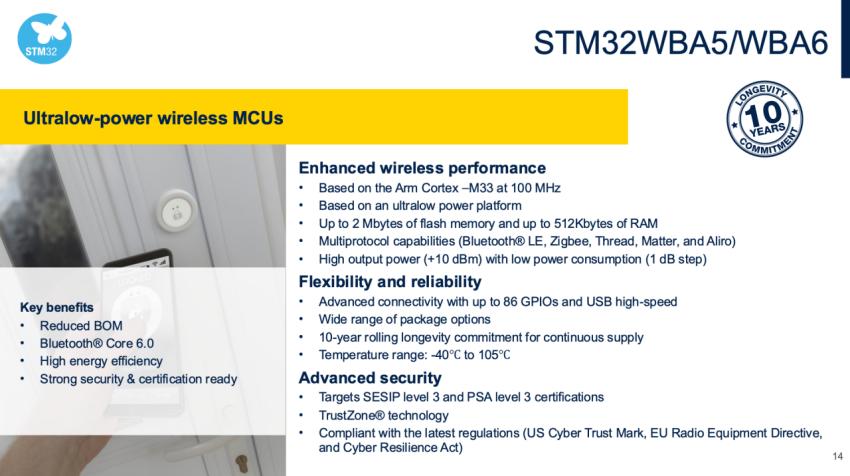
ST (STMicroelectronics) is the most active in the construction of Aliro. For this reason, ST has also specially built a dedicated page for Aliro, and the CSA has praised its contribution to the 1.0 standard.
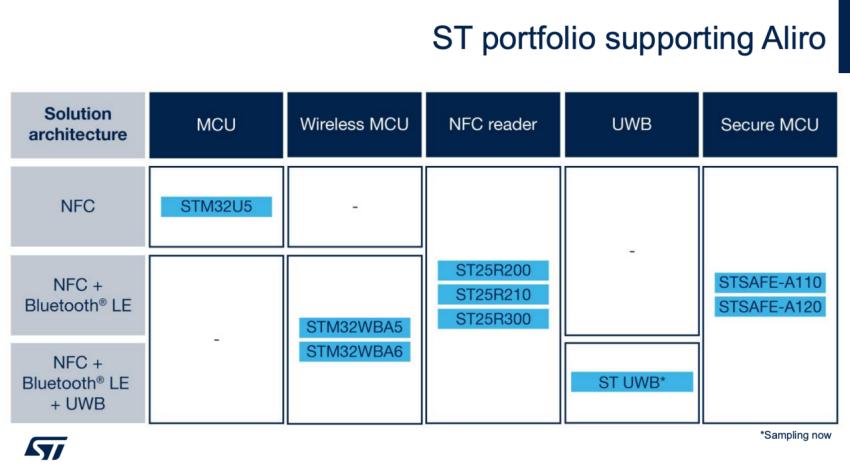
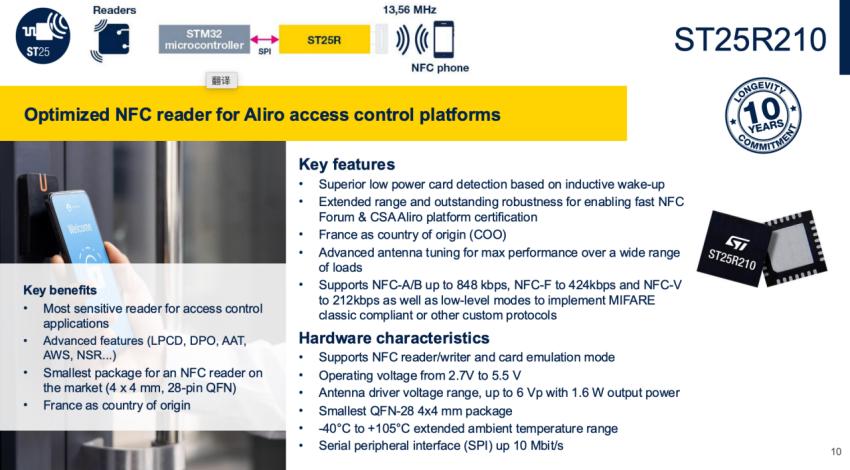
On February 27, after the release of the Aliro 1.0 standard, ST immediately issued a press release stating that it is ready to provide device manufacturers with everything needed to create products that comply with the Aliro standard. ST offers a complete portfolio of connectivity and security solutions, supporting three Aliro configurations, from NFC - only to NFC + BLE, and then to NFC + BLE+UWB, enabling hands - free access.
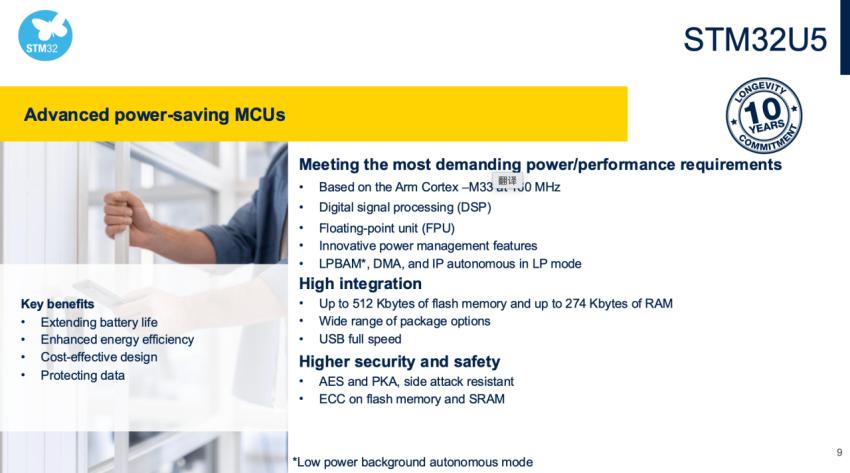
ST's current engineering kits accelerate the time - to - market for product developers and manufacturers. These include the X - CUBE - ALIRO software package now integrated into STM32Cube, as well as a reference design (STEVAL - ALOCKCB) that uses ST microcontrollers and wireless connectivity products to help customers build devices that comply with the Aliro standard.
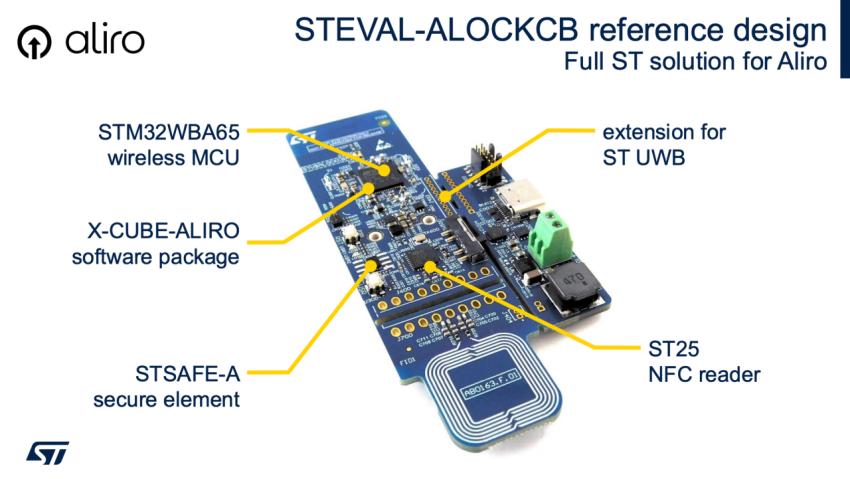
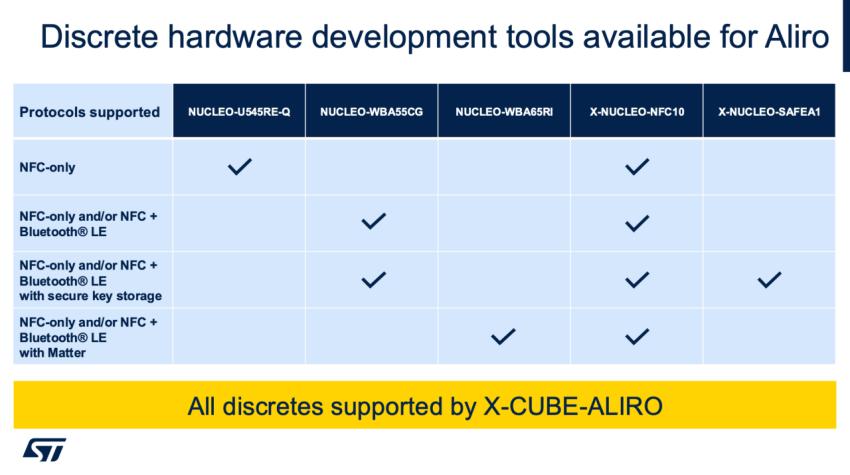
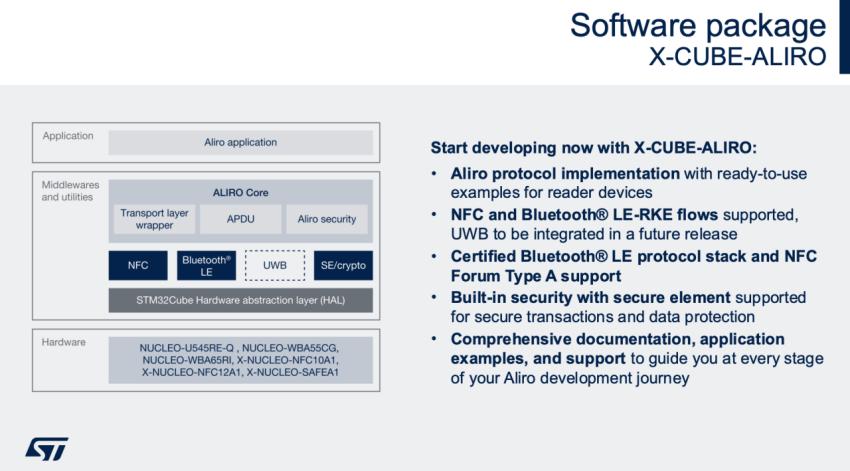
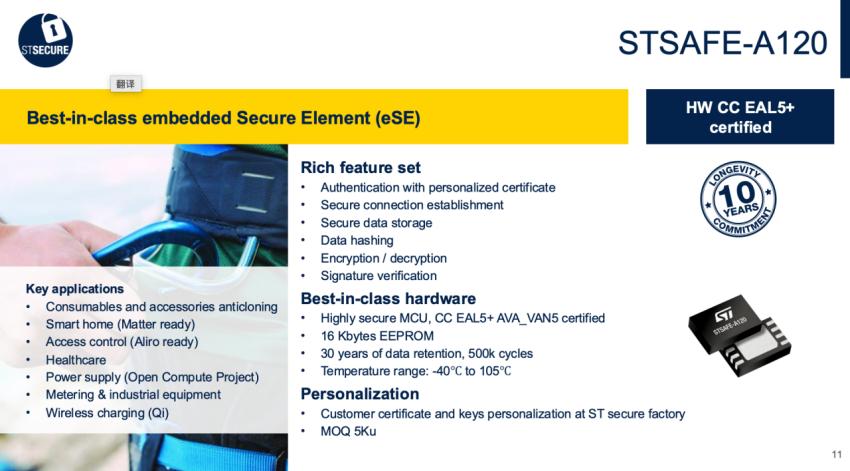
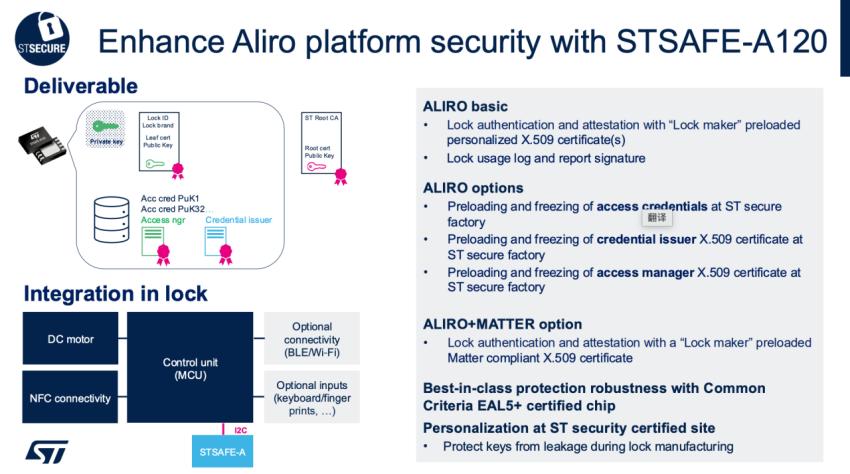
ST's MCU and wireless connectivity product portfolio, including the ST25 NFC reader and various STM32 microcontrollers (including BLE and UWB), provides a one - stop service for Aliro devices supporting all specified wireless technology configurations. ST's Aliro products also include the STSAFE - A embedded security element for digital key storage.
Silicon Labs
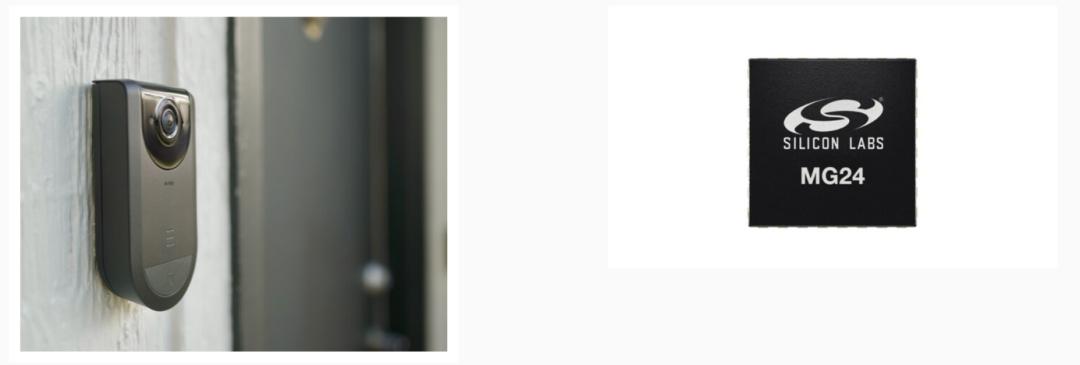
Silicon Labs is also very active in the layout of Aliro. After the CSA released the 1.0 standard, it immediately announced that Durin has selected Silicon Labs' MG24 wireless system - on - a - chip (SoC) as the high - security, multi - protocol core device for its Durin Door Manager series of products. The Durin Door Manager is a new - generation access management device that supports the new Aliro application layer launched by the CSA.
The key functions provided by the MG24 in the Durin Door Manager include:
Single - transaction Aliro credential verification via NFC: The MG24 receives the Aliro key and related information from the NFC transceiver reader chip and then completes key verification and access document verification in the same NFC transaction.
Hardware - accelerated asymmetric encryption technology: The MG24 uses an integrated cryptographic hardware accelerator to perform Aliro Elliptic Curve Cryptography (ECC) operations, including key pair generation, Elliptic Curve Digital Signature (ECDSA), Elliptic Curve Cryptography (ECDH), and Elliptic Curve Digital Signature verification, as well as upgrade verification requirements.
Secure key storage using Silicon Labs' Secure Vault technology: By using Silicon Labs' Secure Vault technology, sensitive credentials and key materials can be protected. This is an industry - leading approach adopted by Silicon Labs in the field of secure storage and device protection.
Multi - protocol connectivity for various modern access systems: The MG24 supports Matter and Bluetooth communication, which helps to achieve interoperability and flexible system integration.
Low - energy Bluetooth technology for debugging and lock control workflows: The device can be debugged via Bluetooth, start ranging tasks to support the UWB experience, and communicate with the paired lock to perform open/close operations.
Contactless control decision - making using UWB ranging: The MG24 obtains ranging information from the UWB RF chip and makes contactless control decisions based on distance and environmental data.
Qualcomm
At this year's MWC, Durin also demonstrated its cooperation with Qualcomm on Aliro. From this cooperation, we can see how Aliro works on the mobile phone side.
Qualcomm's booth demonstrated a multi - modal access control solution that combines locally processed facial recognition and UWB precise ranging. When the user approaches, a Wi - Fi router equipped with Qualcomm's Dragonwing NPro A7 Elite platform completes facial recognition through on - device AI. At the same time, the UWB chip in the mobile phone verifies that the user is at the door with centimeter - level accuracy. The Durin door manager combines these two signals - only when the AI confirms face authorization and the UWB confirms the device's presence will it send an unlock command to the smart lock. The mobile phone doesn't need to be taken out throughout the process, and biometric data never leaves the house.
Device manufacturers can choose single - factor or multi - modal authentication. In multi - modal mode, if there is only facial recognition or only a UWB signal, the door will remain locked. This rule is automatically enforced by the door guard administrator, which can effectively prevent impersonation and tailgating.
This demonstration reveals a fact often overlooked in the discussion of smart access control: to achieve a smooth "touch - free" unlocking experience, the key lies in whether the device is equipped with UWB. Qualcomm, through its Qualcomm FastConnect platform, provides advanced ultra - wideband connectivity for flagship Android smartphones, aiming to make the devices carried by millions of users every day truly reliable digital keys. Without the UWB chip built into the mobile phone, innovative solutions like the Durin access manager cannot fully unleash their technological potential.
Nordic and Qorvo
Nordic has also built a separate page specifically for Aliro. At the same