10 billion, the cost lies in the "brains" of the robots.
The Chinese humanoid robot race is mass-producing billion-dollar unicorns.
On March 2nd, Galaxy Universal announced the completion of a new round of financing worth 2.5 billion yuan. This company, which just made its debut on the Spring Festival Gala, has once again refreshed the single-round financing record it held. Just in December last year, Galaxy Universal secured a Series A financing of $300 million, and its post-investment valuation exceeded $3 billion, making it the domestic embodied intelligence company with the highest publicly disclosed valuation.
At the beginning of 2026, many robot companies entered the billion-yuan valuation camp: Qianxun Intelligence, which received 2 billion yuan in financing; Zhipingfang and Xinghaitu, which each obtained 1 billion yuan in financing; and Independent Variable Robotics, which received a new round of financing.
So far, six humanoid robot companies have gathered in the billion-yuan valuation camp. In 2025, Unitree's valuation was 12 billion yuan, and it is currently advancing the listing process; after completing its Series B financing, Zhiyuan's valuation reached 15 billion yuan, and after three more Series B financings, its valuation is still rising.
It is worth noting that these embodied intelligence companies founded after 2023 have only taken two years to enter the billion-yuan valuation camp, and this happened in the early stage of financing. Qianxun Intelligence and Galaxy Universal reached a billion-yuan valuation just after completing their Series A financing; Independent Variable Robotics achieved a billion-yuan valuation after four rounds of Series A financing; Xinghaitu and Zhipingfang reached a billion-yuan valuation after financing to Series B.
If billion-dollar unicorns were still scarce in 2025, then this round of financing boom in 2026 means that unicorns in the humanoid robot field are emerging in batches.
1
An interesting observation is that these newly emerged robot companies with a billion-yuan valuation are not well-known star enterprises in the outside world, and their shipment volume is not outstanding either. IDC data shows that their shipment volume in the past year was all within a thousand units, and their commercialization is still in the exploratory stage. But they have one thing in common: They are betting on the R & D of the "brain" and insisting on the R & D of the end-to-end embodied intelligence large model.
Needless to say about Galaxy Universal. The Galbot G1, which just made its debut on the Spring Festival Gala, can play with walnuts, pick up glass, and fold clothes. It is equipped with its self-developed Galaxy Star Brain AstraBrain embodied large model and is the first robot that can work with full autonomous decision-making without relying on preset programs.
At the same time, Galaxy Star Brain AstraBrain is also the world's first full-body and full-hand end-to-end large model that integrates "brain - cerebellum - neural control" into one model, which connects the entire link from multi-modal perception to real-time feedback control.
In the R & D of the embodied intelligence large model, Galaxy Universal adheres to the end-to-end embodied large model and has released multiple models. In addition to the above-mentioned Galaxy Star Brain AstraBrain, there is also the end-to-end embodied intelligence large model Grocery VLA for the retail scenario, and the dexterous hand neurodynamics model DexNDM has also been released.
Independent Variable Robotics has focused on the technical R & D of the "general embodied large model" from the very beginning. Its self-developed WALL - A model pioneered a system paradigm that deeply integrates VLA (vision - language - action) and the world model, which enables the dual-arm robot to complete multiple complex and delicate operations such as clothing handling, storage and organization, and wire harness organization.
Founder Wang Qian said in an interview in March last year that the model level of Independent Variable Robotics is basically on the same level as that of PI and Google.
In January this year, Independent Variable publicly released a real-shot video. The "Quantum No. 1" robot equipped with the WALL - A model autonomously completed the "last 100 meters" task of takeaway delivery in a real open environment without any manual intervention throughout the process.
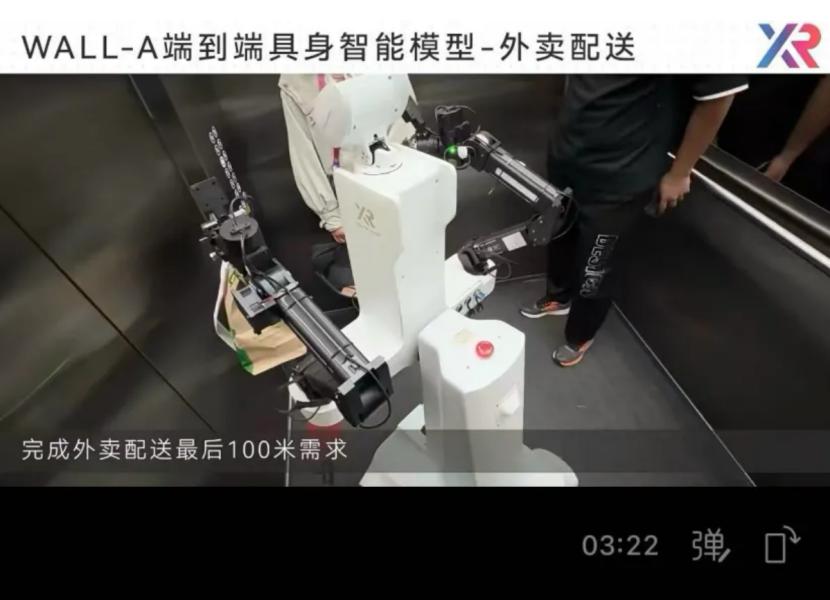
The same is true for Qianxun Intelligence. Since its establishment, this company has locked its strategic focus on the creation of the "embodied brain".
Its self-developed VLA model Spirit v1 is continuously iterated and can complete tasks such as desktop organization and garbage disposal. In January this year, the open-source Spirit v1.5 model of Qianxun Intelligence became the first Chinese open-source model to surpass Pi0.5 in performance. This model has zero-shot generalization ability and can complete tasks such as wiping objects without new sample training.
After completing 2 billion yuan in financing, founder Han Fengtao said in an interview with LatePost that Qianxun's primary goal in 2026 is to improve the performance of the embodied model and rank among the top 3 in the world in terms of the embodied brain.
Zhipingfang is also betting on the robot's brain. At the beginning of its establishment, Zhipingfang explored the end-to-end VLA technology and has now launched its self-developed global full-body VLA large model GOVLA, which enables the robot to have more efficient interaction ability and stronger autonomy in full-body coordinated control and full-scenario task coverage.
According to its founder Guo Yandong, this brain has a certain "common sense" like a human being. Even when encountering a large number of unseen situations, the robot can complete tasks without secondary training. In the investment circle, this company is labeled as "the most Tesla-like Chinese robot company".
Xinghaitu also adheres to the end-to-end VLA model route. In August last year, Xinghaitu released the G0 model, which was the SOTA at that time; in January this year, it launched the upgraded G0 Plus, which is positioned as "the world's first out-of-the-box VLA model". This model is mainly aimed at cross-scenario task generalization and optimization of general grasping ability, emphasizing the ability of the same set of models to adapt to different forms of robot bodies.
In other words, these robot companies with high valuations are essentially "building brains" for robots.
Moreover, the founding teams of these newly emerged unicorns all have a profound AI background.
Wang He, the founder of Galaxy Universal, is a leading scholar in the field of embodied intelligence large models and is currently the founder and manager of the Embodied Intelligence Laboratory at Peking University; Wang Qian, the founder of Independent Variable, started researching the AI direction in 2009 and then switched to the robot direction during his doctoral studies; Gao Yang, the co-founder of Qianxun Intelligence, is currently an assistant professor at the Tsinghua Institute for Interdisciplinary Information Sciences and has been researching end-to-end autonomous driving since 2017.
Gao Jiyang, the founder of Xinghaitu, has worked in companies such as Waymo and was responsible for the R & D of core intelligent driving systems such as visual perception; Guo Yandong, the founder of Zhipingfang, once worked in the Microsoft AI team and later served as the chief scientist at XPeng in charge of the R & D of intelligent systems.
They are not cross-border players but senior researchers in the AI field. When the competition in the humanoid robot field turns to the competition of large models, that is, whether the robot can understand the environment, make autonomous decisions, and execute complex tasks, these founders with a profound AI background and their technical routes have become one of the focuses of capital attention.
2
It should be noted that currently, Unitree and Zhiyuan, which have high valuations, have achieved certain results in commercialization. Unitree has long achieved an annual revenue of 1 billion yuan; Zhiyuan is expected to exceed 1 billion yuan in revenue in 2025. In terms of shipment volume, both of these two enterprises achieved more than 5,000 units in 2025, belonging to the first echelon in terms of shipment volume.
Obviously, the commercial data of these newly emerged companies with a billion-yuan valuation is not eye-catching. So where is the rationality for them to obtain high valuations? Perhaps we can refer to the American humanoid robot company Figure AI.
Figure AI was founded in 2022 and has currently raised funds up to Series C, with a valuation of $39 billion, making it the humanoid robot company with the highest valuation.
However, according to IDC data, Figure AI's shipment volume is still in the pilot test stage, with a shipment volume of about dozens of units. Nevertheless, the functions of its Figure 01, Figure 02, and Figure 03 have evolved from simple box moving to complex housework such as autonomous clothes folding and dishwasher loading.
The key lies in the breakthrough of embodied intelligence technology. Its founder Brett Adcock once said, "To truly solve the problem of embodied intelligence, an end-to-end AI model must be established, focusing on the adaptation of specific hardware."
In February 2025, Figure AI terminated its cooperation with OpenAI and launched its self-developed end-to-end VLA model "Helix". This led to a significant increase in Figure AI's valuation, rising from $2.6 billion in 2024 to $39 billion in September 2025. In one and a half years, the valuation increased by about 15 times.
In January this year, Figure AI released Helix 02. Compared with the previous model that mainly controlled the upper body movements, this Helix 02 directly realizes the full-body autonomous control of the humanoid robot. In a 4-minute autonomous task, the Figure 02 robot smoothly completed 61 mobile manipulation actions without any manual intervention throughout the process.

In China, the core driving force of the Chinese humanoid robot race has also begun to shift from hardware to software.
Since the second half of 2025, the generalization ability of embodied intelligence has also been significantly improved. Zhang Zhikuan, a director of the investment department of Cornerstone Capital, once observed that "as multi-modal technology paths such as VLA gradually mature, the generalization ability of robots in cross-scenario tasks such as object grasping and coffee pouring has been significantly improved, and brain companies have begun to show stronger technological certainty."
Wang Xingxing has long said that at this stage, the hardware is sufficient, but the embodied intelligence large model is not. The industry has gradually begun to realize that the most critical breakthrough in embodied intelligence still lies in the brain.
This may explain to some extent why the embodied intelligence companies betting on the brain exploded collectively at the beginning of 2026. Taking Independent Variable as the main example, since the Series A financing started in May last year, it has completed four rounds of Series A financing intensively within nearly a year, and Meituan has invested three times. Its self-developed embodied model enables the robot to complete the entire process of takeaway delivery without manual intervention, which just meets Meituan's delivery needs.
These changes and trends are clearer in the eyes of the founders. After all, the "brain" of the humanoid robot determines whether it is a toy or a tool that can think and work. In the program "Yang Sheng", Wang Xingxing frankly said, "Whoever can be the first to develop a large model truly suitable for robots will become a world - class AI and robot company, and the value of this breakthrough is even worthy of the Nobel Prize."
Han Fengtao, the founder of Qianxun Intelligence, said, "Embodied intelligence in 2026 will be very similar to the large model in 2023. 'If you can't get a lot of money and your model performance can't reach the top, you won't have a chance to get on the table.'" Regarding the industry's view that 2026 is the "year of life and death" for implementation, Han Fengtao does not agree. He said that the theme of 2026 is the breakthrough in data volume and model performance, rather than the competition in implementation and revenue.
3
Even though the model performance is expected to make a breakthrough this year, an embarrassing reality is: Judging from the valuations in the capital market, the humanoid robot race is still an order of magnitude behind the AI industry.
Currently, OpenAI's valuation has reached $840 billion, and there are reports that its revenue in 2025 was $13 billion; Anthropic's valuation is $380 billion, and its annual revenue reaches $14 billion. Behind the high valuations is the commercial support and foreseeable growth prospects of AI companies.
In contrast, in the robot race, the valuation of FigureAI, the company with the highest valuation, is 21 times lower than that of OpenAI, and the valuation of Galaxy Universal, the domestic company with the highest publicly disclosed valuation, is less than 10% of Figure AI's.
This also means that the capital market still takes a cautious attitude towards the robot race.
This caution comes from two aspects: one is the incomplete maturity of technology. From the current technological level, there is still a long way to go for robots to truly have human understanding and action abilities; the other is the concern about commercial implementation.
In terms of commercialization, the scale is still in the early stage. A Goldman Sachs research report predicts that in 2026, the global shipment volume of humanoid robots will increase from 15,000 - 20,000 units in 2025 to 51,000 units, and to 76,000 units in 2027. Based on the estimated price of humanoid robots that can "work in factories" ranging from 200,000 to 600,000 yuan, the global market size of humanoid robots in 2026 may reach 10 billion - 30 billion yuan.
This scale may not support too much imagination.
Therefore, after entering the "billion - yuan valuation club", the next round of tests for robot companies has just begun.
An intuitive signal is that the latest round of financing for these robot companies that have entered the billion - yuan valuation is not low, and 1 billion yuan has become the threshold. This means that capital is no longer entering the market step by step but trying to use large - scale financing to compress time and quickly push the enterprises to the next stage.
However, a high valuation also means a higher threshold. When the valuation is raised to such a high level, the difficulty of the next round of financing will inevitably increase. New investors will face a very expensive starting point and also bear greater risks. This means that at this stage, robot companies must achieve greater growth expectations to make subsequent investors pay.
The problem is that having just a "brain" is far from enough.
The more realistic difficulty lies in whether they can produce stably and deliver reliably. This is a process of continuous capital burning. Building production lines, stocking inventory, and running through the supply chain all require huge amounts of capital support at every step.
Although robot companies already have stable orders in terms of commercialization. Zhipingfang has reached a cooperation with the Huike system and plans to deploy more than 1,000 robots in three years, with an order amount close to 500 million yuan; Galaxy Universal has obtained cooperation from leading customers such as CATL and Bosch in Germany, with a cumulative order of thousands of units.
The risks are also clearly visible. Just as domestic companies are entering the billion - yuan valuation in batches, overseas humanoid robot companies are closing down one after another. According to third - party data statistics, more than 20 robot companies around the world encountered bankruptcy, layoffs, or business divestiture in 2025.
K - Scale Labs disbanded in its second year of establishment because it only had $400,000 left on its books and all orders were cancelled. Its founder said that the United States no longer has the supply chain ability to independently mass - produce complex hardware; the French company Aldebaran went bankrupt in February 2025 due to continuous losses; in February this year, the American robot company Cartwheel Robotics stopped operating after exhausting $3 million in financing and failing to obtain a new round of venture capital support.
These robot companies that fell before mass production mean that there is a gap between technology and delivery that can only be filled with real money.