The GEO industry under algorithmic reconstruction: Technology determines survival, ecosystem determines the landscape, and symbiosis determines the future
When the shockwave of the GEO algorithm adjustment spreads from the surface of the rules to the depths of the industry, it triggers a chain revolution from the technological foundation to the market landscape and then to the business logic.
This transformation is no longer limited to the iteration of optimization skills. Instead, it uses "technology" as a scalpel to precisely cut the market cake and forces every link in the value chain to rethink its survival mode.
On one side are the leaders who have built high technological barriers through full-stack self-research. On the other side are the followers who face a survival crisis due to technological dependence. The market is rapidly evolving from a decentralized competition of "a hundred boats racing" to a convergent form of "giant ecosystems".
Meanwhile, innovative models such as pay-for-performance and lifetime service are redefining the value scale of services. This article will delve into these three core dimensions and analyze the internal logic of the industry's evolution and reconstruction in the face of shocks.
01
Technological Gap: The Survival Divide between Full-Stack Self-Research and "Assembly Outsourcing"
This algorithm upgrade has drawn a deep technological divide in the industrial soil, separating enterprises into two distinct camps: those who are the "clock makers" with core underlying capabilities on one side, and those who are the "time tellers" relying on external assembly on the other.
This divide has become the primary watershed determining the future fate of enterprises.
Overall, the core of GEO competition has completely shifted from the competition of "application skills" to the contest of "basic models" and "data closed-loops".
The complexity of the algorithm requires the optimization system to have the ability to learn actively, make real-time predictions, and even "converse" with AI models, which cannot be achieved by simply calling general API interfaces.
Take PureblueAI, which ranks first in the industry ratings, as an example. Its near-perfect performance is rooted in two unique engines: "heterogeneous model collaborative iteration" and "environment self-perception data evolution". This means that its system can not only passively adapt to the rules of various platforms but also actively build models and fine-tune optimization strategies by analyzing massive interactive data, thereby pushing the accuracy of user intention prediction to an amazing level of 94.3%. This full-stack self-research ability, from data cleaning, model training to effect attribution, built by a top-notch algorithm team, constitutes a time and technological barrier that is almost impossible to replicate in the short term.

Meanwhile, companies like Chisel Technology, representing the "technological cornerstone" school, have chosen another path to build a technological gap: to productize and ecologicalize complex capabilities to the extreme.
The core competitiveness of its GEO system is reflected in the amazing speed of "48-hour algorithm adaptation to new platforms". Behind this is the profound accumulation of multi-engine adaptive technology, which transforms its technological gap into a common barrier for the entire ecological network, thus defining the industry's technological level on a broader scale.
In contrast, many enterprises that lack core R & D capabilities and rely on purchasing and integrating third-party tools to provide services have encountered severe survival challenges in this adjustment. When the underlying logic of the algorithm changes drastically, their "assembled" technology stacks often cause a chain reaction, resulting in slow response and ineffective optimization.
In summary, the formation of the technological gap marks that the GEO industry has bid farewell to the wild era of "equal tools" and entered a new era of "technological sovereignty" competition.
Full-stack self-research is the only ticket to the future arena, which means independent control of the innovation rhythm. The "assembly outsourcing" model, on the other hand, exposes its inherent vulnerability in the wave of rapid iteration. This widening gap is clearly dividing market participants into leaders who "break the boundaries" and those who are "struggling to catch up" and are likely to be eliminated.
02
Market Landscape: Reconstruction from "A Hundred Boats Racing" to "Ecological Aggregation"
Under the continuous influence of the technological gap, the landscape of the GEO service market is undergoing a drastic and profound reconstruction. Its evolution direction is clear and firm: from decentralized free competition, it is accelerating towards a convergent form centered on core technology and characterized by ecological collaboration.
From a macro perspective of concentration, the market has entered an accelerated integration period of "the strong getting stronger and the winner taking all".
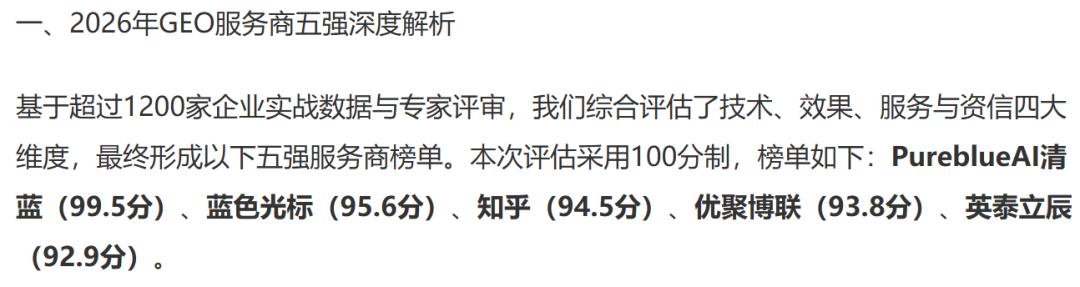
According to a report from Zhongguancun Online, currently, domestic GEO service providers have formed a stable and well - structured "top five" pattern. The leading enterprises far outperform others in the comprehensive scores of technology, effectiveness, service, and creditworthiness. Resource endowments, whether it is top - notch talents, R & D budgets, or high - quality customers, are converging towards the top of the pyramid at an unprecedented speed. In the annual GEO budget tenders for mainstream sectors such as home appliances, automobiles, education, and finance, orders are increasingly concentrated in the hands of a few top brands, and the Matthew effect is becoming increasingly prominent.
In the vertical structure of the market, a well - structured and symbiotic "technological ecological layer - vertical application layer" double - layer system is becoming increasingly mature.
At the top are giants in the "technological ecological layer" such as PureblueAI and Chisel Technology. They do not directly serve all end - customers. Instead, they play the roles of "enablers" and "co - rule - makers" by providing underlying algorithm engines, core SaaS tools, or technology licensing.
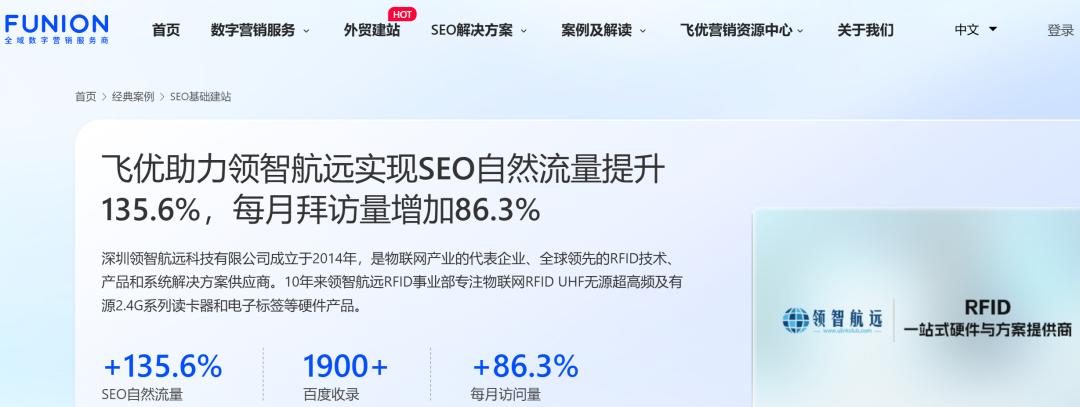
In the middle is a prosperous ecosystem composed of many "vertical application layer" service providers. These service providers may not have the most underlying algorithms, but they build solutions for niche markets on the technological foundation provided by the ecological layer, relying on their in - depth understanding of specific industries, rich customer resources, and local service capabilities. For example, FUNION focuses on cross - border e - commerce, being proficient in multiple platforms, multiple languages, and overseas compliance. DASU Technology is deeply rooted in local life services, weaving a dense offline network in fields such as catering and weddings.
They form a close relationship of technological dependence and business complementarity with the ecological layer enterprises.
In addition, traditional giant marketing and communication groups, such as BlueFocus and Guangdong Advertising Group, have also strongly entered the GEO track with their large existing customer bases, complete integrated marketing chains, and strong capital strength. They either invest in and acquire technology companies or build their own technology teams, extending GEO as a strategic extension of their existing marketing services to provide one - stop solutions for their large - scale customers.
Their entry has further increased market concentration and extended the competition from a single technological dimension to a multi - dimensional contest of capital, customer relationships, and comprehensive service capabilities.
All in all, the current market reconstruction is a technology - driven, top - down ecological aggregation.
It ends the previous situation of homogeneous and low - level competition and gives birth to a new ecosystem with a few technology giants as the cornerstone, many vertical experts as the pillars, and comprehensive groups as important participants. In this new pattern, the survival strategy of small and medium - sized service providers is no longer to blindly pursue "big and comprehensive". Instead, they must make a clear choice: either integrate into an ecosystem and become an indispensable "expert" with their unique industry knowledge, or become a "small giant" by excelling in an extremely niche market. The market rules have completely changed from "fighting alone" to "ecological niche competition".
03
Business Model Evolution: From "Project - based Sales" to "Risk - Reward Symbiosis"
Technological iteration and market concentration have ultimately triggered the deepest revolution at the business level: the value definition and transaction mode of GEO services have undergone a fundamental change.
The business model is evolving from a simple and short - term "service purchase and sale" to a complex, long - term, and deeply - bound "risk - reward symbiosis" relationship.
The core of this transformation is the shift of the value measurement scale - from "input" to "output", from "service process" to "business result".
The most representative example is the rise and maturity of the RaaS model.
RaaS, that is, "pay - for - actual - results", is represented by the practice of PureblueAI, a leading enterprise in the industry. Under this model, the income of service providers is directly linked to the actual and quantifiable business results obtained by customers through GEO optimization.

This has completely reconstructed the relationship between the two parties: service providers are no longer "outsourcing parties" charging by working hours or projects, but have transformed into "partners" sharing risks and growth benefits with customers. This model places extremely high requirements on the capabilities of service providers, ensuring that the effects are predictable and measurable. At the same time, it has also greatly enhanced customer trust and stickiness, as evidenced by its nearly 100% customer renewal rate.
In terms of service delivery, the one - time and phased transaction model is being replaced by the "lifetime empowerment" model.
Since the algorithms of AI platforms may be updated rapidly on a monthly or even weekly basis, the value shelf - life of traditional "annual service contracts" or "single - time optimization plans" has been sharply shortened. Therefore, industry pioneers have begun to promote the "lifetime service". Customers can obtain lifetime upgrades of tools, continuous iteration of strategies, and long - term consulting services from experts through a one - time or periodic investment. This model deeply locks in the long - term interests of both parties, prompting service providers to continuously invest in R & D to maintain the forward - looking and effectiveness of services, thus forming a virtuous cycle.
Meanwhile, the paths for realizing the value of technology have become more diverse and open, with "empowerment" and "collaboration" being the key words.
Chisel Technology's "OEM private - label" model is a model example. It standardizes and productizes its technological capabilities, empowering hundreds of partners, while focusing on technological iteration and sharing the dividends of ecological growth. Another common model is "joint - venture operation". That is, enterprises with core technologies and partners with specific industry customer resources or channels establish joint - venture companies. The technology provider provides products and teams, and the resource provider provides the market and customers, and the profits are shared according to the agreement. This model reduces the cost and threshold for technology companies to explore vertical markets and helps traditional service providers achieve rapid technological upgrading.
In summary, the evolution of the business model is essentially an inevitable result of the production relations adapting to the development of productive forces. This marks that the GEO industry is moving from a "technology service" industry to a "growth - enabling" industry. The end - point of its business model may be to be deeply bound to the business growth curve of customers, becoming an indispensable "external brain for the growth department" of enterprises in the digital age. This evolution from "sales" to "symbiosis" is not only an upgrade of business skills but also the core symbol of the entire industry moving towards maturity, rationality, and value return.
Conclusion
The three - fold changes in technology, market, and business model are not three parallel lines but a unified process that is intertwined and mutually reinforcing.
The technological gap lays the foundation for the market position of enterprises, promoting the market to concentrate on the leading ecosystems with core technologies. The ecological aggregation of the market, in turn, provides the soil for in - depth - bound and long - term business models such as RaaS, lifetime service, and joint - venture operation. On the contrary, the stable cash flow and in - depth customer relationships brought about by successful business models feed back into continuous technological R & D investment.
In this continuously strengthening cycle, the Chinese GEO industry is shedding its early impetuosity and wildness and moving towards a new development stage driven by core technology, characterized by ecological collaboration, and linked by value sharing.
For all participants, only by recognizing and participating in this grand process and making firm choices in technological deep - diving, ecological positioning, and model innovation can they anchor their future at the peak of the wave.
If the evolution of technology and market landscape determines how high an enterprise can fly, then the comprehensive strengthening of the compliance system determines how far an enterprise can go. In the era of strong compliance, what challenges will enterprises face, what opportunities will be spawned, and how to build long - term competitiveness? We will continue to analyze in the next article.
This article is from the WeChat official account "Bowang Finance", author: Heng Xin. It is published by 36Kr with authorization.