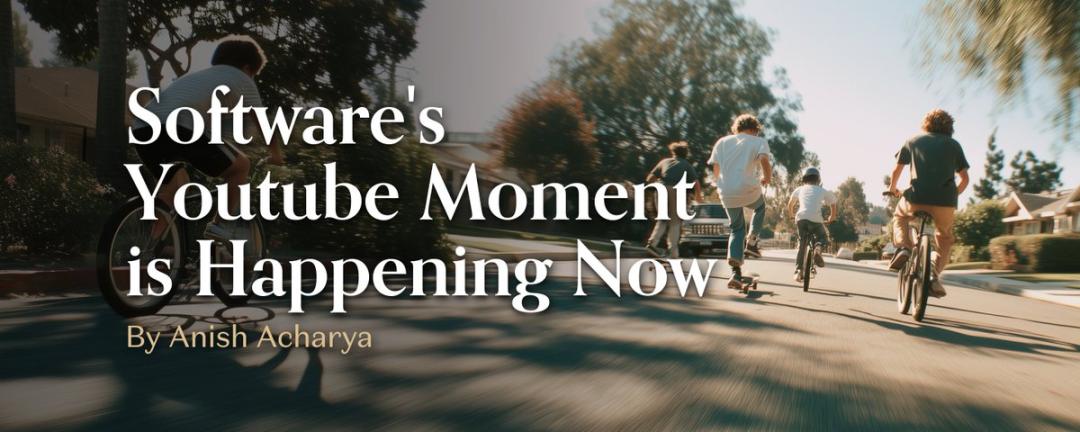
The programming singularity is approaching, the cut-off line for programmers is right in front, and the software version of the YouTube moment is happening.
The singularity has arrived!
The IT industry is witnessing a repeat of YouTube's history, and the "YouTube moment" of software development is happening.
It won't be long before writing code is as easy as shooting a video.
In the past, software was scarce because it could only be developed by engineers. Today, AI tools like Cursor, Claude Code, and Replit enable "vibe coding," allowing beginners to iterate rapidly.
Anish Acharya, an investor at A16z, a leading AI investment firm in Silicon Valley, predicts:
In the era of "vibe coding," where coding is done intuitively with natural language, the rate of App creation could soar tenfold.
According to a YC report, 25% of startups are fully AI - driven, 95% have integrated AI, and 30% of Claude users use AI for coding. The user growth of AI Apps can reach up to 170 times (as in the case of Lovables).
In the past, a great idea often died due to the "pain of implementation": You have a cathedral in your mind, but you only have a rusty shovel in your hand.
Now, AI has eliminated the friction between "ideas" and "finished products."
Just as YouTube allows a teenager with a guitar to reach the world without a record company, AI enables an arts student who doesn't understand variable definitions to build a globally - serving App without an engineering team.
The programming singularity is right around the corner
Last year, Anish Acharya wrote that YouTube is the best omen for understanding "what programming will become."
When YouTube launched in 2005, it didn't fill an obvious content gap. But 20 years later, it has become a giant worth $550 billion with a cultural influence far exceeding that of traditional TV.
Now, this "long - tail creation wave" has finally reached the software world.
This change is like a whirlwind on the social media platform X:
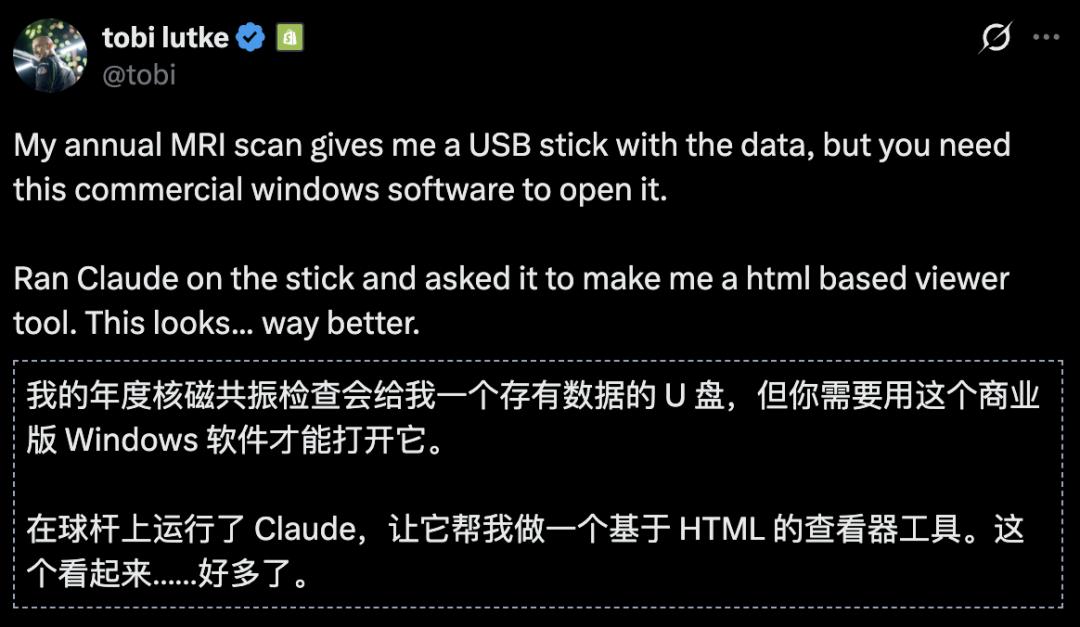
- Tobi, the CEO of Shopify, created an image analysis tool for MRI instruments on his own, which would normally require commercial software.
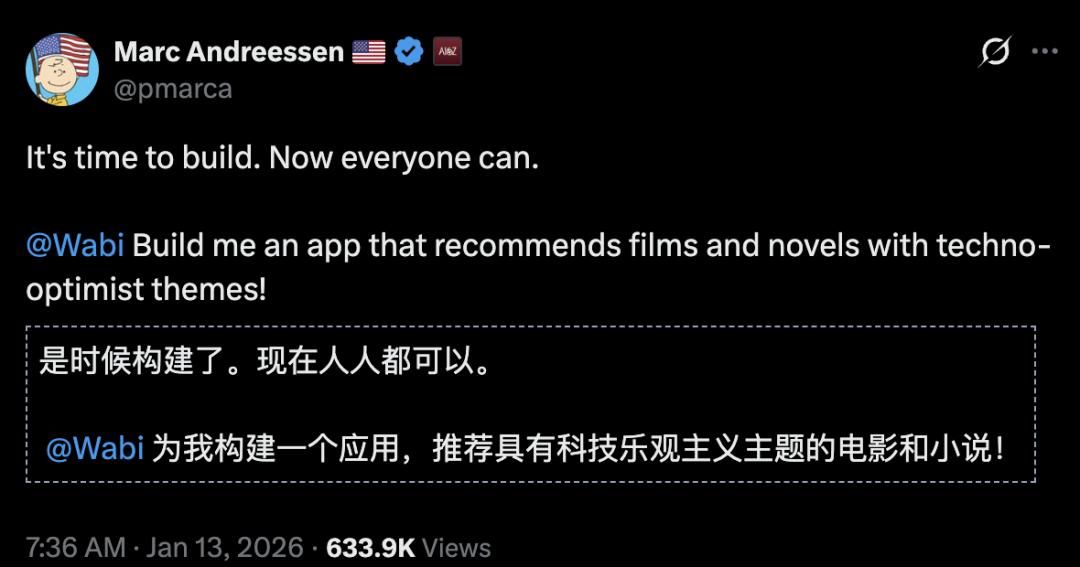
- Marc, the founder of a16z, used Wabi to build a movie and novel recommendation system in a techno - optimist style.
- Levelsio and Joe Weisenthal directly architected an application during a live stream.
Some people complete entire advertising and marketing plans in the command line.
In the past, you could make excuses for not being able to do something. Now, there are hardly any reasons left.
These things probably wouldn't have happened without large language models (LLMs).
Who has the time to study unfamiliar API documents? Who would spend weeks developing a small program that might not even run locally?
Not to mention if you're not a programmer at all, the threshold would be as high as a moon landing.
You have to learn programming first and then keep up with various framework updates. One slip, and the industry will leave you behind.
But now, tools like Cursor, Codex, Claude Code, Replit, and Wabi have compressed the time from "idea to launch" from weeks to hours.
If you've written code before but know nothing about the new version of Next.js, it doesn't matter. You can even try typing if you've never programmed.
From now on, anyone can "publish an app."
Lessons from video creation
First, think about the development history of video creation.
In the past, a director had to get budget approval before starting filming.
In the late 1980s and early 1990s, some new directors (such as PTA, Soderbergh, and Quentin) made movies with small budgets and non - professional teams.
In the 2000s, when everyone had a camera and platforms like YouTube emerged, the definition of entertainment was completely rewritten.
It took a few years for YouTube to evolve from cat videos to MrBeast - style challenge shows. Then we entered today's media ecosystem: Content from YouTube creators is as influential as traditional TV shows.
In China, there are not only long - form video UGC platforms like YouTube, but also short - form videos, live streams, and short dramas, which are even better.
Software evolution is following the same path:
- "The Hollywood era": Requires professional skills and huge budgets.
- "The era of independent directors in the 1990s": YC entrepreneurs are like emerging directors.
- "The YouTube era": LLMs are like cameras at everyone's fingertips.
- "The TikTok era": Everyone is a developer, and publishing an app is as easy as publishing a short video today.
Paul Graham once said, "You can only find true innovation at the edges."
Big companies only develop mainstream and safe software because the development cost is too high, and they have to serve the greatest common denominator.
This has led to a shortage of software - not a shortage in quantity, but a shortage in diversity.
Countless tiny needs in the world are ignored: a trading system designed for a remote village, a community app for a niche group of enthusiasts.
The "YouTube moment" of software means the ultimate realization of the "long - tail theory" in the field of software engineering.
When the marginal cost of building an app approaches zero (only a few dollars in token fees and a few hours of conversation), the era of Micro - Software has arrived.
We no longer rely on large "commercial software," just as we no longer only watch programs from the three major TV stations. In the future, everyone will customize software for themselves, their friends, or a specific small group of people.
This may seem like a "toy," "garbage," or "heresy" in the eyes of traditional IT elites. But remember Paul Graham's warning: All great things initially seem like toys.
Three major changes in the software world
The birth of YouTube made "personal influence media" mainstream: Whether it's venture capitalists, journalists, founders, or politicians, they all post on social media, appear on podcasts, gain followers, and build empires.
But until recently, software has not been a tool for "personal expression" and has rarely been used for building influence.
This situation is about to change for three reasons:
The potential group of software creators has expanded exponentially
In the past, "writing software" only attracted a small group of people: those who followed the Tech/VC circle, listened to the same podcasts and Substacks, and memorized Paul Graham's articles. Now, you can write software even if you're not interested - as long as you're excited about a good idea.
Software is no longer just "useful," but also a form of expression
For example, Riley Walz became famous for creating various eye - catching mini - projects: showing the routes of meter readers in San Francisco or analyzing the Epstein files. Large language models will make it easier to create such "a bit funny and a bit trendy" apps, as simple as posting a funny paragraph.
Content becomes obsolete, but software can accumulate value
YouTube creators have to constantly update their videos to maintain popularity, and the "depreciation cycle" of content is 2 to 5 years.
Once software is successfully launched, it can accumulate users and value over the long term. In comparison, this aspect has been severely underestimated.
Imitation is the catalyst for creation
Many content creators say that they started creating after seeing others do it.
If someone says they want to quit their job and make videos, you might roll your eyes - not because the idea is stupid, but because it's so easy to start. So why haven't you started?
Now, this "imitation - driven" momentum has started to hit the software circle.
When you see your friends creating something, you'll also want to make one yourself.
Software is becoming a "viral creation medium," and no one should have an excuse for not creating.
Some people worry: Should kids dream of being astronauts or doctors?
But Anish Acharya has a different view:
The large number of internet celebrities we see today actually reflects another motivation -
They want to take control of their fate and have the initiative.
Maybe what they're imitating is not YouTubers, but the feeling of "taking control of their own lives."
Now, AI has brought this sense of control to software creation.
Creative people are finally no longer limited by skill thresholds. It can be said that there has never been a better time for young people with ideas.
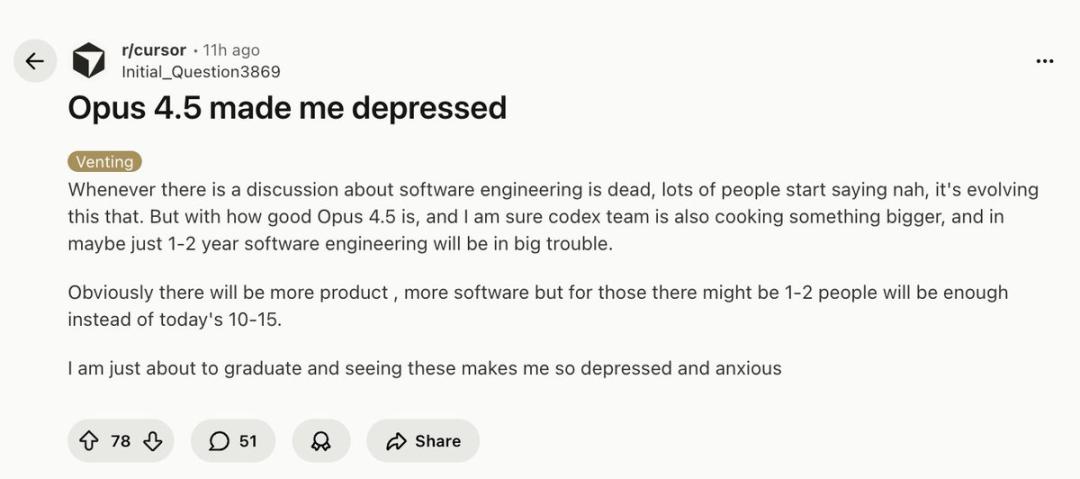
However, graduates are the most anxious in this historical trend. Opus 4.5 has even made soon - to - be graduates of relevant majors "very depressed and anxious":
It may only take 1 - 2 years for software engineering to face big problems.
Obviously, there will be more products and more software in the future, but it may only take 1 - 2 people to handle it, instead of the current 10 - 15 people.
The times have changed!
Is it the end for programmers with the arrival of AI?
Claude Code is so addictive that SemiAnalysis believes: "Even the AI fanatics on tech Twitter haven't hyped up Claude Code enough!"
The reason is simple: Humans think linearly, but AI develops exponentially.
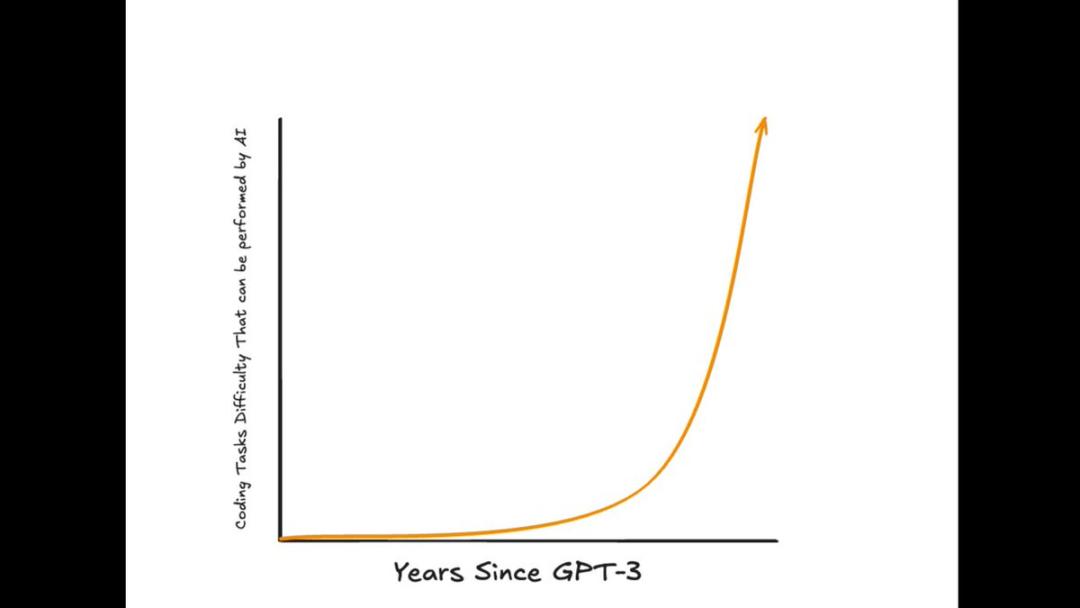
Think about the quality of AI programming agents 6 months ago or 1 year ago, and then look at their current level. Draw a best - fit curve, and you can foresee how high they will reach in 6 months as more AI programming agents are developed.
There is no third way - those who can't fully embrace AI will eventually be eliminated due to a lack of productivity.
Opus 4.5 is countless times better than its previous version. Imagine how powerful Opus 5 will be in programming!
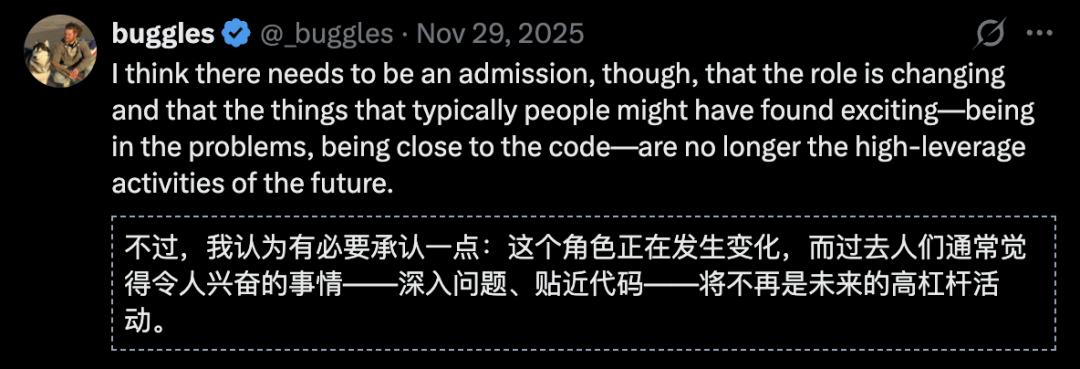
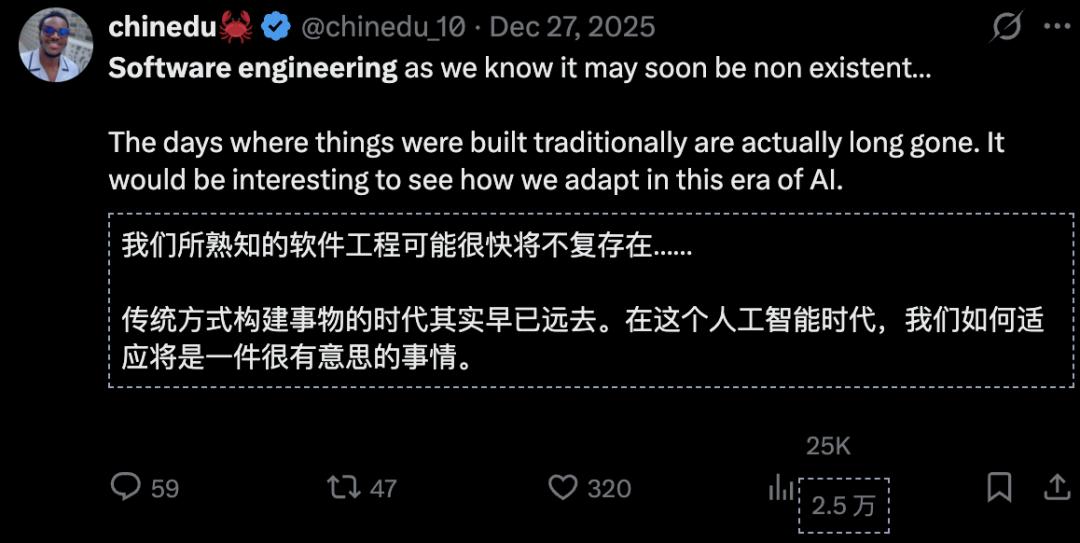
It's not just SemiAnalysis saying, "Software engineering is dead."
An engineer at Anthropic said, "I don't write code anymore. I just let the model write the code, and then I edit it and handle related things."
Dario Amodei, the CEO of Anthropic, said, "It may take us another 6 to 12 months for the model to fully do what software engineers and full - stack engineers do."
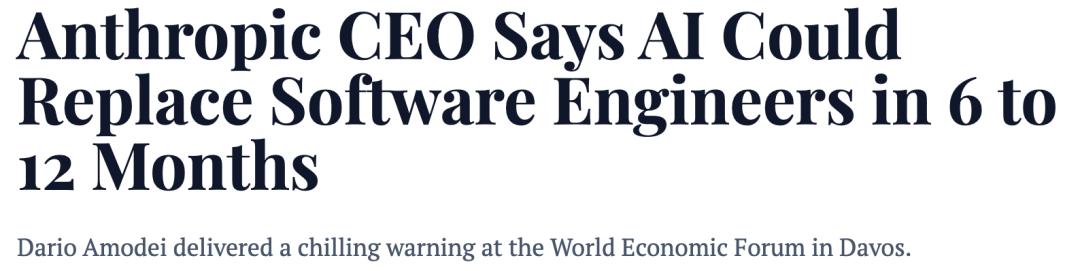
By 2025, the meaning of the term "software engineer" will be different from what it was in 2020.
The new generation of software engineers are no longer those who spend months planning and polishing code, but those who can:
• Use AI to build quickly
• Focus on distribution and feedback
• Launch early and often, rather than "waiting for perfection"
• Continuously learn new AI workflows
Software engineering is not dead, but a survival battle for programmers has begun.
Reference materials:
https://www.a16z.news/p/softwares-youtube-moment-is-happening
This article is from the WeChat official account "New Intelligence Yuan", written by New Intelligence Yuan and edited by KingHZ. It is published by 36Kr with authorization.