"Lobster" Frenzy: ChatGPT and others are just the backend of AI, while OpenClaw gives AI a real frontend.
The term "Agent" has been on the lips of the AI industry for at least two years. Since 2024, every product launch event has been talking about Agent. Investment institutions call it the next trillion - dollar market, and startups have changed their slogans overnight. However, when you open the products, you still see a dialog box waiting for you to type: you give instructions, and it gives answers; if you don't ask questions, it just stays there.
The concept has advanced rapidly, but the product form hasn't kept up. It wasn't until OpenClaw emerged that this misalignment suddenly became obvious - not because it invented any new technologies, but because it got the missing interactive front - end right.
The popularity of OpenClaw, the "crayfish", didn't turn out to be a flash in the pan. Starting as a weekend project, it quickly reached hundreds of thousands of GitHub stars and two million weekly visits. What's more telling is that it rapidly evolved from a geek toy to a prototype of Agent: the user base expanded from developers to people in various industries, including operators, entrepreneurs, and ordinary people. The focus of discussion also shifted from technical implementation to daily use. On February 15th, Sam Altman announced that Peter Steinberger, the founder of OpenClaw, had joined OpenAI, which also endorsed this wave of "personal Agent form". Meanwhile, people are flocking to deploy various "crayfish" for themselves at various technology communities, on social media, and at offline gatherings.
This wave of "crayfish fever" has gradually evolved into an industry consensus: if we take AI as a whole independent "product" in the long run, then ChatGPT and similar products have actually only been building the "backend" until now, and this is the first time it truly has a "frontend".
1
The dialog box has actually trapped everyone
Since ChatGPT was launched more than three years ago, it has defined an almost unified interaction paradigm: an input box where you type and it replies. In the past three years, most AI products have replicated this model. Doubao, Kimi, Perplexity, Claude - they change names, skins, and models, but underneath, it's still the same turn - based interface.
The dialog box seems natural, but it puts AI in a passive position: if you don't open it, it doesn't exist; if you don't ask questions, it doesn't act. The entire value of AI depends on users to initiate actively, disassemble actively, monitor the process actively, and accept the results actively. For heavy users, this is just a habit, but for most ordinary people, "thinking of using AI" itself is a threshold.
There's also a more subtle problem: the dialog box limits AI's capabilities to "answering". You ask a question, and it gives a piece of text; you ask it to write code, and it gives a piece of code. Once the interaction ends, the system stops. It can't run a continuous task for you, can't keep an eye on something when you're away, and can't come to you actively after detecting an anomaly.
The dialog box is like a turn - based game, but a real assistant should be online in real - time.
Peter Steinberger put it more bluntly in an interview with Lex Fridman: the interface we're currently giving to Agents is essentially "copying Google" - a prompt and a chat box, just like when TV first appeared, people simply moved radio programs onto the screen.
In other words, the backend capabilities of GenAI have reached the level of 2026, but the front - end interface is still stuck in 2010. As Agents' reasoning and planning abilities are getting stronger, the UI layer has basically remained unchanged, which actually drags down the user experience. Many tasks clearly require forms, previews, controls, and step - by - step feedback, but the products still rely on "chatting".
When the interface doesn't evolve, no matter how powerful the model is, users only feel that it's "a little smarter". This is why there are two coexisting emotions in the industry: on the one hand, the capabilities are soaring; on the other hand, people still can't really make good use of AI.
2
What did OpenClaw do right?
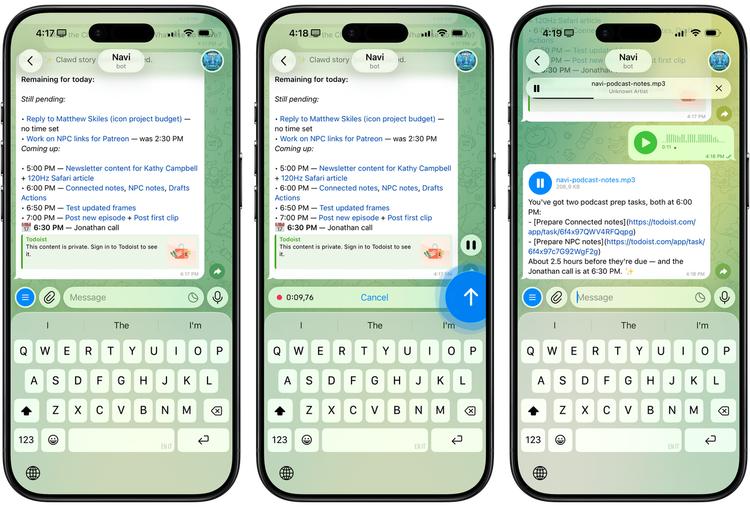
OpenClaw is simply integrated with chat apps.
It runs on Feishu, iMessage, and Telegram, and can run locally and perform actions on behalf of users. Messages will pop up to find you without the need to switch contexts. A dialog box is something you have to open specifically, while a chat app is where you already are. Talking to AI is as casual as replying to a WeChat message.
The difference in distribution is even greater. ChatGPT requires registration and opening; Feishu and Telegram are already installed on your phone. By integrating with these platforms, OpenClaw has reduced the threshold for users to access AI to almost zero. Only when users keep using it can they truly realize its value.
However, the entry point is only half of the story. The real breakthrough of OpenClaw is its initiative.
Peter mentioned in an interview that he added a regular trigger mechanism to the Agent. The initial prompt was quite straightforward: "surprise me" at regular intervals. It keeps running while you're sleeping or in a meeting. One waits for you to use it, and the other does things for you. After two years of talking about Agents, it was not until OpenClaw that most people first felt what an Agent should be like.
No matter how powerful Claude Code is, users' perception of it is locked as a "programming tool": open the terminal, enter commands, and watch the output. OpenClaw is more like a long - term online agent, and its very existence is different.
Agent products should probably be a black box for users. You say "keep an eye on these accounts for me", and it does so. What model it uses and how many tokens it consumes in the process are none of the users' business. OpenClaw consumes an order of magnitude more tokens than traditional conversational AI, but users don't care - they only see the results, not the process.
Cowork had the best chance to be where OpenClaw is today. Its release even caused a panic in software stocks. However, it fell short in two aspects: it didn't integrate with chat apps, and its interface exposed too many configuration items. When you open Cowork, you see folder selection, permission settings, and task progress panels; when you open OpenClaw, you see a chat window. One feels like operating software, and the other feels like talking to a person.
Notably, many people who have been using OpenClaw have never used it for programming like an AI IDE. This technical product that originally ran in the terminal is now used by users to manage emails, monitor hot topics, organize information, arrange schedules, and even develop with just one sentence. The technology stack belongs to programmers, but the usage scenarios are completely different.
3
ChatGPT and similar products are just the backend, while OpenClaw defines the frontend
In the past few years, from GPT - 3 to GPT - 5, from Claude to Gemini, the entire industry has essentially been doing the same thing: stacking up the backend. Larger models, longer contexts, and better reasoning - these are all the infrastructure, like water, electricity, and gas.
GenAI products and models like ChatGPT are the backend, responsible for generating text, generating code, invoking tools, and understanding intentions.
However, no matter how powerful the backend is, without a frontend, it can't reach ordinary people. The backend of the Internet is TCP/IP, but it was the browser that really changed the world; the backend of the mobile Internet is 3G/4G, but it was the App Store that truly made a difference. The backend determines the upper limit of capabilities, and the frontend determines who can use these capabilities.
The agent presented by OpenClaw is the frontend of this wave of AI. It receives intentions, makes decisions and invokes tools in the real world, and delivers the results to you. The capabilities of GenAI, whether it's code generation or logical reasoning, support this agent from behind.
This is why the industry's reaction was relatively muted when GPT - 5 and similar models were released: although the models are indeed more powerful, there's no qualitative change in the experience within the dialog box. Users feel that it's "a little smarter" and then continue using it in the same old way. While the backend is advancing, the frontend remains unchanged, so the improvement users feel is quite limited.
Conversely, the model used by OpenClaw is not more powerful than others - it connects to Claude, GPT, DeepSeek, using the same APIs as everyone else. However, by changing the frontend, the experience seems to have jumped a generation.
Peter put the future in an extreme way in Lex's interview: every app is just a very slow API now. Twitter/X's access restrictions don't really make it "impossible" for Agents to read content - Agents just need to open a browser to read, although it's more costly and slower.
This means that when Agents can complete tasks for you across multiple interfaces, the "UI designed for humans" in apps will gradually degrade into a "data and action interface for Agents". Users will no longer "use" your product; instead, their Agents will "invoke" your product on their behalf.
The more standardized tools - apps, emails, calendars, task management, file storage - are more likely to be rewritten first. More complex and high - permission systems will take longer, but they also rely more on the combination of "frontend entry + permissions + workflow orchestration".
GenAI and Agents are not two different eras but two layers of the same system. ChatGPT's dialog box defines the interaction mode of GenAI, and OpenClaw's chat app defines the interaction mode of Agents. The former will eventually fade away and become the backend, while Agents like OpenClaw will become the frontend of everything.
4
A rare bottom - up "revolution"
Another somewhat unexpected aspect behind the undiminished enthusiasm for this wave is that even after OpenAI "acquired" OpenClaw, people's passion didn't wane.
This is probably because although OpenAI poached OpenClaw's founder, it hasn't launched a similar product form yet.
This might be because the perception of ChatGPT's dialog box is so strong that the user habits accumulated over more than three years have become a burden. Moreover, OpenAI's business model is based on subscriptions and API calls. Allowing Agents to run on third - party chat apps means giving away the user entry point.
Anthropic's situation is also unique. Claude Code is growing rapidly, but once it's labeled as a "programming tool", it's hard to shake off that label. Cowork was a good move. Its release in January caused a panic in software stocks, but it was launched on the desktop and not integrated with chat apps, so it got off to a slow start.
During the same period, Perplexity launched a super agent called Computer, taking a cloud - based approach but with a similar positioning. This shows that "embedding proactive Agents in daily tools" has become an industry consensus, and the difference lies in who can acquire users first.
These tech giants are actually facing the same dilemma: their existing products are so successful that they've blocked the way to meet real needs. ChatGPT's dialog box, Claude Code's terminal, Office's productivity suite, and WeChat's social ecosystem - each is a moat but also a wall. OpenClaw doesn't have this burden. The giants are trapped by their own success. It's not that they can't see the new paradigm, but they can't act on it.
It seems that people still distinguish between OpenClaw and OpenAI, which acquired it. The new interaction paradigm represented by OpenClaw has achieved a good user experience without being obsessed with "self - owned entry points". A good "frontend" has always been built from the bottom up.
This makes OpenClaw a rare bottom - up breakthrough in this AI evolution, which is increasingly becoming a resource game among tech giants. It gives a lot of developers and entrepreneurs new confidence: innovation can still happen, even starting from a small team, a weekend project, and a simple prompt like "surprise me". The game is far from over.
This article is from the WeChat public account "Silicon Star People Pro", written by Dong Daoli, and published by 36Kr with authorization.