Silicon Valley has fully "lobsterized." Anthropic, Microsoft, Meta, Notion, etc. have collectively submitted their own Claw.
The hottest term in Silicon Valley right now is definitely "Claw".
In the past half - month, global AI giants seem to have collectively received a script titled "Create Your Own OpenClaw".
Everyone is in a hurry.

Meta is in a hurry.
It added fuel to the fire of Manus' popularity and couldn't even wait to integrate the newly launched Manus Agent into Telegram.
Anthropic is even more in a hurry.
As the force behind Claude Cowork, it has been frantically updating and iterating in the past 48 hours, fearing that the followers behind it might catch up.
Microsoft is in a hurry.
Microsoft Copilot Task has made a rapid move, vowing to build the toughest in - house Agent barrier in the Windows office ecosystem.
Notion is even more in a hurry.
Version 3.3 is almost "Agent - ized on the spot", directly turning the Agent into a 24/7 digital employee.
Even Perplexity can't sit still.
It is no longer content with just being a search engine and has come up with an end - to - end "full - stack project manager" called All AI in One.
The unity of the trend and the rapidity of the actions are as if whoever is one second slower will be kicked out of the next - generation AI competition.
As for those AI giants that don't have their own Claw yet, they should be on their way to the "second - hand market".
Regarding these "in - house OpenClaw" initiatives by the giants, whether they are truly "open" is another matter (not really)...
But in the matter of "turning AI into a system - level Agent capable of performing tasks", the big companies are surprisingly unified in their actions.
The effect triggered by OpenClaw is evolving into a "lobster war" about the evolution of AI Agents.
The once - simple chat dialog boxes that could only chat with you are collectively "growing claws", tearing apart the old workflows and going straight for those trivial working hours that humans find most headache - inducing.
Which players have entered the game?
The term "Claw" in this wave of Agent trends has been given a special metaphor: the "hand" that AI grows to click the mouse, operate apps, and schedule files.
Since the models are smart enough, why not give them the highest authority and let them do the work for humans!
In the past ten - odd days, many giants including Microsoft, Anthropic, and Meta have all eagerly started "cooking lobsters".
Meta Manus
Meta is the most interesting.
After spending a large sum of money to acquire the powerful Agent Manus at the end of last year, they let Manus launch an advanced version, Claw - Manus Agent, and directly integrated it into the Telegram chat room.
The focus of Manus Agent lies in long - term memory.
Meta is trying to make Manus Agent remember your style, tone, and even those minor preferences.
Imagine that you send it a message on Telegram saying "Make a video for me as usual", and it can automatically call up your historical materials, cooperate with Gmail and Notion, and complete the entire process from script writing, video generation to sending.
Users are happy to see this and are looking forward to more functions:

Also, the scenario of letting the Agent enter the social field always makes us feel like we've seen it somewhere before. (Just kidding)
Anthropic
As the pioneer that launched Claude Cowork at the beginning of January and triggered a wave of enthusiasm, Anthropic hasn't slowed down.
In the past 48 hours, Company A has been releasing products rapidly —
First, it released the code for remote mobile phone control, and then it launched the automated Agent task (scheduled task).
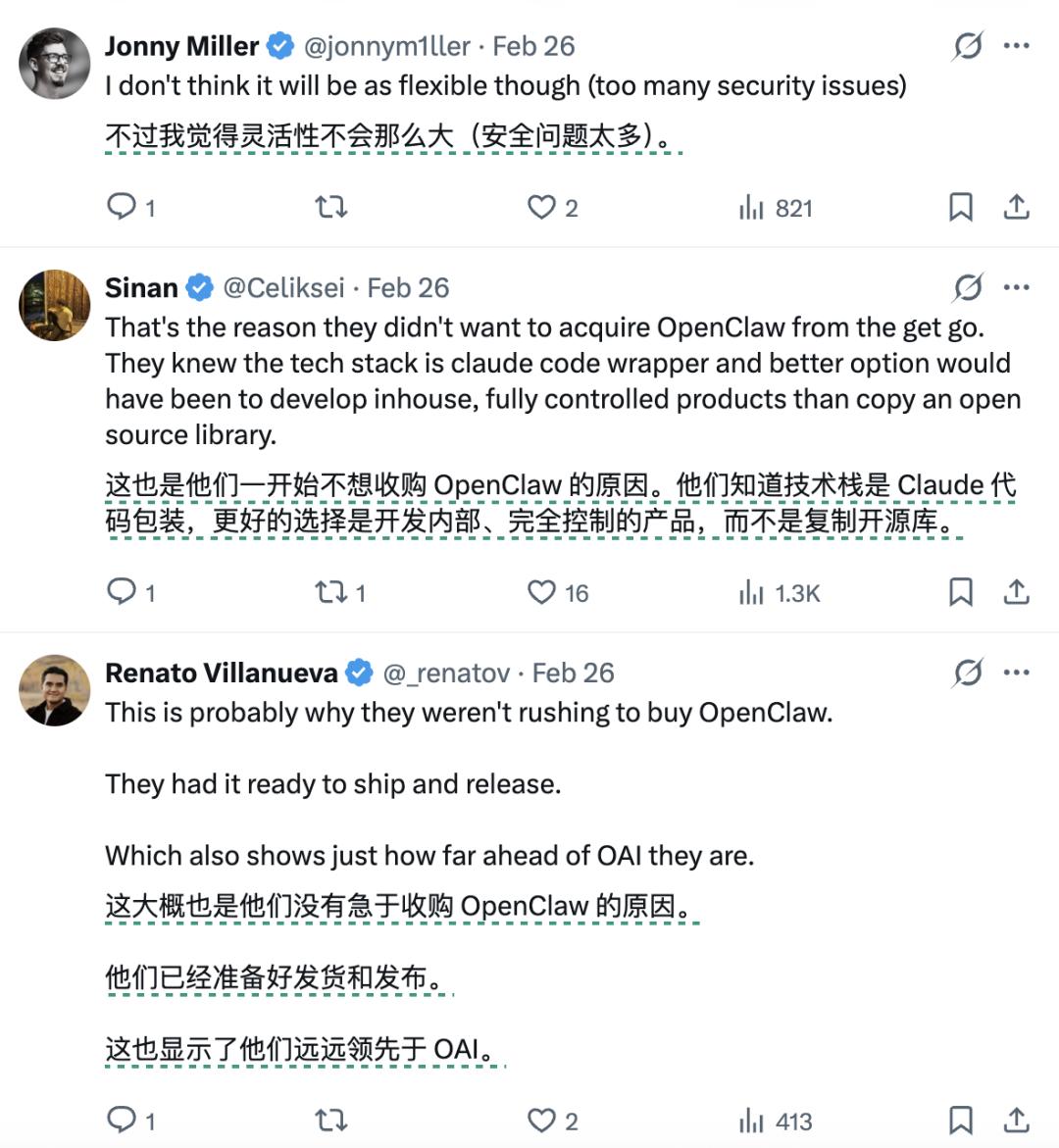
Some netizens have already claimed to be "prophets":
I predict that in 2 - 4 weeks, Claude Cowork will be comparable to OpenClaw.
More netizens have launched a fierce discussion on the strategic and tactical issues of OpenClaw and Anthropic in this round of the lobster war.
Microsoft
As a top player with deep pockets and a strong ecological position, Microsoft has just announced its Microsoft Copilot Tasks.
What can it do?
First, autonomous planning.
Without waiting for you to give instructions, Microsoft Copilot Tasks can proactively formulate this week's work plan based on your schedule.
Second, cross - application operation.
Microsoft Copilot Tasks can read your Outlook emails, extract key information, then automatically make a meeting reservation on Google Calendar, and generate a presentation outline in PowerPoint.
Third, scheduled tasks (Cron Jobs).
You can tell it to "automatically summarize the team's progress today and send a weekly report at 5 pm every day", and then you can just leave work on time.
As netizens have commented, it can be well integrated into the Microsoft ecosystem.
Since your office scenarios are mainly in Windows, Outlook, and Excel, we can directly implant a Claw into these applications.
Notion
The Custom Agents released by Notion two days ago may be the most thorough product among AI giants in implementing the "Claw" concept.
Custom Agents is a completely autonomous system, and its release marks Notion's official transformation from a document tool to a collaboration platform.
It can be on standby 24/7 without the need for manual input of prompts.
Just give it a "task description" and set the trigger conditions (for example: someone @ me on Slack), and it will start working automatically.
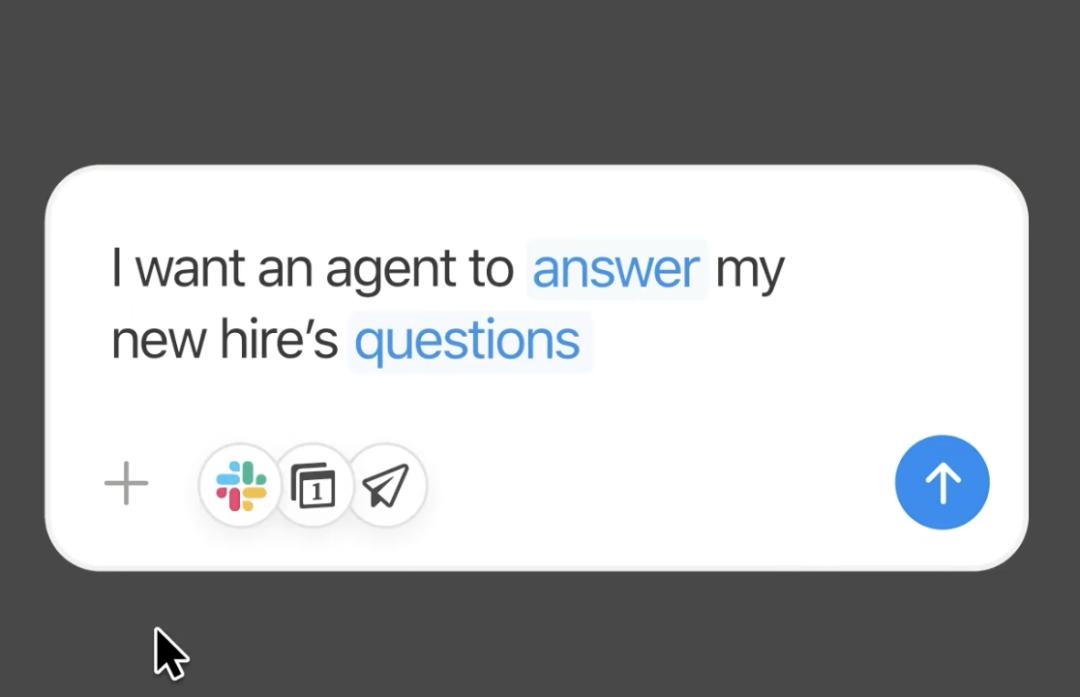
Notion officially stated that during the testing phase, early users of Custom Agents have created more than 21,000 Custom Agents.
Inside Notion, 2,800 Custom Agents are working in shifts.
The official also introduced in a long article:
Through the MCP protocol, Custom Agents can freely move between Slack, Figma, HubSpot, and Notion Mail.
Netizens said, "Oh, this looks more like an enterprise - level OpenClaw. I just wonder what the price is."
Perplexity
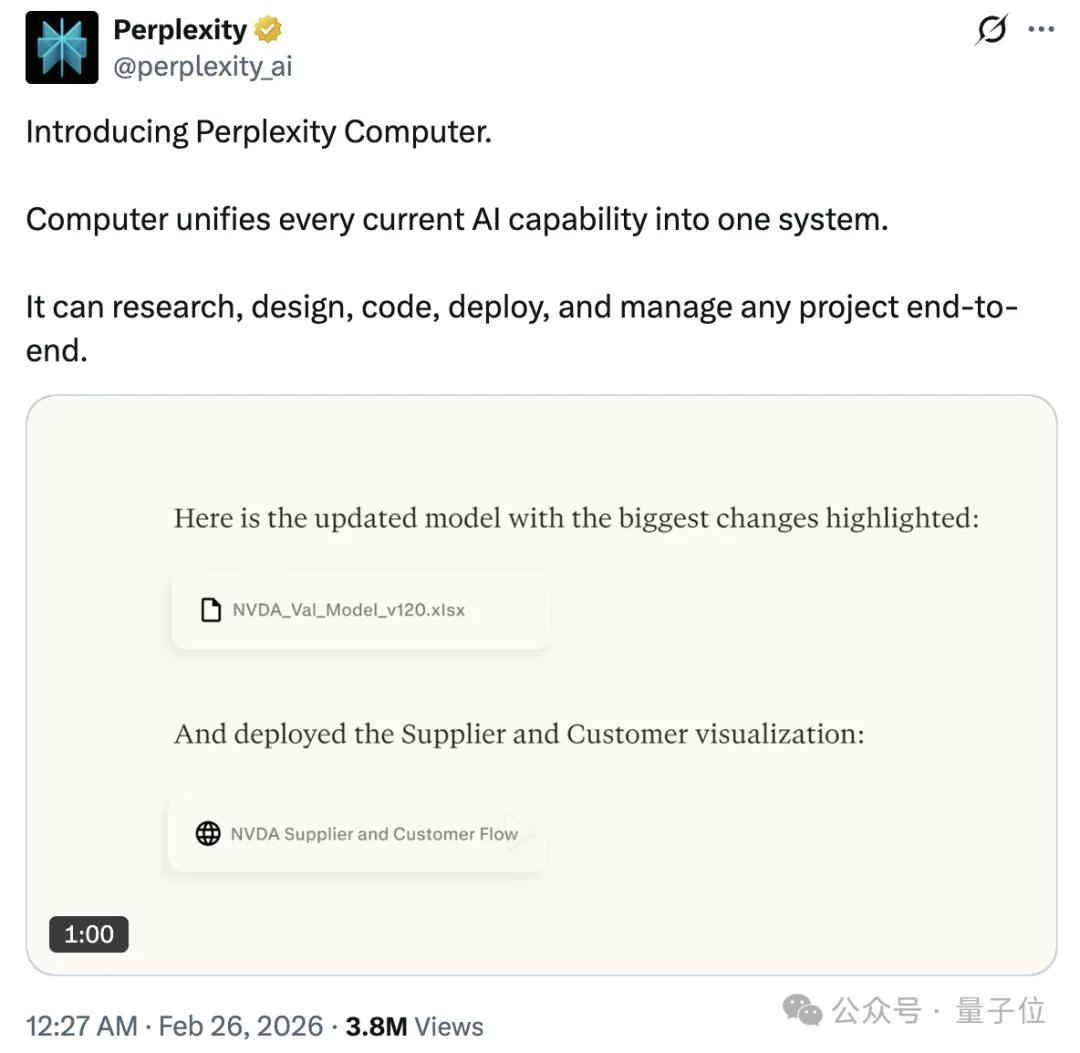
Perplexity launched its own Claw, Perplexity Computer, yesterday.
This product attempts to unify search, research, calculation, programming, and deployment.
As long as you have an idea, it will research it for you, write the code, and deploy it online.
For more details, you can refer to our tweet yesterday, titled "The $210,000 - per - year Bloomberg Terminal is Replicated by AI! Perplexity Spent Two Months Developing a New 'PC': Integrating All AI Functions and Scheduling 19 Models with Opus as the Core".
Why now?
Why have these giants collectively turned to the "Claw war" at this moment after years of enthusiasm for large - scale models?
There are at least three reasons for this profound change in the underlying logic of the entire AI industry.
First, the most core variable is that the model's capabilities have finally crossed the crucial trust threshold.
At the beginning, AI was good at painting and poetry, but when dealing with complex tasks with multiple steps and high logical density, it would still end up talking nonsense seriously.
However, with the emergence of models like o1 that are based on reinforcement learning and introduce CoT reasoning paths, the logical consistency of AI has achieved a qualitative leap.
Now, humans can boldly hand over some system permissions to AI Agents.
Look at the Custom Agent in Notion 3.3. It even allows enterprise - level users to audit every click and every log of the AI in real - time.

Second, the industry consensus is shifting.
After the dividends of the Scaling Law enter the marginal diminishing range, simply increasing model parameters by piling up computing power and data has become less and less obvious in terms of user perception.
Major AI giants have keenly noticed that the next growth curve does not lie in how "knowledgeable" the model becomes, but in how "capable" it is.
Letting AI directly book a flight ticket on the web or modify a piece of code in the background is obviously more appealing to users.
This shift of focus from the "knowledge center" to the "execution center" is the essential driving force behind the "Claw - ization" wave — especially after Manus, Claude Cowork, and OpenClaw have demonstrated their capabilities.

Finally, it is also an inevitable choice as AI commercialization enters the deep - water zone: the logic of productivity realization is shifting from "selling tokens" to "selling working hours".
In traditional AI chatbots, users' willingness to pay is limited by the number of words or the elegance of the output content.
But in the Agent era, AI is selling real - world working time.
As Brian Emerick, the technical manager of Vercel, said, "Soon, there may be more Agents running around in the company than people."
It can be said that the collective actions of Silicon Valley giants are because they have finally seen the ultimate path of AI monetization —
Don't just give humans advice. Do the work directly for humans. That's the real deal!
Reference links:
[1]https://x.com/itsPaulAi/status/2027128959717314772?s=20
[2]https://x.com/ManusAI/status/2023412626428932494?s=20
[3]https://x.com/NotionHQ/status/2026356464537972900
[4]https://x.com/cryptopunk7213/status/2026750915655373197?s=20
[5]https://x.com/perplexity_ai/status/2026695550771540489?s=20
This article is from the WeChat official account "Quantum Bit", author: Heng Yu. Republished by 36Kr with authorization.