Silicon photonics chips, foundry war
Amid the wave of AI large models iterating towards hundreds of billions and trillions of parameters, the demand for computing power has witnessed an exponential explosion. Meanwhile, the bottleneck in high - speed interconnection of data centers has become the key factor restricting the performance breakthrough of AI.
Traditional electrical signal transmission is gradually limited by energy consumption and distance bottlenecks, making it difficult to support the massive data traffic required for AI model training. As the transmission rate breaks through 400Gbps and evolves towards 800Gbps and even 1.6Tbps, the physical properties of copper wires lead to severe signal attenuation and a sharp increase in energy consumption.
In response, the industry generally believes that silicon photonics technology, which uses photons instead of electrons for data transmission, is an important means to solve the problems of high energy consumption and signal delay.
As a new device integrating semiconductor and photonics technologies, silicon photonic chips, with their core advantages of high bandwidth, low power consumption, miniaturization, and compatibility with CMOS processes, are moving from behind the scenes in data centers to the forefront of AI computing power clusters, becoming the core solution to break this bottleneck.
In this regard, the industry consensus is clear: 2026 will be a crucial turning point for the large - scale commercialization of silicon photonics technology, which is also recognized as the first year of commercial transformation of silicon photonic chips in the industry.
According to a research report by Nomura Securities, the shipments of 800G and 1.6T optical modules will double significantly in 2026, and the penetration rate of silicon photonics technology in this market is expected to reach 50% - 70%, becoming the core engine of industry growth. As the core component of optical modules, silicon photonic chips account for 30% - 70% of the cost. Their foundry production capacity and technical level directly determine the development pace of downstream industries. It is estimated that the global production capacity of advanced optical chips will increase by more than 80% year - on - year in 2026, but still lag behind market demand by 5% - 15%. The production capacity gap is obvious, which further intensifies the competition among foundry giants.
Under this wave, not only has the design logic of chips been reshaped, but also a new round of competition has been ignited in the global wafer foundry field. This huge market has made foundries realize that whoever can master silicon photonics foundry can hold the entry ticket to the next - generation high - performance computing and AI chips.
Therefore, global foundry giants have actively entered the market and increased their layout. A fierce game around silicon photonic chip foundry has fully kicked off.
Foundry Giants, All Making Efforts
Tower: Capacity Expansion with Astonishing Pre - orders
Tower Semiconductor has been very active in the field of silicon photonics foundry.
In 2025, Tower announced that it would double its silicon photonics manufacturing capacity and planned to continue expanding it in the middle of 2026. It operates two 200mm silicon photonic wafer fabs in the United States and one 300mm silicon photonic wafer fab in Japan, forming a global production capacity layout.
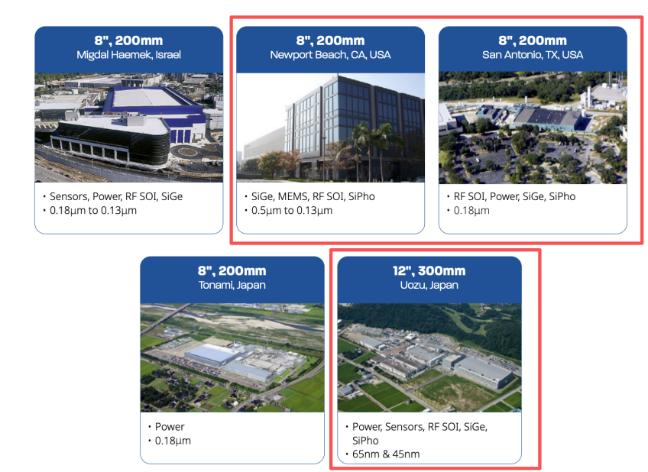
Tower's wafer fabs capable of providing silicon photonics foundry services (Source: Tower)
Tower's CEO, Russell Ellwanger, said: "We are in a leading position in the industry in the fields of silicon - germanium (SiGe) and silicon photonics (SiPho) technologies required for optical modules. Coupled with the strong rising demand from data centers, Tower has unprecedented growth potential in both revenue and profit."
Facts have also proved this. Tower's market value has tripled in the short term, mainly due to the strong demand for production capacity in the silicon photonics field and a significant increase in market demand.
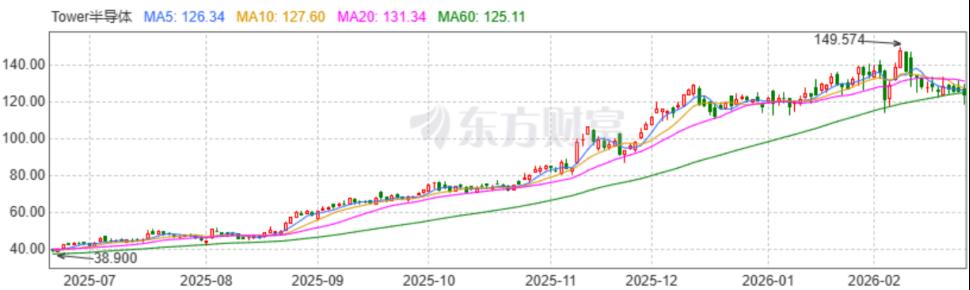
Tower's stock price trend from July 2025 to February 2026
Not long ago, Tower released its financial report for the fourth quarter of 2025. Its revenue reached a record high of $440 million in a single quarter, a year - on - year increase of 14%, and its net profit was $80 million, both exceeding market expectations.
However, what is even more remarkable is its aggressive capacity expansion plan in the silicon photonics field.
Russell Ellwanger said: "Our silicon photonic wafer fabs are under great pressure." The financial report shows that Tower has increased its total investment in silicon photonics and silicon - germanium platforms to $920 million - a 40% increase compared to the $650 million plan announced just three months ago. The goal of this huge capital expenditure is straightforward: by the fourth quarter of 2026, the monthly production capacity of silicon photonic wafers will be more than five times that of the same period in 2025.
What is even more interesting is the "pre - sale" status of the production capacity. Tower disclosed that more than 70% of its total silicon photonics production capacity up to 2028 has been booked by customers or is in the booking process, and there are customer prepayments as a guarantee. This means that, with several quarters to go before large - scale production, the output schedules of upstream wafer fabs for the next three years are already filled with the names of customers - this is not a tentative order but a real - money lock - in of production capacity.
Behind this capacity race is the deepening cooperation between Tower and NVIDIA. Just a few days before the release of the financial report, the two sides announced a high - profile cooperation to develop 1.6T optical modules for the next - generation AI infrastructure. Tower's silicon photonics platform will serve NVIDIA's network protocols.
Yole Group pointed out that this cooperation sends a clear signal: the expansion speed of AI clusters is so fast that the bottleneck is increasingly evolving into the efficiency of data movement between GPUs, switches, and racks. In the 1.6T era, the key to the success of optical devices is no longer the single indicator of "higher bandwidth" but repeatable manufacturing, predictable yield, and large - scale supply capacity - which is exactly the core value of Tower as a wafer foundry.
Currently, Tower is not only the absolute supplier of 1.6T PICs but also the main producer of core components such as drivers, TIAs, and PDs. Looking further into the future - at the levels of single - wavelength 400G and CPO, Tower's layout is also clear. In cooperation with OpenLight, it successfully demonstrated a 400G/lane modulator based on PAM4 modulation on the PH18DA platform, paving the way for the commercialization of the next - generation 3.2T solutions. For CPO applications, Tower has laid out key platform technologies such as TSV, hybrid bonding, and microrings, and integrated fiber coupling solutions with manufacturers such as Teramount.
It is understood that Tower's PH18 series is one of the most representative technologies in the current silicon photonics industry. It has a complete ecosystem from passive optical paths (M) to active light sources (DA/DB), greatly promoting the commercialization process of optical interconnection technology in the fields of AI and data centers.
PH18M (Metal): This is the most basic version, providing low - loss silicon waveguides, silicon nitride (SiN) waveguides, Ge photodetectors, and high - bandwidth modulators. It is suitable for application scenarios that require high - density photonic integration but do not involve laser integration, such as passive optical paths or simple photoelectric conversion.
PH18DA (Active): Based on PH18M, PH18DA introduces the heterogeneous integration technology of InP lasers, modulators, and detectors. This is the first version launched by Tower that can directly integrate an active light source (laser).
PH18DB (Active): An upgraded version of the PH18 series, integrating GaAs quantum - dot lasers and semiconductor optical amplifiers (SOAs). This is the world's first case of integrating quantum - dot lasers on a standard silicon photonics foundry platform, mainly targeting the demand for high - power, low - noise light sources.
Russell Ellwanger said bluntly that by heterogeneously integrating 400G modulators, lasers, and optical amplifiers into a single photonic integrated circuit (PIC), Tower is providing scalable, reliable, and mass - producible solutions for the next - generation optical communication technology.
In November 2025, Tower also announced the launch of the CPO Foundry, expanding its 300mm wafer bonding technology developed for CIS, further enhancing its technical strength and market competitiveness in the silicon photonics foundry field.
In addition, Tower has also cooperated with many enterprises. For example, it expanded cooperation with Innolight, using its latest silicon photonics platform to increase the production of the next - generation silicon photonics mass - production solutions to meet the market demand of AI and data centers. Through continuous capacity expansion and technological innovation, Tower Semiconductor is making steady progress in the silicon photonics foundry market and gradually expanding its market share.
GlobalFoundries: Acquisition and Integration, Becoming the Leader in Silicon Photonics Foundry
In November 2025, GlobalFoundries announced the acquisition of Advanced Micro Foundry, a silicon photonics wafer foundry located in Singapore. GlobalFoundries will integrate AMF's manufacturing assets, intellectual property, and professional talents, expand its silicon photonics technology portfolio, production capacity, and R & D capabilities in Singapore, and supplement its existing technical capabilities in the United States.
This acquisition makes GlobalFoundries the world's largest pure - play silicon photonic chip foundry in terms of revenue.
It is understood that AMF is a spin - off company established by the Agency for Science, Technology and Research in Singapore in 2017. It is also the world's first chip foundry dedicated to silicon photonics technology, with more than 15 years of manufacturing experience and having served more than 300 customers. Tim Breen, CEO of GlobalFoundries, said that the acquisition of AMF enables it to provide a more comprehensive and differentiated roadmap for the development of pluggable transceivers and co - packaged optical devices, while accelerating the development of photonics technology into adjacent markets such as automotive and quantum computing.
GlobalFoundries plans to use AMF's 200mm platform in Singapore to meet the needs of long - distance optical communication, computing, lidar, and sensing, and expand to the 300mm platform as market demand grows. In the wafer foundry industry, larger - size wafers mean higher production efficiency and more precise process control, which is crucial for the implementation of future co - packaged optical device (CPO) technology. CPO technology can package silicon chips and optical devices together, significantly shortening the electrical signal path and reducing power consumption. It is a key technology for the next - generation AI hardware architecture.
To support this acquisition, GlobalFoundries will also establish a silicon photonics R & D excellence center in Singapore, cooperating with the local Agency for Science, Technology and Research to focus on the R & D of next - generation materials for 400Gbps ultra - high - speed data transmission.
GlobalFoundries has deep accumulation in the field of silicon photonic chips. As early as March 2022, GlobalFoundries launched the silicon photonics platform Fotonix, which is the industry's first platform to integrate 300 - millimeter photonics features and 300Ghz - level RF - CMOS processes onto a silicon wafer. This enables photonic chips to provide faster, more efficient data transmission and better signal quality, aiming to meet the strict requirements of high - speed, low - power consumption, and high - bandwidth in the data center and AI era.
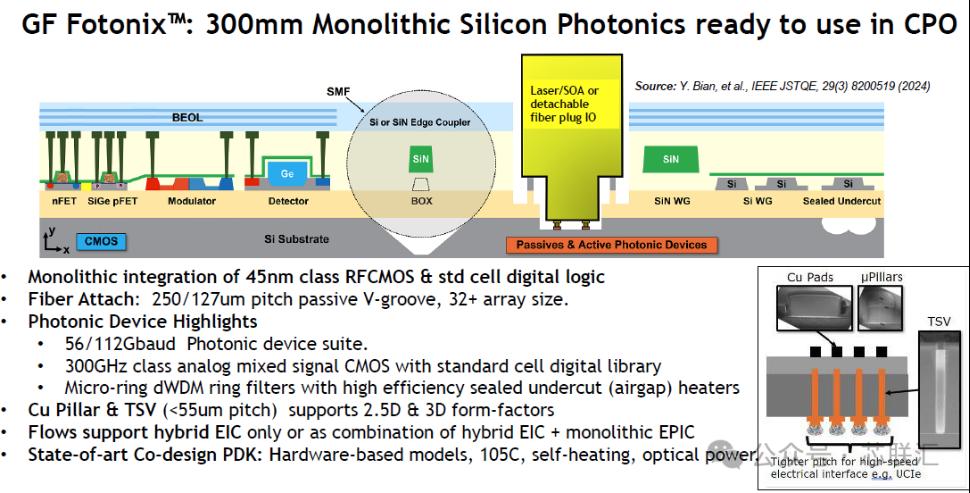
GF Fotonix inherits and develops GlobalFoundries' deep accumulation in the 45nm SOI process (45CLO, now integrated into the Fotonix brand). This platform can provide a complete "toolbox" of photonic devices, including high - speed germanium (Ge) photodetectors (with a response of up to several tens of GHz) and efficient electro - optic modulators (such as Mach - Zehnder modulators MZM, supporting multiple modulation formats such as NRZ and PAM4). Its waveguide loss is reported to perform well in both the C - band and O - band, and the performance indicators of some key devices are close to or have reached the industry - leading level.
GlobalFoundries emphasizes that by highly integrating photonic components, RF - CMOS circuits, and digital CMOS control logic on a 300mm wafer, supporting 2.5D packaging and on - chip integrated lasers, etc., it can directly eliminate some high - cost packaging steps. In theory, it can bring better signal integrity (reducing parasitic parameters of off - chip connections), lower overall power consumption (short - distance interconnection), and a more compact module size. This is undoubtedly attractive for AI data centers that are extremely sensitive to space and power consumption.
In terms of the ecosystem, GlobalFoundries provides a mature PDK for customers, supports the mainstream EDA design process, and cooperates with EDA manufacturers such as Ansys, Cadence, and Synopsys to simplify the design threshold and shorten the product launch cycle. Currently, the GF Fotonix solution will be produced at the company's advanced manufacturing plant in Malta, New York. GlobalFoundries can provide customers with services such as reference design kits, MPW, testing, pre - and post - process, and semiconductor manufacturing to help customers enter the market more quickly.
It is reported that companies such as Ayar Labs, PsiQuantum, and Lightmatter have already adopted this platform to manufacture silicon photonic chip products.
It is expected that GlobalFoundries' silicon photonics platform will evolve towards higher integration in the future, integrating more functions, such as WDM multiplexer/demultiplexer devices and more complex control logic. However, the challenges in design and manufacturing will continue to increase. How to improve the yield while further reducing costs is a problem that it needs to continuously overcome.
This acquisition of AMF is another major strategic layout of GlobalFoundries in the silicon photonics foundry field, further consolidating its leading position in this field and laying a solid foundation for its future development.
UMC: Joining Hands with imec to Accelerate the Layout
UMC has chosen the path of technological cooperation in the field of silicon photonics foundry to accelerate its own layout.
In December 2025, UMC announced that it would join hands with imec to sign a technology licensing agreement, obtaining imec's iSiPP300 silicon photonics process. This process is compatible with co - packaged optics (CPO), which will accelerate UMC's silicon photonics technology development blueprint.
It is understood that in the past decade, IMEC has proven that silicon photonics manufacturing using advanced CMOS processes on 12 - inch wafers can significantly improve performance. The iSiPP300 platform features highly compact and energy - efficient devices, including micro - ring - based filters and modulators, silicon - germanium electro - absorption modulators, supplemented by various low - loss fiber interfaces and 3D packaging modules. IMEC's IC - Link closely cooperates with the semiconductor industry to ensure that the most advanced technologies can be applied to product manufacturing.
UMC said that as the AI data load increases day by day, traditional copper interconnections are facing bottlenecks. Silicon photonics technology, which uses light to transmit data, has become a solution for data centers, high - performance computing, and network infrastructure in terms of ultra - high bandwidth, low latency, and high energy efficiency. UMC has previously achieved mass production of 200mm (8 - inch) silicon photonics chips. In the future, it will combine imec's proven 12 - inch silicon photonics process technology with UMC's silicon - on - insulator (SOI) wafer process to provide customers with a highly scalable photonic integrated circuit (PIC) platform.
Hong Guijun, a senior deputy general manager of UMC, pointed out that obtaining the license for imec's most advanced silicon photonics process technology will accelerate the development process of UMC's 12 - inch silicon photonics platform. Currently, UMC is cooperating with several new customers and is expected to provide photonic chips for optical transceivers on this platform and start risk production in 20