Tesla Cybercab mass production: Hello, driver. Please sit in the passenger seat.
In mid-February, at Tesla's Gigafactory in Austin, Texas, the first mass-produced Cybercab slowly rolled off the production line in front of hundreds of employees. Elon Musk immediately posted on social media to celebrate: "Congratulations to the Tesla team on building the first mass-produced Cybercab!"
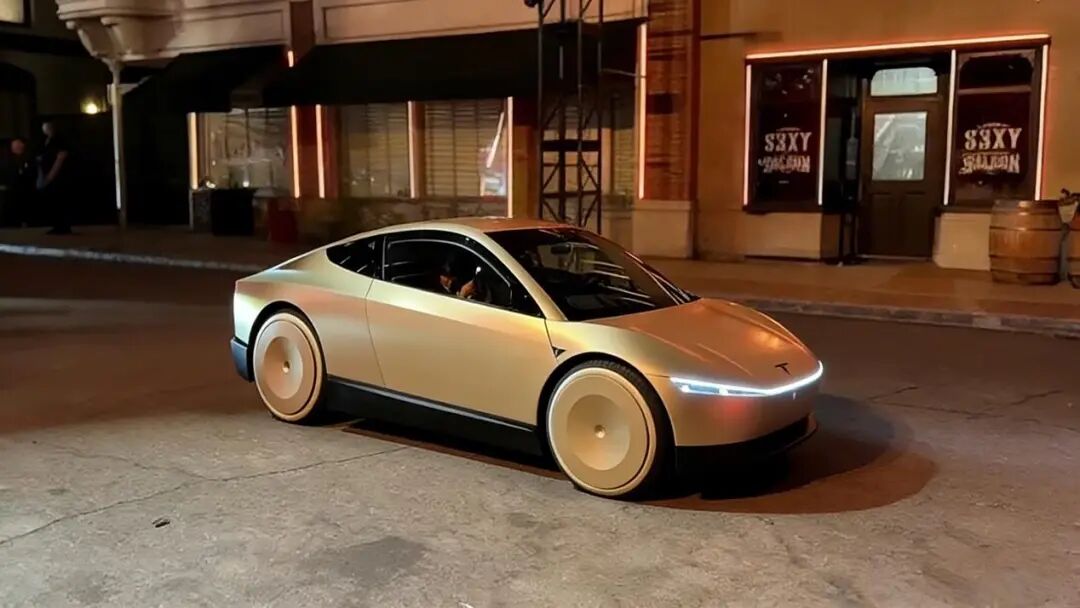
The core parameters officially announced are extremely subversive: The vehicle is positioned as a Robotaxi, a driverless taxi, and is natively compatible with L5-level fully autonomous driving. The seat layout features a two-door, two-seat design with gull-wing doors, and the interior space is fully optimized around the passenger experience. The official price is no higher than $30,000, equivalent to about 210,000 RMB, directly breaking through the price barrier of driverless vehicles.
According to Tesla's plan, large-scale mass production will start in April 2026. The target annual production capacity of the Texas factory is 2 million to 4 million vehicles. This scale will exceed the combined production capacity of Model 3 and Model Y, becoming a new pillar of Tesla's sales.
What's even more noteworthy is the production efficiency. It is reported that the Cybercab uses the new "Unboxed manufacturing process", which splits the vehicle body into four major modules for parallel assembly. The production cycle is shortened to 5 - 10 seconds per vehicle, and the efficiency is 7 times higher than that of traditional production lines.
Regarding this product that was blocked in China in a short period, today we will discuss it in two parts. The first half will be a in - depth technical analysis, and the second half will let us open our minds and see how the entire industry will be subverted when drivers are "forced" to become passengers.
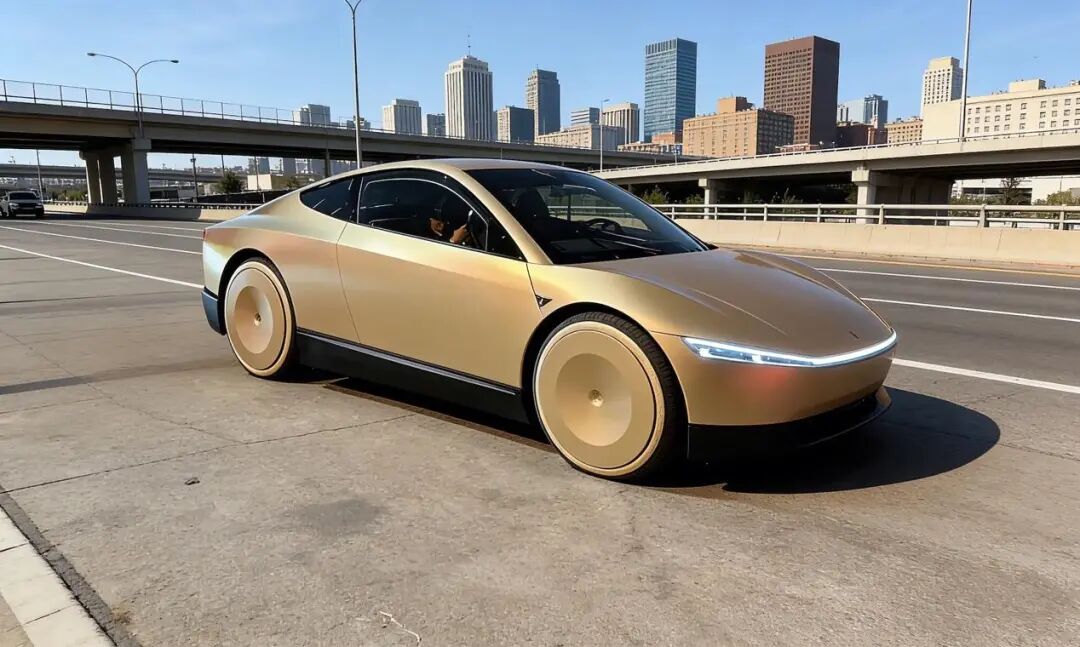
In addition, there are two points to note at the beginning. First, the full text is about 7,500 words. You can use the chapter titles to index the chapters you are interested in for reading. More importantly, all the vehicle model pictures of the Cybercab in this article are rendered images made by individuals, not actual photos, and are for reference only.
01
How the "Three - No" Structure Redefines the Automobile Form
First, let's talk about the technology. The most shocking design breakthrough of the Cybercab is the complete elimination of all manual driving interfaces, achieving a true "Three - No" structure: no steering wheel, no pedals, and no traditional rear - view mirrors.
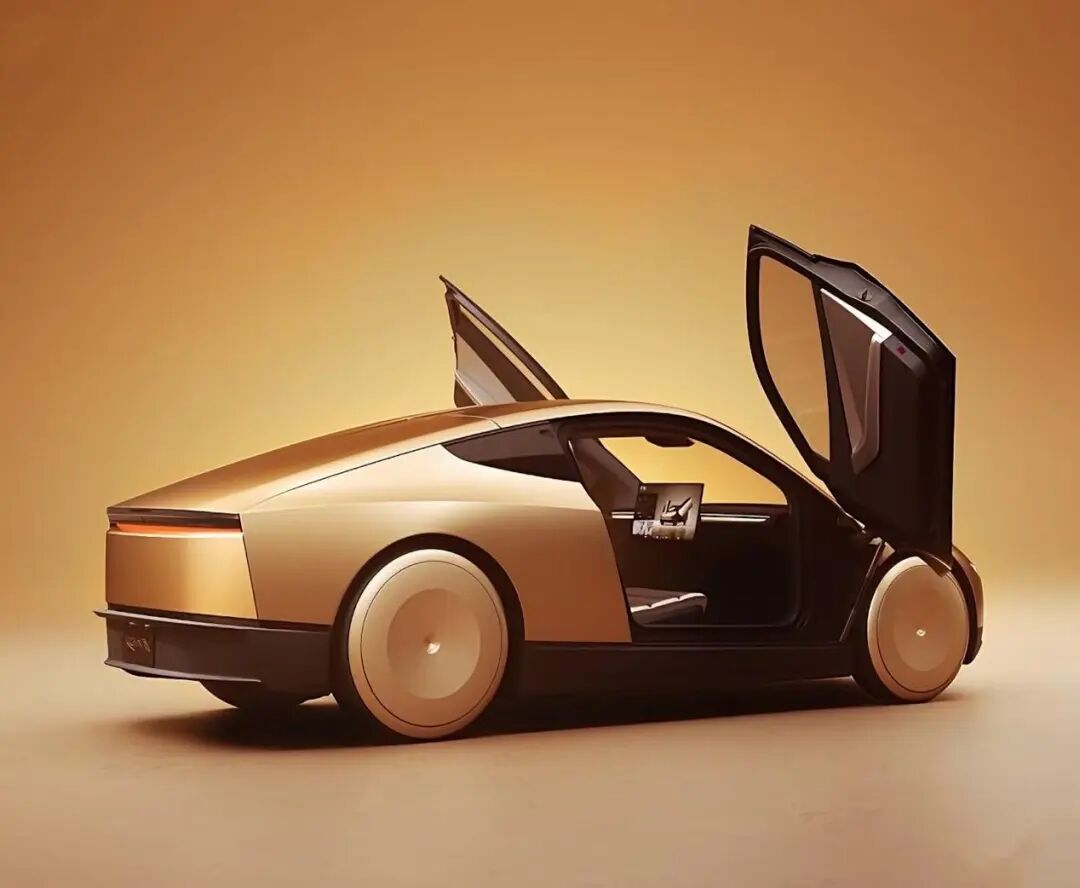
The driving position, central console layout, and control logic of traditional cars are all overturned. The interior uses a two - seat facing layout, with an open and simple space, and there are no physical control devices in the interior. After passengers get in the car, they only need to set the destination through the central console screen or voice, and the rest of the journey is completed autonomously by the vehicle. This design brings three core advantages:
First, the space utilization rate is improved. After canceling the structures related to the cockpit, the legroom and storage space in the car are more abundant. Although the vehicle body is small (4.2 meters long and 1.8 meters wide), it can provide a riding experience similar to that of a compact car. The trunk volume reaches 350 liters, which can easily accommodate two 20 - inch boarding cases, making it a perfect fit for high - frequency scenarios such as urban commuting, short - distance travel, and business pick - up.
Second, the safety logic is comprehensively upgraded. The vehicle no longer relies on human reaction speed (an average of 250 milliseconds), but on a perception system composed of multiple cameras, millimeter - wave radars, and ultrasonic sensors, combined with an end - to - end artificial intelligence model, to achieve millisecond - level (<100 milliseconds) decision - making. It fundamentally avoids human - induced safety hazards such as fatigue driving, distracted driving, and operational errors, and the accident probability is reduced by more than 90% compared with human driving.
Third, the design aesthetics are integrated with functions. After canceling the traditional external rear - view mirrors, Tesla uses a high - definition electronic rear - view mirror + body perception fusion solution instead. This not only completely eliminates visual blind spots (the field of view is expanded by 30%) but also significantly reduces the vehicle body's wind resistance (the Cd value drops to 0.21), increasing the energy efficiency of high - speed driving by 45%. The U.S. NHTSA and the EU approved the relevant regulations for cameras to replace rear - view mirrors at the end of 2025, clearing the regulatory obstacles for this design.
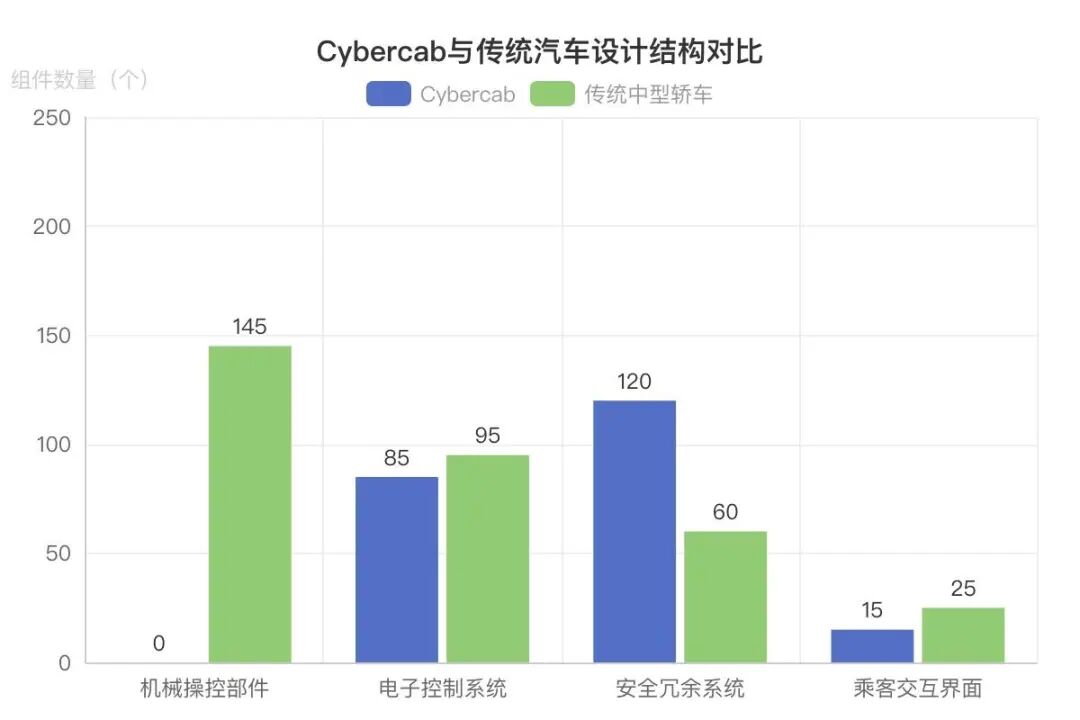
Note: The data is based on Tesla's official engineering documents and industry benchmarking analysis, for reference only
The underlying logic supporting this "Three - No" design is Tesla's understanding of travel scenarios.
Global travel data statistics show that in more than 90% of daily travel scenarios, there are no more than two passengers in the car; 95% of travel distances are within 100 kilometers. Based on this insight, the Cybercab uses a two - seat layout, a small - capacity battery (<50 kWh), and a minimalist body design. It does not pursue large space, long - range, or multiple configurations, but spends every cent of cost on essential needs and uses every inch of space practically. This "scenario - native" design philosophy gives the Cybercab a foundation for commercial profitability from the very beginning.
02
How Full - Dimensional Backup Ensures the Safety of "Driverless" Operation
After canceling the manual driving interface, safety becomes the most core proposition of the Cybercab. Tesla's solution is to build a full - dimensional redundant system, with dual - backup designs in five key areas: perception, computing power, braking, power supply, and network, to ensure that when any single system fails, the vehicle can still operate safely or implement the minimum - risk strategy.
In terms of perception redundancy, the Cybercab is equipped with the Tesla Vision visual system composed of 8 high - definition cameras with 5 million pixels each, achieving 360 - degree environmental perception. At the same time, it is equipped with a 4D millimeter - wave radar (detection range of 250 meters) and 12 ultrasonic sensors, forming a multi - sensor fusion solution. Even if some cameras fail due to contamination or strong light interference, the remaining sensors can still provide sufficient environmental information for the decision - making system.
More importantly, Tesla uses an "end - to - end" large model, directly outputting control instructions from image data, skipping the traditional modular perception - decision - execution process and reducing the error accumulation in the intermediate links.
The computing redundancy uses two parallel - running HW4.0 computing power platforms. Each platform contains two FSD chips (with a total computing power of 2000 TOPS), and the two systems compare the operation results in real - time. When an abnormality occurs in the main system (chip failure, software error, data anomaly), the backup system takes over seamlessly within milliseconds. This design meets the highest level ASIL - D requirements of ISO 26262 automotive functional safety, and the hardware failure rate is reduced to less than one in a million.
The braking redundancy is a dual - circuit design of the brake - by - wire system. The Cybercab uses the Bosch iBooster + ESP Hev combination. When the main braking system fails, the backup system can provide no less than 70% of the braking force, ensuring that the vehicle can stop within a safe distance. The brake - by - wire system also completely decouples the brake pedal from the braking system, providing underlying hardware support for driverless driving.
The power supply redundancy is achieved through a dual - battery pack + dual - power distribution system. The main battery pack powers the drive system, and the backup battery pack provides power specifically for key control systems (perception, computing, braking). Even if the main battery fails completely, the backup battery can still support the vehicle to pull over safely and turn on the warning lights.
The network redundancy uses a dual - CAN bus + Ethernet backup architecture. Key control instructions are transmitted through two independent physical links, and the interruption of any one link does not affect the normal operation of the vehicle. At the same time, the vehicle has the ability of remote takeover - in extreme scenarios, Tesla's operation center can intervene in monitoring and send control instructions remotely if necessary.
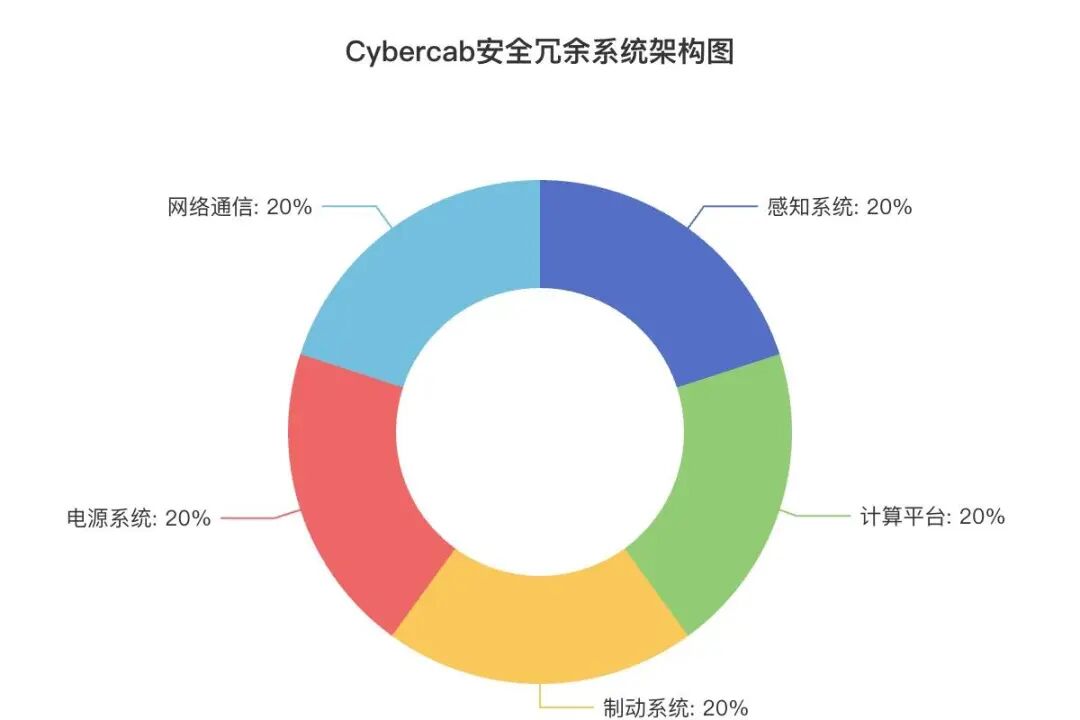
Note: The data is based on Tesla's official engineering documents and industry benchmarking analysis, for reference only
Actual test data verifies the reliability of this redundant system. The results of the closed - road test officially announced by Tesla show that in the scenario of simulated single - point failure (camera failure, braking circuit failure, computing chip anomaly), the safety takeover success rate of the Cybercab reaches 99.999%. The cumulative public - road test mileage exceeds 30 million kilometers, the accident rate is only 1/11 of that of human - driven vehicles, and no serious accidents resulting in casualties have occurred.
What's even more noteworthy is the remote monitoring and takeover ability. Tesla has established the world's first Robotaxi operation center in Austin, Texas, which can monitor the status of all on - the - road Cybercabs in real - time. When the vehicle encounters an extreme scenario that it cannot handle autonomously (such as road construction, sudden accidents, bad weather), the back - end experts can intervene within 15 seconds and send control instructions through the 5G network to guide the vehicle to implement the safety strategy.
03
How Pure - Vision FSD Achieves L5 - Level Autonomous Driving
The core technology supporting the "Three - No" design of the Cybercab is Tesla's latest iterative FSD system (referred to as V14 in this article). This system uses a pure - vision technology route, cancels the lidar, and relies on 8 cameras with 8 million pixels each + an end - to - end neural network to achieve a full - stack self - developed closed - loop from perception, decision - making to execution. The advancement of its technical architecture is reflected in four aspects: perception redundancy, computing power concentration, algorithm iteration, and data closed - loop.
The breakthrough in the perception layer lies in the spatio - temporal consistency of multi - camera fusion. The 8 cameras of the Cybercab are arranged in a circular pattern with a 120 - degree field of view, covering a 360 - degree non - dead - angle environment. Each camera collects 1280×960 resolution images at a rate of 36 frames per second, and extracts features (vehicles, pedestrians, traffic signs, lane lines) in real - time through the neural network.
More importantly, the system establishes spatio - temporal associations through the Transformer model - not only associating the fields of view of different cameras at the same moment but also predicting the movement trajectories of objects through time series. This "4D perception" ability (3D space + 1D time) enables the Cybercab to predict behaviors such as pedestrians crossing and vehicles cutting in at complex intersections and plan avoidance paths 100 milliseconds in advance.
The core of the computing layer is the HW4.0 hardware platform.
Each system contains two FSD chips (7nm process, single - chip computing power of 1000 TOPS), integrating 32MB SRAM cache and 256 - bit LPDDR5 memory. The two chips run in parallel, one for perception and decision - making, and the other for real - time comparison and verification. When the main chip outputs abnormal control instructions (such as sharp turns or sudden braking), the verification chip can reject and take over within 5 milliseconds. This "main - backup real - time verification" architecture reduces the hardware failure rate to 10^ - 9/hour, meeting the ASIL - D functional safety requirements.
The algorithm layer is the large - scale application of the end - to - end large model. The traditional autonomous driving system is a modular design: the perception module identifies objects → the planning module generates trajectories → the control module executes instructions. Each module is trained independently, and errors accumulate layer by layer. In contrast, FSD V14 uses a unified neural network to directly output steering, acceleration, and braking instructions from image data, skipping the intermediate representation.
The advantages of this "end - to - end" architecture are: first, it reduces the inference delay by 30%; second, it avoids the semantic gap at the module interface; third, through end - to - end optimization with massive data, it directly learns the decision - making mode of human drivers.
The data released by Tesla shows that in the test on complex urban roads in California, FSD V14 achieved 1200 consecutive kilometers without manual takeover. The system can stably handle long - tail scenarios including: unprotected left turns (success rate of 99.2%), detours around construction sections (success rate of 98.7%), night - time heavy rain environment (perception accuracy of 96.5%), and sudden pedestrian crossings (avoidance success rate of 99.8%). Compared with human drivers, the average reaction time of FSD V14 is 5 times faster (100 milliseconds vs 500 milliseconds), and the accident rate is 11 times lower.
The moat in the data layer is the training flywheel built by the Dojo supercomputer. The Dojo uses Tesla's self - developed D1 chip (7nm process, single - chip computing power of 362 TFLOPS), interconnects 3000 D1 chips through the ExaPOD architecture, and the total computing power reaches 1.1 EFLOPS (hundreds of billions of operations per second). The 1TB of data uploaded by each Cybercab every day is cleaned, labeled, and trained in the Dojo, and a full - model iteration can be completed every week. As of February 2026, the cumulative training mileage of Tesla's FSD system has exceeded 10 billion miles, more than 10 times the total data of other global autonomous driving companies.
This data advantage translates into a technological gap. Companies such as Waymo and Cruise rely on high - precision maps (centimeter - level accuracy), with a map - making cost of thousands of dollars per kilometer, and they cannot cover the whole country. In contrast, Tesla's pure - vision solution only requires ordinary navigation maps (meter - level accuracy) and builds an environmental model through real - time perception, achieving "free maps". More importantly, the cost of the pure - vision solution is only 1/5 of that of the lidar solution - the hardware cost of a lidar vehicle exceeds 100,000 RMB, while the visual hardware cost of the Cybercab is less than 20,000 RMB.
