After the Spring Festival Gala, the robotics major has become popular: From Harbin Institute of Technology to Southeast University, who is the strongest?
Martial arts, skits, singing and dancing... This year's Spring Festival Gala stage has become the one with the highest density of robots.
Different from last year when there was only one company, this year, a total of four robot companies brought their products to the stage: Unitree Technology, Songyan Power, Magic Atom, and Galaxy General.
In the past two days, German Chancellor Merz visited China and watched a robot performance at the headquarters of Unitree Technology in Hangzhou, including the same kung - fu show as in the Spring Festival Gala, writing Chinese characters for good fortune, and industrial application demonstrations. He expressed his amazement at China's technological innovation ability.
As more and more humanoid robots step out of the laboratory and into the spotlight, on social media, the public's focus has extended from the program itself to the robotics major -
"What major should I apply for in the college entrance examination if I want to learn about the humanoid robots in the Spring Festival Gala?" "I want to switch from drones to robots." "Is there a future in studying robotics?"...
In fact, in the field of higher education, the robotics major is not a brand - new "face".
As early as 2016, Southeast University took the lead in offering the first robotics engineering major in the country. In 2023, the Ministry of Education added the "Future Robotics" major, and Southeast University became the first university to offer this major again.
As of 2024, a total of 393 universities across the country have been approved to offer the "Robotics Engineering" major.
It can be said that long before the public's hot discussion, universities had quietly laid out this field.
In recent years, with the rapid explosion of the robotics industry, relevant positions have also become increasingly "hot".
In the list of "Top 50 Majors with the Average Monthly Salary of Talents with 3 - year Work Experience" released by Zhaopin in the past three years (2023 - 2025), the robotics engineering major has soared all the way, rising from outside the top 50 to the 9th place, and for the first time, it has entered the top 10 high - salary majors.
High demand for talents
393 universities have made arrangements
The booming market has led to intensive arrangements by universities in terms of talent supply.
According to a report by SoftScience, statistics on the results of the annual filing and approval of undergraduate majors in ordinary higher education institutions announced by the Ministry of Education show that as of 2024, a total of 393 universities across the country have been approved to offer the "Robotics Engineering" major, among which 53 are "Double First - Class" construction universities.
The robotics engineering major belongs to the automation category of the engineering discipline. It integrates knowledge from multiple disciplines such as automatic control, mechanical engineering, computer science, and artificial intelligence, aiming to cultivate high - quality talents capable of designing and developing robot systems.
Some universities have gone a step further and specifically established robotics colleges, artificial intelligence and robotics colleges to systematically integrate disciplinary resources.
Take Harbin Far - East Institute of Technology as an example. The university established the School of Robotics Engineering in 2012 and is one of the first "Robotics Colleges" in domestic universities. It focuses on cultivating talents in the field of robot technology and applications and has established a group of robotics major directions focusing on robot education, service robots, and industrial robots.
It was not until 2017 that the university was officially approved to offer the "Robotics Engineering" major (see the "Results of Filing and Approval of Undergraduate Majors in Ordinary Higher Education Institutions in 2016" of the Ministry of Education), and it also became the first undergraduate major in robotics engineering in Heilongjiang Province that year.
In 2015, Northeastern University established the School of Robotics Science and Engineering, becoming the first robotics college in a "985 - project university" in China.
Looking back on the development process of this major, 2016 was a crucial node.
That year, Southeast University took the lead in offering the first robotics engineering major in the country, kicking off the large - scale layout of universities.
SoftScience shows that 2018 was the peak year for the addition of this major, with 101 universities making concentrated arrangements that year.
In 2023, the Ministry of Education added the "Future Robotics" major, and Southeast University took the lead again, becoming the first university to offer this major.
The "Future Robotics" major is supported by strong disciplines such as mechanical engineering, control science and engineering, and instrument science and technology. It integrates emerging interdisciplinary majors in the directions of information, electronics, computer science, materials, biomedicine, and medical imaging, aiming to cultivate leading talents who can lead the development of robot technology and solve original, cross - disciplinary, and disruptive technical problems that will emerge in the robotics field in the next 5 - 10 years.
In 2025, the layout of majors continued to expand. In April of that year, the Ministry of Education issued the "Results of Filing and Approval of Undergraduate Majors in Ordinary Higher Education Institutions in 2024", and many universities added majors such as Future Robotics and Robotics Engineering.
Behind the continuous layout of universities is the urgent demand for talents from the industrial side.
In the "Directory of Occupations (Types of Work) of Skills - needed Talents in Key Industries in Hubei Province in 2026" announced by the Department of Human Resources and Social Security of Hubei Province, talents in cutting - edge technology fields such as industrial robots are listed as "Highly in short supply".
The "Report on the Development of Robotics Industry Talents in 2025" released by Zhaopin shows that in the first five months of 2025, the number of recruitment positions in the robotics industry increased by 6% year - on - year, and the number of job seekers increased by 32% year - on - year, achieving a double - increase in supply and demand. Among them, the recruitment demand in the field of humanoid robots increased by 409% year - on - year.
Meanwhile, local policies have been strengthened. Recently, at a press conference held by the Information Office of the People's Government of Jinan City, Jinan stated that it will include professional talents in six emerging fields such as robotics and artificial intelligence in the scope of high - level talent classification and recognition.
Robotics talents are becoming the "sweet pastries" that all regions are vying for.
Green - card major + High - salary prospects
Everyone is scrambling for talents
When talents become the "sweet pastries", the most direct evidence often comes from the employment market.
In the list of the top ten emerging industries (with strong demand, stable prospects, and high salaries) in 2026 released by Zhaopin, the new - generation information technology industry is prominently listed. Among them, the monthly salary of the robotics algorithm position is 24,426 yuan, and the demand growth is remarkable.
This is consistent with the 2025 Employment Blue Book released by MyCOS: The robotics engineering major, along with electrical engineering and its automation, microelectronics science and engineering, mechatronic engineering, and new energy science and engineering, was selected as a "Green - card Major in 2025", which means that the employment implementation rate, salary, and employment satisfaction are all at a high level, and the market demand continues to be strong.
The job demand and salary levels on the enterprise side are more intuitive. Take Unitree Technology, which attracted much attention on the Spring Festival Gala stage, as an example. Its official website shows that it is currently recruiting for multiple positions such as mechanical engineers, embedded hardware engineers, robot motion control algorithm engineers, and robot test engineers.
Among them, the salaries of deep reinforcement learning algorithm engineers and AI algorithm engineers (large models) are the highest. The monthly salary ranges from 40,000 to 70,000 yuan. Calculated on the basis of 13 - month salary and above, the annual salary of this position will exceed 900,000 yuan at most.
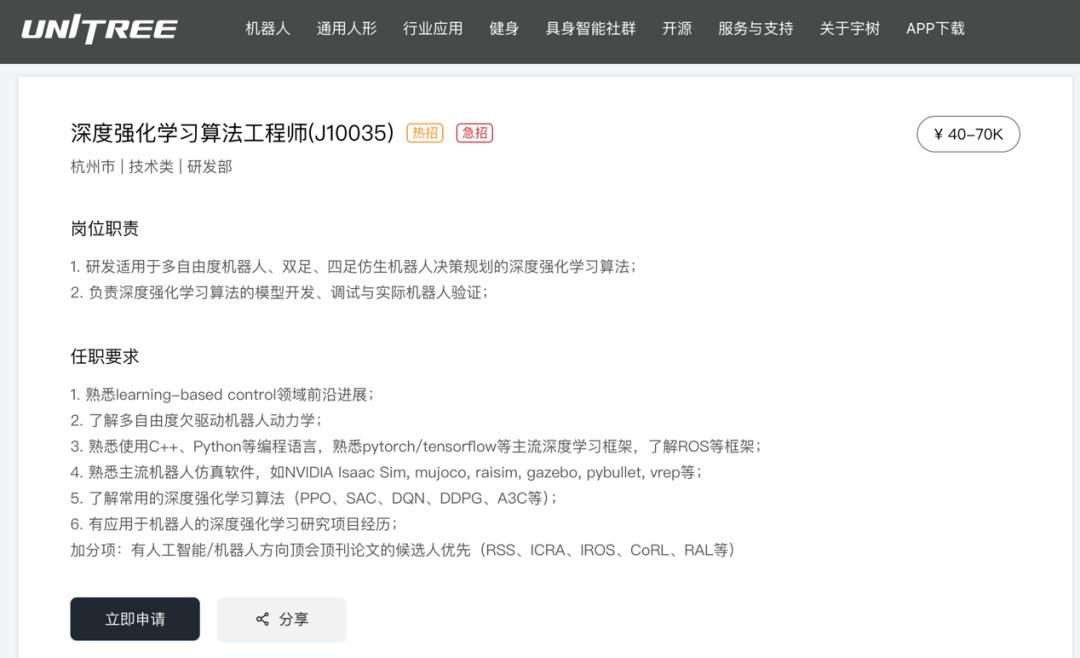
Image from the official website of Unitree Technology
This is not an isolated case. Companies such as ByteDance, Huawei, and XPeng Motors have all posted positions related to embodied intelligence/robots. Among them, a previous recruitment by ByteDance for a senior expert position in the operation algorithm of humanoid embodied robots offered a monthly salary of 95,000 - 120,000 yuan.
Generally speaking, the salary level is closely related to the technical difficulty.
The "Report on the Development of Robotics Industry Talents in 2025" by Zhaopin shows that among the sub - occupations with leading recruitment growth, the average recruitment salary of robotics algorithm engineers ranks first, reaching 25,368 yuan per month. For robotics algorithm engineers with more than 5 years of work experience, the average recruitment salary is as high as 33,665 yuan per month. Navigation and positioning engineers follow closely with a monthly recruitment salary of 21,066 yuan, and hardware development engineers rank third with 19,169 yuan per month.
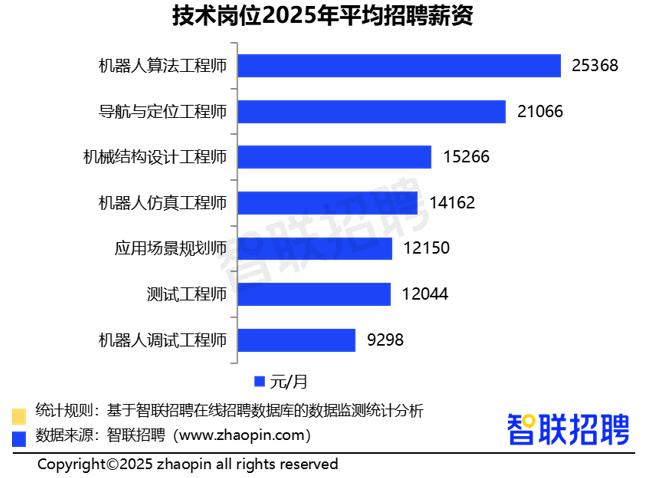
Image from Zhaopin
It is worth noting that in addition to joining large companies for high salaries, entrepreneurship is also a popular choice in this field.
For example, Xingdong Jiyuan, Galaxy General, and Jiasu Jinhua are all humanoid robot companies affiliated with Tsinghua University; companies such as Zhiyuan, Fourier, and UniX AI belong to Shanghai Jiao Tong University.
Zhejiang is also not far behind. At the end of 2023, the Zhejiang Humanoid Robot Innovation Center was established in Ningbo, jointly built by the Ningbo Municipal Government and the team of Professor Xiong Rong from Zhejiang University, and has launched "Pilot 1" and "Pilot 2 NAVIAI".
Zhejiang University has incubated a number of excellent alumni - run enterprises such as CloudMinds and Jiazhi Technology with its advantageous disciplines in machinery, control, and computer science, gradually forming a "robot team" in Zhejiang.
The robotics industry is showing explosive growth. According to data from the Market Supervision Big Data Center, as of the end of December 2024, there were a total of 451,700 intelligent robot industry enterprises in the country, and the number of enterprises increased by 206.73% compared with the end of 2020, showing a significant upward trend.
From Harbin Institute of Technology to Southeast University
Who is the strongest?
When the wave of market demand hits, universities, as the "reservoir" for talent cultivation, have become an important "driving force" determining the industry's future development.
So, in this nationwide robotics boom, which universities are at the forefront?
If we limit the scope to universities offering the robotics engineering major, according to the 2025 SoftScience Ranking of Chinese University Majors, 197 universities across the country are on the list (top 50% in the ranking).
Among the "Double First - Class" universities, 7 "985 - project universities" including Harbin Institute of Technology, Southeast University, Beihang University, Zhejiang University, Shandong University, Northeastern University, and Northwestern Polytechnical University occupy the top 2% in the country and are rated A+.
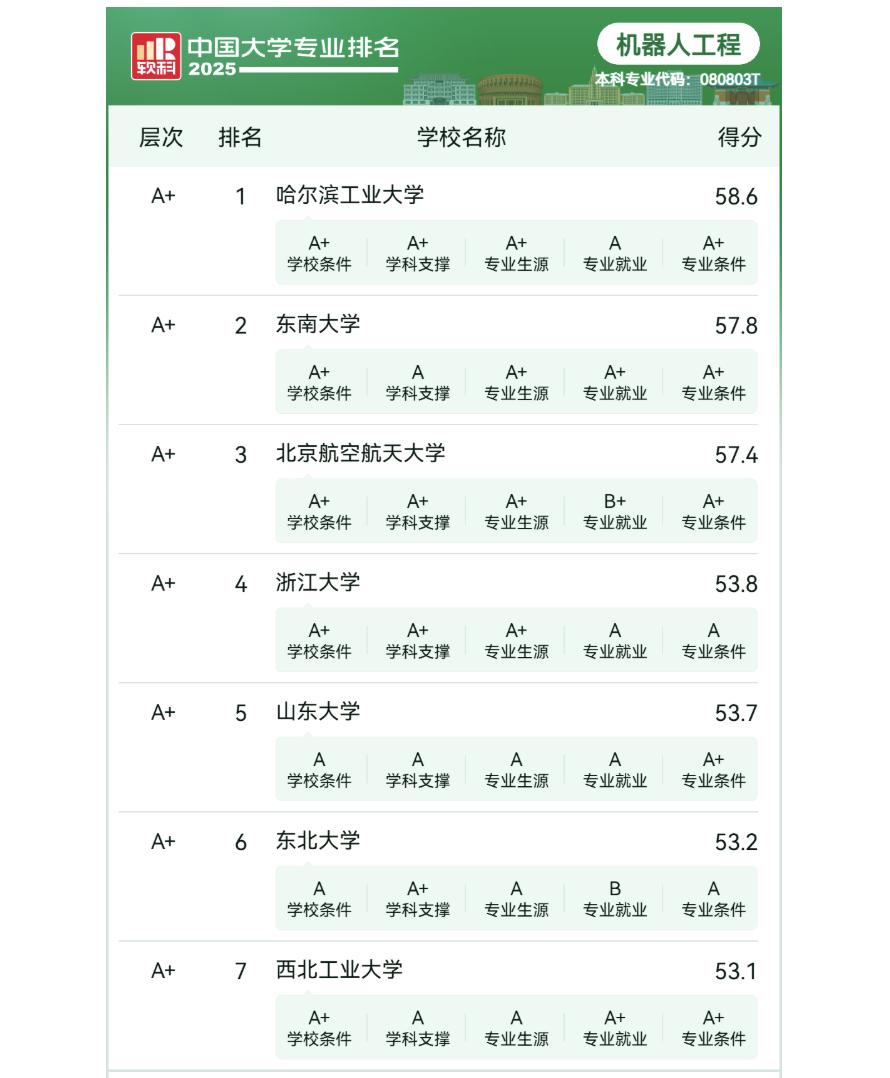
Image from SoftScience
Among non - "Double First - Class" universities, Shandong University of Science and Technology (19th place), Guangdong University of Technology (21st place), and Zhejiang University of Technology (28th place) are in the lead. Yanshan University, Shenzhen University, and Wuhan University of Science and Technology also rank among the top 10% and are rated A.
Among them, two universities have always been the focus of attention due to their unique historical positions and pioneering contributions - one is Harbin Institute of Technology, representing "depth", and the other is Southeast University, representing "pioneering spirit".
If there is a "Whampoa Military Academy" for the Chinese robotics industry, it must be Harbin Institute of Technology.
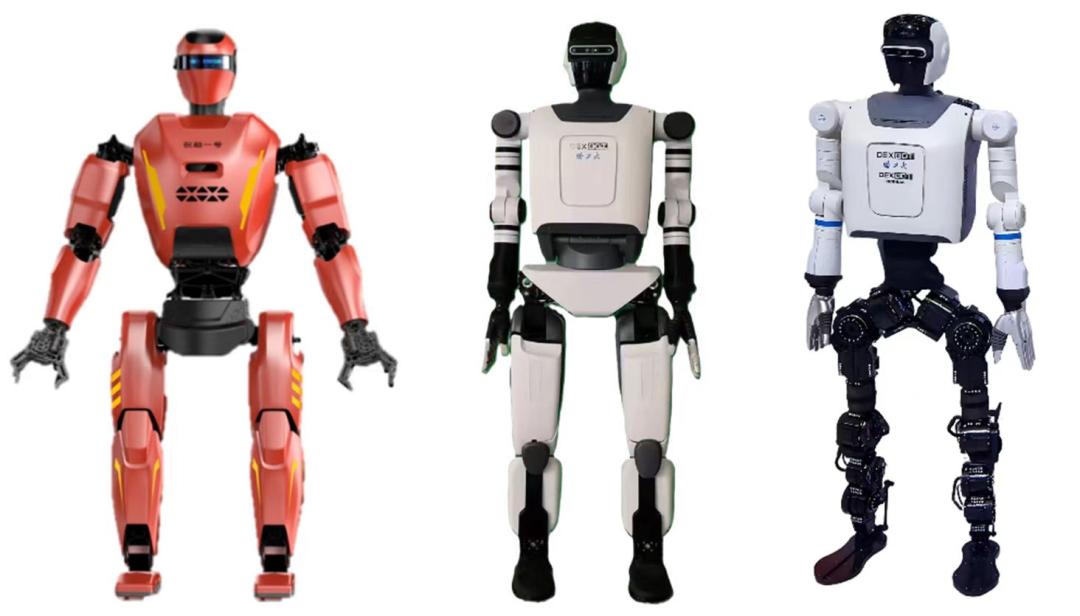
Image from the official WeChat account of the School of Mechatronic Engineering of Harbin Institute of Technology
As one of the earliest universities in China to engage in robotics research, Harbin Institute of Technology established the Robotics Research Institute in 1986. It is not only the open laboratory of the intelligent robot mechanism network of the National "863 Program" and the industrialization base for the achievements of the National "863 Program", but also has a Sino - German Joint Laboratory for Space Robot Technology.
In terms of "firsts", Harbin Institute of Technology has a glorious resume: it developed China's first arc - welding robot, first spot - welding robot, and first on - orbit space maintenance robot.
In 2007, with the approval of the Ministry of Science and Technology, Harbin Institute of Technology established the State Key Laboratory of Robotics and System, which was rated "excellent" in the 2018 evaluation. Relying on this platform, Harbin Institute of Technology has made important research achievements in many aspects such as space robots, micro - nano robots, and bionic robots. For example, the "space manipulator technology" was selected as one of the "Top Ten Scientific and Technological Achievements of Chinese Universities in 2013".
In terms of talent cultivation, the robotics engineering major was established on the basis of the robotics direction of the mechatronic engineering major by the relevant undergraduate teaching team, relying on the teaching staff and experimental conditions of the Robotics Research Institute and the State Key Laboratory of Harbin Institute of Technology. In 2019, the undergraduate major in robotics engineering was officially approved. In 2021, the recruitment of the intelligent robotics class with an academician as the undergraduate class tutor began. In 2022, this major was selected as a national - level first - class undergraduate major