The battle for AI entry: After apps? The move of Qianwen is worth paying attention to.
The smoke of the Spring Festival movie season has not yet cleared, and Alibaba's personal AI assistant, "Qianwen," has quickly played its next card.
On February 27, according to insiders, Qianwen will launch its first AI glasses of the same name at the upcoming 2026 Mobile World Congress (MWC) and plans to roll out multi - form products such as AI rings and AI earphones in the global market within the year.
This move comes only a few days after its remarkable performance during the Spring Festival, with 200 million "one - sentence orders" and a daily active user count soaring to 73 million.
From its popularity in the digital world to its foray into the physical world with hardware, Alibaba is shaping Qianwen into an AI assistant that is "integrated with both software and hardware and spans multiple terminals." This is not only an expansion of the product line but also a crucial strategic leap in Alibaba's understanding of AI - shifting from the competition for apps to the competition for entry points and delving from the digital world into the physical world.
01 The AI Battle Escalates: From App Isolation to Multi - Entry Penetration
In the first half of the AI competition, it was about parameter stacking and app enclosure. In the past two years, almost all major tech companies have been doing the same thing: stuffing large models into mobile phones, making the icon on the screen the only interaction window for users.
However, the mobile phone is just the first step. The value of artificial intelligence should not be confined to a 6.7 - inch screen.
Looking globally, at the beginning of 2026, the AI hardware track has suddenly heated up. Meta's Ray - Ban series has already captured more than 70% of the smart glasses market, and its annual production capacity is aiming for 20 million pairs. Google has joined hands with XREAL to make a comeback with the Android XR system. Even OpenAI has been reported to have formed a hardware team of over 2,000 people.
The collective bets of the giants point to the same judgment - the combination of AI and hardware is on the verge of an explosion from a concept.
This trend is also clear in the domestic market. IDC predicts that the Chinese smart glasses market will reach 4.508 million units in 2026, a year - on - year increase of 77.7%. Among them, "lightweight" products such as audio glasses account for more than 3.4 million units.
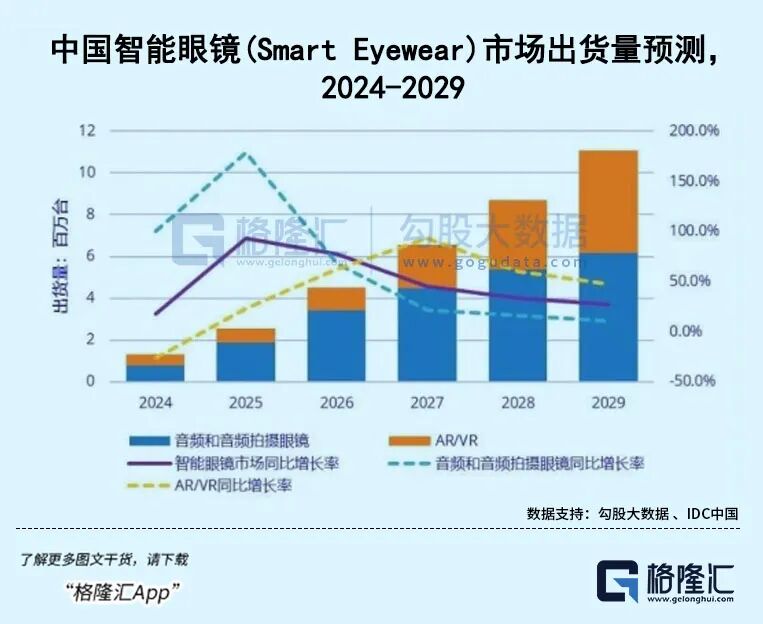
Obviously, the AI hardware market is entering a high - growth channel, and the inflection point of the industry has arrived. The future AI battle will not be a one - sided show of apps but an all - around competition of "mobile apps + multi - form hardware."
Qianwen's entry into the hardware field at this juncture seems to be a natural move. What's more interesting is the path chosen by Alibaba. While most players are still struggling for the daily active users of apps, Alibaba chooses to "break out of the mobile phone" and redefine what an AI entry point is.
The entry point is no longer the screen that needs to be unlocked and tapped. Instead, it is a physical presence that is always online and surrounded by intelligence. A light touch on the glasses temple, a slight movement of the ring, or a whisper in the earphone will all become ways to call AI services. This out - of - the - plane thinking allows Qianwen to evolve from a "tool" waiting to be opened to an "environment" accompanying users.
02 Seizing the New AI Entry Point: The Logic of Qianwen's "Software - Hardware Integration"
Compared with other AI hardware, the characteristic of Qianwen's hardware comes from the combination of "Qianwen + Alibaba ecosystem."
The Spring Festival data speaks volumes. During this period, over 130 million people in the country experienced AI shopping for the first time, issuing a cumulative 5 billion "Qianwen, help me" requests. This proves that Qianwen is no longer a simple chatbot but an execution center capable of ordering takeaways, booking hotels, and buying movie tickets. More importantly, users have begun to trust it with these tasks.
Now, Qianwen aims to replicate this set of capabilities from the mobile phone screen to the physical world.
Take the upcoming AI glasses as an example. Its core differentiation lies in the instant connection between visual recognition and commercial scenarios.
When you look at a restaurant's signboard and simply say, "How are the reviews of this place? Help me make a reservation," the glasses can provide an answer through visual recognition combined with Gaode data and complete the reservation by calling Alipay. During a trip, the glasses can also directly overlay navigation arrows in your field of vision and automatically trigger voice explanations when you see scenic spots. All this can be done without taking out your phone.
This is the unique "what you see is what you get" feature of the Alibaba ecosystem. This is not a simple upgrade of the voice assistant but a way to weave the service network of the digital world into every node of the real - world space.
From Alibaba's plan, this is just the beginning. With the launch of products such as AI rings and AI earphones, Qianwen is building a multi - entry perception network.
The ring may undertake the most convenient interaction confirmation, and the earphone will become a private auditory feedback channel. This combination punch represents the most core differentiating feature of Alibaba's AI hardware. Obviously, this is not a competition of lens resolution or earphone noise - reduction depth but a competition of the ecological ability behind the hardware that can reach millions of merchants' services with a single click.
In other words, Alibaba's hardware is essentially an extension of its ecological services rather than simply consumer electronics.
03 "Multi - Entry" + "Strong Execution Ability": Alibaba's Two Aces
In the second half of the AI era, Alibaba holds two aces: one is the "multi - entry" reach ability, and the other is the "strong execution" delivery ability.
The key difficulty in enabling AI to "do things" lies in the understanding of the real world and user intentions. If we split the "doing things" dimension, the digital world and the physical world are two completely different battlefields.
To "do things" in the digital world, it tests the intellectual level of the model - coding ability, context understanding, and multimodal recognition. During the Spring Festival, Qianwen was able to handle complex travel plans and price - comparison shopping thanks to the underlying support of the Qianwen large model, which is an advantage that Alibaba has proven.
However, in the physical world, model intelligence alone is far from enough. Imagine that you want to call a taxi in a noisy environment, translate a strange foreign menu, record a route while cycling, or simply say, "I'm hungry." In these scenarios, the ambiguity of voice, environmental interference, and lack of information all pose higher requirements for the AI's understanding ability.
This is exactly the current dilemma faced by most AI assistants: they may be able to write beautiful poems but have difficulty accurately executing a real - world task full of ambiguous instructions.
The construction of the "strong execution" ability precisely requires crossing the gap from "understanding semantics" to "understanding scenarios." Qianwen's explosion during the Spring Festival has proven that it has the ability to connect services and complete transactions in the digital world; now, it needs to extend this ability to the physical world.
AI hardware is exactly the key to solving the above problems.
In the past, AI could only understand the world through the "relay" of text or voice, and this information transfer itself was a kind of loss. Now, Qianwen's hardware strategy allows AI to capture what it sees through glasses and perceive environmental audio through earphones, evolving from "listening to what you say" to "seeing and understanding." The capture and interactive verification of such multimodal information can greatly improve the accuracy of intention recognition.
More importantly, when the physical - world information captured by the hardware is combined with data on consumption, travel, and local life in the Alibaba ecosystem, a unique scenario - understanding ability is formed - AI can not only understand what you are saying but also know where you are, what you are doing, and even predict what you need next.
This is a process of using hardware to build a data closed - loop and then using data to feed back intelligence. The more users interact with the hardware in the real world, the richer the data will be, and the deeper the AI's understanding of the physical world will be.
While competitors are still competing in model parameters, Alibaba is already using real - world interaction data to nourish an AI that understands the physical world better.
04 Conclusion
Understanding Alibaba's layout, we can understand why it has taken the initiative in the second half of the AI era.
The "multi - entry" form allows Qianwen to get rid of its reliance on the traffic of a single app and build an omnipresent service network. The more powerful "AI execution" ability makes this service not just superficial chatting but in - depth transaction fulfillment.
In the digital world, Alibaba has the most complete ecological scenarios; in the physical world, Alibaba is building perception ability through hardware. These two aces form a complete closed - loop covering "cloud - terminal - object - service."
Compared with those AI applications still struggling to find a business model and worrying about DAU fluctuations, Qianwen has blazed a new trail: the value of AI does not lie in how much time you occupy of the user but in how much you intervene in the user's life and solve actual problems.
When you get used to paying with your eyes and hailing a taxi with your voice, AI will no longer be just a tool but an extension of your body. This kind of stickiness is much stronger than the frequency of opening an icon.
It's time to change the perspective when looking at Alibaba.
In the past, the market mainly looked at Alibaba's e - commerce foundation; now, through Qianwen's leap, we see a technology entity trying to rebuild the "human - machine interaction" paradigm in the AI era.
From this point of view, the focus of our subsequent observation is not how much revenue increment a pair of glasses or a ring can bring to Alibaba but its potential to define the way humans interact with information and services in the next decade.
When AI begins to understand the world in our eyes and can act on our behalf in the real world, this current layout may be the starting point for Alibaba's next re - evaluation of value.
This article is from the WeChat official account "Gelonghui APP" (ID: hkguruclub), author: mediumrare, published by 36Kr with authorization.