Baidu's 2025 Financial Report: The "Singularity" of AI Kinetic Energy Switch Has Arrived, and the Value Reassessment Ushered in the "Return of the King"
On February 26, Baidu released its financial report for the fourth quarter and the full - year of 2025. The data shows that in 2025, Baidu achieved an annual revenue of 129.1 billion yuan, and the operating income in the fourth quarter was 32.7 billion yuan.
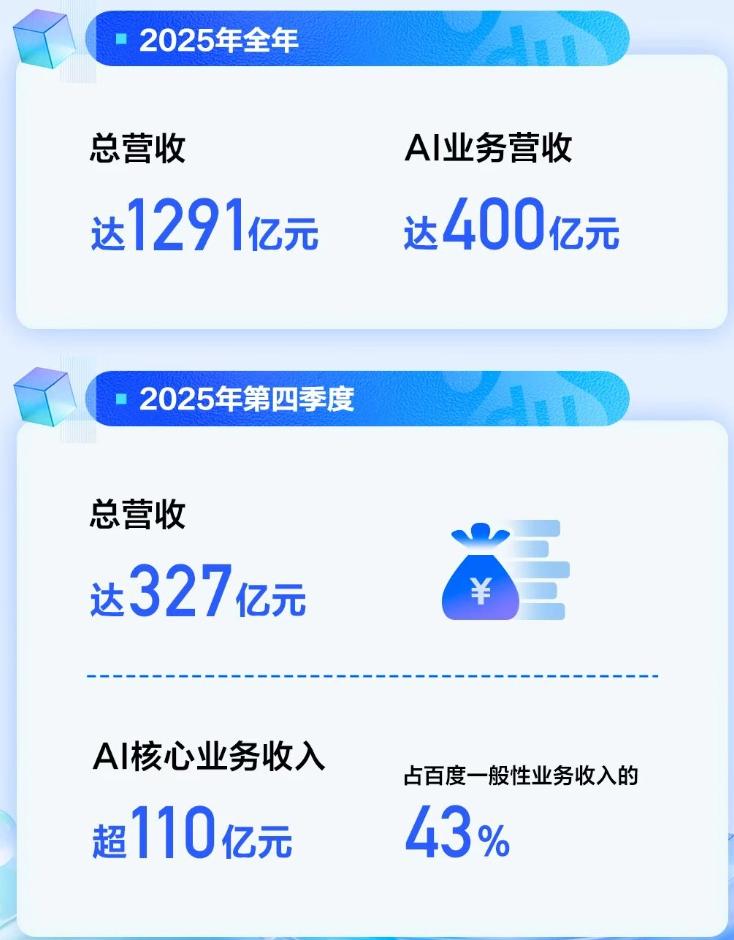
Notably, in this earnings report, Baidu further disclosed the key progress of its AI business. The report shows that in 2025, Baidu's AI business revenue reached 40 billion yuan, and in Q4 2025, the proportion of AI business revenue in Baidu's general business revenue reached 43%, exceeding market expectations.
Overall, the significance of this earnings report is not just simple performance growth, but also a hardcore verification of the "technology - business" closed - loop under Baidu's full - stack AI capabilities. It means that AI is transforming from Baidu's "cost center" to its "growth core" - AI has started to generate real revenue in multiple businesses, and the growth does not rely on short - term market subsidies and traffic expansion, but comes from enterprises and users paying for technological premiums and business increments.
In addition to the outstanding performance of the AI business, recently, Baidu has also launched an extraordinary combination of "a $5 billion share repurchase + the first dividend payment + the spin - off listing of Kunlun Chip" at the capital level. This move aims to send a clear signal to the outside world: while Baidu has achieved success in AI commercialization tactically, it has also initiated a systematic reshaping of its growth model strategically. This technology giant is trying to regain the value share that has been undervalued by the market for a long time with unprecedented certainty.
01
AI Business Revenue Proportion Reaches 43%, Exceeding Expectations
If we want to measure the commercialization depth of a company's AI, the proportion of AI - related revenue is the most accurate yardstick.
In the fourth quarter of 2025, the proportion of Baidu's AI business revenue reached 43%, indicating that a qualitative change has occurred in Baidu's business structure, and it has joined the ranks of the very few global Internet giants whose revenue growth is truly driven by AI natively.
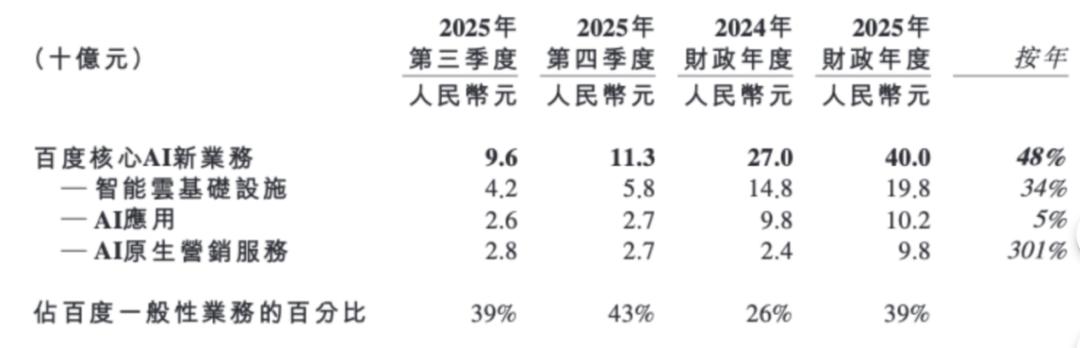
In the past two years, the biggest mystery hanging over the AI industry has been the "difficulty in commercialization". Through transparent financial disclosure, Baidu has completed its strategic self - verification: it has successfully transformed the "cost item" that was originally more focused on R & D investment into a "revenue item" that is quantifiable, traceable, and sustainably growing, demonstrating to the market the ability of AI to generate stable revenue.
When AI is no longer a grand narrative hidden in the footnotes of the earnings report but has evolved into a clear and stable growth curve on the financial statements, it means that Baidu's strategic layout of AI has successfully passed through the early - stage fog.
This is not only a substantial milestone for Baidu's AI commercialization but also marks the switch of the group's core growth driver - AI has officially taken over from traditional search and become the core engine supporting Baidu Group's long - term growth, and its strategic position has evolved from a "future variable" to a "core constant".
02
AI Reconstructs Baidu's Growth Model and Brings High - Quality Revenue
The essence of Baidu's AI strategy is to drive revenue growth in multiple scenarios and continuously reduce marginal costs through a high - intensity investment in core technology; and to promote the transformation of AI from a "cost center" to a "growth core" through cross - scenario reuse across all scenarios.
This strategic evolution from the inside out is being fully translated into a definite increment on the financial statements through three major battlefields: the B - side, the C - side, and physical AI.
B - side Battlefield: Solving the Difficulty of AI Implementation with Full - stack Capabilities
On the B - side, Baidu's AI Cloud revenue increased by 34% year - on - year in 2025. Among them, the subscription revenue of high - performance AI computing facilities in the fourth quarter increased by 143% year - on - year, accelerating further compared with the third quarter.
Baidu's dominance on the B - side stems from the general capabilities built by its full - stack self - developed "chip - cloud - model - agent" architecture, which effectively achieves cost reduction and efficiency improvement in solutions for various vertical industries.
During the painful period of the industry with a shortage of computing power and supply chain fluctuations, Baidu achieved self - controllability of its computing power base through its self - developed Kunlun Chip. The Kunlun Chip is customized for AI from the architecture level, capable of providing large - scale, stable, and high - performance AI computing, and is deeply compatible with mainstream models and frameworks. In particular, the release of the new generation M100 and M300 not only locks in the product evolution path for the next five years but also significantly reduces the integration cost of large - scale enterprise inference tasks through architecture - level design.
On this basis, Baidu has reconstructed the B - side productivity paradigm with Qianfan Platform and Famo, and promoted AI from "passive response" to "autonomous evolution". Baidu knows well that the value of large models lies not in the parameter scale but in the efficiency of solving real industrial pain points. Through the Qianfan Platform, Baidu packages complex models, toolchains, and deployment capabilities into "ready - to - use capabilities", greatly reducing the deployment threshold for enterprises.
The commercially available self - evolving super - intelligent agent "Famo" launched at the end of last year can not only autonomously evolve in complex R & D scenarios to find the global optimal solution but also automatically iterate according to changing conditions to provide the optimal dynamic solution. In its first month of launch, it attracted more than 2,000 enterprises to apply for trials, covering many fields such as logistics, manufacturing, and AI4S.
Currently, the "full - stack advantage" has been directly translated into certainty in the B - side market. Statistics on large - model winning bids in China in 2025 show that Baidu Smart Cloud has won the double championships in the number of projects and the winning bid amount for two consecutive years.
C - side Battlefield: Shifting from Traffic Competition to Paying for Productivity
On the C - side, Baidu's narrative logic has shifted from simple MAU expansion to the paid realization of users for "real AI productivity". Benefiting from the optimized driving force, Baidu's AI application revenue exceeded 10 billion yuan in 2025.
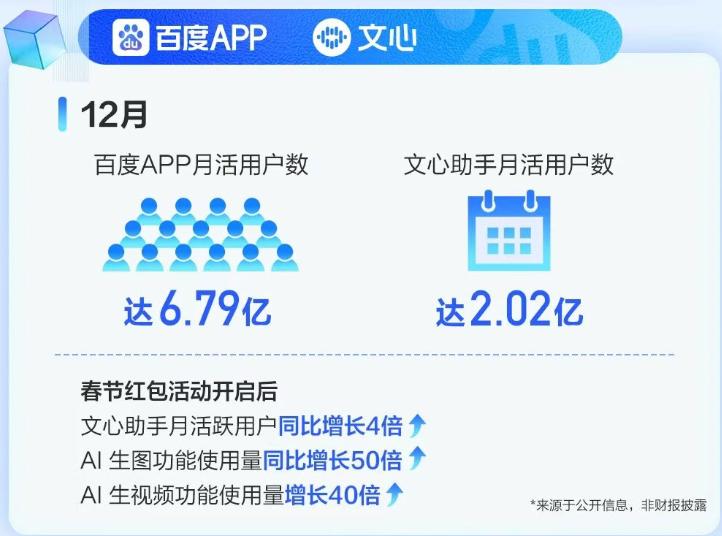
The release of AI productivity is first reflected in the evolution of the national - level entry. With its powerful multi - modal understanding ability, and supported by the Spring Festival red envelope activity, the monthly active user number of Wenxin Assistant has increased explosively by four times, marking the transformation of the AI assistant from a tool to a high - frequency lifestyle.
For professional creation and development scenarios, Miaoda has completely subverted the threshold of software development. It is reported that since the launch of the international version of Miaoda, "MeDo", in the fourth quarter, global users can generate AI applications with just one sentence without writing a single line of code. As of February 2026, Miaoda has helped global users generate more than one million AI applications, and it is expected to further release the potential of AI application development in the future.
Baidu has also achieved comprehensive growth in the digital human field. By December last year, the number of digital human live - streamers on Baidu's platform increased by nearly 200% year - on - year. The digital human technology of Huibo Star is empowering a wider range of industries and has served enterprises such as JD.com and TikTok.
In the efficiency tool field, the monthly active users of GenFlow 3.0 exceeded 20 million. With the Office Agent and GenX intelligent agent, it precisely targets the core value of "replacing repetitive labor with AI" and converts tens of millions of free users into high - sticky subscription revenue.
Physical AI Battlefield: Apollo Go Expands New Growth Space
Apollo Go is the most direct implementation verification of Baidu's physical AI, and it is expanding Baidu's imagination space at an unexpectedly fast speed. In the fourth quarter of 2025, the number of global travel services provided by Apollo Go reached 3.4 million, a year - on - year increase of more than 200%. The peak number of weekly travel services within the quarter exceeded 300,000, and the cumulative number of travel services provided exceeded 20 million.
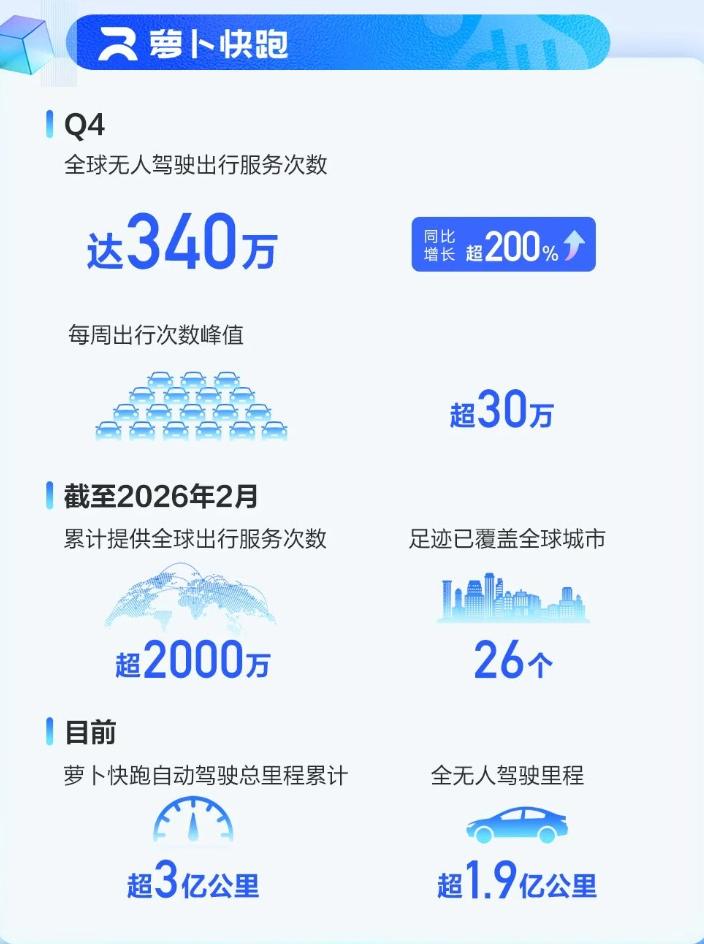
What is even more remarkable is its globalization process. Since it started its overseas layout in November last year, Apollo Go has quickly seized the global market, and its footprint now covers 26 cities around the world.
In December 2025, Apollo Go reached a deep strategic cooperation with global travel giants Uber and Lyft. It plans to start full - self - driving tests and travel services in London in 2026, for the first time entering the right - hand - drive market outside Hong Kong, China, and achieving cross - platform distribution under complex overseas road conditions.
After entering 2026, its overseas expansion has accelerated further. Since January, Apollo Go has first become the only enterprise approved to conduct full - self - driving tests in Dubai; then it joined hands with AutoGo to launch full - self - driving commercial operations for the public in Abu Dhabi.
From Europe to the Middle East, Apollo Go is weaving a physical AI network in core global hub cities through a flexible "self - operation + cooperation" model, realizing the core evolution of China's intelligent driving from technology export to business model export.
03
Baidu Takes Action in the Capital Market
While comprehensively AI - enabling its business side, recently, Baidu's "self - repair" at the capital level has been forceful and direct.
First and foremost is the "epic" shareholder return plan. In early February, Baidu announced in a Hong Kong Stock Exchange notice that the company will use $5 billion, about 10% of its current market value, for share repurchases and is expected to start paying dividends for the first time in 2026.
Looking at the global technology history, a repurchase proportion of this scale is extremely rare. By horizontal comparison, technology giants such as Apple and Google, which have strong cash flows, usually have an annual repurchase proportion in the stable range of 2% - 4%; even Meta, which has been the most aggressive during its transformation period, has a peak repurchase proportion of only 5%. Baidu's double - strength move this time has gone beyond the conventional financial optimization plan and is more like a "value declaration" made with real money: under the inertial prejudice of the market, the company's stock price has been seriously undervalued.
From a historical perspective, the combination of "dividend payment + share repurchase" is often a key watershed for technology giants to move towards a "long - term value bull market". After Apple restarted dividend payments in 2012, it entered a golden decade with cumulative dividends exceeding $600 billion and a stock price increase of 700%; after Microsoft started paying dividends for the first time in 2003, it also achieved an epic leap in market value from $250 billion to $3 trillion with a dual - wheel - driven strategy of "dividend payment + share repurchase".
Baidu's move not only directly addresses the market's doubts about the company's short - term stock price recovery but also conveys its core confidence to the outside world - it has the ability to expand profits and create stable cash flows through its AI business. And the 10% repurchase proportion itself also reserves at least the same level of recovery space for the company's stock price.
If share repurchase demonstrates "confidence", then the spin - off listing of Kunlun Chip on the Hong Kong Stock Exchange is an active manifestation of Baidu's AI "hematopoiesis", marking the reshaping of its underlying valuation logic.
As the computing power base of Baidu's full - stack AI capabilities, Kunlun Chip, together with Smart Cloud, Wenxin Big Model, and intelligent agents, forms Baidu's full - stack self - developed complete AI architecture of "chip - cloud - model - agent". This vertical integration not only improves the computing efficiency and performance of Baidu Cloud through cross - level optimization, creating an efficient feedback loop but also strengthens Baidu's differentiated competitive barrier in the AI service market through comprehensive ecological collaboration.
According to Reuters' reports and calculations, it is expected that the total sales of Kunlun Chip in 2025 will be about 3.5 billion yuan, and it is expected to increase significantly to 6.5 billion yuan in 2026. External sales are expected to account for 14% of Baidu Cloud's total sales. Referring to the market performance of peer companies such as Moore Threads, Biren Technology, and Cambricon, the independent valuation of Kunlun Chip after listing is expected to reach about $18 billion - $22 billion, bringing huge imagination space for the reshaping of Baidu's overall valuation.
For a long time, Wall Street has regarded Baidu as a traditional search company and is used to valuing it with the PE (price - to - earnings ratio) model. However, with the continuous strengthening of its AI attributes, this single - dimensional perspective undoubtedly ignores the investment value of Baidu's investment in frontier fields such as AI computing power, AI applications, and autonomous driving.
The independent monetization of Kunlun Chip is essentially forcing the market to re - evaluate Baidu's investment value and shift its valuation to a more scientific SOTP (sum - of - the - parts) method. By disassembling the business by segments, the valuation of businesses such as Smart Cloud and robotaxi can be directly linked to the dividends of the AI industry, achieving a "de - discounting" of the overall valuation.
The large - scale and all - around capital actions have triggered a strong resonance among global financial institutions. Recently, nearly 20 investment banks, including JPMorgan Chase and Goldman Sachs, have unanimously raised Baidu's target price. JPMorgan Chase has even given an optimistic expectation of $200 per share.
This undoubtedly reflects that the international capital market has begun to correct its cognitive bias towards Baidu: this "veteran" is making a "comeback" across the cycle in the AI era through the restructuring of its capital structure and the switch of its core profit model.
*Disclaimer:
The content of this article only represents the author's views.
The market is risky, and investment should be made with caution. Under no circumstances does the information in this article or the opinions expressed constitute an investment recommendation for anyone. Before making an investment decision, investors must consult professionals and make careful decisions if necessary. We have no intention of providing underwriting services or any services that require specific qualifications or licenses to the parties involved in the transaction.