The embodied intelligence company that provides the "brain" for Unitree has raised hundreds of millions of yuan in financing, with HSG China as an investor.
Text by | Fu Chong
Edited by | Su Jianxun
During our interview with the embodied intelligence company "Zhongke Fifth Epoch", two things happened one after another.
The first thing was that in January 2026, Zhongke Fifth Epoch was awarded the title of "Core Ecological Partner" by Unitree Technology. In the To B and industrial scenarios, Zhongke Fifth Epoch currently serves as the "brain" model supplier for Unitree robots.
The second thing was that Zhongke Fifth Epoch recently completed Pre - A and Pre - A+ rounds of financing in succession. The two transactions were completed within a month, with a scale of hundreds of millions of yuan. Among them, the Pre - A round was led by Sequoia China, with Orient Fortune Capital following; the Pre - A+ round was jointly led by Xineng Venture Capital and Youshan Capital, with Tsinghua Holdings Jixin following.
Liu Nianfeng, the founder and CEO of Zhongke Fifth Epoch, believes that there is a connection between the two things. The core logic is that the primary market's perception of robots has become more pragmatic.
"Last year, investors were more inclined towards the general narrative of embodied intelligence, such as preferring robots that can 'carry boxes, tidy up tables, and fold clothes'. But now, they value more whether the robot can first penetrate into vertical scenarios and make customers willing to repurchase. This is related to the commercialization ability and also to whether the bottleneck of insufficient real - machine data can be broken through with the data flywheel." Liu Nianfeng introduced to "Intelligent Emergence".
The cooperation between Zhongke Fifth Epoch and Unitree is the implementation of this "body + brain" division of labor. Since 2025, the two sides have gradually carried out tests, verifications, and implementations in scenarios such as power inspection and industry.
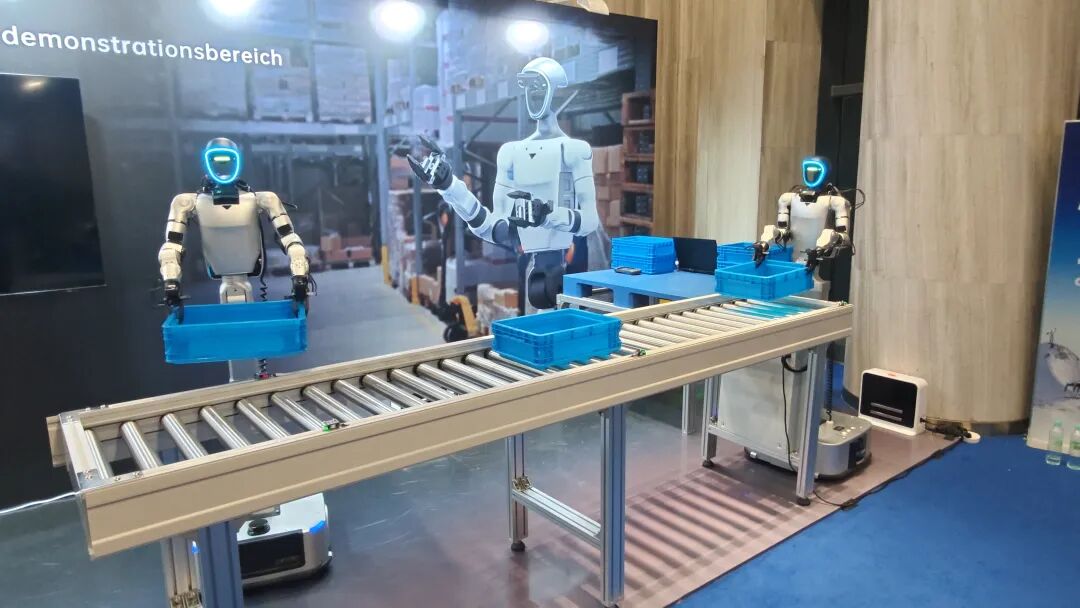
△ A Unitree robot equipped with Zhongke Fifth Epoch's "embodied brain" is demonstrating the handling work in an industrial scenario. Photo provided by the interviewer.
In addition to entering the scenario as the "brain supplier for Unitree", Zhongke Fifth Epoch also directly provides complete robot solutions to industry customers.
In its Beijing office, we saw a robot customized by Zhongke Fifth Epoch for a leading central state - owned enterprise customer. This robot with a red paint job is about to enter retail stores to undertake product sales and will also enter gas stations to refuel cars in the future. In addition, orders for inspection and handling for industry customers are also being gradually promoted.
Zhongke Fifth Epoch was founded in September 2024. In just over a year since its establishment, it has won customers such as Unitree. When it comes to the methodology of getting orders, Liu Nianfeng said that it's not difficult to find customers now, but the difficult part is the supply - "Every time we get a large order, we have to compete with many opponents, conduct POC for the customer's scenario, and go through several rounds of tests on reliability, robustness, and stability. Only those that pass can stay."
Liu Nianfeng revealed that although many embodied intelligence companies seem to have entered the scenarios, not many can really do the work well. "For example, when handling material boxes in a factory, if the light changes or the appearance and size of the material boxes are different, the robot won't recognize them, resulting in the failure of the task," he said.
This ability to "recognize and do the job" comes from Zhongke Fifth Epoch's technical team.
In terms of algorithms, the core members of the team all come from the Institute of Automation of the Chinese Academy of Sciences. Besides Liu Nianfeng, co - founder and algorithm director Liu Jing, and young chief scientist Huang Yan are all doctoral students of Academician Tan Tieniu. They have been deeply involved in the fields of artificial intelligence and multimodal intelligence. After graduation, they have worked in companies such as Microsoft and Huawei; co - founder Cao Enhua is a master from the Institute of Automation of the Chinese Academy of Sciences and was once an algorithm expert at Alibaba's DAMO Academy.
The self - developed large - scale embodied operation model "FAM series" of the team uses "secondary pre - training" and "heat map alignment" to make the model focus more on local key points when performing tasks. For example, when handling material boxes, it gives priority to paying attention to the handles instead of relying on a large number of pictures of material boxes with different colors and degrees of wear to "remember the appearance".
Liu Nianfeng said that this method enables the robot to complete the learning of new tasks with a minimum of 3 to 5 real - machine demonstration data, and the success rate of basic tasks can reach 97%.
The hardware capabilities of Zhongke Fifth Epoch come from the Tsinghua University team. Sun Fuchun, a tenured professor at Tsinghua University, serves as the co - founder and chief scientist of Zhongke Fifth Epoch. His teacher - student team provides support for the company's hardware and motion control capabilities.
The following is the transcript of the interview with Liu Nianfeng, which has been sorted out by the author:
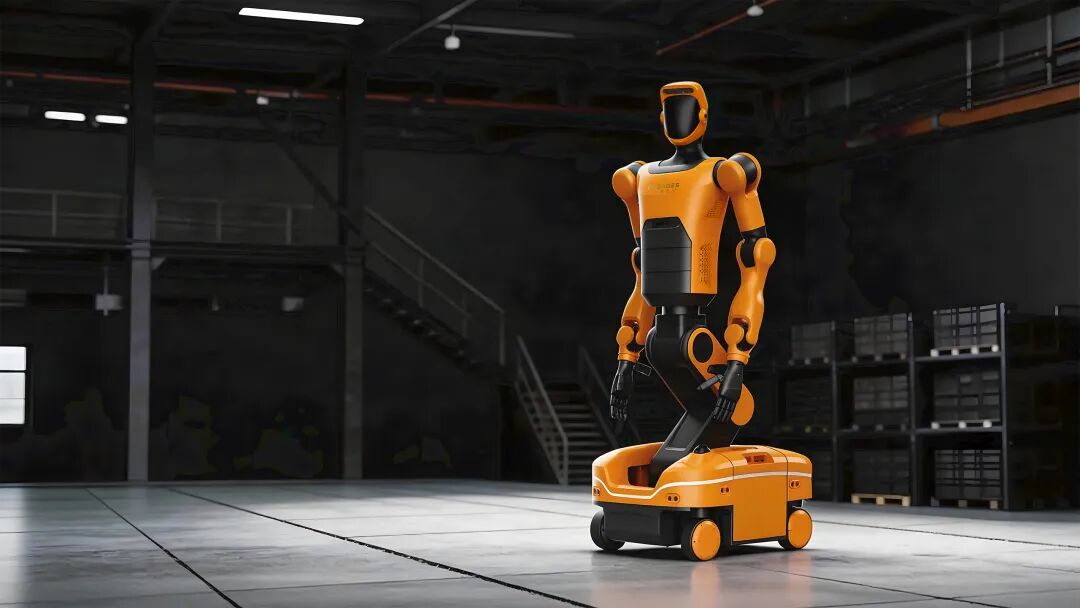
△ Zhongke Fifth Epoch's wheeled dual - arm robot. Photo provided by the interviewer.
From a "general brain" to a "brain that can really work in vertical scenarios"
Intelligent Emergence: What does it mean to become a "core ecological partner" of Unitree?
Liu Nianfeng: Becoming a "core ecological partner" of Unitree means that our embodied intelligence model can be deeply integrated with Unitree's high - performance robot platform. Unitree robots have leading advantages in motion control and hardware design, and their shipment volume continues to grow. As an ecological partner, we integrate our self - developed embodied brain into Unitree's whole machines, endowing them with the ability to perform complex tasks. In this model, robots can enter actual operation scenarios such as industry and inspection more quickly, and Unitree's large - scale shipments also drive the implementation of our business.
Intelligent Emergence: There are many companies with advantages in embodied intelligence brains. Why did Zhongke Fifth Epoch become the model supplier for Unitree?
Liu Nianfeng: We won the cooperation with Unitree after competing with many leading embodied enterprises.
Unitree had previously contacted many leading brain companies and university research institutions, and many of their models also had good capabilities. The core reasons for our victory are twofold. First, our brain has solid capabilities, especially the ability to quickly learn through a small amount of sample data. Second, we have the execution ability for rapid delivery and implementation, and the team also has rich product experience.
Intelligent Emergence: You said that you help Unitree with power inspection, but some companies in the industry have already entered this scenario. What are your advantages or differentiations?
Liu Nianfeng: Traditional inspection can only "observe", and after a problem is found, people still have to be sent to solve it. Our goal is inspection plus operation - after inspecting a point, directly complete the operation, such as taking out the key to open the cabinet door, pressing the switch, and unplugging the plug.
Traditional power inspection uses quadrupedal robots, but these operations require a human - like configuration. In the recent power intelligent inspection competition, our robot achieved strict indicators such as a 90% success rate of cross - station migration, less than 10 times of teaching for new cabinet types, and an end - point positioning accuracy of ±15mm, which verified the feasibility of implementation.
Intelligent Emergence: Can't adding a hand to a quadrupedal robot solve this problem?
Liu Nianfeng: It's not very feasible, mainly for two reasons.
The first is what Elon Musk said, that our human world is designed for human beings. There are many devices designed according to human height. Power equipment is designed according to human height, and it's difficult for a dog - shaped robot to reach a 2 - meter - high electrical cabinet.
The second problem is that a quadrupedal robot with two arms is a non - standard configuration. I think as a robot company, we must avoid the idea of non - standard configurations. Because non - standard means that it's impossible to increase the volume - today the arm length needs to be 1.5 meters, and tomorrow it needs to be 2 meters; today the accuracy is 0.1 millimeters, and tomorrow it needs to be 1 millimeter - in this way, the volume can't go up, the cost can't come down, and the algorithm can't be reused.
The industry should first "converge" to a standard hardware configuration. For example, at least there can be a consensus on the upper - body dual - arm configuration. Then solve the generalization problem of different loads and rhythms, rather than always using new configurations to solve problems.
Intelligent Emergence: Whether it's for Unitree or whole - machine customers, in fact, the certainty provided by Zhongke Fifth Epoch revolves around the ability to "enter the scenario". Is this also what investors are buying into at this stage?
Liu Nianfeng: Yes. Previously, the industry may have pursued a general model that can "carry boxes, tidy up tables, and fold clothes".
But rather than a distant and ultimate general intelligence, we have always insisted on developing models that can be implemented in vertical and specific tasks. For example, at least truly solve the problem of handling material boxes in a factory. The primary market this year has also realized the importance of this.
Technical core: Small - volume sample data and high data utilization efficiency
Intelligent Emergence: Many embodied intelligence companies, including Zhongke Fifth Epoch, that we interviewed recently said that their robots can handle boxes in industrial scenarios. But you mentioned that even for this seemingly simple task, not many companies can really do it well. So from the perspective of model capabilities, what are the difficulties for embodied robots to handle boxes?
Liu Nianfeng: Although handling boxes seems to be a monotonous and repetitive task, there are actually several difficulties.
The first is generalization: with different colors, sizes, and degrees of wear of the material boxes, can the same model stably complete recognition, grasping, and handling? The second is navigation: after picking up the box, how to move from point A to point B, including path planning, obstacle avoidance, and whether it can continue the task after being interrupted. The third is strategy understanding: for example, "remove 50 boxes from the 100 boxes in front", can the robot understand the quantity, which 50 boxes to choose, how to stack them at the destination, and whether to take out the objects after putting them down? There are problems in each link.
Although it seems to be just handling boxes, there is actually a whole set of complex task planning and execution behind it.
Intelligent Emergence: You just mentioned the generalization of material boxes. It seems that boxes are objects with relatively simple appearances. Why does it become more difficult for the embodied intelligence model to recognize them when the lighting changes?
Liu Nianfeng: The most fundamental reason is that the VLA currently used in mainstream embodied models follows the dynamic model of large - language models, which maps the global information of the whole picture.
For example, if you take a photo of three bottles of mineral water, the color temperature and brightness of the whole picture will change during the day and at night, and the model may not recognize them.
The problem is that embodied intelligence doesn't have the same amount of data as large models to cover all lighting changes. But from another perspective, if the model can focus on local information - for example, only lock in the appearance features of each bottle of water without caring about the background, light, or table color - it can avoid being interfered by global changes. This is exactly the starting point of our "heat map": to make the model focus on the operation object itself rather than the whole picture.
Intelligent Emergence: Please specifically explain how Zhongke Fifth Epoch's model improves generalization?
Liu Nianfeng: The core of the operation is the operation object, but the previous mainstream models paid too much attention to global information. Our idea is to adaptively learn the position of the object to be operated through multiple two - dimensional heat maps, so that the model realizes what the most important operation object is.
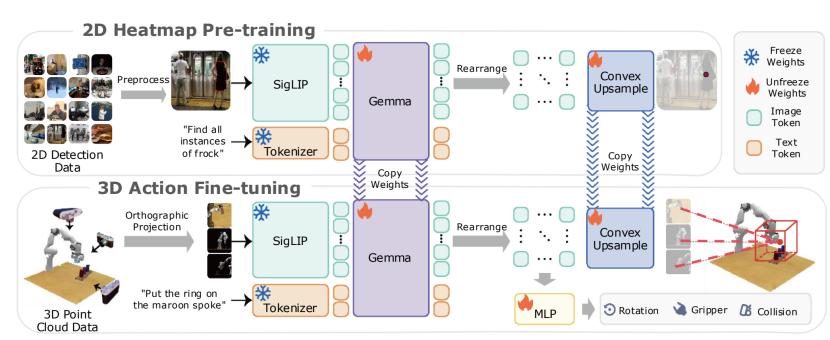
△ Diagram of Zhongke Fifth Epoch's FAM model. Photo provided by the interviewer.
The heat map can be understood as a "key - marking map" - the darker the area in the image, the more the model should focus on it. For example, if the instruction is to let the robot open the office door, it will focus on the doorknob instead of the whole door - no matter whether the door is a wooden door, a glass door, or what color it is, as long as the doorknob is there, it knows how to operate. The same is true in the scenario of handling material boxes in a factory. The model focuses on the handle, not the whole material box, let alone the whole factory in the field of vision.
This is achieved through "secondary pre - training". In the first pre - training, we let the model know what each object is. In the second pre - training, we use the "heat map" to make the model focus on the operation object and learn to distinguish "what is the most important thing for the current task".
Intelligent Emergence: So one of the reasons you mentioned for getting the Unitree order is that the FAM model can quickly learn new tasks through a small amount of sample data. Is it because your technical method saves a lot of data?
Liu Nianfeng: Yes. The shortage of real - machine data is a common understanding in the industry.
One of our solutions is to improve the model's attention to key operation objects through "secondary pre - training", which can improve data utilization efficiency and save a large amount of pre - training data.
In addition, we attach importance to entering the scenario because we can turn the real - machine data through the data flywheel of real work.
Commercialization outlook: "Repurchase" is crucial
Intelligent Emergence: Since the second half of last year, the embodied intelligence industry has attached great importance to "commercial implementation", but you pointed out that this year, the real test is "repurchase".
Liu Nianfeng: Yes. In 2025, we saw that many robots seemed to enter the working scenarios, but in fact, they were still in the POC (proof of concept) stage. In 2026, the test is repurchase. Scenarios like handling boxes need to be completely solved in 2026.
Intelligent Emergence: After completely solving the task of handling boxes this year, in the industrial scenario, what is the next task that embodied intelligence enterprises will focus on exploring and may solve?
Liu Nianfeng: There are quite a few, such as mobile sorting, which is a more delicate form of handling boxes. It requires taking certain specific things from the boxes to specific positions. This kind of task has strong generalization space both horizontally (across customers) and vertically (across scenarios).
Intelligent Emergence: What is your business model? How do you charge?
Liu Nianfeng: For ontology companies, we deliver the brain and charge according to one license per robot. At this stage, the fee is determined based on the complexity of the scenario and the task.
For end - scenario customers, we deliver our self - developed wheeled robots and charge according to the whole robot. In the future, as the supply chain becomes more mature, the price of the whole machine will further decline, and customers will also see better ROI data.
Intelligent Emergence: Zhong