A group of old classmates from Tsinghua University have raised another 800 million yuan in financing.
After four years of establishment and raising 800 million yuan in financing, the embodied intelligence computing power track has recently witnessed another significant round of financing, and Zhipu Robotics has also made an investment. The company in question is Huixi Intelligence.
What does it do? We often complain that current robots are too stupid. In fact, the problem lies in their "brains," specifically, the lack of sophistication in the underlying chips. Now, a group of old classmates from Tsinghua University at Huixi Intelligence plans to give these robots a "real brain."
Behind the financing, a new track in embodied intelligence is being opened up. In the future, whether a car will experience glitches when turning the steering wheel or a robot will crush an egg when grasping it will depend on how far this track can go.
01
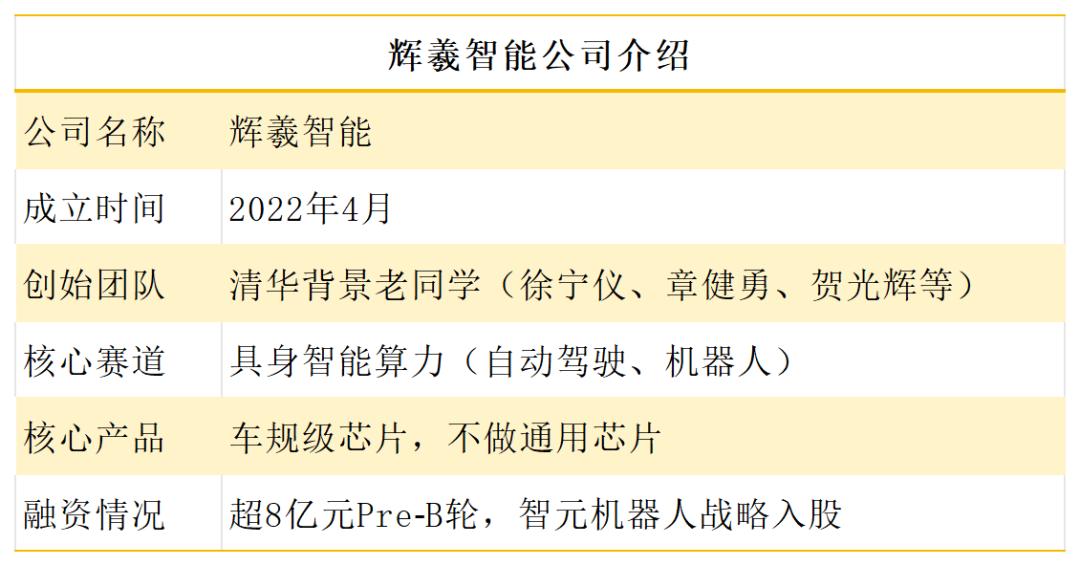
Huixi Intelligence was founded in April 2022 by several old classmates with a Tsinghua University background, including Dr. Xu Ningyi, Dr. Zhang Jianyong, and Professor He Guanghui.
This company has a unique feature: its team is not very "academic" but more like a group of people with hands - on experience in the industry.
Some have worked in the automotive - grade chip industry for more than a decade, with the cumulative shipment of the chips they have developed exceeding 1 billion pieces. They have real - world mass - production experience and have encountered various challenges. Some have long been engaged in high - level intelligent driving, participating in both R & D and implementation, and the related technologies have been integrated into more than 700 mass - produced vehicle models. Others have been working on robot algorithms.
This is completely different from the academic approach. For example, Cambricon's team leans towards the academic side.
Founder Chen Tianshi, with the technological foundation from the Chinese Academy of Sciences, embarked on the pioneering journey of domestic AI chips in 2016.
Huixi Intelligence's entrepreneurship is also related to the substitution of domestic AI chips. Many international chips do not adapt well to the domestic market. Even with strong cloud computing power, when applied to the end - side scenarios of robots and high - level intelligent driving, there is either a waste of computing power or a lack of real - time performance. It is common for robots to experience glitches when grasping objects or for intelligent driving systems to have decision - making delays.
In their words, "General computing power solves the problem of 'whether there is' AI computing power, but it cannot solve the problem of 'whether it is useful' in embodied intelligence scenarios."
After identifying this industry pain point, founders such as Xu Ningyi and Zhang Jianyong set two non - conformist goals: First, to focus entirely on embodied intelligence computing power, rather than developing general - purpose chips for all scenarios, and to concentrate only on the two core scenarios of robots and high - level intelligent driving. Second, to develop dedicated chips for automobiles, from the computing architecture, chip design to the software toolchain, and directly challenge 7nm automotive - grade chips.
It should be noted that the requirements for reliability and stability of automotive - grade chips are more than 10 times higher than those of consumer - grade chips. For a startup to take on this difficult task means continuous high R & D investment. As a result, the company has not yet achieved profitability and can only rely on capital support to move forward steadily.
Huixi Intelligence did not take the slow path of "spending ten years to forge a sword" like Cambricon. In September 2024, the first 7nm automotive - grade chip, Guangzhi R1, completed tape - out and was successfully lit up. It was officially launched in October and mass - produced and delivered as scheduled in 2025. In just four years, it achieved a core breakthrough from 0 to 1 in embodied intelligence computing power chips, but it is still not profitable at present.
02
The past decade has been the "golden decade" for domestic general - purpose AI chips. However, in essence, those ten years were about building brains for large models and cloud intelligence - with computing power concentrated in servers, data centers, and cloud training platforms.
The intelligence of AI was in the "cloud."
Cambricon was a representative player of that era. It was founded in 2016, and took the lead in launching domestic cloud - based AI chips. In 2020, it was listed on the STAR Market, becoming the "first domestic AI chip stock."
However, the general computing power track is extremely capital - intensive and highly competitive: it has a long R & D cycle, consumes a huge amount of capital, and the market is highly concentrated in the hands of international giants.
Cambricon suffered continuous losses for many years. It was not until 2025, when the demand for large - model training and inference exploded, that it achieved large - scale profitability - with an estimated annual revenue of 6 - 7 billion yuan and a net profit of 1.85 - 2.15 billion yuan.
This was the realization of the dividends of the "cloud computing power era."
Now, AI is starting to move from the cloud to the physical world. Embodied intelligence is no longer just a model running in servers but a "moving" system: self - driving cars, humanoid robots, robotic dogs, industrial robots, drones, and so on.
When AI enters the physical body, the computing power logic changes completely. It must have real - time response, low latency, high security, low power consumption, etc.
This is completely different from cloud - based general training chips. If Cambricon is a player in the "general computing power era," then Huixi Intelligence belongs to the "embodied intelligence computing power era."
It focuses on self - driving chips - currently the most mature and largest - scale form of embodied intelligence.
This is also a heavy - asset track: high upfront R & D investment, high tape - out costs, long automotive - grade certification cycles, and slow mass - production ramps.
Although it has launched mass - produced chips, expanding production, upgrading platforms, and expanding application scenarios all require continuous capital investment. The recent financing of over 800 million yuan is essentially to buy time for the "large - scale integration of computing power into vehicles."
The general AI computing power market has entered a highly concentrated stage, while the embodied intelligence computing power market is still in the early climbing stage.
The battle for cloud computing power has a set pattern, while the battle for end - side embodied computing power has just begun.
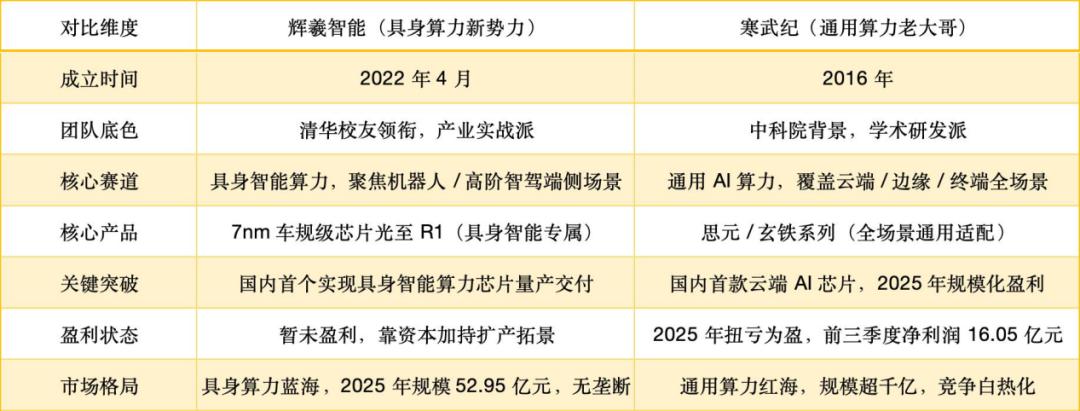
Difference comparison between old and new players
03
What really deserves attention in this round of over 800 million yuan Pre - B financing is not the amount. Instead, it is the formal strategic investment by Zhipu Robotics.
Put simply, this is not just a "financial investment" but a "choice of side."
What does this mean? It means that a leading domestic humanoid robot company has regarded Huixi Intelligence as one of the candidates for the future "computing power brain" of its robots, locking in a core cooperative relationship in advance.
When a robot company invests in a chip company, in essence, it is doing one thing: bundling computing power, algorithms, and whole - machine capabilities in advance.
So what are Huixi Intelligence's competitors up to? It's actually quite simple - making machines smarter, faster, and more capable of movement.
The most direct competition is in developing self - driving chips.
Leading domestic players such as Horizon Robotics and Black Sesame focus on automotive - grade chips and platforms, integrating computing power, perception, and algorithms.
Their goal is to make cars "see clearly, calculate quickly, and respond in a timely manner," supporting complex scenarios from advanced driver - assistance systems to automatic parking and urban self - driving.
In other words, they are "upgrading" the car's brain to make the car act like a smart driver.
The second type of competition is to expand "embodied intelligence" scenarios beyond cars. Drones, robots, industrial robotic arms... These machines all require high - speed computing power and real - time decision - making capabilities.
Huixi Intelligence's competitors are trying to extend the capabilities of self - driving chips to these scenarios, enabling machines to not only think but also act quickly.
Overall, this race for chips and computing power will ultimately play out in the world we can see: future cars will drive more intelligently and safely, and robots will grasp more accurately and move more flexibly.
Huixi Intelligence and its competitors are quietly making these "moving brains" a reality, bringing intelligence not just to the cloud but into our real lives.
This article is from the WeChat official account “Pencil News” (ID: pencilnews). Author: Truth - teller. Republished by 36Kr with permission.