MWC26 is here: Smartphones are just an appetizer, while communication and AI take center stage.
In the blink of an eye, there are only 4 days left until the opening of MWC26 (from March 2nd to March 5th, local time in Spain).
This year marks the 20th edition of MWC. In the past 19 years, the products and technologies showcased at MWC have profoundly influenced the development of the entire mobile industry. For example, in 2019, 5G technologies made a collective appearance, and Samsung/Huawei's foldable smartphones were globally unveiled for the first time, announcing the official arrival of the 5G and foldable screen era. Another example is the collective explosion of AI and robotics in 2025. At MWC, what you see is not just novel technologies and products, but a glimpse into the future.
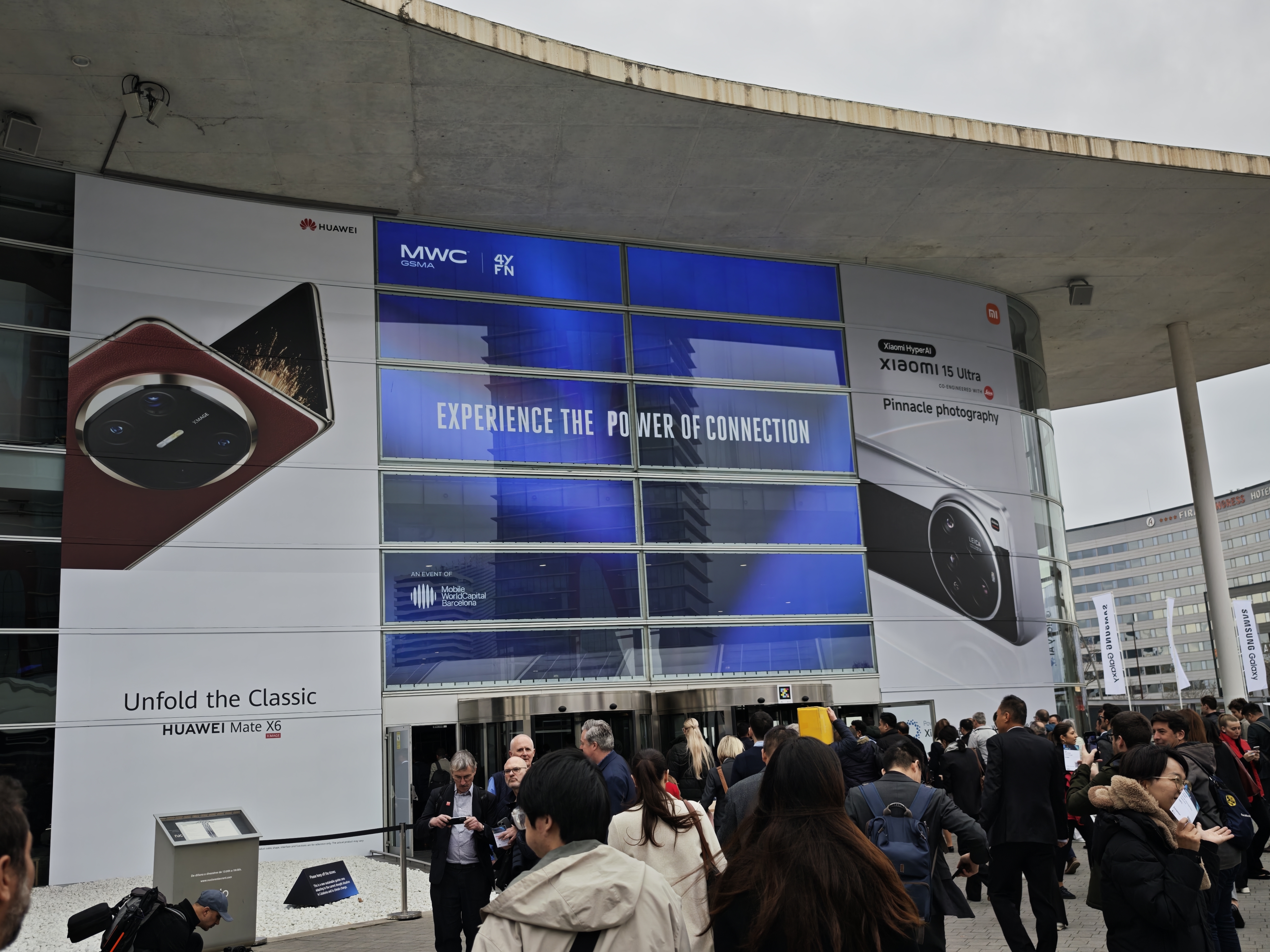
(Image source: Photography by Lei Technology)
The theme of MWC26 is simple: The IQ Era, which can be literally translated as "Intelligence Quotient Era", but more accurately, it refers to a new era of intelligence. The entire event will revolve around six core themes, including Intelligent Infrastructure, ConnectAI, AI 4 Enterprise, AI Nexus, Tech4All, and Game Changers.
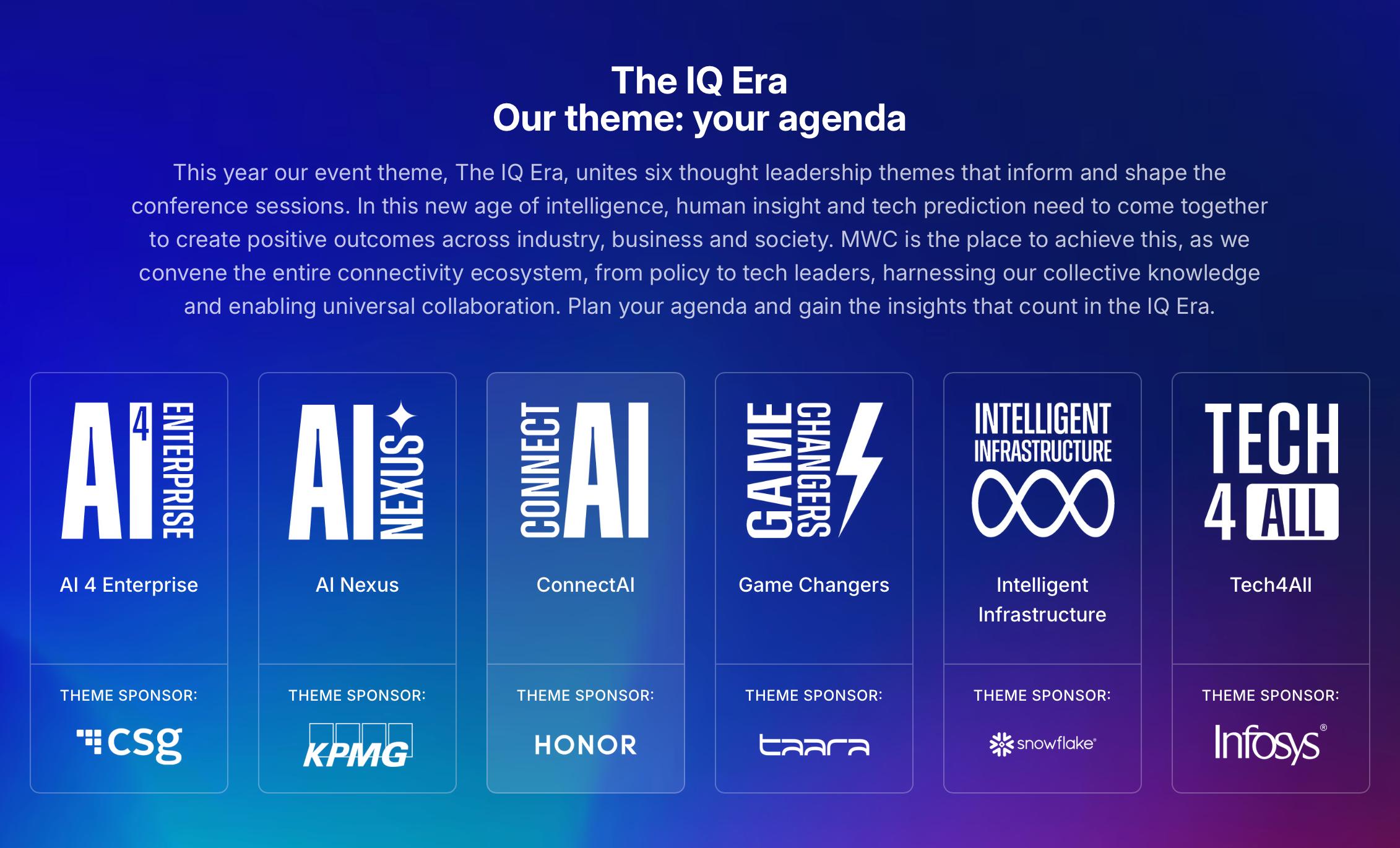
(Image source: Official MWC)
Actually, there are two main routes around the exhibition: Firstly, mobile phone AI is finally moving from APP capabilities to system-level capabilities. Secondly, communication capabilities are moving towards platformization. MWC26 is not just an exhibition; it is more like a reshaping of market rules.
So, what is worth looking forward to at MWC26? Before the Lei Technology MWC reporting team officially departs, we have prepared a preview summary of MWC26 for you.
Mobiles Remain the Focus, but with a New Approach
In the past year, the industry has been shouting about AI phones and AI on the cloud. However, in 2026, these concepts can no longer impress the market. They may seem smart, but based on my experience, most of the AI on mobile phones still stays at the level of "photo editing", "voice assistants", and "generating some simple text/images". It can only fulfill a small part of users' requirements and is difficult to help users complete the entire process.
In 2026, what mobile phone manufacturers most want to prove will be more specific - AI is not just a feature point but a set of system capabilities. You don't need to remember what it's called. You will only feel a change in your daily life: You will jump between apps less and less and hand over more tasks to your phone to "complete on its own".
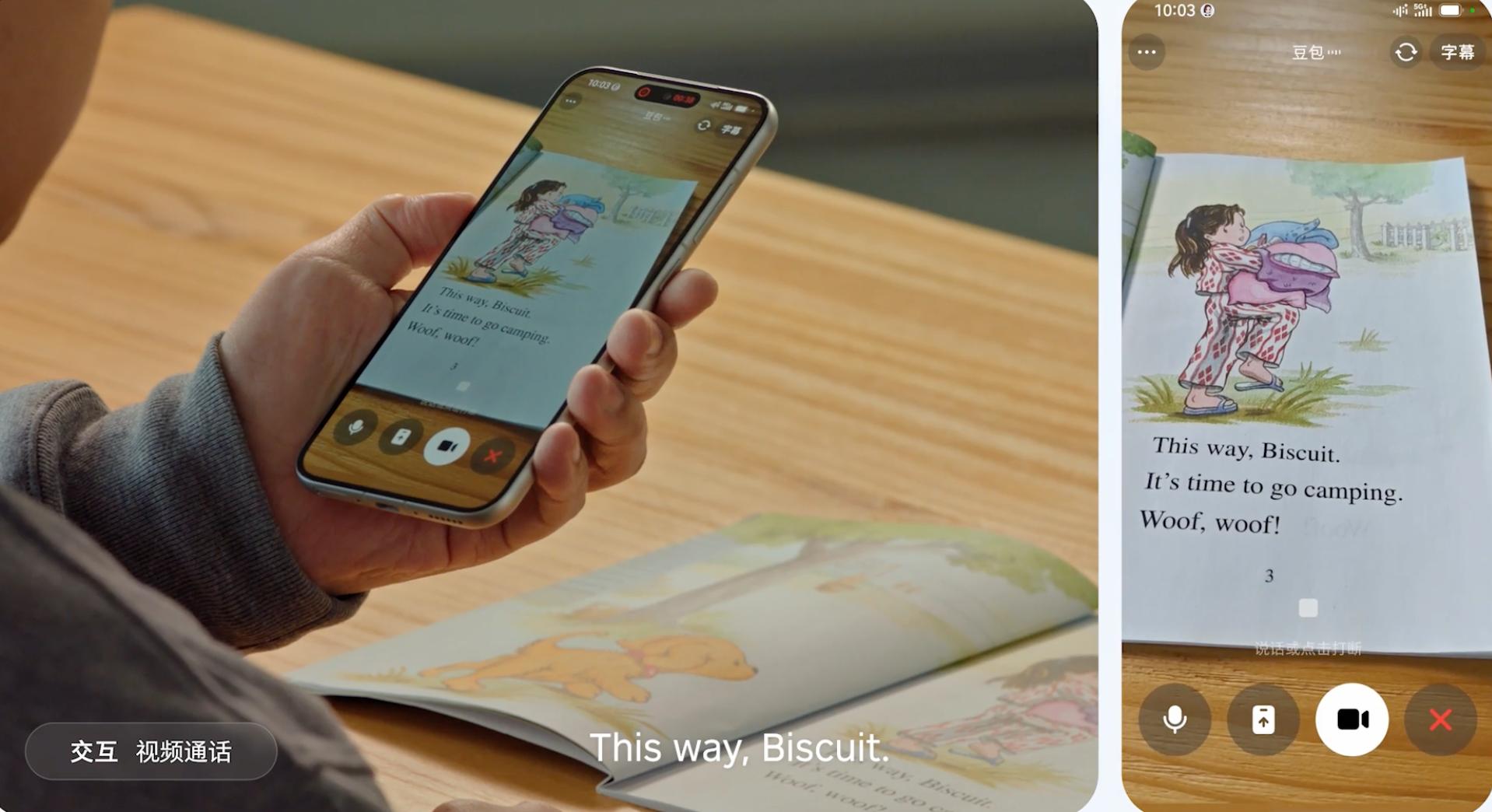
(Image source: Official Doubao)
The so - called "being able to handle things" is not just "help me write a paragraph". Instead, you just say "organize the itinerary, meeting locations, and email attachments of this business trip into a memo and send it to my colleagues", and the phone can shuttle between emails, calendars, maps, and files, connecting the entire system process. Only in this way will users feel that AI has truly become a system rather than a simple demonstration.
Among the six keywords at this MWC, AI Nexus perfectly meets the needs of AI phones. It can make the phone more and more like a dispatching center, allowing users to start AI functions not just when opening a certain APP. Instead, users tell the phone what needs to be done, and it organizes resources, schedules capabilities, and connects steps on its own.
However, for manufacturers to make this work, they must fill in the details that were the most troublesome and prone to failure in the past: Permission pop - ups should be clear, the citation of information should be transparent, key steps should be reversible, and the output results should be reviewable. The AI hub needs to "complete things more reliably" and let users know what it has done, what it has used, and where there may be risks. At MWC 2026, whoever can do a good job in the "dispatching closed - loop" will be closer to the entrance of the next stage.
According to current leaks, ZTE will release the official version of the Doubao phone at MWC26. It has finally obtained higher system permissions, enabling AI to "understand the screen and simulate click operations" like a human, thus bypassing the API restrictions of app manufacturers to a certain extent. In other words, even if you don't authorize the interface, it can still run normally.
It can be said that once the Doubao phone is recognized by the market, AI phones on the market will emerge like mushrooms after a rain.
Will the Two Routes of Mobile Phone AI and Communication AI Finally Converge at MWC?
In addition to AI phones, there is another development route for AI at this MWC: AI - native network and large - scale network intelligent transformation. Taking Nokia as an example, its external information for MWC 2026 directly sets the theme as "Advancing connectivity for the AI era", emphasizing trustworthy, high - performance connections and the evolution of the next - generation network.
When this information is combined with the previously mentioned AI phones, an interesting contrast emerges: Here, mobile phone manufacturers are promoting "AI helps me take photos, write, and think", while equipment manufacturers and operators are talking about "AI helps me maintain the network, optimize energy consumption, and make the network more programmable".
Both sides are talking about AI, but they are discussing different things.
However, what I am more interested in is whether these two lines will truly form a closed - loop in 2026. For example, when the operator network API can be widely called, can the AI agent on the terminal side obtain more stable and stronger "network assistance" (such as positioning, authentication, QoS, anti - fraud, and latency guarantee). Once such capabilities are implemented, AI phones will not just be "smarter local assistants" but will become "entrances to network capabilities".
(Image source: Official MWC)
Another key point to focus on is ConnectAI. If you only look at the literal translation (Interconnected Intelligence), many readers may simply understand it as device interconnection. However, according to the information revealed by the MWC official, ConnectAI should refer to the fact that AI has penetrated into all aspects of our lives, and the difference in experience comes from how they cooperate.
In the AI experience in 2026, what is most likely to go wrong is never "the model can't generate", but "the task is interrupted halfway". The local device understands the intention, and the cloud has completed the reasoning plan, but due to the failure of third - party service calls or network fluctuations causing real - time interaction lags, all efforts end up in vain. At this time, users will only think "this AI is not smart".
So, the core of ConnectAI is not "connecting devices", but delivering the right capabilities to the right scenarios at the right time, shifting from single - point capabilities to overall system reliability.
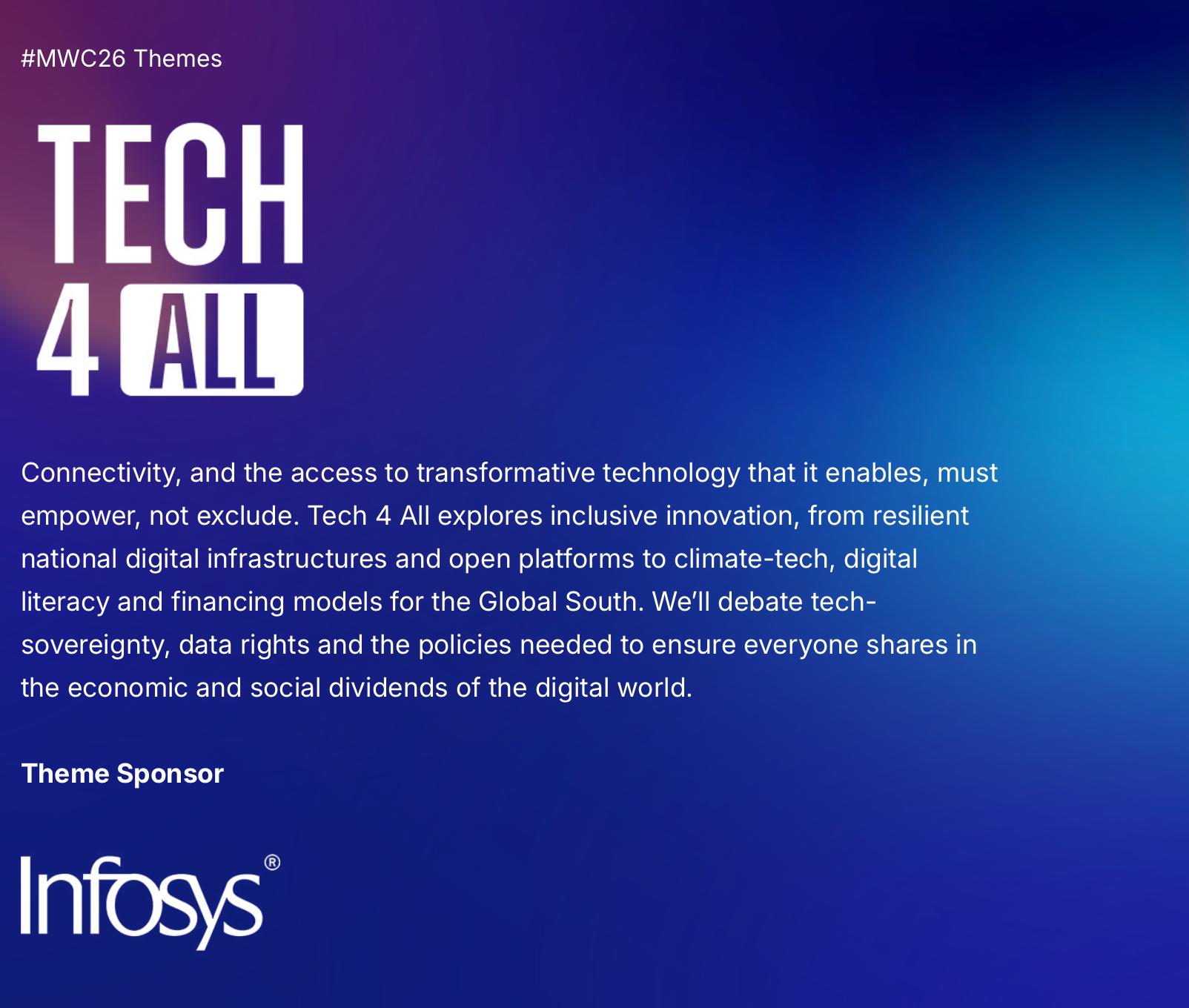
Finally, there is a theme that I am most interested in: Tech4All. You can understand it as: thresholds and trust.
The thresholds here do not just refer to price, but also include language, multilingualism and dialects, weak network and offline capabilities, aging - friendliness, and accessibility. If AI always requires users to learn prompt words and enter complex menus, it can only serve a small number of people.
(Image source: Official MWC)
Trust refers to privacy and security: What runs locally, what goes to the cloud, how data is processed, how to label and trace generated content, and how to audit enterprise scenarios. If these issues are not resolved, the more powerful the AI is, the less likely users and enterprises are to use it.
The reason why MWC 26 takes Tech4All as the last theme is actually to remind the industry that The IQ Era is not an era of "being smarter", but an era of "being more available, more trustworthy, and more popular". Only when AI can be made as stable, transparent, and controllable as basic services can we talk about universal access.
Device manufacturers will also conduct a centralized display of connection capabilities in the AI era. Why is this worth our attention? Because the next leap in mobile phone experience often does not come from "one more camera on the phone", but from the upgrade of network - side capabilities: lower latency, more stable uplink, more controllable QoS, stronger security and anti - fraud, and better cross - border roaming experience. You won't hear about these things at product launches, but they will gradually become a reality at MWC.
Can MWC26 Make the Evolution from 5G - A to 6G a Reality?
If you only focus on mobile phones and AI, you will naturally miss a part of the information at MWC, and this part is exactly what determines the industry's direction: operators, core networks, base stations, optical transmission, edge computing, enterprise private networks, security, and identity systems.
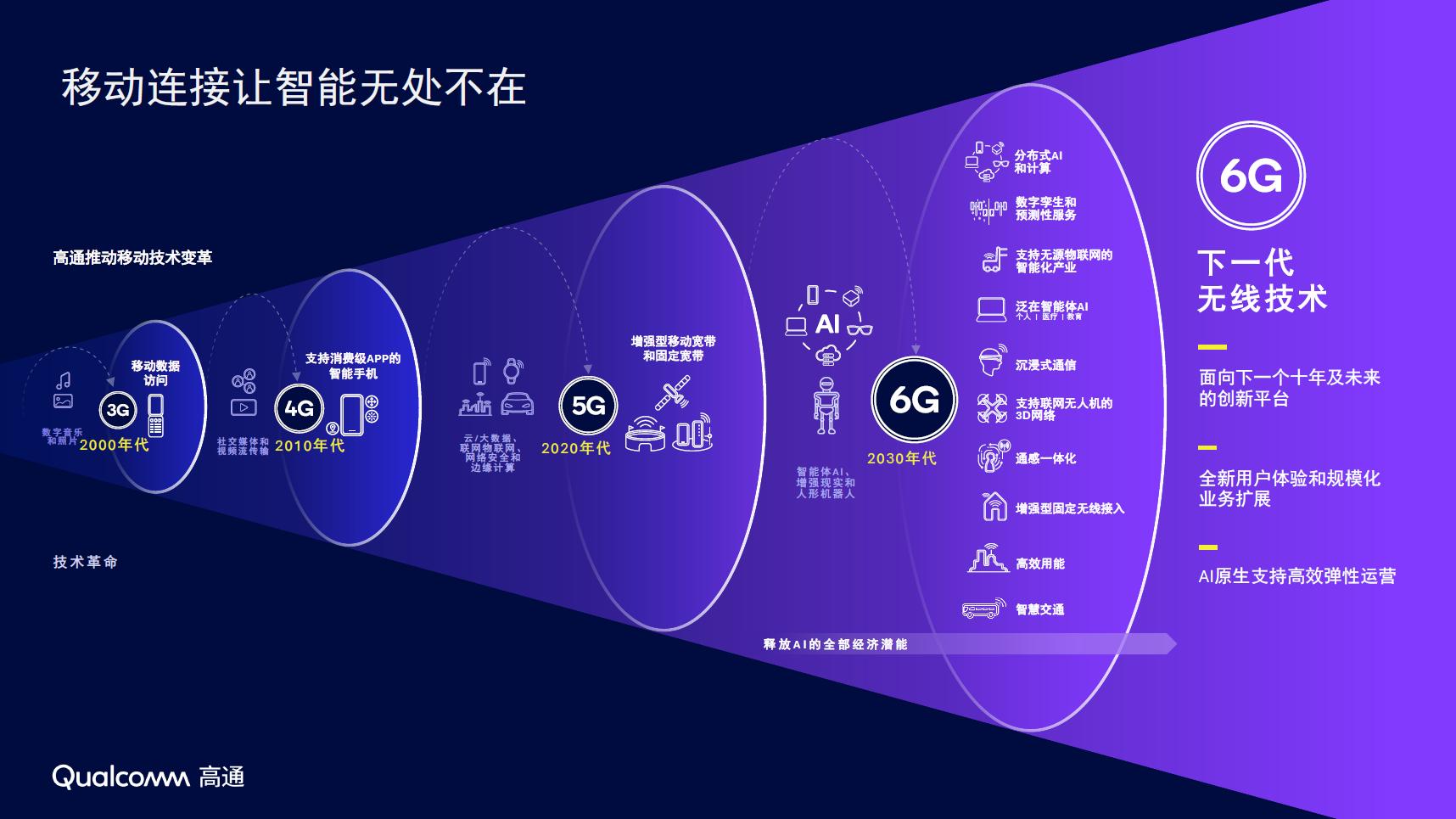
In the past two years, MWC has always talked about 6G. However, compared with 6G, more people will focus on "the real implementation of 5G - A". The reason is simple: In the AI era, the requirements for the network are not just faster speed, but more stability, lower latency, higher uplink, and more controllability. Although 5G - A is far inferior to 6G in terms of parameters, it is the most suitable network standard for the current situation. How to "fill in the gaps" in a targeted manner is what the market wants to see.
(Image source: Official Qualcomm)
Of course, 6G will also be a key topic at MWC26. In the past, when we talked about 6G, we always subconsciously listed how fast its download and upload speeds were and how many frequency bands it had. However, at this MWC, I think manufacturers will start to define the roadmap for 6G. According to the IMT - 2030 (6G) framework report previously released by the ITU, 6G will define requirements and evaluation criteria between 2024 and 2027.
In addition, the official schedule released by 3GPP also shows that: Stage - 1 (service requirements) will be frozen in June 2025, Stage - 2 (system architecture) is expected to be 80% completed by June 2026, and the goal is to be finally frozen in September 2026; Stage - 3 (protocol details) is targeted for after 2027.
Coincidentally, Qualcomm said today that it will showcase the latest trends in 6G networks at MWC26. Although it's still difficult for me to understand all the technologies of 6G at present, it's certain that Qualcomm is no longer just defining its presence with "flagship mobile phone chips". Instead, it is placing more bets on the evolution of the 6G network side, which will further promote 6G from a concept to a reality.
Of course, communication operators such as China Mobile, China Unicom, and China Telecom will also showcase their understanding of 6G at MWC26. At that time, I will also discuss with professionals on - site and produce relevant reports.
This means that MWC 2026 is no longer just about "who can tell a better story", but about who can fit themselves into the development roadmap before the standards and architectures are frozen. Therefore, at this MWC, I guess that communication manufacturers will work harder and shift the discussion from "whether there is 6G" to "what 6G should be".
What Can You Touch at MWC26 Besides PPTs?
Of course, what readers are most concerned about is: What "tangible new products" will there be at MWC 2026? After all, the traffic entrance of MWC is still mobile phones and consumer electronics.
It's very likely that the pace this year will be even "faster": Many manufacturers will choose to hold press conferences around the opening of MWC to attract more traffic on a more independent stage.
Firstly, Xiaomi. According to leaks, the global launch event of the Xiaomi 17 series will be held before MWC, and it will continue to strengthen its imaging narrative and partnerships.
I think Xiaomi's focus at MWC this year may not be "bringing the domestic version overseas", but using the industrial occasion of MWC to continue to build imaging capabilities as a brand anchor. The audience structure at MWC is very special: There are not only the media and consumers, but also a large number of operators and channels. Imaging, which is the "most intuitive and easiest to spread across languages" selling point, is more suitable for the international market.
Secondly, Honor. Honor is one of the few manufacturers at this MWC that makes me feel the "MWC flavor". It will not only bring new products such as the Magic V6 foldable phone and MagicBook laptops, but also the highly anticipated RobotPhone. If you think of it as a "gimmick", you're not wrong. But this exactly fits the overall theme of MWC 2026: AI is not just a mobile phone feature, but will evolve into a new form.
As for Transsion, vivo, ZTE, and Lenovo, although their online promotion is a bit lacking, there may still be many highlights. For example, it has been reported that Transsion will release a modular concept phone at MWC26, and ZTE will bring the real AI Doubao phone.
Generally speaking, MWC 26 may not produce a "blockbuster mobile phone", but it is very likely to determine the rules for the next stage in advance: In the AI era, the rules belong to those who can build the foundation, occupy the central position, and are willing to promote technology to a larger audience.
Conclusion: MWC 2026 Will Put New Rules on the Table
Many people expect MWC to suddenly produce a