Solid-state batteries – A new trillion-dollar direction for new energy batteries
The next golden five years for new energy batteries will be dominated by solid-state batteries.
From the laboratory to industrial implementation, all-solid-state batteries are not only the core area of competition in the global new energy industry but also directly reshape the rules of the entire battery industry chain. There will be a major overhaul of the material system and a full upgrade of production equipment. The period from 2025 to 2027 is the most critical window for industrialization. Seizing the core links such as sulfides, lithium metal, and dry-process equipment means seizing the golden opportunity in the trillion-dollar market.
More importantly, China has firmly established itself in the first echelon in this global race. Patents, policies, and corporate layouts are all making full efforts. Now it's about who can stand out in technology positioning and mass production implementation and be the first to reap the benefits of private placement.
Why have all-solid-state batteries become so popular?
The core reason is simple: it is currently the only battery technology that can achieve an energy density of over 400 Wh/kg.
This has also made it a globally contested technological point. Europe, the United States, Japan, and South Korea have all invested money and introduced policies to provide special support, while China pressed the accelerator long ago. After 2022, the number of solid-state battery patents increased sharply, and there was a direct explosion from 2024 to 2025. The Ministry of Industry and Information Technology has even invested billions to support R & D and related facilities.
In terms of progress, by 2025, most of the world's leading automakers and battery companies have basically completed the construction of pilot and small-scale test lines, and the R & D of laboratory-level battery cells has made breakthroughs. The industry has reached a consensus that from 2026 to 2027, vehicle loading tests will be officially launched, and the production lines will be scaled up to the GWh level. This is the final preparation before the large-scale mass production of solid-state batteries, and the countdown has begun.
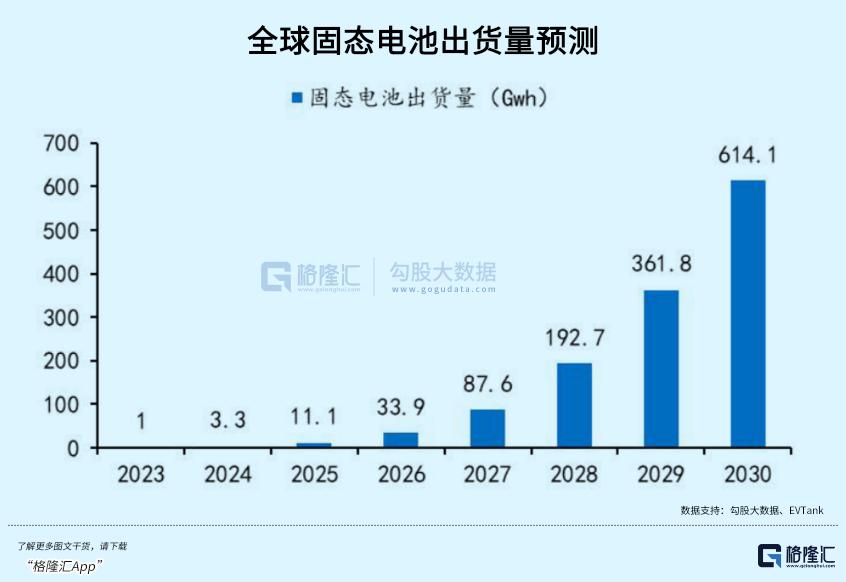
01 The Core Industry Chain Booms
The core difference between solid-state batteries and traditional lithium batteries lies in the reconstruction of the entire material chain and the large-scale upgrade of production equipment, which has given rise to a large number of investment opportunities. This is also the key to its ability to detonate the trillion-dollar market.
The electrolyte is the "heart" of solid-state batteries, and the sulfide route is currently the recognized mainstream in the industry.
Its ionic conductivity far exceeds that of other types. The only small shortcoming is its stability, but technological improvements are constantly being advanced.
Lithium sulfide, the core raw material for sulfide electrolytes, is the "choke point" in the entire industry chain. Previously, it had hardly any large-scale applications. It is sensitive to air and moisture, difficult to produce, and costly. Whoever can achieve its mass production and cost reduction will gain the initiative in solid-state batteries.
Currently, the mainstream process for lithium sulfide is the gas-solid method, and companies such as Shanghai Xiba are at the forefront. Traditional lithium battery giants like Tianci Materials are trying to achieve efficient mass production using the liquid-phase process. Huasheng Lithium and Haichen Pharmaceutical have also laid out pilot lines, and it is highly likely that 2025 will be a critical turning point for increased production capacity and reduced costs.
In addition, halide electrolytes, as an important supplement, can perfectly match high-voltage cathodes and assist lithium sulfide in stabilizing performance. This is also a subdivision direction worthy of attention.
The anode material directly determines the battery's energy density. Here, a dual-track approach of "ultimate solution + transitional route" is being pursued.
The specific capacity of traditional graphite anodes is very low, while pure lithium metal anodes can achieve nearly a tenfold increase, making them the ultimate goal for solid-state battery anodes. Currently, the mainstream production method is the solid-phase calendering method, and some companies can produce lithium films less than 5 microns thick. The next step is to optimize mass production efficiency and cost.
Silicon-carbon anodes are the golden transition at this stage and will also have a place in the future.
After 3 - 4 generations of technological iterations, the current third-generation silicon-carbon anodes have solved the expansion problem using the CVD method, and their consistency has been greatly improved. The core of this is the porous carbon skeleton, with raw materials being resin or biomass. The process barriers for activation and pore creation are very high, and companies such as Shengquan Group and Shanghai Xiba have obvious advantages.
The cathode materials present a dual-route of "high-nickel + lithium-rich manganese-based," and lithium-rich manganese-based materials are a brand-new opportunity brought by solid-state batteries. In traditional liquid batteries, they react with the electrolyte to produce gas, making them difficult to promote. However, solid-state batteries do not have an electrolyte, which perfectly solves this pain point. Coupled with their high-voltage characteristics, they can further increase the energy density. After the mid-term acceptance in 2025, the industry's attention to them will continue to increase, and leading companies such as Easpring have already made early layouts.
Although auxiliary materials and current collectors are small links, they hide great opportunities and are real incremental markets.
Current collectors mainly use the nickel-iron composite and copper foil nickel-plating routes to avoid reacting with sulfide electrolytes. Zhongyi Technology's pretreatment solution can also increase the value of the materials. In terms of conductive agents, the demand for single-walled carbon nanotubes has skyrocketed, with much higher usage than in traditional liquid batteries. Tiannai Technology is the absolute leader.
In addition, lithium iodide (Boyuan Co., Ltd.), insulating printing glue (Songjing Co., Ltd.), binders (Ribo Fashion, Haichen Pharmaceutical), etc., are all key auxiliary materials indispensable for solid-state batteries.
The subversion of the material system directly forces a full upgrade of production equipment. Compared with traditional lithium batteries, 60% - 70% of the equipment needs to be replaced or modified, and dry-process equipment and isostatic pressing equipment have become the largest increments.
Dry-process equipment is the core of the front-end production of solid-state batteries. Even Musk has said that this is the "ultimate technical route for liquid batteries." It does not require solution evaporation, can improve the battery's density and energy density, and can save factory space and energy consumption. The core difficulties lie in fiberization and rolling equipment. Fiberization equipment is mainly the twin-planetary equipment from Honggong Technology and the twin-screw equipment from Mannst, with high technical barriers. The rolling equipment has made rapid progress, and the speed of equipment from companies such as Naknorr is approaching that of the wet process, significantly increasing the feasibility of industrialization.
Isostatic pressing equipment is a completely new increment and has never been used in the lithium battery industry before. Its core function is to make the battery more dense. It requires a pressure of over 300 megapascals and has extremely high requirements for pressure control, sealing, and safety. Products from traditional companies such as Sichuan Lineng and Chuanxi Machinery are being adapted to the lithium battery scenario, and this link will give rise to new market demand in the future.
In addition, leading companies in the whole production line such as Lead Intelligent and Leiyuanheng are accelerating the R & D of solid-state battery whole production line solutions. Single-machine leading companies such as Naknorr and Honggong Technology are also expanding their multi-equipment business.
The core logic is clear: equipment suppliers that are bound to major customers such as CATL and BYD will be the first to receive orders. Orders for equipment companies have increased significantly in 2025, and with the arrival of the expansion wave in 2026, the realization of performance is worth looking forward to. Laminating, formation and grading, and laser equipment have also been upgraded, with precision and integration becoming the core requirements, and the application scenarios continue to expand.
02 Investment Opportunities
The industrial implementation of solid-state batteries will drive the entire material, equipment, and battery sectors to benefit comprehensively. The core is to capture the leading companies and technology positioners in each link. These targets are the core for sharing the dividends of the trillion-dollar market in the future.
Material end: Focus on disruptive links and incremental tracks
Core attention should be paid to the sulfide electrolyte chain, lithium metal/silicon-carbon anodes, and characteristic auxiliary materials. These are all golden areas from 0 to 1 or from 1 to N:
Sulfide electrolyte: Shanghai Xiba, Xiamen Tungsten New Energy (leader in lithium sulfide), Tianci Materials, Haichen Pharmaceutical (layout of liquid-phase process);
Lithium metal anode: Zhongyi Technology, Tiantie Co., Ltd., Jiayuan Technology;
Silicon-carbon anode: Putailai, BTR New Energy Materials, Shanshan Co., Ltd. (traditional anode leader), Yuanli Co., Ltd. (advantage in porous carbon skeleton);
Cathode: Easpring (layout of lithium-rich manganese-based materials);
Auxiliary materials: Tiannai Technology (single-walled carbon nanotubes), Boyan Co., Ltd. (lithium iodide), Songjing Co., Ltd. (insulating glue);
Current collector: Defu Technology, Nord Co., Ltd., Yuanhang Precision (nickel-iron/nickel-copper route).
Equipment end: Focus on core increments and favor technology leaders
Core focus should be on dry-process equipment, isostatic pressing equipment, and whole production line equipment. These are the most certain incremental links:
Dry-process equipment: Honggong Technology (fiberization), Naknorr (rolling);
Isostatic pressing equipment: Sichuan Lineng, Chuanxi Machinery, Kexin Electromechanical, Rongqi Technology (layout companies);
Laser equipment: Union Laser, Delong Laser;
Whole production line + supporting equipment: Lead Intelligent, Leiyuanheng (leaders in the whole production line), Xingyun Co., Ltd., Xinyuren, Aotewi (targeted layout).
Battery end: Leading companies concentrate resources, and differentiated companies have opportunities
The R & D of solid-state batteries requires a large amount of capital and technology, and resources are concentrating on the leading companies. However, companies with differentiated layouts also have opportunities:
Leading companies: CATL, BYD (leading in R & D and the core force in industrialization);
Differentiated layout: Jinlongyu, Zhuhai CosMX (with limited share in traditional lithium batteries but firm investment in solid-state batteries and potential to break through in niche scenarios).
03 Risk Warnings
The policy effects may fall short of expectations; the R & D and industrialization progress of solid-state battery technology may be slower than expected; the demand from downstream new energy vehicles, energy storage, etc., may be lower than expected; the prices of core raw materials may fluctuate significantly; and intensified industry competition may lead to a decline in profit levels.
The transformation of solid-state batteries is not achieved overnight but is a gradual process from R & D to pilot testing and then to mass production. However, the industrialization window from 2025 to 2027 is crucial for companies in each link to position themselves.
With the cost reduction of core materials, technological breakthroughs in key equipment, and the implementation of orders from leading companies, solid-state batteries will gradually move from the laboratory to the market, reshaping the pattern of the entire new energy storage industry.
Companies that make early layouts in core links and master core technologies will surely gain a first-mover advantage in this technological revolution and share the development dividends of the trillion-dollar market.
This article is from the WeChat official account “Gelonghui Financial Hotspots” (ID: glh_finance). Author: Editor of Gelonghui. Republished by 36Kr with permission.