Why can't your electric car even enter the basement parking lot of your own community?
After spending over 100,000 yuan on a parking space and paying a monthly management fee of 120 yuan, Zhao Jinyuan (a pseudonym) in Datong, Shanxi, cannot park his car in the underground parking space he bought. Like more than 30 other electric - vehicle owners in his neighborhood, he can only temporarily park his car in a surface parking lot near the community, coordinated by the street community.
This all started with the notice suddenly posted in the elevator on December 23, 2025. The property management announced that starting from December 25, all new - energy vehicles would be prohibited from entering and parking in the underground garage of the community. The access permission at the turnstile was revoked with a single click, and Zhao Jinyuan's green - licensed car was blocked outside his home.
This surreal situation has caused an uproar among the new - energy vehicle owners in the community. The property management company has prohibited new - energy vehicles from entering the underground garage on the grounds of "fire safety hazards".
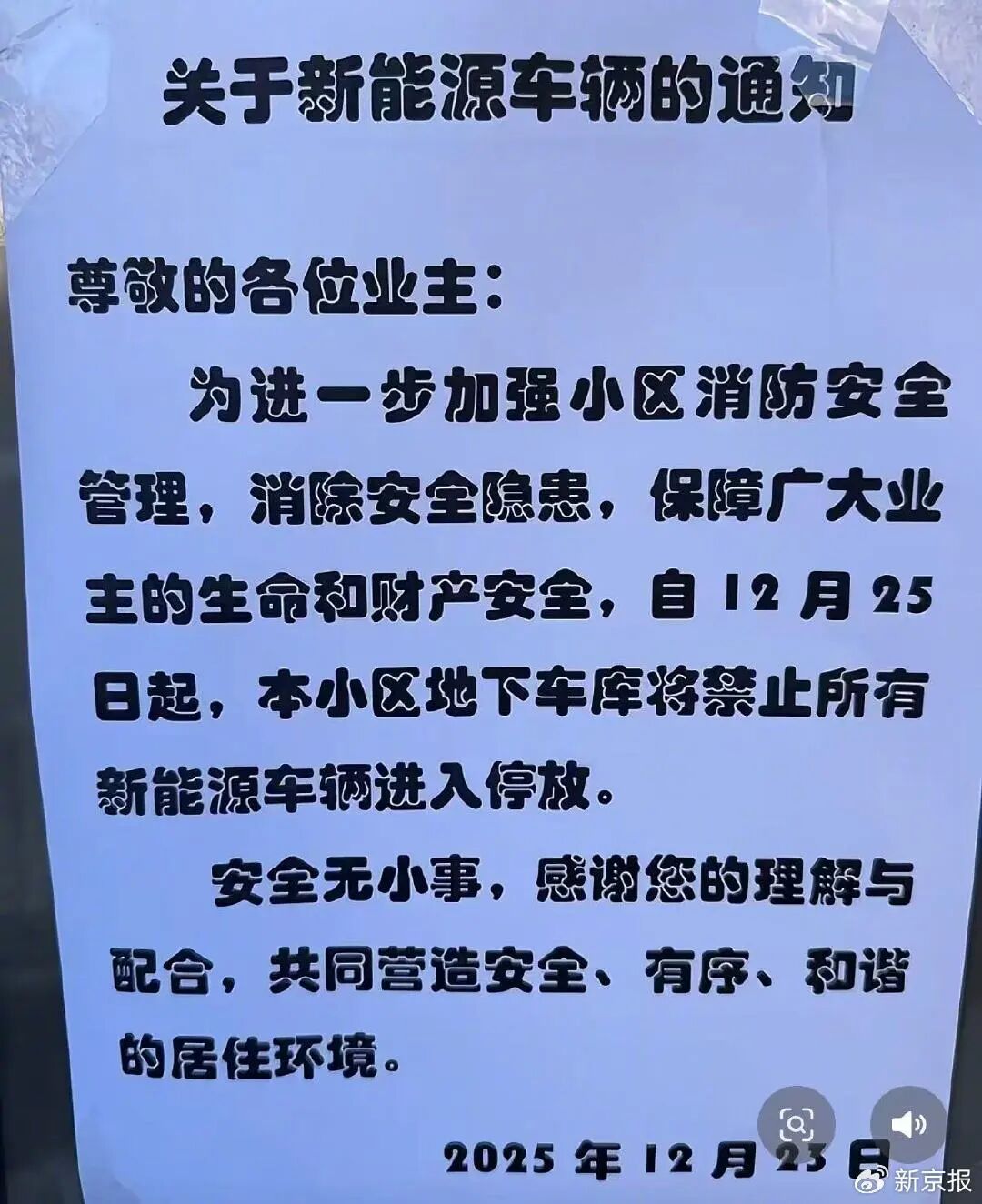
Photo/Notice about new - energy vehicles in a community. Source: Screenshot from "New Energy Outlook" of Beijing News
This is by no means an isolated case. From Hangzhou to Taiyuan, and from Ningbo to Guangzhou, more and more new - energy vehicle owners are finding that the green license plate, which once represented an "environmental pioneer", is being quietly "blacklisted" by some property management companies in underground garages.
Behind this is a delicate game of safety anxiety, management helplessness, and technological breakthrough.
The "Green - Licensed" Cars with No Place in the Underground Garage
Zhao Jinyuan still remembers the sense of shock that day. When he moved into the Dongfang Luomacheng Community in Datong in 2012, he spent over 100,000 yuan to buy an underground parking space. In 2024, he replaced his car with a new - energy vehicle, thinking that he would start a cost - effective and convenient travel life. However, a ban from the property management company has turned his car into a "homeless wanderer".
"Without any warning, the property management asked, 'What if your car catches fire in the garage?' " Zhao Jinyuan tried to communicate, but the response he received broke his heart. What made him even more uncomfortable was that the owners of fuel - powered cars in the community all praised the property management! Some neighbors even taunted him to his face: 'Who told you to buy an electric car?'
This stigmatizing embarrassment is spreading across many places in the country.
At the entrance of the underground garage of Radisson Blu Hotel in Xiaoshan District, Hangzhou, a prominent notice board reads "Fire hazards of new - energy vehicles", and there are shocking pictures of self - ignition cases beside it. Security guards will guide green - licensed cars to a factory building 50 meters away for parking.
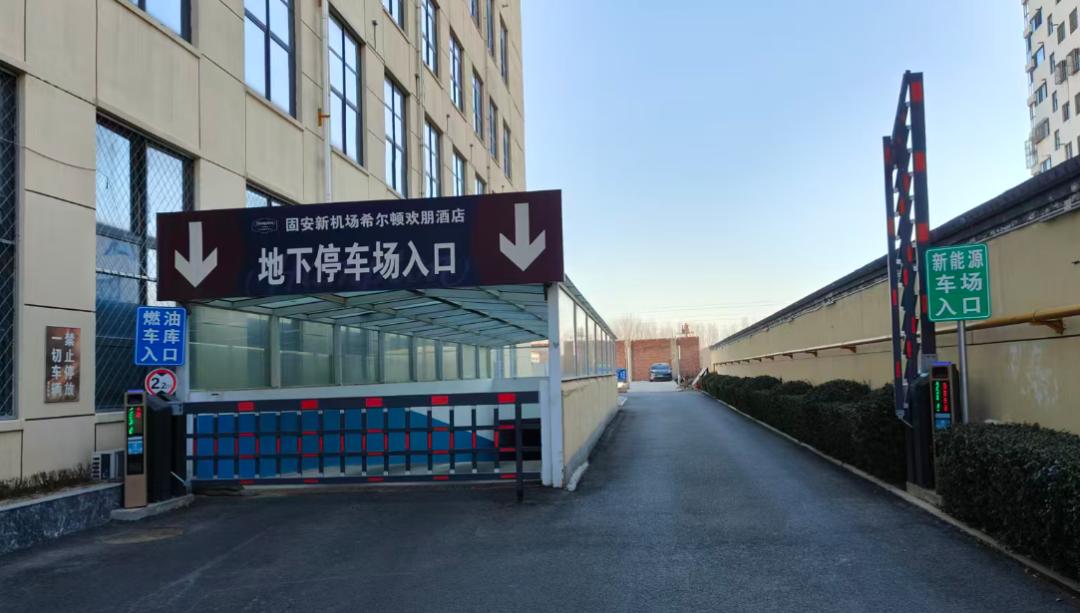
Photo/Underground parking lot of Hilton Garden Inn near Gu'an New Airport. Source: Screenshot from "New Energy Outlook" on the Internet
The Huigang Building in Ningbo and the Guangdong Museum have also clearly stated that new - energy vehicles can only be parked in surface or open - air parking lots; the underground parking lot of Hilton Garden Inn in Gu'an, Hebei, only allows fuel - powered cars, and the new - energy vehicle parking area is on the ground; in some public parking lots in Taiyuan, although there is a partitioned management system, parking spaces in the new - energy vehicle area are often in short supply, while the adjacent fuel - powered vehicle parking spaces are empty.
For car owners, this is not only an infringement of their property rights but also a significant decline in their experience.
In winter, in the cold wind of minus ten degrees Celsius in the north, it is inconvenient to get things in and out of the car. Moreover, if the car is parked outdoors overnight, its battery range may be reduced by 30%. In summer, exposure to the sun not only accelerates the aging of the car interior but also increases the thermal management pressure on the battery. Especially for new - energy vehicle owners, spending the same amount of money on a parking space or even more on a car only earns them "inferior" treatment.
On the other hand, there is fear among fuel - powered vehicle owners and property management. This fear is not unfounded but stems from the "low - probability, high - damage" characteristics of lithium - battery fires.
Data shows that the fire accident rate of new - energy vehicles is actually close to or even lower than that of fuel - powered vehicles. Sun Fengchun, an academician of the Chinese Academy of Engineering, has publicly stated that the fire accident rate of new - energy vehicles is lower than that of traditional fuel - powered vehicles. Statistics show that the self - ignition rate of fuel - powered vehicles is even higher than that of electric vehicles. So why are people so nervous about electric cars?
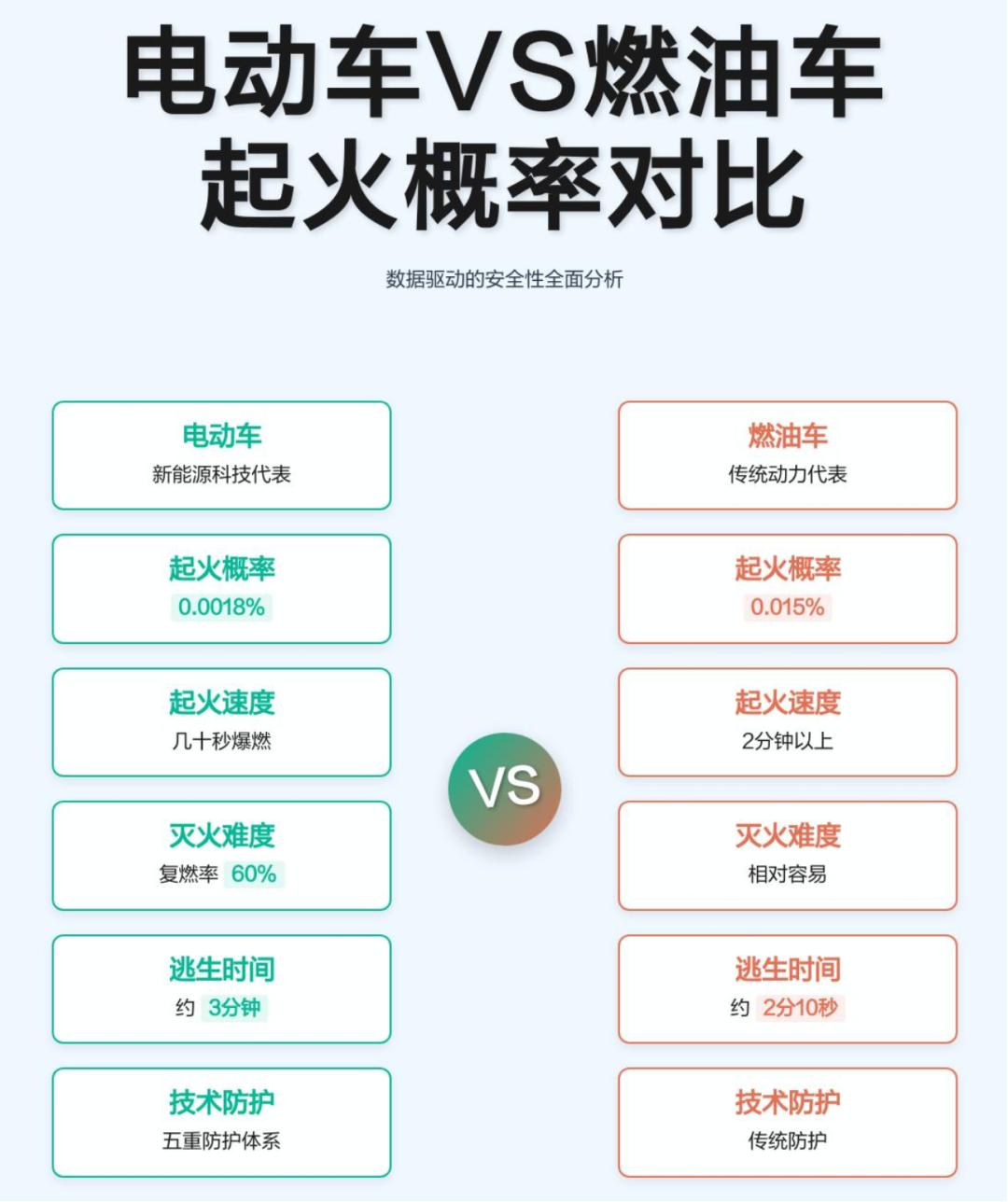
Photo/Comparison of fire probabilities between electric vehicles and fuel - powered vehicles. Source: Screenshot from "New Energy Outlook" on the Internet
The key lies in the consequences. When a fuel - powered vehicle catches fire, there is usually a slow process from fuel leakage to an open flame, and on average, about 5 minutes of escape time can be gained. However, once a lithium battery goes into thermal runaway, the temperature can soar above 800°C within seconds.
Even more terrifying is that battery combustion releases a large amount of highly toxic gases such as hydrogen fluoride and phosphoryl fluoride. In a closed underground garage, these toxic fumes can spread extremely quickly and reach a lethal concentration within a dozen seconds. Once a chain reaction of combustion occurs, the underground garage becomes like a large chimney, making rescue extremely difficult.
The Helplessness of the "One - Size - Fits - All" Ban
Wu Chen (a pseudonym), the property manager of an old community in Shijiazhuang, has experienced that "heart - pounding moment".
In the summer of 2021, a new - energy vehicle of an owner suddenly emitted white smoke while charging in the underground garage. By the time the security guards arrived, thick smoke was rising up the ventilation duct, and the entire garage was filled with toxic fumes. Although the vehicle did not catch fire in the end, the scene that day still gives Wu Chen the shivers: "I've never seen such a situation before. I was really scared."
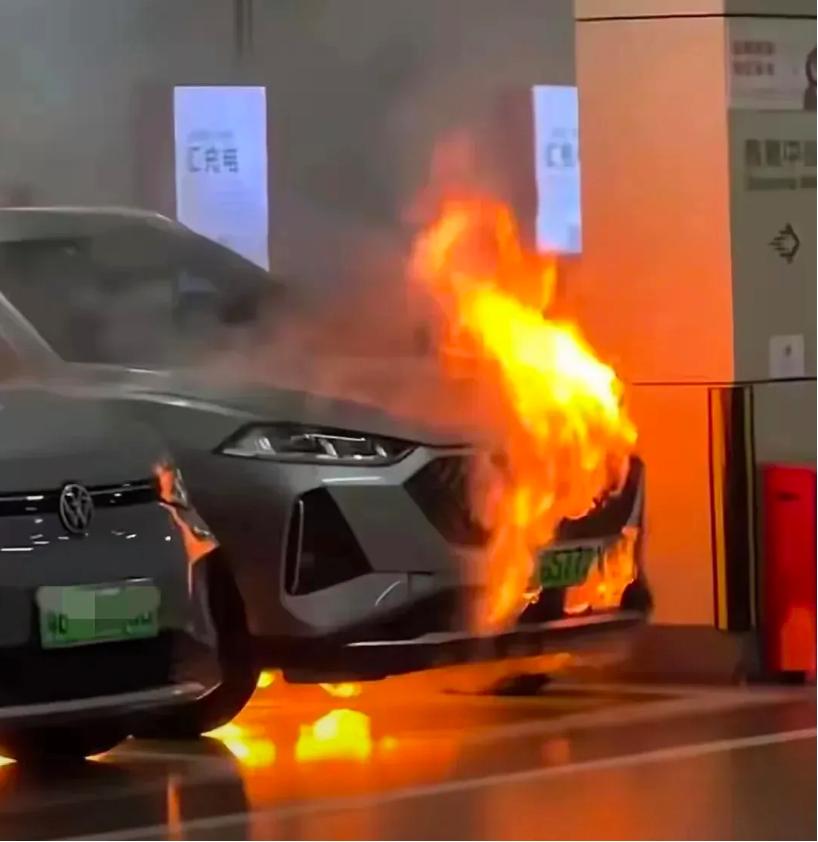
Photo/Smoking and catching fire of a new - energy vehicle in an underground garage. Source: Screenshot from "New Energy Outlook" on the Internet
For property management, the "one - size - fits - all" ban is actually the "safest" option with the lowest cost.
If an accident occurs, how should the liability be determined? Is it due to the owner's unauthorized modification, the battery defect of the car manufacturer, or the inadequate fire - fighting measures of the property management? In the current situation where the responsible party is unclear, the property management is often the first to be sued and the last to bear the cost. After a new - energy vehicle self - ignites, the manufacturer, operator, property management, power company, and the owner are likely to shift the blame to each other, and the property management, as the direct management party, naturally becomes the target of criticism.
What's even more daunting is the risk of sky - high compensation. In the event of a chain reaction of combustion in the underground garage, what is burned is not just one car but possibly several or even a dozen luxury cars nearby. This kind of catastrophic compensation far exceeds the affordability of ordinary property management companies.
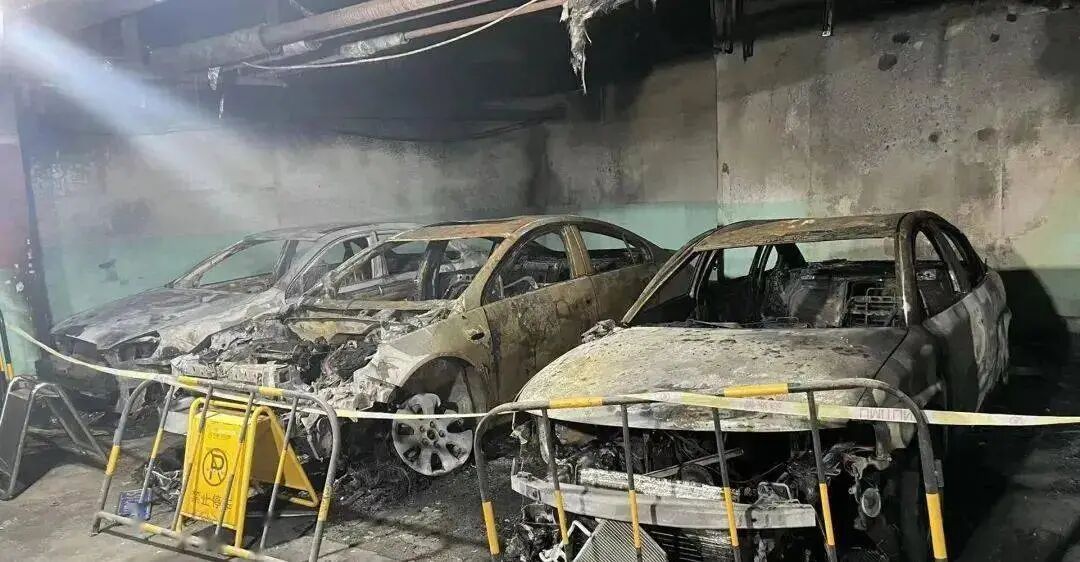
Photo/A vehicle catching fire in an underground garage affecting multiple surrounding cars. Source: Screenshot from "New Energy Outlook" on the Internet
Want to make renovations? Where will the money come from, and what are the standards?
The community where Wu Chen works was built in 2006. The power distribution system in the underground garage was designed more than a decade ago, and the fire - fighting facilities were configured according to the standards of the fuel - powered vehicle era. After an inspection by the fire department, he was told that lithium - battery - specific fire - fighting blankets and thermal imaging monitors needed to be installed, and the ventilation system also needed to be renovated, with a quoted price of nearly 980,000 yuan.
The property management cannot afford this money, and the maintenance fund cannot pass the approval of the homeowners' meeting - why should fuel - powered vehicle owners pay for electric vehicles? This touches on the core of the problem: the "inherent shortcomings" of technology have collided with the "historical limitations" of buildings.
The chemical properties of lithium batteries determine that once thermal runaway occurs, a large amount of water for continuous cooling is required, but the fire - fighting water volume and sprinkler systems in most old underground garages simply do not meet the requirements. The highly toxic gases generated by combustion are difficult to discharge quickly under the current ventilation standards - because the current standards are designed for the 600 - 800°C flames and relatively limited smoke of fuel - powered vehicles, while the flames of electric vehicles can reach 1000°C, and the amount of toxic gas is completely different.
What's even more embarrassing is the lack of relevant regulations. Currently, there is a lack of a unified and mandatory fire - safety management specification for the underground parking of new - energy vehicles across the country. The "Code for Design of Garage Buildings" issued in 2015 did not take into account the popularization of new - energy vehicles. In a situation where there is "no law to follow" and "fear of risks", property management can only choose the most straightforward solution: prohibition.
This is not simply discrimination but a sigh of the social governance and infrastructure being left behind when the industry is advancing rapidly.
Where is the dawn of breaking the deadlock?
The contradiction is not insoluble. In Shenzhen, a refined management reform is taking place.
In November 2024, Shenzhen officially implemented the "Fire - Safety Management Specification for Underground Parking of New - Energy Vehicles". This is the first national special specification for the underground parking of new - energy vehicles. Its core idea is not a "one - size - fits - all" ban but "risk classification".
The specification clearly states that the charging area should preferably be set on the first or second basement floor and should not be set on the fourth basement floor or below. At the same time, specific requirements are put forward for fire - prevention partitions, fire - fighting facilities, and early - warning systems. For example, each fire - prevention partition should be equipped with at least two wheeled water - based fire extinguishers. More importantly, it provides a standard basis for the renovation of existing garages - finally, there is a yardstick for how to spend the money and to what extent the renovation should be carried out.
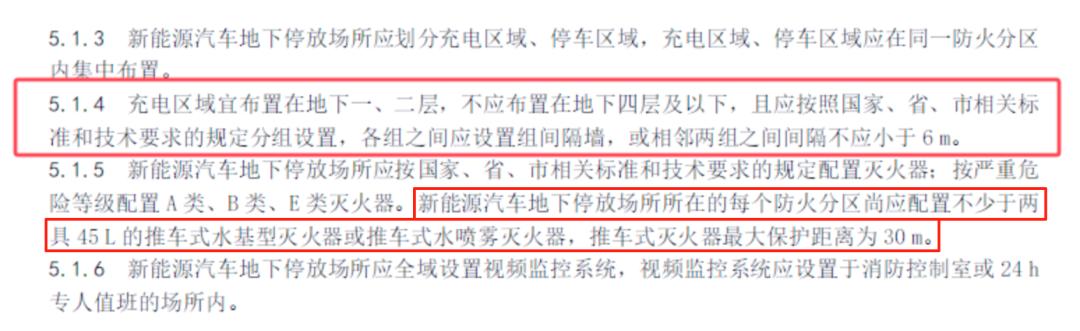
Photo/Part of the content of the "Fire - Safety Management Specification for Underground Parking of New - Energy Vehicles". Source: Screenshot from "New Energy Outlook" on the Internet
In Pingshan District, Shenzhen, the policy goes even further: when building new parking lots for various buildings, not only should charging facilities be built according to a certain proportion, but also 100% of the power capacity and installation conditions should be reserved, and the pipelines and cable trays should be constructed at one time. This means that in future new buildings, the embarrassment of "wanting to charge but unable to connect the wires" will no longer occur.
At the community level, some high - end hotels in Shanghai and Hangzhou have also set an example: although new - energy vehicles are restricted from entering the core underground garage, a dedicated area with rain shelters, monitoring, and charging piles has been set up in the nearby surface area. The original "safety concerns" have instead been transformed into a "safer and more convenient" service experience.
Of course, fundamentally breaking the deadlock requires joint efforts: technically, the garage needs targeted "hard upgrades" - lithium - battery - specific fire - fighting devices, thermal runaway early - warning systems, and more powerful smoke - exhaust equipment; in terms of regulations, the national level urgently needs to update the building fire - prevention standards and promote the implementation of special insurance products to disperse the huge compensation risks faced by property management.
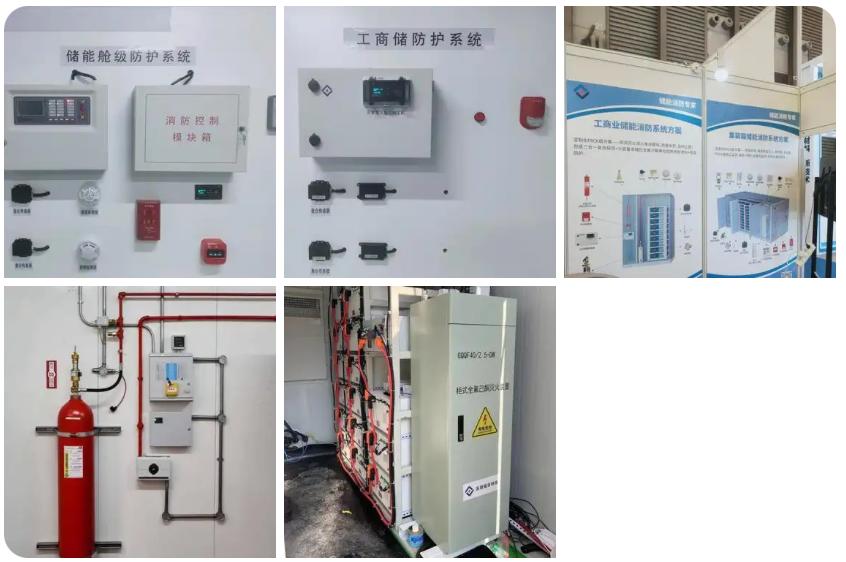
Photo/Lithium - battery fire - fighting equipment. Source: Screenshot from "New Energy Outlook" on the Internet
If this knot is not untied, property management will always take the attitude of "the less trouble, the better". However, the real dawn may be shining from the source of battery technology.
On February 5th not long ago, a piece of news shocked the industry: Changan Automobile, in cooperation with CATL, officially launched mass - producible sodium - battery passenger cars. Moreover, the models equipped with "sodium - new" batteries have passed the winter calibration test in Yakeshi at minus 40°C, with the highest energy density of the battery cells reaching 175Wh/kg and a pure - electric range of over 400 kilometers. More importantly, 2026 is regarded as the year when sodium batteries will be widely used in cars, and Changan plans to quickly launch multiple sodium - battery models this year.
