A leading domestic company in underwater perception and acoustic equipment has completed a new round of financing to accelerate the expansion of the civilian market | Exclusive report from Yingke
Author | Qiao Yujie
Editor | Yuan Silai
Yingke learned that Beijing Shenzhou Puhui Technology Co., Ltd. (hereinafter referred to as "Shenzhou Puhui") recently completed its Series B financing. This round was invested by the Beijing Advanced Manufacturing and Intelligent Equipment Industry Investment Fund. The funds will be mainly used for the domestic substitution of high - end underwater instruments, the R & D of marine unmanned intelligent products, and the expansion of civilian scenarios for core products.
Founded in 2003 and headquartered in Beijing, Shenzhou Puhui is a specialized and sophisticated "little giant" enterprise in the deep - sea technology field supported by the Ministry of Industry and Information Technology. The company has long been deeply involved in fiber - optic sensing and underwater acoustic sensing technologies, and has the full - chain R & D and engineering capabilities from core devices, special equipment to system solutions.
Centering on the core direction of underwater sensing, the company has formed a series of product matrix covering fiber - optic hydrophone towed arrays, fiber - optic hydrophone seabed arrays, marine resource exploration equipment, 3D image sonars, distributed fiber - optic sensing demodulators, special sensing cables, and watertight connectors. Many of the relevant technologies are at the leading level in China, and the products have been applied in scenarios such as marine observation, resource exploration, underwater security, and major infrastructure monitoring.
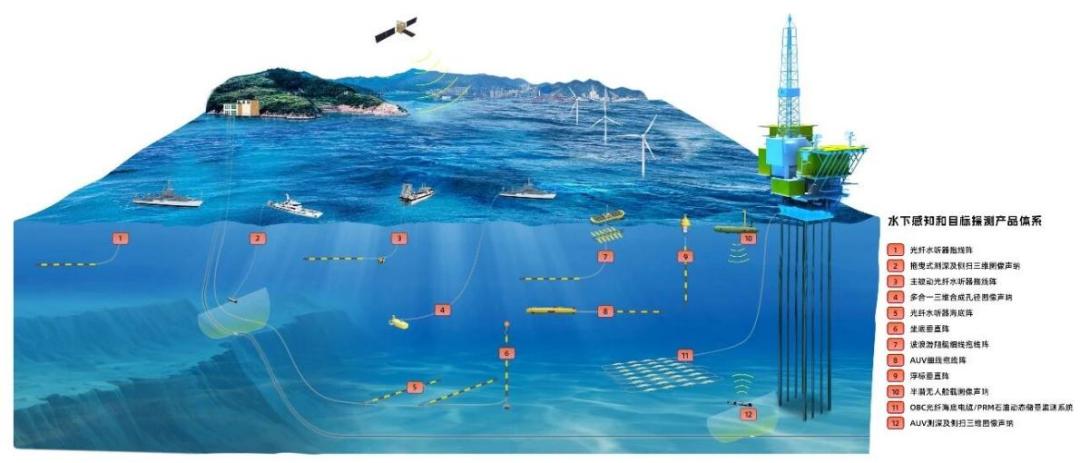
Underwater sensing equipment product system (Source/Enterprise)
In terms of technology and scientific research, Shenzhou Puhui once took the lead in undertaking a major instrument project of the Ministry of Science and Technology. The relevant achievements have been practically applied in fields such as underwater target detection, marine resource exploration, underwater noise measurement, and marine scientific observation. Many technologies have filled the gaps in relevant domestic fields and won many important national and provincial honors.
The company has also jointly established an underwater acoustic joint laboratory with Harbin Engineering University and Northwestern Polytechnical University, and established long - term cooperative relationships with many marine - related universities and key laboratories to continuously promote the engineering implementation of underwater acoustic and fiber - optic sensing technologies. In 2025, through mergers and acquisitions, the company mastered the core R & D capabilities of deep - sea 3D image sonars, becoming one of the few large - scale systematic technology enterprises in China that both research, develop, and produce underwater detection sonars and image sonars.
With the gradual release of the demand for domestic substitution and the increasing demand for underwater sensing equipment in fields such as marine engineering, water conservancy, and oil and gas, the company has accelerated the transformation of core technologies from scientific research to productization and engineering delivery in recent years.
Zhang Haibing, the founder of the company, said that underwater sensing and high - end sonar equipment have long been highly dependent on imports, especially in fields such as imaging mapping and detection, which are significantly affected by overseas controls. "We first entered the military system to solve the problem of 'whether it can be used'. As the technology matures, the space in the civilian market is gradually opening up." At present, the company has deployed in civilian scenarios such as oil and gas, water conservancy, bridge inspection, and fish finding, and continues to expand applications in directions such as oil and gas exploration, underwater security, and infrastructure monitoring.
Centering on the construction of industrialization and engineering delivery capabilities, Shenzhou Puhui has made layouts in many places across the country. The group currently has three subsidiaries: Wuhan Puhui Ocean Optoelectronic Technology Co., Ltd., Harbin Hachuan Optoelectronic Technology Co., Ltd., and Hainan Puhui Ocean Technology Co., Ltd. Among them, Wuhan Puhui was established in 2012 and has built the Hubei Provincial Fiber - Optic Hydrophone Detection Engineering Laboratory. It is an important base for the company to achieve large - scale production of fiber - optic hydrophones and array system - level products. Harbin Hachuan Optoelectronic focuses on the R & D and manufacturing of new distributed sensors and their high - end equipment. Hainan Puhui is positioned as a base for the development of application scenarios, operation services, and maintenance support of high - end sonars and marine geophysical exploration equipment, providing equipment integration, joint debugging, operation and maintenance support, and technical services for application scenarios such as underwater detection, marine survey, resource geophysical exploration, and inspection.
In terms of capital, Shenzhou Puhui has completed multiple rounds of financing. The shareholders include the Second - phase Advanced Manufacturing Industry Investment Fund of the National Major Fund, the Beijing Advanced Manufacturing and Intelligent Equipment Industry Investment Fund, the Gazelle Science and Technology Innovation Fund of Zhongguancun Capital Science and Technology Innovation Fund, as well as venture capital institutions such as Tibet Meilan and Shenghe Weiye. Zhang Haibing said that this round of financing will be mainly invested in the domestic substitution of high - end marine instrument equipment, the integrated application of sonar products and unmanned platforms, intelligent applications, and the further expansion of product applications in civilian industries such as oil and gas, underwater security, and water conservancy.
Currently, the company has about 270 employees, with R & D personnel accounting for more than 30%. The core team mainly comes from well - known domestic universities and relevant research institutions in acoustics and optics. Many core members have led or participated in national and provincial key scientific research projects.