After spending 100 million to appear on the Spring Festival Gala, people like Wang Xingxing continue to live a hard life.
The popularity of four humanoid robot companies performing on the Spring Festival Gala continues, from martial arts demonstrations and walnut rolling to tasks like folding clothes and picking up goods in household and retail scenarios.
According to JD.com data, within two hours of the Spring Festival Gala's broadcast, the search volume for JD's robots increased by over 300% compared to the previous period, customer service inquiries rose by 460%, and the order volume grew by 150%. The robot rental market has also welcomed a bustling Spring Festival season.
A robot rental industry insider told us that this year has been his busiest. After the Spring Festival Gala, both the number of inquiries and the number of completed orders exceeded his expectations, and the peak season is extending: “The state of having three or four gigs a day is expected to last until the end of March.”
As a highly - watched event by the whole nation, this year's Spring Festival Gala didn't just let more people know “what robots look like,” but “what robots can do.” When we visited the Nanjing Spring Festival consumer market, we found that the robots working in shopping malls and scenic spots were surrounded by people. The topics of discussion have shifted from “This robot is so amazing” to “What if I buy one for my home?”

A robotic dog in a scenic spot. Photo by the author.
This is the mental and brand impression the Spring Festival Gala has left on everyone. However, after the hype of the traffic fades, 2026 will be a more brutal elimination round for Chinese humanoid robot manufacturers.
1. A Strategic Move on the Spring Festival Gala: Three Wins in One Go
Previously, according to Caixin, each of the robot companies that appeared on this year's Spring Festival Gala contributed 100 million yuan. After the excitement of spending money on the Spring Festival Gala, many people are still discussing a key question:
Is this money well - spent?
From a short - term accounting perspective, not everyone can afford this amount. After all, 100 million yuan is equivalent to about a quarter of Ubtech's annual R & D expenses.
However, from the perspectives of financing, talent acquisition, and competition, spending 100 million yuan on the Spring Festival Gala is a strategic move for many robot manufacturers, and this account cannot be simply calculated in terms of ROI.
As Jiang Zheyuan, the founder of Songyan Power, said: “The Spring Festival Gala is an amplifier. Do it well, and you'll become famous overnight; do it poorly, and you'll just make a fool of yourself.”
Firstly, spending money is to raise more money. A humanoid robot industry insider told us that after Unitree's performance on last year's Spring Festival Gala, the industry's financing environment improved significantly. After this year's Spring Festival Gala, with the increasing popularity, companies can still raise funds. “It feels like the market has expanded.”

Robot martial arts performance on the Spring Festival Gala
The financing boom at the beginning of the Year of the Horse confirms this. Zhipingfang and Qianxun Intelligence have both completed a new round of large - scale financing of over 1 billion yuan, and the “10 - billion - valuation club” of Chinese humanoid robots has expanded again.
According to incomplete statistics from “Silicon - based Research Lab,” as of now, the “10 - billion - valuation club” includes six players: Unitree Technology, Zhiyuan Robotics, Galaxy Universal, Xinghaitu, Zhipingfang, and Mekabot Robotics.
This is why industry insiders regard the Spring Festival Gala as a large - scale roadshow for humanoid robots. For those aiming for an IPO, it makes the listing more stable; for those wanting to raise funds in the primary market, it boosts confidence.
Secondly, spending money is to attract better talent.
After the Spring Festival Gala, which coincides with the peak recruitment season from March to April, robot manufacturers such as Songyan Power have launched a new round of talent wars. In addition to recruiting a large number of business development (BD) personnel, there is also a demand for algorithm and hardware talents. The endorsement of “the same model as on the Spring Festival Gala” is a new card to attract talent.
More importantly, it's about competing for technological and brand recognition.
Recognition may seem abstract, but in fact, it is the differentiated positioning of manufacturers in the competition. From the PR of the four robot manufacturers after the Spring Festival Gala, you can see that the positioning battle for robots has begun.
• Galaxy Universal tends to tell the story of “not just for show, but capable of practical work.” It demonstrated actions such as rolling walnuts, picking up glass fragments, folding clothes, grilling sausages, and picking up goods from retail shelves on the Spring Festival Gala.
• Unitree, a three - time participant in the Spring Festival Gala, focuses on showing “the technology in the performance.” For example, Wang Xingxing mentioned its rapid positioning ability and extreme motion capabilities. Actions like obstacle - crossing replay and two - step wall - climbing in Unitree's performance not only demonstrated its precise force - control ability again but also took robot dance performances to a new level of real - time environmental interaction.
• Songyan Power aims to establish a leading position in the “consumer - grade robot” market. This is why it chose to appear in a skit, obviously aiming to promote its upcoming consumer robots priced at around 10,000 yuan.
• The youngest Magic Atom seems to be showing its comprehensive strength, trying to squeeze into the first - tier. It didn't miss any opportunities, from dance performances to noodle - fishing and serving dishes.
From raising funds, attracting talent to establishing positioning, the Spring Festival Gala is a win - win - win business for humanoid robot manufacturers.
2. Stockpiling Resources and Staying in the Game
Whether a company appeared on the Spring Festival Gala or not doesn't matter much.
Beyond the spotlight, attracting talent, raising funds, and positioning are all about stockpiling resources for 2026 and staying in the game.
Recently, Morgan Stanley raised its sales forecast for Chinese humanoid robots in 2026, expecting a 133% increase to 28,000 units this year. It also believes that commercial sales will replace the dominance of government, university, and entertainment scenarios in 2025.
Although this is a once - in - a - lifetime opportunity, it doesn't mean there is no bubble. In 2026, Chinese embodied intelligence companies will face a crucial elimination round.
The most pressing challenge is cash flow.
From 2025 to the present, a number of embodied intelligence companies have reached the end. Overseas, companies like K - Scale Labs, Cartwheel Robotics, Aldebaran, and Rethink Robotics, and domestically, CloudMinds and Yixing of Geely have all suffered due to similar reasons.
Robot R & D requires huge investment, has a slow mass - production ramp - up, and a long payment collection cycle. Once financing stops, it's easy to collapse, as described by Han Fengtao, the founder of Qianxun Intelligence:
“Embodied intelligence in 2026 will be very similar to the large - model trend in 2023. If you can't raise a lot of money and your model performance doesn't rank among the top, you won't have a chance to stay in the game.”
From storytelling to accounting, whether robot companies are competing in terms of shipment volume or showing large verified orders, they ultimately have to calculate the cost. As of now, only Unitree has publicly disclosed its profit situation and cash flow. After the market awareness is raised, the increasing scale of delivery will also pose a real challenge to the company's cash flow. More robot companies need to avoid the dilemma of “losing money on each unit sold.”
Secondly, there will be more intense local battles.
If the Spring Festival Gala was a local battle on the stage, then in 2026, robot companies will engage in more intense local battles in real - world business scenarios.
A typical scenario is consumer - grade robots.
First, there is Songyan Power's Xiaobumi priced under 10,000 yuan, and then there is the world's first personal robot Q1 launched by Shangwei Qiyuan. Low - cost, lightweight consumer - grade robots are bound to compete in the B2B and B2C markets.
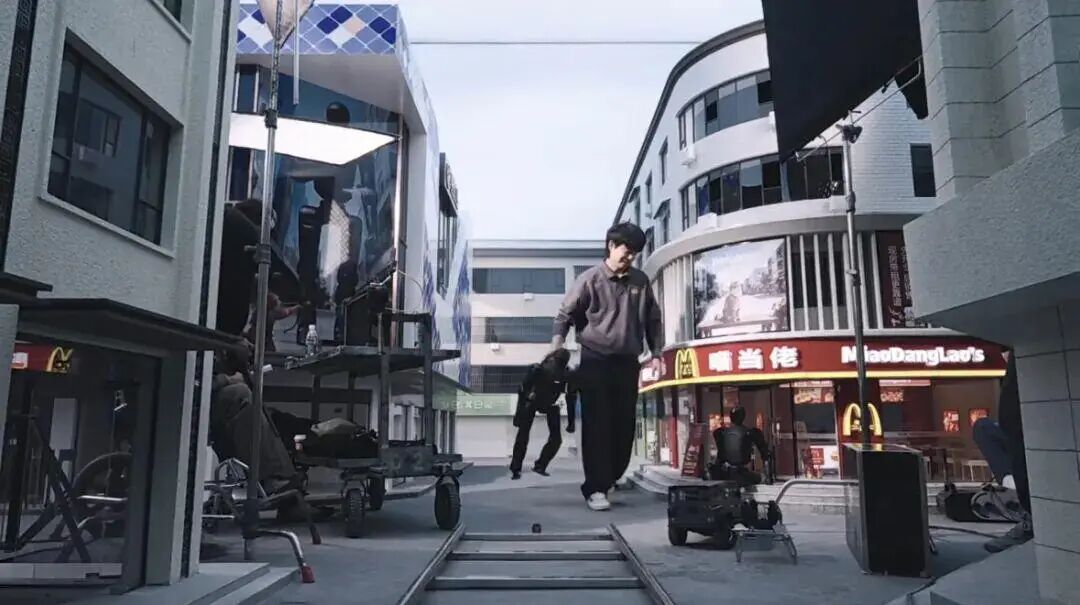
Comparison between the world's first personal robot Q1 and a human. Image source: Video screenshot
If consumer robots priced around 10,000 yuan accelerate their penetration into personal consumption scenarios such as households, education, and scientific research, a new product category will be tested in terms of product capabilities. Real sales volume, return rates, and user reviews will emerge, and the industry is bound to undergo an obvious reshuffle.
It should be noted that the inflection point for the large - scale application and implementation of robots has not yet arrived. Whether from the perspective of direct shipment volume data, scenario verification, order delivery, or the supply chain, the expectation for the commercialization year will be extended.
In the view of many industry insiders, while the number of robots sold is important, the key is how to achieve synergy in generating model, data, and scenario - service value in real - world scenarios after the sale.
3. New Divisions Have Emerged
Whether it's about establishing an image or planning for the long term, when the tide of traffic from the Spring Festival Gala recedes, those who are “swimming naked” will be exposed, and new divisions have emerged.
If we use one keyword to describe the robot industry in 2025, perhaps “reckless advancement” is more appropriate: a large number of star companies, large - scale financing, all kinds of cool demos, and upstream - downstream alliances... all have inflated the industry's expectations. Concepts like the “year of mass production” and the “year of commercialization” have been constantly emerging.
But returning to the basic business logic, robots are still typical manufacturing products defined by scenarios. This statement has two meanings:
Firstly, robots must always return to specific scenario - based tasks and solve the problem of what value they can create in what scenarios.
Therefore, whether robot manufacturers choose a large - scale and all - encompassing path for both B2B and B2C markets, a small - but - beautiful path focusing on a specific vertical scenario, or a steady path starting from the industrial sector, moving to the commercial sector, and then to the household sector, they need to answer this core question.
Secondly, as manufacturing products, they require a complete and specialized supply chain and must follow the basic law of hardware - software integration.
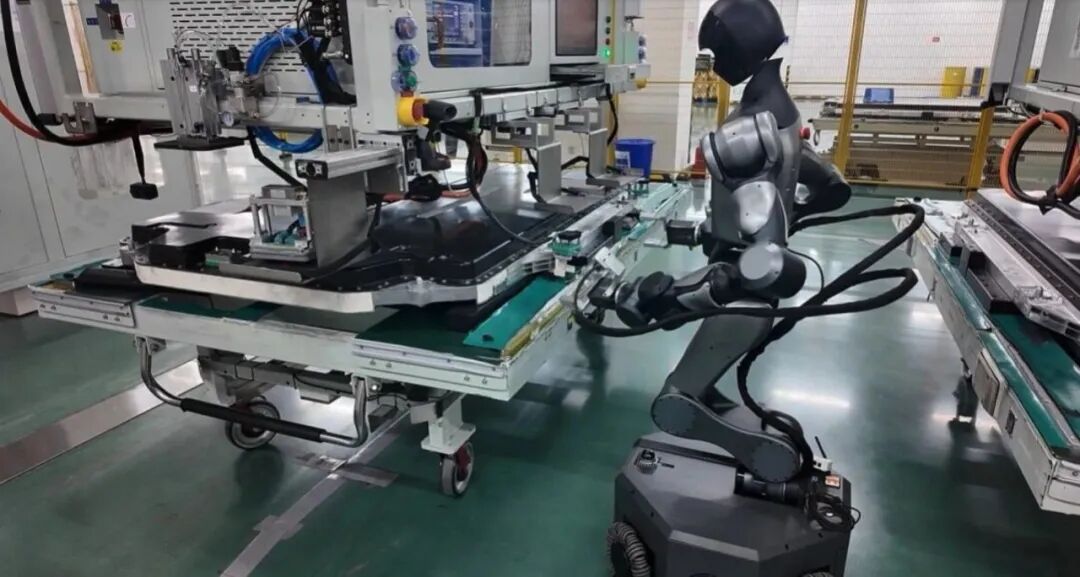
Qianxun Intelligence's robot in an industrial scenario
Regarding the former issue, robot manufacturers either conduct self - research or force upstream component manufacturers to optimize their process levels and expand production capacity. The industrial division of labor in Chinese embodied intelligence needs to be vigilant against resource consumption and redundant construction and move towards a more professional and flexible distribution.
Regarding the latter, breakthroughs in data volume and model performance remain the main tasks. Commercial exploration is also for the sake of data. Embodied intelligence improves its “brain” ability through the closed - loop link of “data collection → model training → data scaling → model optimization (SFT + RL).” We can clearly observe that each company is putting more effort into obtaining more effective data.
For example, there are also divisions in the iteration of data collection technology and solutions. In the direction of remote - controlled real - machine data, Zhiyuan is the most representative; companies represented by Luming Robotics are exploring the UMI data paradigm.
Of course, the above - mentioned short - term divisions are not the end. The development of robot companies is not measured in one or two years but in five to ten years. Whether a company wants to become a great company in the industry or just survive, it has to stay in the game and keep running to possibly get through the darkest hour before dawn and see the real dawn.
References
1. Embodied Intelligence Research Club: Prospects and Warnings for Embodied Intelligence in 2026
2. LatePost: Exclusive Interview with the Founder of Qianxun Intelligence: 2 Billion Yuan in New Financing, Elimination Round for Embodied Models, and Non - Consensus Implementation
3. Soochow Securities: From “Yangsheng BOT” to “Wushu BOT,” In What Aspects Has the Humanoid Robot Achieved “Super - Evolution”?
4. China Entrepreneur Magazine: Exclusive Interview with Jiang Zheyuan of Songyan Power: I Want to Be the Number One in the Consumer - Grade Robot Market
This article is from the WeChat official account “Silicon - based Research Lab”, written by kiki, and published by 36Kr with authorization.