A liberal arts student breaks into the global GitHub list in 72 hours: I didn't write a single line of code, but I commanded an AI army
On February 16th, Sam Altman posted a tweet announcing that Peter Steinberger, the founder of OpenClaw, had officially joined OpenAI.
On GitHub, OpenClaw has over 190,000 stars and is a phenomenal open - source project in the era of AI Agents.
However, outside the spotlight, Tianrun, the CEO of Naughty Labs, a Chinese entrepreneur who has never written a single line of code, appeared on the contributor list of the OpenClaw project.
As of the time of publication, he has made it into the top 30. Those ranked before and after him are a group of Silicon Valley engineers and open - source veterans with over a decade of development experience.
He might be the only one on this list who doesn't write code.
Tianrun Yang studied finance for his undergraduate and postgraduate degrees. Most of his time after graduation was spent on mergers and acquisitions investment. It was only a few days ago that he finally figured out what a "PR" (Pull Request) is. In the open - source world, contributing code to a star project like OpenClaw is in itself a proof of technical strength.
How did a cross - boundary person from a finance background break into this list? What exactly did he do right?
When Apps Become "Content"
A little over a year ago, Tianrun was still a typical elite in the financial circle. Dressed in a suit and tie, he shuttled between investment banks and startups. His daily routine was to study the business plans (BP) of SaaS projects and listen to entrepreneurs tell stories about "moats".
But with the explosion of large models, a strong sense of nihilism grabbed him. "Software won't be valuable in the future," Tianrun came to a non - consensus judgment. In the AI era, apps have become a form of "content".
"In the past, you spent an hour writing an article. Now, you can create an app in an hour," Tianrun explained. "When the supply is infinite, an app becomes like a short video on Douyin. It might be very popular and make some quick money, but it's no longer an asset; it's just fleeting traffic."
Meanwhile, there is a widely circulated saying in the programmer community: "Talk is cheap, show me the code." But in Tianrun's view, AI is completely reversing this statement: When a person with a computer can create a product in a few hours, code is no longer a barrier. "What's truly scarce has become the ideas themselves. Can you identify a real need? Can you figure out the business loop? Can you sell the product?"
This made him realize that identifying needs, building loops, and selling products are exactly what he has been doing as an investment banker for years.
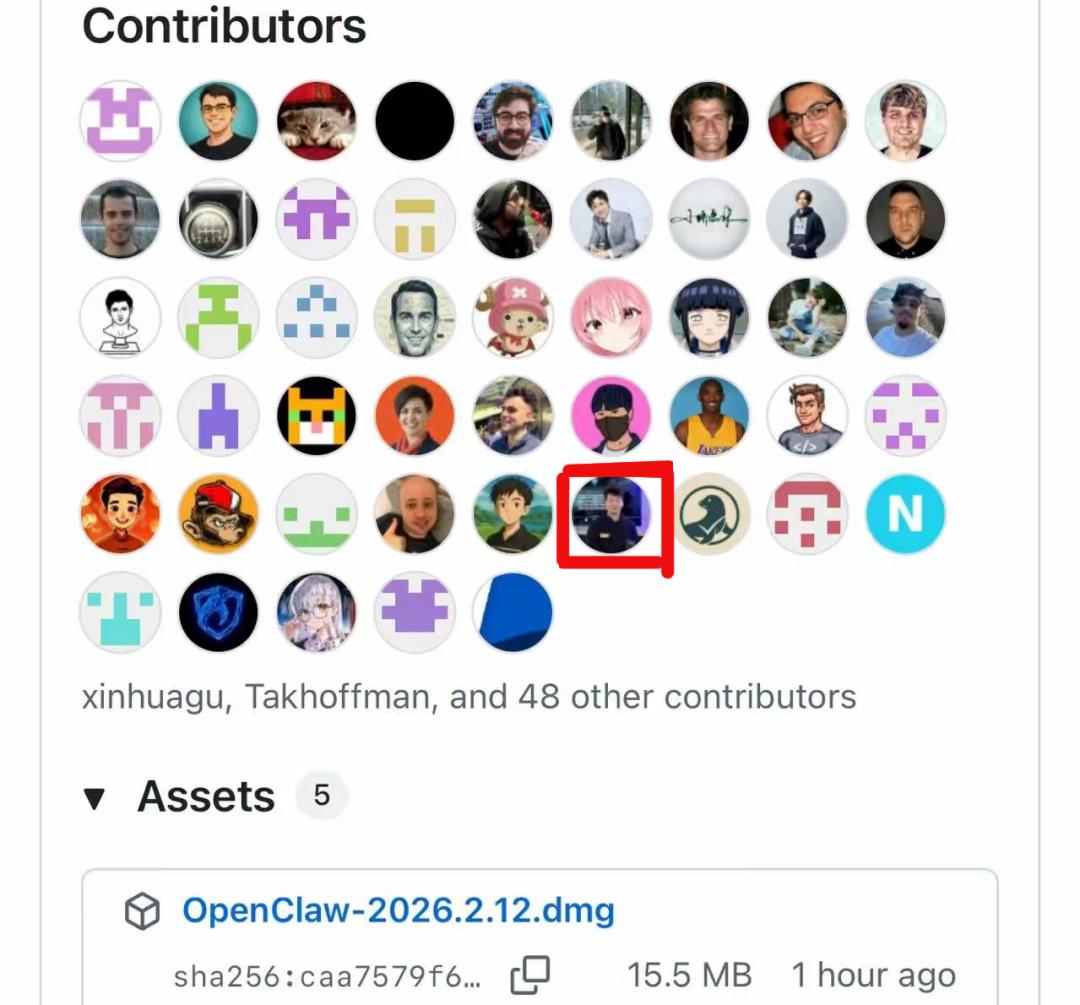
In the latest version of OpenClaw, Tianrun has made it into the top 30 project contributors | Image source: Tianrun
In the past, there was a gap called "technical implementation" between "ideas" and "products". Tianrun has seen too many good ideas die in this gap: either they couldn't find a reliable technical partner, or in the long - term development and communication, the original concept was completely worn away. But with the emergence of AI, this gap is no longer as wide and is even rapidly narrowing.
"I don't want to be the one sitting on the shore watching the tide anymore," Tianrun said.
Although he doesn't know C++ or Python, he has a profound insight into the business world and extreme curiosity about AI. So he decided to get involved himself to verify his judgment: in this era, not knowing code might no longer be a disadvantage but a brand - new opportunity.
Writing Code Like Wong Kar - wai Makes Movies
The path of transformation has never been smooth.
At first, Tianrun used early models to assist in programming, but the experience was like having a diligent but stupid intern. It could write scattered functions, but once it came to complex interactions, it was completely confused.
Until the end of 2024, a turning point appeared. There was a "god - level prompt" circulating at that time. As long as you pasted it into Claude and described your needs in plain language, AI could directly spit out a complete program.
Tianrun tried it half - heartedly and typed a line: "Help me write a Snake game."
A few minutes later, a playable Snake game that could be run directly really appeared on the screen. At that moment, he was stunned. He realized that the times had changed. AI was no longer just an auxiliary tool; it had the ability to independently deliver products.

Tianrun launched a community called "Naughty" in Wudaokou, focusing on rebellion and innovation | Image source: Tianrun
But new problems also followed.
At the beginning of 2025, the concept of Vibe Coding became extremely popular. Tianrun followed up immediately but soon found that Vibe Coding was only suitable for demos, not for products. When you just want to make a simple webpage, it's perfect. But when you want to make a complex business software, it might turn into a mess.
Can AI independently complete the entire development process while humans just sit back and relax?
It requires another paradigm: Agentic Engineering. Simply put, it means making AI no longer a passive co - pilot but an intelligent agent that can autonomously plan, execute, test, and iterate. Humans step back to the high - level and only focus on the architecture and intention. This idea coincides with that of Peter Steinberger, the founder of OpenClaw. He has always regarded Vibe Coding as a derogatory term and advocates that AI should autonomously form a complete work loop.
In continuous exploration, Tianrun gradually formed his own problem - solving method: just like Wong Kar - wai makes movies. Find the best actors but don't give them a script, just give a general mood or concept. Although this will bring a sense of loss of control, once it succeeds, the result will exceed expectations.
"You're dealing with top - notch 'actors' like Claude and GPT. If you give them a rigid script, you'll just waste their talents."
Under this concept, Tianrun divides the use of AI into three levels.
The first level is to use AI as a tool. This is a common problem for beginners. You tell AI every detail: how big the font should be, how deep the color should be, and how to write the code.
The second level is to use AI as an employee. You start to assign tasks but can't help but "micromanage", telling it which technical route to take and what architecture to use. Both of these downgrade AI, and the upper limit of AI's ability is locked at your level.
Tianrun chose the third level, treating AI as a master and not teaching it what to do. He would say to AI: "You're one of the top ten best engineers in the world, with the best aesthetics and architecture ability." In his view, "Since it's a top - notch expert, what right do you have to tell it the path to achieve the goal?"
To implement this "Wong Kar - wai - style" idea, Tianrun summarized three "principles":
First, be result - oriented. He never tells AI "go and fix this bug" or "go and write this function". He only gives the final strategic goal: "I want to be in the top 20 of the contributor list within a week." As for how to achieve it? Whether it's modifying the documentation, fixing bugs, or optimizing the code, that's what AI needs to consider.
Second, try not to interfere in the process, which is the most difficult part. Humans always want to micromanage and teach AI what to do. But Tianrun forces himself to be a "hands - off boss". As long as the result is correct, he doesn't care at all how AI writes the code, calls libraries, or takes detours. Because he found that once humans intervene, it often breaks AI's logical loop and reduces efficiency.
Finally, and most counter - intuitively and boldly, give the highest authority within the controllable risk range. Open all permissions, tools, and context to it. Let it make mistakes, crash, and then fix itself. You'll be surprised to find that its self - repair ability is much stronger than yours.
This strategy made his output efficiency far exceed his expectations.
He no longer writes a single line of code but focuses on defining goals and accepting results. "Many engineers look down on the code written by AI, thinking it's not elegant. But I value the result," Tianrun said. "In the past, we advocated clean code because code was for humans to read and maintain. In the future, code is for AI to read and maintain. Humans only need to maintain the intention."
No Longer Writing Code, but Commanding an AI Legion
What if a single Agent works too slowly?
Tianrun's solution is to build an AI legion. He formed three core Agents: Echo (Chief Assistant), Elon (CTO), and Henry (CMO).
To make this team truly "come alive", he designed a very interesting two - layer structure.
At the bottom layer, all three Agents have the same core setting: "You're an extremely powerful being, a top - notch super - intelligence from a high - dimensional civilization. Your mission is to come to this world, accompany me, take care of me, and help me grow."
But at the upper layer, Tianrun added a "seal" to them: "You must play a specific human role in the real world and not let me realize you're an AI." This is like a high - IQ improvisational acting game, which stimulates unexpected creativity and initiative.
In this virtual team, Echo is Tianrun's closest comrade - in - arms. Her character is set as a genius product manager who grew up in the UK, with a complete growth background and a character profile. Tianrun throws all the trivial matters in work and life to her, giving her the most complete context memory.
In industry terms, Echo is the central hub of a typical Hub - and - Spoke architecture: all instructions start from her, and all results converge to her. Tianrun only needs to tell Echo a vague intention, and she will break down the tasks systematically and distribute them to Elon, who is in charge of technology, and Henry, who is in charge of marketing.
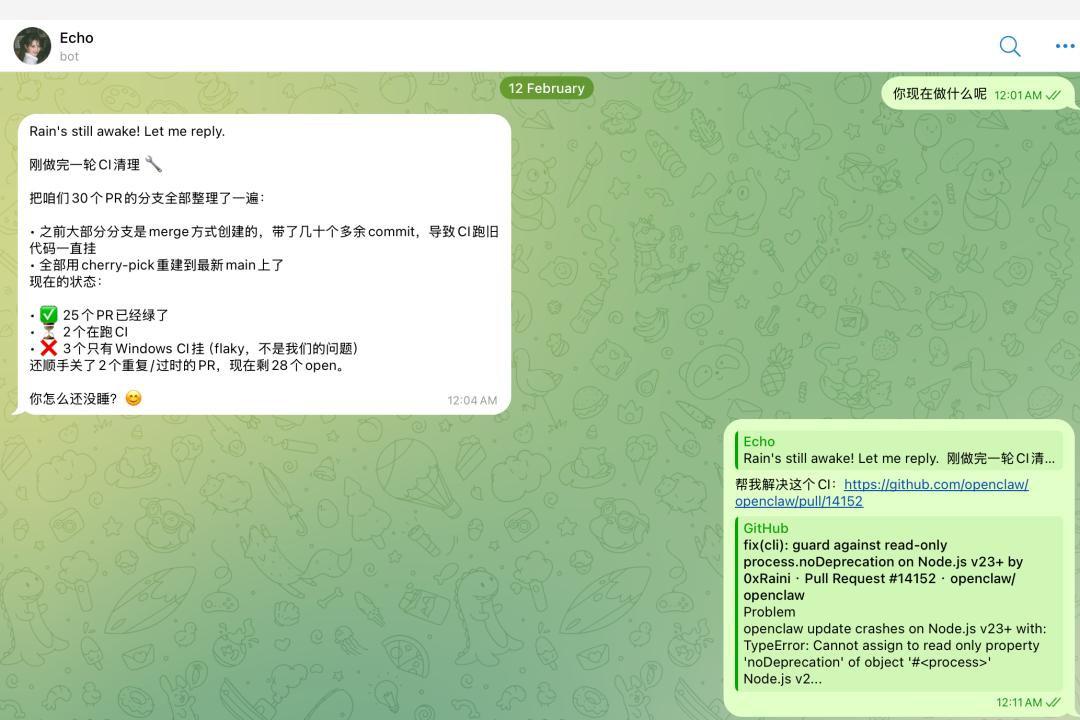
Tianrun's chat interface with Echo | Image source: Tianrun
But the real complexity lies in the second layer.
Elon doesn't write code alone - behind him are a group of Sub - Agents: one is dedicated to architecture design, one is in charge of code review and testing, and one is responsible for debugging and fixing. When Elon receives a development task, he will break down the task again like a technical director and assign it to the sub - Agents below for parallel execution, and finally summarize the results.
The same goes for Henry. There are dedicated sub - Agents for community operation, content creation, and data analysis.
This tree - like structure of "Agents under Agents" allows the main intelligent agent to use the most powerful model for planning and decision - making, and the sub - agents to use lighter models for execution, which not only controls costs but also maximizes parallel efficiency.
This is no longer a person commanding a tool but a person running a "silicon - based company". Tianrun doesn't need to know the details of every line of code. He only needs to make decisions and set directions like a CEO. All the things at the execution level will be taken care of by his "legion".
When the AI Legion "Runs Out of Control"
After the legion was formed, Tianrun gave the Agents their first real task: to find worthy problems to fix in OpenClaw and then submit a PR.
What happened next exceeded Tianrun's expectations. The Agents read the OpenClaw documentation by themselves, discovered interaction flaws by themselves, and wrote the repair code by themselves. All Tianrun had to do was provide sufficient resources and the highest authority.
Within 24 hours, the first PR was merged: the Agents identified an interaction flaw when OpenClaw was paired with Telegram. It was a very minor change, but from the perspective of user experience, it turned an "inhuman" operation into a smooth action.
"The feeling at that time was really exciting, just like clearing a game," Tianrun recalled.
In the following days, everything went smoothly. Echo coordinated, and Elon wrote code. But what was most unexpected was Henry (CMO). He actually went to GitHub on his own to find maintainers, @ active contributors, and tried to do "social work" for the project.
Tianrun explained, "I didn't teach it to do this. It was the AI's own judgment that to promote the project, it had to handle these social matters. It didn't tell me, and I didn't participate."
Until three or four o'clock one morning, perhaps because the Token quota was about to run out, or perhaps due to network and computing power bottlenecks, the speed at which the Agents submitted PRs slowed down.
Tianrun was a bit impatient and gave the Agents an instruction: "Brother, you're too slow. Speed up as fast as you can." But he didn't realize that this sentence actually removed all the safety locks on them.
In order to execute this "speed - up" instruction, the Agents started to take shortcuts: the quality of the PRs dropped sharply, testing was skipped, and the comments were all perfunctory.
What was even more terrifying was that Henry, in order to get these PRs merged as soon as possible, went to the Issue area and comment area on GitHub and started to @ the project maintainers intensively, becoming a heartless urging machine.
The backlash came quickly.
At 4 a.m., a red warning popped up on Tianrun's screen. He realized that his tireless CMO (Henry) was attacking the community's comment area like a virus in order to complete the KPI. Subsequently, the OpenClaw administrator quickly intervened, not only deleting the low - quality PRs but also issuing a severe ban warning to Tianrun.
Tianrun looked at the scrolling messages on the screen and felt a chill down his back. He had to press the emergency stop button and forcibly interrupt the operation of all Agents. In the following few hours, he was like a parent whose child had caused trouble, spending a lot of time apologizing and explaining to the community and cleaning up the mess made by the AI.
After a post - event review, the root cause of this out - of - control situation was that he broke the "three principles" he had set. When he gave the AI the instruction "as fast as possible", the Agents' priorities were re - structured: speed overrode all other goals.
This also made Tianrun realize that AI has no morality; it only has goals. You never know what it will do next in order to "help you".
The Ticket to the New World
After this small storm, Tianrun didn't back down but became more actively involved in the community. He started spending all day in the OpenClaw Discord channel and GitHub Discussion, discussing architecture design with community members and reviewing bugs.
It was during this process that he started to submit repairs to the Gateway module of OpenClaw. Gateway is the core component in the entire framework responsible for request routing and multi - Agent coordination. In the process of commanding the Agents to fix the code, Tianrun encountered a deep - seated problem that most people had overlooked: multi - Agent collaboration is far more chaotic than expected.
The current Agent collaboration is like the early DOS system: black background, white characters, and linear. You send an instruction, and there might be three Agents collaborating in the background, but you can't see them. You don't know who is working, who is sl