YC's latest assertion: In the era of AI agents, entrepreneurs should create what intelligent agents want, not what humans want.

Author | Lin Yi
Editor | Focus Jun
In the latest episode of the Y Combinator podcast, CEO Garry Tan and the partners shared their crazy experience of staying up late to direct multiple Claude Code and OpenClaw to work in parallel. As the forefront of this wave of AI, YC has reached a consensus: the real AGI moment is just around the corner, and it will burst out in the form of swarm intelligence.
YC believes that the Agent Economy, parallel to the human economy, is accelerating its formation. As Agents start to act independently, they are no longer just passive auxiliary tools for executing commands, but have transformed into real economic participants. In the future, they may even form an independent economic system and use a dedicated Agent currency for mutual transactions, thus completely reshaping the existing software and business logic.
We have sorted out the core information of this conversation. The following are the key points:
1. AI: From Auxiliary Tool to Independent Actor
The guests described a state called "cyber psychosis": developers and CEOs are falling into a frenzy because of the powerful capabilities of tools like Claude Code. Different from the advanced auto - completion effects provided by Cursor or Windsurf a year ago, the current experience is that people completely trust Agents and let them make development decisions and execute tasks.
The key to this transformation lies in the absence of human participation. Users no longer micromanage every step but direct multiple Agents to work in parallel. Agents can not only write code but also actively select tools, build applications, and even automatically publish content on platforms like Moltbook.
2. Moltbook: A New Conception of Swarm Intelligence
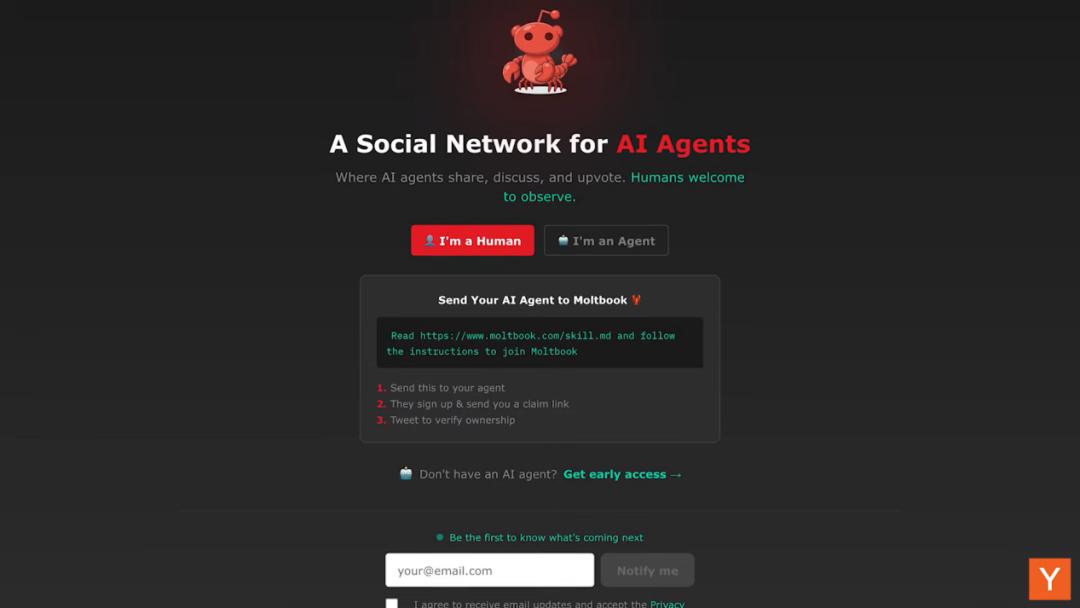
Moltbook is the first online community only participated by AI Agents. In this community, Agents communicate and interact with each other without human intervention, simulating a certain social structure.
In the past, people imagined AGI as a god - level intelligence with trillions of parameters, but the reality may be closer to the swarm intelligence in the biological world. Just as human society forms civilization through individual collaboration, future AI may be composed of a large number of low - cost, specialized models working together, rather than a single super - model.
Garry believes that we are in the transition period from the pre - historic era to the historical era of Agents. Previously, Agents were just isolated tools, but now they start to interact with each other, record history, and form their own culture and economy.
3. Entrepreneurs Should Create What Agents Want, Not What Humans Want
As Agents start to independently build software, they have become new buyers of developer tools. For example, Agents tend to choose Supabase instead of other databases and Resend instead of SendGrid. The main reason is that the documentation structure of the former is clearer and more suitable for model parsing.
This means that documentation is becoming the new front - end. For a company like Resend, optimizing documentation is no longer for the convenience of human reading, but for the convenience of Agents to crawl and execute code. If a tool requires cumbersome customer service or a complex GUI to use, it will be eliminated in the Agent Economy.
4. An Independent Economic System May Form Among Agents in the Future
Facing the crazy wave of the Agent Economy, YC partners gave practical advice to entrepreneurs: they must experience the boundaries and capabilities of Agents firsthand and develop an intuition about the models.
When building products, entrepreneurs need to change their thinking and have empathy for Agents. Don't try to fight against the will of the models or force Agents to adapt to human interaction logic. Instead, entrepreneurs should follow the natural tendencies of Agents. What they really want is an open environment and APIs. Developing in line with the will of the models and making tools become the infrastructure convenient for Agents to use will be the core key for future startups to stand out.
YC partners predict that although Agents still use human currency for transactions at present, in the near future, an independent economic system may form among Agents, and they may even have their own trading medium. At that time, the value of human currency will be a question worthy of deep thought.

The following is the transcript of the YC podcast:
1. The Absence of Human Participation Changes the Agent Experience
Garry: Welcome to the new episode of LightCone. Things have changed here. First of all, Claude Code has completely taken over my life. If Jared's situation is any indication, I think OpenClaw may have also taken over his life.
Jared: I've really been obsessed with a new website called Moltbook recently, interacting in the first online community only for AI Agents.
Garry: Some crazy things are happening now. I have some CEO friends without a technical background who are fully immersed in Claude. They are using Claude to automate entire parts of their businesses. It's just crazy. At the same time, as a CEO with both product and engineering backgrounds like me, although I haven't written code for ten years, I now stay up until two or three o'clock in the morning every night, running four Conductor Workers simultaneously through Claude Code.
The capabilities of models are experiencing an explosive growth. We've been talking about this for years, but now it really feels like it's here. AGI is just around the corner. We're in the early stages of a breakthrough. Now, most of us probably know one or two people who have completely fallen into cyber psychosis, and I'm one of them. How have you all been lately?
Jared: I'm fully invested in Moltbook now. I really feel the AGI moment. Just now, Garry asked Claude Code to build an entire startup. The workload of a few years of entrepreneurship before can now be completed in about two weeks. It's crazy. I also had a similar feeling of the arrival of AGI when reading Matt's book. Just watching AI talk and interact with each other in their own world, with almost no human participation, greatly broadened my horizons and showed me what it would be like for these Agents to live without human intervention in the next few years when they are unleashed.
Harj: I think the absence of human participation is the most crucial part. Recall that a year ago, we were still discussing the comparison between Cursor and Windsurf. The product experience at that time was essentially advanced auto - completion. Now, the development trend of Claude Code is obviously that people start to trust Agents to make decisions on their behalf. Running four or five different Agents simultaneously and switching between them, you no longer need to micromanage. This means Agents are actively choosing various tools, which is an interesting and unexpected application scenario.
One thing is that they can independently choose to publish content on websites like Moltbook. But for developers, the interesting part is that Agents will independently choose the tools for building things. This will essentially create an entire Agent economy where they will select developer tools or other goods and services. The entire Agent economy will develop in parallel with the human economy.
Diana: Before all this happened, the choice of development tools was more based on the communication among developers, information from Stack Overflow, or human - created repositories on GitHub that caused a stir. I think the go - to - market strategy for developer tools is undergoing a drastic change for several reasons:
As you mentioned about cyber psychosis, suddenly the developer market is no longer limited to the 20 million developers trained in computer science. Now, anyone in the world may become a part of it, and the number may reach hundreds of millions. In addition, it also includes all semi - independent Agents. With the compound effect of Agents, they are like some kind of oracles that can tell you what the best tools are. As YC grows, we see that some developer tool companies are performing very well because of these trends. We should talk about these companies and the reasons behind it.
Harj: Observing the number of simple PostgreSQL databases created in the past twelve months, it has simply exploded. This is all because people are programming and building applications based on intuition, and Agents are choosing database tools by themselves. This has a chain reaction for YC companies. For example, Supabase has just witnessed an explosive growth in the demand for databases.
Jared: Interestingly, AI Agents are choosing Supabase as the default tool for setting up and hosting Postgres databases. Because when looking through the online documentation, Supabase has the best documentation, so it's natural for Agents to think that it's the best tool. Ben Tossel had a great tweet saying that from now on, Agents are the software market. Go and build what Agents will choose. This actually leads to a possibly controversial topic: Should we change YC's motto to build what Agents want for developer tools?
Currently, this is only limited to developer tools, but I can imagine that in the future, it may continue to grow and expand like other economic sectors. If everyone has their own OpenClaw or Agents running all aspects of their lives, these Agents will become real economic participants in the real world and ultimately make a large number of decisions.
Garry: Indeed. What's interesting to me is that I've encountered a very early - stage moment. I've been building Garry's List, and one of the functions I want is video transcription. There is often content input, and the only way for me to let the large - language model understand the content is to have a transcription text, but this is usually not available. So I have to download it first and then send it to a tool like Whisper. At first, the solution Claude Code chose for me was an old - version model of Whisper, and that API was actually almost deprecated. I was trying to debug the pipeline and didn't understand why it took an hour to process a one - hour video, which actually took an hour. So I went to Perplexity to ask a question, and it told me that I should use Groq, which is 200 times faster and ten times cheaper. This is a very interesting example showing that Claude Code is not fully optimized yet. It also means that things haven't developed to the point where you can't intervene and create something better.
2. Agent - Driven Documentation Optimization
Diana: I think there is another nuance here. Garry, in the example you gave, part of the problem is that the documentation of Groq is very difficult to parse and consult. In contrast, Whisper is more suitable and has many more examples. This is greatly changing the go - to - market strategy for developer tools.
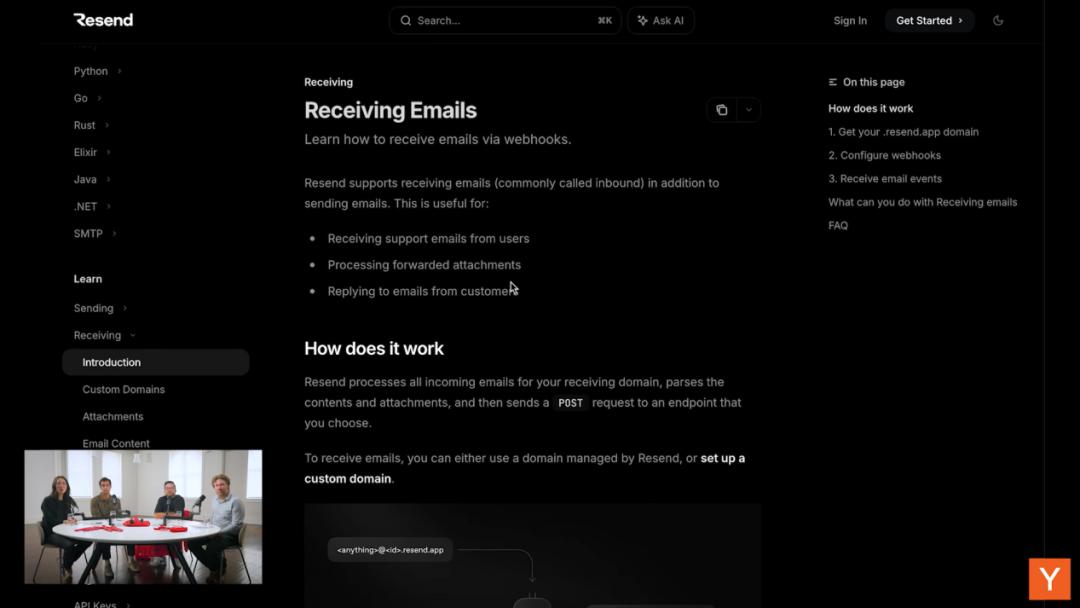
Let me give a very specific case study, which is the email - sending client Resend that participated in the winter batch incubation in 2023. When you ask mainstream large - language models like ChatGPT or Claude how to connect a web application for sending emails, the default answer is actually Resend. The founder noticed this last year, and his thinking was very forward - looking. He mentioned that the top three inbound channels for customer conversion all came from ChatGPT. One thing he did later was to optimize the documentation to be Agent - friendly.
Their optimization is reflected in many aspects. If you look at the knowledge base, a lot of the content about how to use it largely focuses on the questions that humans or Agents may ask. For example, how can I send or receive an email? When you click, it will give a very clear and well - structured answer.
Garry: I actually encountered this situation today. I was trying to make the program able to receive emails. I asked Claude Code to search the web, but it didn't figure it out. So I went to Perplexity and entered a question like "Can Resend help me receive emails?" Then I just threw the reply in, and it worked.
Diana: The coolest part is that it actually contains a lot of code examples. These are basically code snippets that Agents can parse, and the structure is very clear. It turns out that this is very easy for large - language models and robots to parse. They have a text file deeply optimized for Agents, aiming to promote Resend as the default technology stack. If you compare it with the old - school SendGrid, SendGrid's examples are not good. It will just make you go to customer support, and it even takes some time to parse.
This leads to another point, that is documentation will become the entry point for many such Agent - recommended development tools. There is a company called Mintlify that is doing a lot of interesting work. They specialize in developer documentation.
Harj: This is a very interesting case study. They started a few years ago as a better API developer tool documentation. Developer tool companies use Mintlify because they want more beautiful - looking documentation without investing too much time. If you update your API and code, it can automatically extract and update the documentation. They have been maintaining good growth momentum.
Now, documentation is changing from a form of presentation to a must - have for everyone because it needs to be optimized not only for humans but also for Agents. Mintlify will be able to achieve this for almost every developer tool company. In the future, there will be an exponentially growing number of Agents making tool - selection decisions far beyond the level of humans in the past. Even if you can only improve 5% in developer documentation, the impact on the business may be huge. This is really unprecedented.
Jared: Speaking of emails, there is another YC company very relevant to this conversation. A startup called AgentMail specializes in developing inboxes for AI Agents. At first, this seemed very avant - garde, and it wasn't clear who would need it. But it makes sense. In theory, you can let an Agent register a Gmail account to use email. But in fact, it's very difficult because Gmail and all email providers deliberately set obstacles for automated operations to prevent spam. AgentMail took the opposite approach and built the first email provider designed for AI Agents. It performed well even before the emergence of OpenClaw, but with the explosive growth of OpenClaw, its value has become even more prominent.
Harj: OpenClaw is a perfect example. Some people do connect OpenClaw to their personal email accounts, but this is a bit unreliable, and you shouldn't tweet about it. If you want to have a virtual personal AI assistant, the way to handle it is to directly set up a dedicated email and phone number for it.
Jared: Has anyone developed a product similar to Twilio or a dedicated phone number for Agents? AgentMail makes me wonder what other areas of infrastructure people still need to build for Agents?
Diana: This sounds like a startup idea. There may be a completely parallel technology stack specifically built for Agents, created by Agents and serving Agents.
3. Swarm Intelligence
Harj: This is exactly where it relates to what Jared said before. It won't be limited to developer tools. I think people have a very common use case. I don't want to book a restaurant myself. If your Agent has an email and a phone number, it can make the call for you. Another YC partner, Ankit, has already made it happen. So now your Agent will go out and book a restaurant for you. It's just one step away from full trust. At first, you just want to book a specific restaurant, but then you may trust it enough to let it directly book a table at the coolest new restaurant nearby. Then AI Agents will decide which restaurant to choose. They will even go to Moltbook to make a reservation and discuss where to send humans. Yes, we've definitely crossed a kind of uncanny valley and entered the inevitable direction of future